
Sabitlenmiş Tweet
Nelson
11.9K posts


Nelson
@nelsonmckey
A decade in crypto. Let’s chat.
Katılım Nisan 2007
7.5K Takip Edilen2.5K Takipçiler

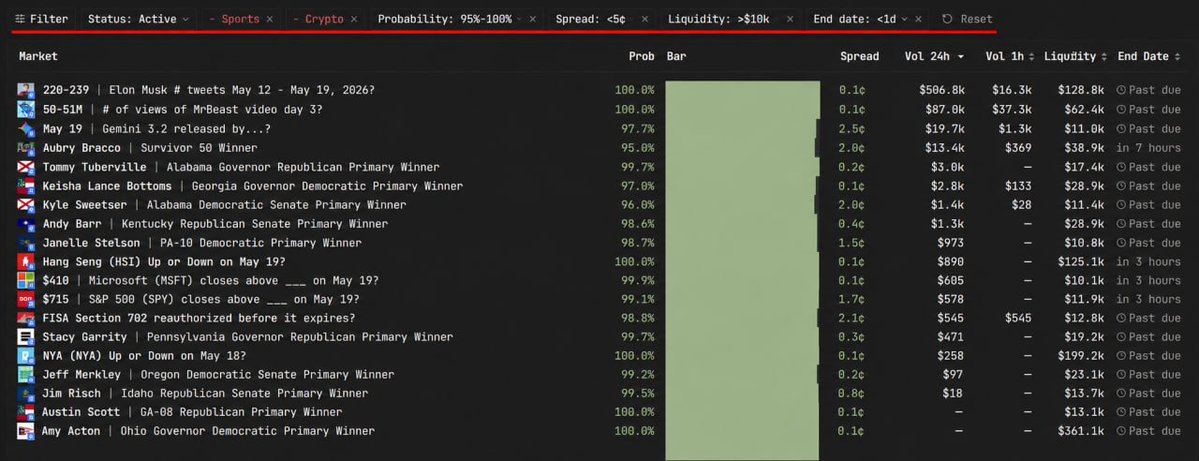
I’m earning +4-5% per day with almost zero risk on Polymarket
And this strategy is stupidly simple
I only trade markets that meet these strict filters:
> Probability >95%
> Spread <5¢
> Liquidity >$10k
> Ends in <1 day
I also exclude sports and crypto events because they can still reverse even at 97-99%
This leaves me with high-certainty setups where I can safely grab 4-5% in 24h or less
My filters are listed below ⬇️
vijn@vijn_crypto
This trader turned $700 into $6,000 with just ONE trade And that looks really strange Here’s what makes it suspicious: He has only 23 trades total on Polymarket His biggest win came from the market "Gemini 3.5 released by May 31?" He aggressively Yes bought at just 7.9 cents per share, now it’s trading at 92 cents I’m starting to track this wallet closely with Parity Terminal so I don’t miss his next move
English

Nelson retweetledi


Excellent summary of the last ~24hr and downstream impacts from Paper.
TLDR:
- Mega has no direct exposure
- There's a question to be answered on who assumes the loss of stolen funds (L2 holders or all holders of Kelp's LRT [~17% of supply])
- Open question on *how* the single DVN approved the fabricated transaction
Entire industry is now scraping all bridges and assets for weak security configs to amend them in light of this.
Personally, I'm buckling down for these types of incidents recurring over the next 9-12mo.
I don't see how we avoid this outcome as Mythos+ type models make their way into the wild and find vuln in contracts that are immutable.
PaperImperium@ImperiumPaper
With the Kelp exploit yesterday, I wanted to provide a quick summary for folks who may be confused or simply looking for compiling what we know. Firstly, my employer would be remiss if I didn’t lead with: MegaETH does not appear to have direct exposure to the incident; I could only locate ~$100 of rsETH on the entire chain. Summary of events: Earlier yesterday, an invalid message that supposedly originated from a smaller L2 was accepted by the Kelp DAO DVN for their LayerZero OFT. As a reminder, L0 has a variety of security setups, which can be on par with or surpassing alternatives, but in practice many teams choose a lower burden. Kelp DAO's controlled contract accepted the invalid first transaction, but blocked a follow-on for another tranche of rsETH. Many teams (including Ethena, who operate USDM) have paused their OFT bridging while an investigation occurs, but as of right now this looks to me like it was a compromise on the Kelp DAO side, and the security assumptions did not require further compromise to execute malicious actions. rsETH is lock-and-mint on mainnet. This means when L0's rsETH goes between L2s, it is burn-and-mint, but when Ethereum is one end of a corridor, there is an rsETH token that is being (un)locked. For example, rsETH traveling from Optimism to Mega would burn 1 rsETH on Optimism for every 1 rsETH minted on Mega. For rsETH traveling from Optimism to Ethereum, however, 1 rsETH on Optimism would be burned and 1 rsETH would be unlocked from the mainnet escrow. In theory, there should be 1 rsETH in the mainnet escrow for every rsETH outside of Ethereum. That is now no longer the case. Somewhere between 17-18% of rsETH supply was unlocked erroneously by the attacker. That rsETH was then swapped on DEXes and borrowed against on lending protocols, including Aave, Compound, and Euler. All of this was done on Ethereum and Arbitrum to the best of my knowledge. The problem set: There are three major, interconnected problems that I currently see. First is whether rsETH is now ~17.5% undercollateralized due to the inflated supply (L1 + L2). Kelp looks like they have two paths they can take. The first is to socialize the dilution across all rsETH holders, and try to recover what it can through cooperation with DeFi teams and law enforcement. The second is to keep the mainnet supply whole, since all rsETH on mainnet are, in theory, the actual assets, and the number of rsETH on mainnet did not chain. This would effectively be pushing all losses onto L2 rsETH holders. I expect many lawyers are being activated already, since there is not clear seniority or differentiation that I can find in the Kelp documentation about this. Second is whether lending protocols now have accrued large amounts of bad debt. I want to be perfectly candid that my initial estimates are in excess of the buffers most of these protocols have in place. For example, should all rsETH holders be diluted 17%, then mainnet Aave alone looks like it has around 2x the bad debt as can be covered by Umbrella, which is more than $50m of coverage. Complicating things is that rsETH losses socialized only among L2 holders would be dramatically larger, and could still result in some Arbitrum deployments becoming insolvent. It will take some time for each lending protocol to even know which scenario would be better for them (my guess is Compound and Aave would like to see it contained to L2s, while Euler and Fluid and others who compete more in frontier markets would want the universal haircut), and then advocate for that solution to Kelp. Thirdly, while all of this is ongoing, the WETH and stablecoin markets are largely illiquid. This creates a lot of negative carry for some highly leveraged trades. Until those trades can unwind, that risks some positions slipping into liquidation at a time that some of these markets will not be especially liquid. 1/2
English


as of last friday, I no longer work at the EF
nothing but respect for the brilliant people i worked with over the last 5 years on network upgrades + funding efforts
I intend to continue working on @ProtocolGuild and Ethereum political economy as long as funding is available
English

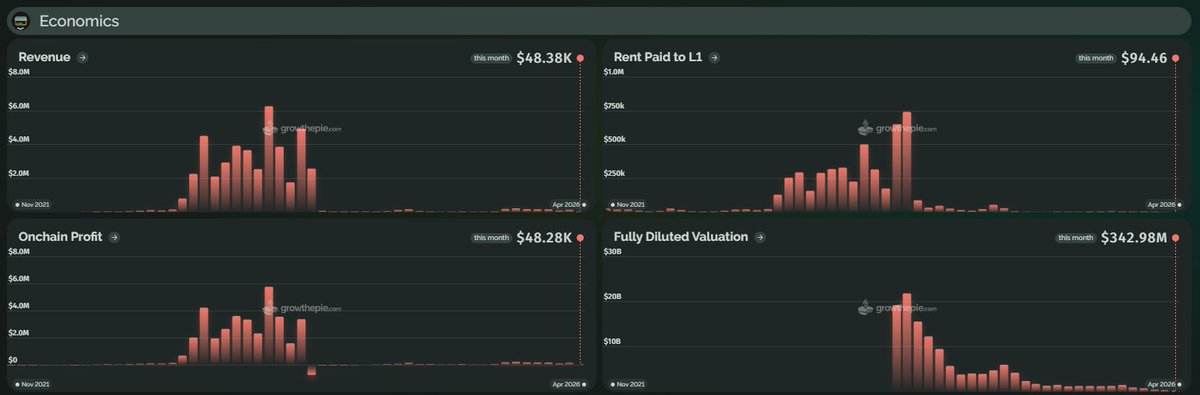
Revenue has dropped but so has onchains costs, it's better to compare onchain profit. Also, instead of looking at an incomplete month, why not use last month?
March 2026 = $142,666.48 (Last month)
March 2025 = $12,335.75
March 2024 = -$755,357.54 (negative)
March 2023 = $677,836.95
Nov 2023 = $5,756,105.50 (peak onchain profit)
It's clear onchain has fallen but hope the extra context helps. See more here growthepie.com/chains/starkne…
English

NEW: @StarkWareLtd is restructuring into two business units and cutting staff after revenue on its network collapsed more than 99% from a late-2023 peak of ~$6M per month to $48,000 in the first half of April.

English


Some observations about HK:
Kowloon > the island.
5 of the top 100 universities.
Currently the world’s best computer vision center?
HK is closer to SZ than SF is to Palo Alto.
4000 buildings taller than 100m, compared to 900 in NY.
Incredibly green! Some of the best hiking in the world?!
Nils@broodsugar
I’m now a permanent resident of the greatest city in the world. Thank you, Hong Kong.
English
@ec265 @kantianum Paradigm can at least argue that they were early.
Blockworks was the same takes, just years late.
English

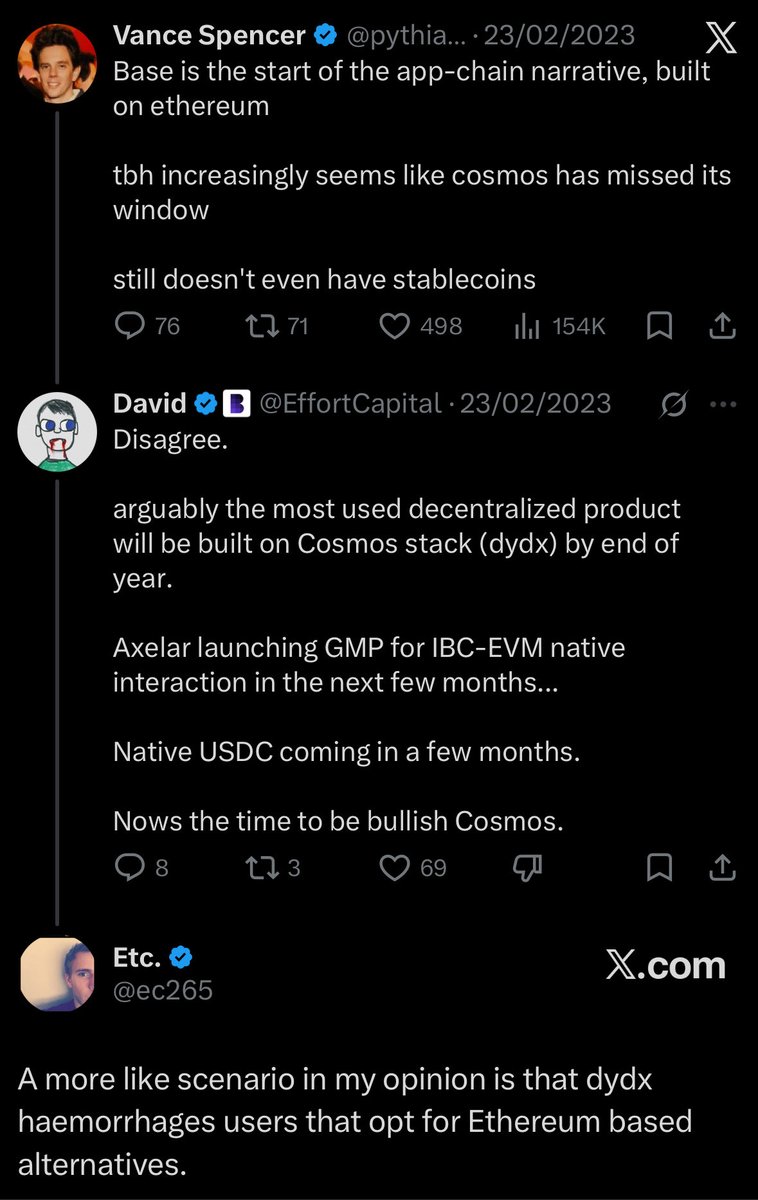
Two of us were right, the other works for Blockworks
Lesson in there
Ethereum Intern@ethereumintern_
>be dYdX >Ethereum rollup, huge DEX >become an alt L1 for some reason >die What were they thinking
English
Your stablecoin transactions are public by default.
Not anymore.
$BOLD can now be shielded through @RAILGUN_Project and the privacy focused wallet, Kohaku 👀.
A truly sovereign stablecoin that's also private.
@EthereumFndn's @ncsgy explained at ETH CC 👇
cypherpunk DeFi will win.
English

@hosseeb Good thing we’ve got a spend management skill for Hermes too @contofinance conto.finance/hermes
English

Migrating my OpenClaw to Hermes Agent tonight. Will update this thread with how it goes.
English
@llamaonthebrink Not comparable tbh.
Although relative performance would be interesting.
English

At the time when the whole industry (including myself to a degree) simped for this grift master for favourable treatment, Vitalik was the only person to quietly protest and point to the dangers of partisanship for crypto.
The stain the Trump family is leaving on this industry is gonna take a long time to wash off unfortunately…
Easy@NotSoEasyMoney
HOW IS NOBODY TALKING ABOUT THIS!?!?!?!? THEY PRINTED 5 BILLION OF THEIR OWN TOKENS THEN WITHDREW IT AS USDC!?!?!?!??!
English

The bullish case for agentic commerce is that it acts as a trojan horse to reshape web standards into being crypto-native.
Imagine the entire cryptocurrency industry existing just to validate @pmarca’s 30-year-old take on HTTP 402.

AI on Base@AIonBase_
X402 ECOSYSTEM MAP x402 is the HTTP of money - universal payment standard for the agentic era. Built directly on HTTP 402 standard. Real-time micropayments for every API call (GET, PUT, POST). The ecosystem is massive on @base and @virtuals_io 👇 Core Protocols - @virtuals_io ACP - @stripe ACP - @circle Wallets - @ethereum ERC-8004 - @Visa TAP - @Cloudflare PPC - @Google AP2 & A2A Infrastructure - @vercel MCP - @eigencloud AI - @Nevermined_ai - @mcpaytech - @questflow - @mrdn_finance - @neynarxyz - @pinatacloud - @firecrawl - @Hive_Intel - @Heurist_AI Live Agents & Apps - @VPAY_Global - @itsgloria_ai - @ethy_agent - @AInalyst_ - @OttoWallet - @tipdotmd - @Roba_Labs - @openservai - @bankrbot Analytics - @x402scan - @scattering_io Facilitators - @coinbase - @PayAINetwork - @daydreamsagents - @thirdweb - @AurraCloud - @x402rs The internet of value is live. Autonomous. Permissionless.
English