

Philip O'Brien
1.3K posts

Philip O'Brien
@philppobrien
Technical Lead @WaltonInst | All views my own
Katılım Haziran 2012
992 Takip Edilen123 Takipçiler

@PulaRJS Constant performative intellectualism...."Look! Look!!! Look how smart I am!!!!"
English

The bizarre ramblings in this Palantir manifesto provide a disturbing insight into the mindset of the faux intellectual, emotionally stunted, overgrown adolescents who now dictate our destinies.
"10. The psychologization of modern politics is leading us astray. Those who look to the political arena to nourish their soul and sense of self, who rely too heavily on their internal life finding expression in people they may never meet, will be left disappointed."
What does that even mean?
Palantir@PalantirTech
Because we get asked a lot. The Technological Republic, in brief. 1. Silicon Valley owes a moral debt to the country that made its rise possible. The engineering elite of Silicon Valley has an affirmative obligation to participate in the defense of the nation. 2. We must rebel against the tyranny of the apps. Is the iPhone our greatest creative if not crowning achievement as a civilization? The object has changed our lives, but it may also now be limiting and constraining our sense of the possible. 3. Free email is not enough. The decadence of a culture or civilization, and indeed its ruling class, will be forgiven only if that culture is capable of delivering economic growth and security for the public. 4. The limits of soft power, of soaring rhetoric alone, have been exposed. The ability of free and democratic societies to prevail requires something more than moral appeal. It requires hard power, and hard power in this century will be built on software. 5. The question is not whether A.I. weapons will be built; it is who will build them and for what purpose. Our adversaries will not pause to indulge in theatrical debates about the merits of developing technologies with critical military and national security applications. They will proceed. 6. National service should be a universal duty. We should, as a society, seriously consider moving away from an all-volunteer force and only fight the next war if everyone shares in the risk and the cost. 7. If a U.S. Marine asks for a better rifle, we should build it; and the same goes for software. We should as a country be capable of continuing a debate about the appropriateness of military action abroad while remaining unflinching in our commitment to those we have asked to step into harm’s way. 8. Public servants need not be our priests. Any business that compensated its employees in the way that the federal government compensates public servants would struggle to survive. 9. We should show far more grace towards those who have subjected themselves to public life. The eradication of any space for forgiveness—a jettisoning of any tolerance for the complexities and contradictions of the human psyche—may leave us with a cast of characters at the helm we will grow to regret. 10. The psychologization of modern politics is leading us astray. Those who look to the political arena to nourish their soul and sense of self, who rely too heavily on their internal life finding expression in people they may never meet, will be left disappointed. 11. Our society has grown too eager to hasten, and is often gleeful at, the demise of its enemies. The vanquishing of an opponent is a moment to pause, not rejoice. 12. The atomic age is ending. One age of deterrence, the atomic age, is ending, and a new era of deterrence built on A.I. is set to begin. 13. No other country in the history of the world has advanced progressive values more than this one. The United States is far from perfect. But it is easy to forget how much more opportunity exists in this country for those who are not hereditary elites than in any other nation on the planet. 14. American power has made possible an extraordinarily long peace. Too many have forgotten or perhaps take for granted that nearly a century of some version of peace has prevailed in the world without a great power military conflict. At least three generations — billions of people and their children and now grandchildren — have never known a world war. 15. The postwar neutering of Germany and Japan must be undone. The defanging of Germany was an overcorrection for which Europe is now paying a heavy price. A similar and highly theatrical commitment to Japanese pacifism will, if maintained, also threaten to shift the balance of power in Asia. 16. We should applaud those who attempt to build where the market has failed to act. The culture almost snickers at Musk’s interest in grand narrative, as if billionaires ought to simply stay in their lane of enriching themselves . . . . Any curiosity or genuine interest in the value of what he has created is essentially dismissed, or perhaps lurks from beneath a thinly veiled scorn. 17. Silicon Valley must play a role in addressing violent crime. Many politicians across the United States have essentially shrugged when it comes to violent crime, abandoning any serious efforts to address the problem or take on any risk with their constituencies or donors in coming up with solutions and experiments in what should be a desperate bid to save lives. 18. The ruthless exposure of the private lives of public figures drives far too much talent away from government service. The public arena—and the shallow and petty assaults against those who dare to do something other than enrich themselves—has become so unforgiving that the republic is left with a significant roster of ineffectual, empty vessels whose ambition one would forgive if there were any genuine belief structure lurking within. 19. The caution in public life that we unwittingly encourage is corrosive. Those who say nothing wrong often say nothing much at all. 20. The pervasive intolerance of religious belief in certain circles must be resisted. The elite’s intolerance of religious belief is perhaps one of the most telling signs that its political project constitutes a less open intellectual movement than many within it would claim. 21. Some cultures have produced vital advances; others remain dysfunctional and regressive. All cultures are now equal. Criticism and value judgments are forbidden. Yet this new dogma glosses over the fact that certain cultures and indeed subcultures . . . have produced wonders. Others have proven middling, and worse, regressive and harmful. 22. We must resist the shallow temptation of a vacant and hollow pluralism. We, in America and more broadly the West, have for the past half century resisted defining national cultures in the name of inclusivity. But inclusion into what? Excerpts from the #1 New York Times Bestseller The Technological Republic: Hard Power, Soft Belief, and the Future of the West, by Alexander C. Karp & Nicholas W. Zamiska techrepublicbook.com
English
@theo Do you use GPT-5.4 pro much or is GPT-5.4 your go-to?
English

Is Opus 4.7 the best model from Anthropic? No, that’s Mythos.
Is it the best model we can use for code? No, that’s GPT-5.4.
Is it the best model in the Opus line? No, that’s 4.5
It’s the best model released today I guess?
English
@charise_lee Not just a religious fanatic but a complete fucking moron. A wonderful mix.
English

I have never been more terrified in my entire life.
English



Rutte - the NATO Secretary General - is advocating for a war which is not supported by the majority of NATO members, which endangers and weakens the world order and which is contrary to international law. He should resign.
Thorsten Benner@thorstenbenner
"The president doing this is crucial. I've seen the polling, but I really hope American people will be with him because he's doing this to make the whole world safer". How judicious on the part of Rutte to cheer a war pushing world toward economic crisis.
English
@RoKhannaNews This is the evil villain we wanted but alas that fucking loser Karp is the one we deserve

English

it is insane how comically evil Palantir is, there's so many videos of Karp and Thiel saying the most evil shit ever
unusual_whales@unusual_whales
Palantir's Karp: "What makes America special right now is our lethal capacities. Our ability to fight war."
English
@PhilipDBunn Pffftttt.....how many Walmarts did Marcus Aurelius build? Augustine? Milton? Not a single one between those losers.
English

Marcus Aurelius's Meditations? Augustine's Confessions? These people are idiots. Don't listen to illiterate people. Don't give them your time or your money. Read a book instead.
David Senra@davidsenra
Great men of history had little to no introspection. The personality that builds empires is not the same personality that sits around quietly questioning itself. @pmarca and I discuss what we both noticed but no one talks about: David: You don't have any levels of introspection? Marc: Yes, zero. As little as possible. David: Why? Marc: Move forward. Go! I found people who dwell in the past get stuck in the past. It's a real problem and it's a problem at work and it's a problem at home. David: So I've read 400 biographies of history’s greatest entrepreneurs and someone asked me what the most surprising thing I’ve learned from this was [and I answered] they have little or zero introspection. Sam Walton didn't wake up thinking about his internal self. He just woke up and was like: I like building Walmart. I'm going to keep building Walmart. I'm going to make more Walmarts. And he just kept doing it over and over again. Marc: If you go back 400 years ago it never would've occurred to anybody to be introspective. All of the modern conceptions around introspection and therapy, and all the things that kind of result from that are, a kind of a manufacture of the 1910s, 1920s. Great men of history didn't sit around doing this stuff. The individual runs and does all these things and builds things and builds empires and builds companies and builds technology. And then this kind of this kind of guilt based whammy kind of showed up from Europe. A lot of it from Vienna in 1910, 1920s, Freud and all that entire movement. And kind of turned all that inward and basically said, okay, now we need to basically second guess the individual. We need to criticize the individual. The individual needs to self criticize. The individual needs to feel guilt, needs to look backwards, needs to dwell in the past. It never resonated with me.
English

Is it not time the Irish & all EU governments expelled all Iranian diplomats based in Ireland & across the EU & shuttered their embassies & consulates?
English

The Artificial Intelligence Ireland Party.
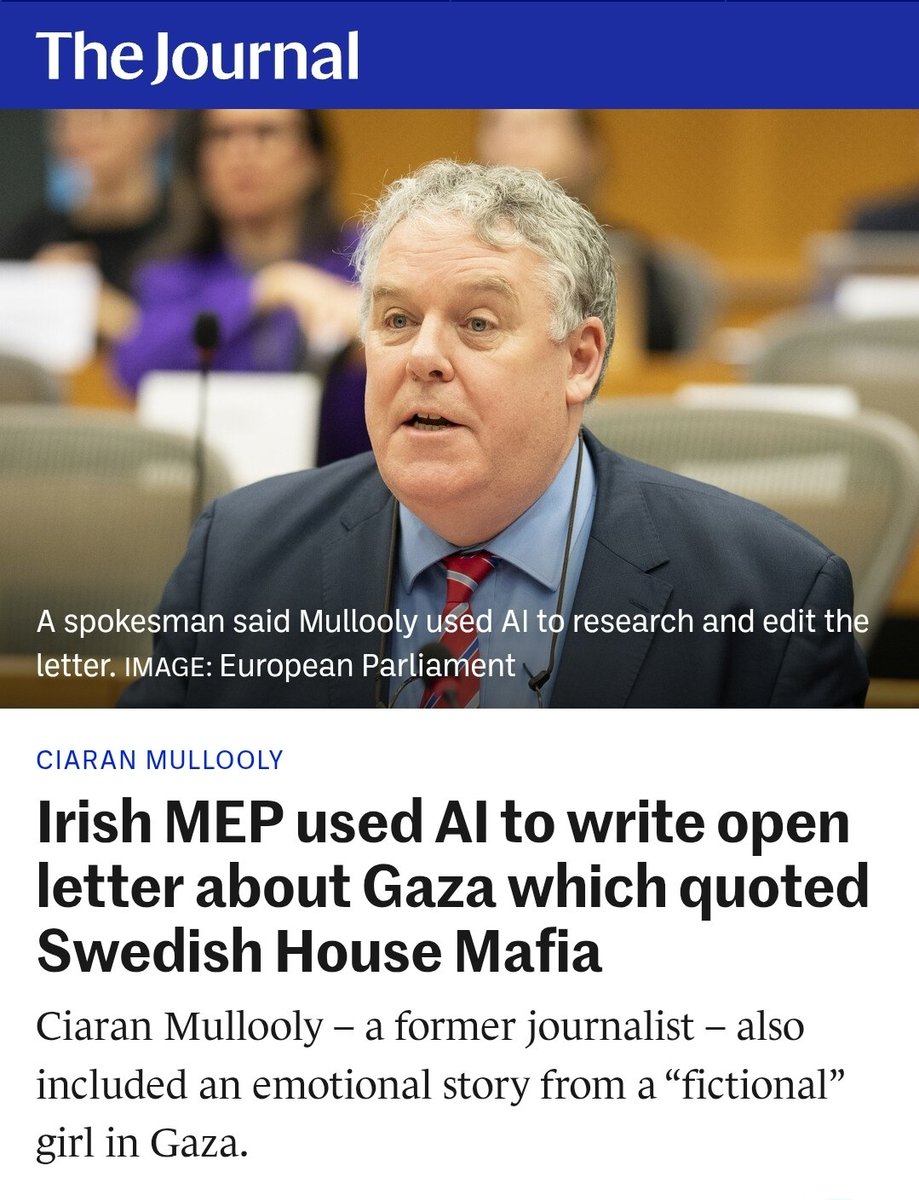
Paul Murphy 🇵🇸@paulmurphy_TD
@Iskesullas Look carefully at the second paragraph. Wtf is going on there?
English



Hi Lynn @LNBDublin we all know Sinn Fein are rattled when they resort to abuse & demonising those who challenge their fraudulent narratives. So I am again asking who last year regularly stalked & abused a young female TCD post graduate student through the now deleted “ Time for Irish Unity” a/c on this platform? I know that it was not you but expect you should know who and, if not, ask some colleagues. To what chamber is that person elected, what political role does the person still occupy & why no explanation for the a/cs deletion? Has SF abandoned its Time for Irish Unity campaign? Previously asked but u didn’t respond. Check with colleagues before doing so. Transparency matters.
And PS, most of my shoes don’t require laces & I don’t wear boots. I know boots were beloved by some in PIRA, useful for stomping on people & feeling all militaristic!
Lynn Boylan 🍷📖🐾@LNBDublin
Sherlock Holmes isnt fit to lace your your boots Alan.
English
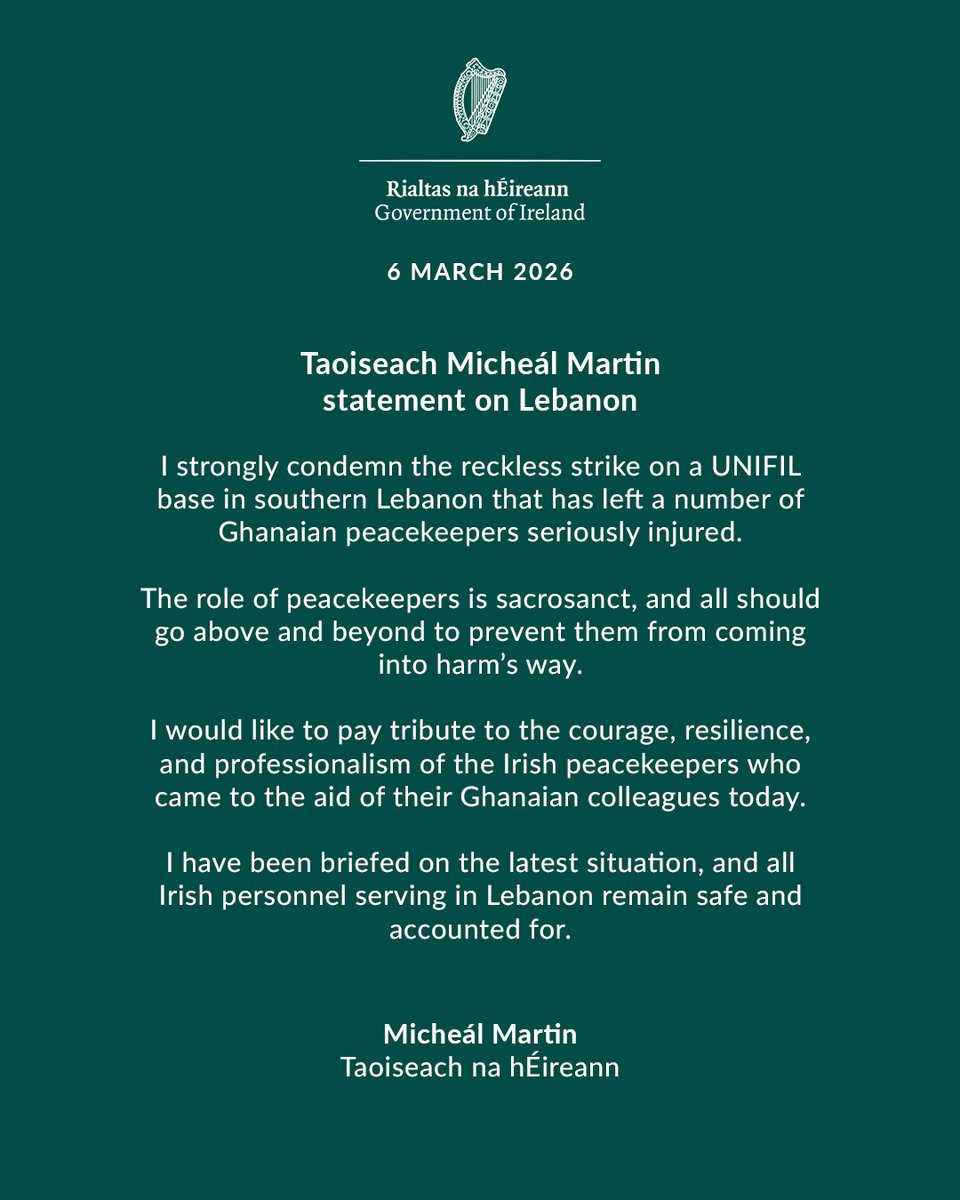
I strongly condemn the reckless strike on a UNIFIL base in southern Lebanon that has left a number of Ghanaian peacekeepers seriously injured.
English

Tehran’s strategy is to sow chaos and set the region on fire. By indiscriminately attacking its neighbours, the regime is making a strong case for its own demise.
The dream scenario would be a democratic Iran that poses no threat to its neighbours. But this outcome is far from certain. Right now, no one can predict which direction Iran will take.
My press remarks in Warsaw ↓
English
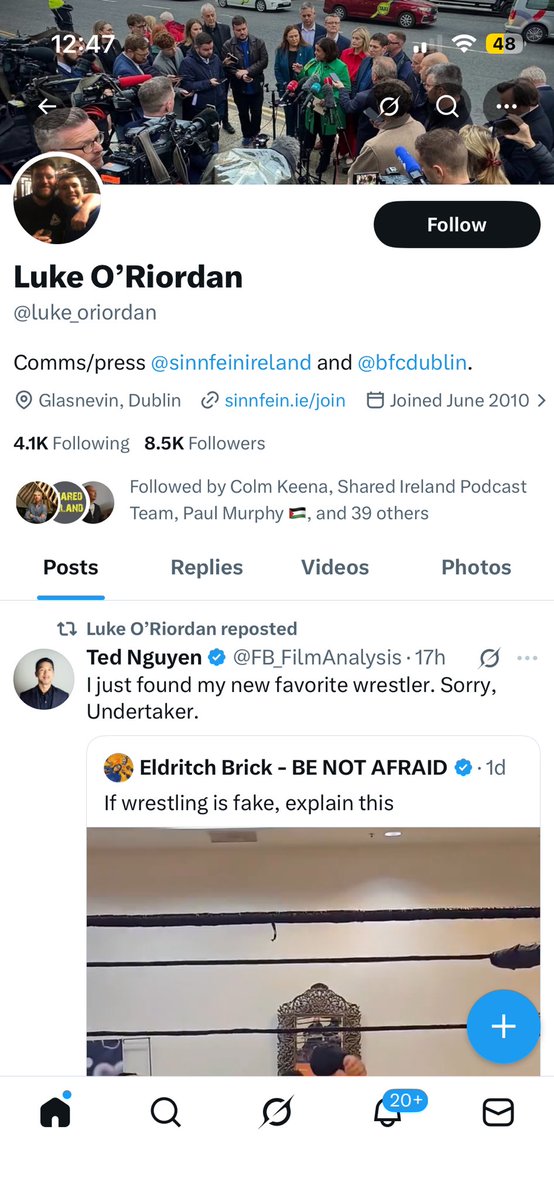
So it seems Sinn Fein & Bohemian FC share the same press & communications officer. Quelle surprise! Who knew? Don’t recall any mainstream media report of that. Explains so much & enlightens beyond conjecture!
English

Israeli troops cross into Lebanon amid fears of wider war
channel4.com/news/israeli-t…
English

Ah, look who’s waded into a discussion about prime ministerial calibre.

English

it’s amazing how soft the world has become.
when i worked on wall street, one of my colleagues was fired on the spot, given a box to pack up his stuff and escorted out by HR. took him months to land back on his feet.
fast forward to today, you have one of the greatest founders in history apologising profusely to his employees for letting them go (because they were getting paid $300,000+ to do what an ai can do).
to help employees cope, he’s promised to keep paying them for 6 months after they’ve been fired, free health care, a $5,000 bonus and let them keep their work phones and laptops.
only thing missing is a five star trip to europe and gender reassignment surgery.
jack@jack
we're making @blocks smaller today. here's my note to the company. #### today we're making one of the hardest decisions in the history of our company: we're reducing our organization by nearly half, from over 10,000 people to just under 6,000. that means over 4,000 of you are being asked to leave or entering into consultation. i'll be straight about what's happening, why, and what it means for everyone. first off, if you're one of the people affected, you'll receive your salary for 20 weeks + 1 week per year of tenure, equity vested through the end of may, 6 months of health care, your corporate devices, and $5,000 to put toward whatever you need to help you in this transition (if you’re outside the U.S. you’ll receive similar support but exact details are going to vary based on local requirements). i want you to know that before anything else. everyone will be notified today, whether you're being asked to leave, entering consultation, or asked to stay. we're not making this decision because we're in trouble. our business is strong. gross profit continues to grow, we continue to serve more and more customers, and profitability is improving. but something has changed. we're already seeing that the intelligence tools we’re creating and using, paired with smaller and flatter teams, are enabling a new way of working which fundamentally changes what it means to build and run a company. and that's accelerating rapidly. i had two options: cut gradually over months or years as this shift plays out, or be honest about where we are and act on it now. i chose the latter. repeated rounds of cuts are destructive to morale, to focus, and to the trust that customers and shareholders place in our ability to lead. i'd rather take a hard, clear action now and build from a position we believe in than manage a slow reduction of people toward the same outcome. a smaller company also gives us the space to grow our business the right way, on our own terms, instead of constantly reacting to market pressures. a decision at this scale carries risk. but so does standing still. we've done a full review to determine the roles and people we require to reliably grow the business from here, and we've pressure-tested those decisions from multiple angles. i accept that we may have gotten some of them wrong, and we've built in flexibility to account for that, and do the right thing for our customers. we're not going to just disappear people from slack and email and pretend they were never here. communication channels will stay open through thursday evening (pacific) so everyone can say goodbye properly, and share whatever you wish. i'll also be hosting a live video session to thank everyone at 3:35pm pacific. i know doing it this way might feel awkward. i'd rather it feel awkward and human than efficient and cold. to those of you leaving…i’m grateful for you, and i’m sorry to put you through this. you built what this company is today. that's a fact that i'll honor forever. this decision is not a reflection of what you contributed. you will be a great contributor to any organization going forward. to those staying…i made this decision, and i'll own it. what i'm asking of you is to build with me. we're going to build this company with intelligence at the core of everything we do. how we work, how we create, how we serve our customers. our customers will feel this shift too, and we're going to help them navigate it: towards a future where they can build their own features directly, composed of our capabilities and served through our interfaces. that's what i'm focused on now. expect a note from me tomorrow. jack
English