Paul Borrill

3.3K posts

Paul Borrill banner
Paul Borrill

Paul Borrill

@plborrill

Physicist & CEO of DÆDÆLUS; Join the conversation on our evolving knowledge of the nature of time & causality. And how we make the world safe for transactions.

Palo Alto, CA Katılım Ekim 2015
3.9K Takip Edilen1.2K Takipçiler
Paul Borrill
Paul Borrill@plborrill·
@barabasi @skdh Almost all of Barabási’s papers are zero bullshit and genuinely move the field forward
English
0
0
1
28
Paul Borrill
Paul Borrill@plborrill·
The insight that “idempotence comes in different shapes” is important, and it resonates deeply with how we think about consistency and correctness in distributed systems. In practice we often reduce idempotence to “retry safely” or “duplicate suppression,” but at its core it’s about the invariants that must hold when operations are repeated or reordered by the system. True idempotence isn’t just a property of a single request: it’s a protocol-level invariant that constrains how state evolves under concurrency, failure, and partial execution. What’s missing from many discussions is how idempotence interacts with causality and feedback. Classical approaches treat operations as forward-only functions on state, but this leaves out the possibility of harnessing observed outcomes as part of the protocol semantics. That’s where frameworks like Open Atomic Ethernet (OAE) shine: they don’t merely avoid unintended effects on retries, they encode the behavior of operations into the channel logic itself so that the system knows what happened, not just that it happened. By making the causal and observational structure of operations explicit, OAE provides a richer foundation for invariants like idempotence — not as a safety afterthought, but as an intrinsic part of the communication model. In other words: idempotence isn’t just about repeating a request safely — it’s about defining a shared ontology of effects that every node in a distributed system agrees on, even in the presence of uncertainty. OAE takes steps toward that by elevating the semantics of the channel beyond simple message passing, making idempotence a first-class citizen of the protocol design rather than an emergent property patched on by retry logic
English
0
0
3
56
Dominik Tornow
Dominik Tornow@DominikTornow·
Idempotence comes in different shapes Idempotence is the guarantee that repeating a request yields the same outcome (or, more formally, does not change the state of the system beyond the initial application) In practice, idempotence comes in a few variants, most notably positive and negative idempotence Positive Positive idempotence denotes that the system has accepted the request in the past: I have accepted this request in the past, I will accept the request again, I will apply this request again, nothing changes -or- I have accepted this request in the past, I will accept the request again, I will not apply this request again Negative Negative idempotence denotes that the system has rejected the request in the past I have rejected this request in the past, I will reject this request again Negative idempotence is often harder to guarantee: When a system accepts a request, the system state changes, the new state is evidence of the past acceptance of the request When a system rejects a request, the system state may not change, there is no evidence of the past rejection of the request Shoutout to @jorandirkgreef of @TigerBeetleDB fame, who coined the term negative idempotence
English
5
8
34
5.1K
Paul Borrill retweetledi
Eva Miranda
Eva Miranda@evamirandag·
Classical billiards can compute. With @Isaacramr__ , we show that 2D billiard systems are Turing complete, implying the existence of undecidable trajectories in physically natural models from hard-sphere gases to celestial mechanics. Determinism ≠ predictability. 🎱🧠@ETH_en
Eva Miranda tweet media
English
50
127
892
80.4K
Paul Borrill retweetledi
DHH
DHH@dhh·
Microservices is the software industry’s most successful confidence scam. It convinces small teams that they are “thinking big” while systematically destroying their ability to move at all. It flatters ambition by weaponizing insecurity: if you’re not running a constellation of services, are you even a real company? Never mind that this architecture was invented to cope with organizational dysfunction at planetary scale. Now it’s being prescribed to teams that still share a Slack channel and a lunch table. Small teams run on shared context. That is their superpower. Everyone can reason end-to-end. Everyone can change anything. Microservices vaporize that advantage on contact. They replace shared understanding with distributed ignorance. No one owns the whole anymore. Everyone owns a shard. The system becomes something that merely happens to the team, rather than something the team actively understands. This isn’t sophistication. It’s abdication. Then comes the operational farce. Each service demands its own pipeline, secrets, alerts, metrics, dashboards, permissions, backups, and rituals of appeasement. You don’t “deploy” anymore—you synchronize a fleet. One bug now requires a multi-service autopsy. A feature release becomes a coordination exercise across artificial borders you invented for no reason. You didn’t simplify your system. You shattered it and called the debris “architecture.” Microservices also lock incompetence in amber. You are forced to define APIs before you understand your own business. Guesses become contracts. Bad ideas become permanent dependencies. Every early mistake metastasizes through the network. In a monolith, wrong thinking is corrected with a refactor. In microservices, wrong thinking becomes infrastructure. You don’t just regret it—you host it, version it, and monitor it. The claim that monoliths don’t scale is one of the dumbest lies in modern engineering folklore. What doesn’t scale is chaos. What doesn’t scale is process cosplay. What doesn’t scale is pretending you’re Netflix while shipping a glorified CRUD app. Monoliths scale just fine when teams have discipline, tests, and restraint. But restraint isn’t fashionable, and boring doesn’t make conference talks. Microservices for small teams is not a technical mistake—it is a philosophical failure. It announces, loudly, that the team does not trust itself to understand its own system. It replaces accountability with protocol and momentum with middleware. You don’t get “future proofing.” You get permanent drag. And by the time you finally earn the scale that might justify this circus, your speed, your clarity, and your product instincts will already be gone.
English
181
1.2K
8.3K
990.6K
Paul Borrill retweetledi
Quanta Magazine
Quanta Magazine@QuantaMagazine·
For the first time, physicists have formulated quantum theory without imaginary numbers, overturning a 2021 claim that these unreal numbers are essential for describing the quantum world. @dangaristo reports: quantamagazine.org/physicists-tak…
English
55
129
614
92.8K
Paul Borrill retweetledi
BusinessIntelligence
BusinessIntelligence@bimedotcom·
An efficient probabilistic hardware architecture for diffusion-like models arxiv.org/abs/2510.23972 ✍️ @andyJelincic @GillVerd @trevormccrt1 et al. via @arxiv @extropic @beffjezos 👉 This work proposes "an all-transistor probabilistic computer that implements powerful denoising models at the hardware level" 👉 "A system-level analysis indicates that devices based on our architecture could achieve performance parity with GPUs on a simple image benchmark using approximately 10,000 times less energy" @Corix_JC @jeanyvesgonin @sonu_monika @JagersbergKnut @ahier @sim010101 @maponi @EstelaMandela @Shi4Tech @CEO_Aisoma @SpirosMargaris @IngridVasiliu @dinisguarda @mvollmer1 @RamonaEid @ChuckDBrooks @FernandaKellner @PVynckier @JoannMoretti @NeiraOsci @tlloydjones @SusanHayes_ @theomitsa @TarakRindani @FrRonconi @Nicochan33 @mikeflache @Khulood_Almani @TysonLester @CurieuxExplorer @KanezaDiane @Ym78200 @amalmerzouk @sulefati7 @pchamard @Analytics_699 @MaryRich78 @TheAIObserverX @NathaliaLeHen @sminaev2015 @jeancayeux @WillyRayNick @DanielleLargier @RLDI_Lamy
BusinessIntelligence tweet media
English
0
26
34
1.2K
Paul Borrill retweetledi
Mitchell Hashimoto
Mitchell Hashimoto@mitchellh·
Some early HC employees will probably remember me joking that it was my divine mission to eliminate YAML from the world. I joked I started HC only to kill YAML. Like, back in 2013. And we (as an industry) were so close! Then Kubernetes came out and fucked it all up.
Akhilesh Mishra@livingdevops

--- - Kubernetes uses YAML - Helm uses YAML - ArgoCD uses YAML - Ansible uses YAML - GitHub Action uses YAML - Gitlab CI uses YAML - Azure DevOps uses YAML Terraform uses YAML - GCP cloud build uses YAML Get good at YAML

English
102
93
2.6K
434.8K
Paul Borrill
Paul Borrill@plborrill·
@DominikTornow That’s exactly how I designed the kernel and scheduler for a Motorola 6809 Microprocessor controlled experiment i which flew on Spacelab 2 : the last successful flight of the Challenger
English
1
0
1
40
Dominik Tornow
Dominik Tornow@DominikTornow·
Initially I dismissed continuations as some esoteric PL feature Then I read trampolined style. No magic, just functions returning closures representing what happens next That clicked: Continuations are the foundation of non-linear control flow Anything from concurrency to I/O
Dominik Tornow@DominikTornow

Trampolined Style If you want to understand Event Loops, you need to read this paper from 1999: A trampolined program is organized as a single loop in which computations are scheduled and allowed to proceed in discrete steps. Grokking Event Loops = Grokking Continuations

English
3
1
56
5.8K
Paul Borrill retweetledi
Sam Lambert
Sam Lambert@samlambert·
Every now and then, the database world dips into a mania where really dumb ideas flourish. The separation of storage and compute at scale for OLTP is the latest. Making all your queries slower so you can shut your DB off quickly is an insane trade-off that nobody serious would make
English
20
9
277
31.9K
Paul Borrill
Paul Borrill@plborrill·
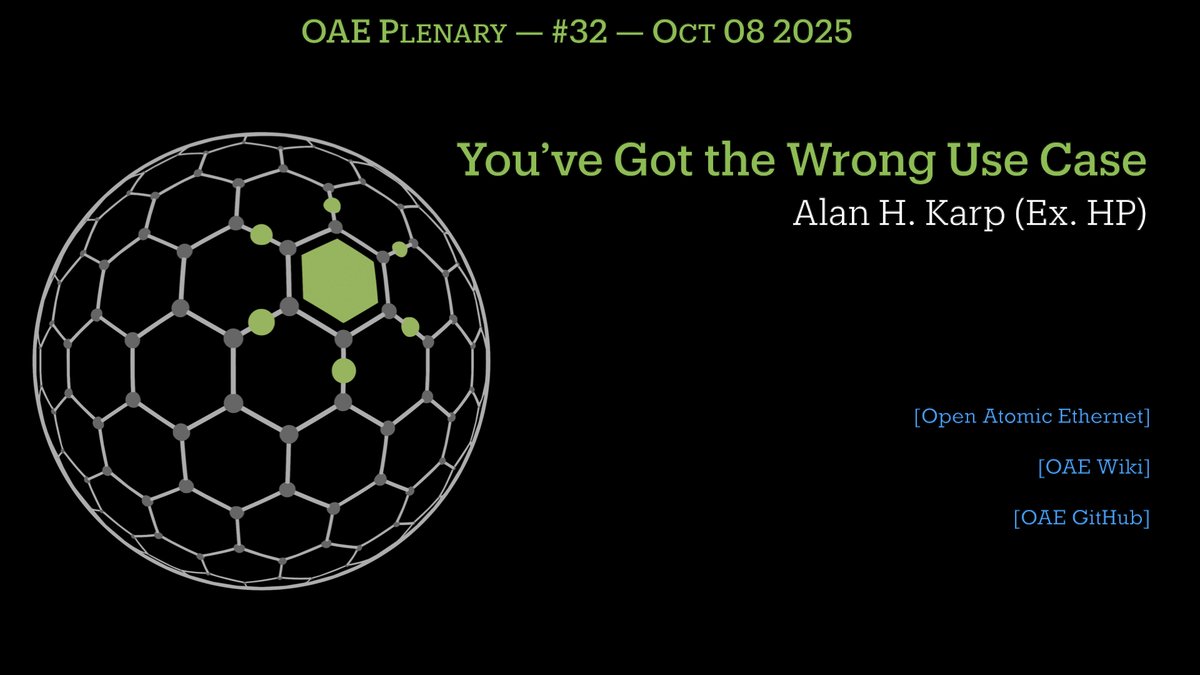
Join us for the 32nd OAE Plenary featuring Alan Karp (Ex-HP, Earth Computing) as he explores why Identity & Access Management systems often fail — and how choosing the right use cases changes everything. Alan will unpack real-world IAM failures caused by oversimplified assumptions, share examples from decades of distributed systems design, and propose the simplest use case that actually captures all access-management hazards. Wednesday October 8th, 9AM PT Meeting link is on the OAE wiki: opencompute.org/w/index.php?ti… #OAE #OCP #IAM #AccessControl #IdentityManagement #Networking #Daedaelus #OpenComputeProject
Paul Borrill tweet media
English
2
0
3
122
Paul Borrill retweetledi
LaurieWired
LaurieWired@lauriewired·
DDR5 is unstable garbage. Max out your memory channels? Flaky. Temperature a bit too hot? Silent Throttle with no logs. Too “Dense” of a stick? Good luck training. Last gen was rock solid by comparison. Here's what happened.
LaurieWired tweet mediaLaurieWired tweet media
English
180
329
5.1K
387.2K
Paul Borrill retweetledi
Deutsch Explains
Deutsch Explains@DeutschExplains·
.@mjgoldwater: Why do you have a positive vision for humanity? @DavidDeutschOxf: Well, I think I'd rather use the word aspiration. So, I think that human beings are what I call universal explainers, which means that they're capable of arriving at any conclusion, but that's true or false. So, and we arrive at true ones via a history of false ones. So, I think there is nothing beyond human capacity to create, to understand, to control, with the only limitation being the laws of physics. But equally, there's no limit to the size of error we can make. And we depend for both things on error correction. So, error correction is the most important attitude of the mind, and it's also the most important institute, the most important characteristic of institutions in society. @mjgoldwater: Sort of the most important mechanism. Yes. So, just to drill down on that, why is error correction so important? @DavidDeutschOxf: Because errors are inevitable. So, I'm a fallibilist, like Karl Popper. So, I believe that there's nothing infallible in the world. There's no touchstone of truth that we can find somewhere in the garden and pick up and say, you know, is this true or not? And it'd be infallible. @mjgoldwater: Sorry, whenever you say that, when I'm listening to you on your podcasts, I always think of the Pope. @DavidDeutschOxf: Yes. @mjgoldwater: Surely you must say, except for the Pope. @DavidDeutschOxf: No. As I have often explained, even if the Pope is infallible, your theory that the Pope has said a particular thing is fallible. Your theory that that is the Pope, you heard saying it, is fallible. Even if you break into the Vatican and hide somewhere, and by the way, he has to be sitting in the throne for it to be infallible. @mjgoldwater: I didn't know that. @DavidDeutschOxf: If he's not sitting in the throne, it doesn't count... So, he's sitting in the throne, you're hiding in the room, you see him sitting in the throne, and he says a thing. You still can't be sure. You're not infallibly sure because you don't know that this is the day on which he's going to... Maybe he's doing a dress rehearsal. @mjgoldwater: Or it could be a fake Pope. It could be a stand-in for the Pope. @DavidDeutschOxf: So, these are all examples of the fact that in order to conclude that something is true on the grounds of papal infallibility, you have to assume fallibly a lot of other conditions, and you can't get past that. There's no way of getting past that completely. @mjgoldwater: So, we come to knowledge through fallibility. Is that what you're saying? @DavidDeutschOxf: Yes.
English
6
14
96
6.4K
Paul Borrill
Paul Borrill@plborrill·
We are honored to welcome Professor Edward A. Lee to the next OAE Plenary. In this talk, Professor Lee will explore the central thesis of his book Plato and the Nerd: that technology and human culture coevolve in a creative partnership. Engineers, through models and abstractions, build “artificial worlds” that reshape what society can do. A key takeaway for our community: we are always building on standardized models. These models give us the discipline and determinism needed to design systems we can reason about. And if we want to innovate beyond the current boundaries—especially in how we treat time, concurrency, and determinism—we must work together toward new, standard models that the ecosystem can rely on. Join us tomorrow, Wednesday 24th at 9AM PDT opencompute-org.zoom.us/j/89756960348?…
Paul Borrill tweet media
English
2
0
4
113
Eli Gaultney
Eli Gaultney@eligaultney·
@lauriewired This is why they tell you to build out a NAS with drives from different batches, or even manufacturers.
English
6
1
103
6.3K
LaurieWired
LaurieWired@lauriewired·
SSDs are pretty reliable in a technical sense. That is, unless you make a really, really bad mistake in firmware. HP had a line of ~20 different Enterprise SSD models for datacenter use. In exactly 3 years, 270 days and 8 hours, every one is irrecoverably bricked.
LaurieWired tweet mediaLaurieWired tweet media
English
124
471
5.9K
307.9K
Paul Borrill
Paul Borrill@plborrill·
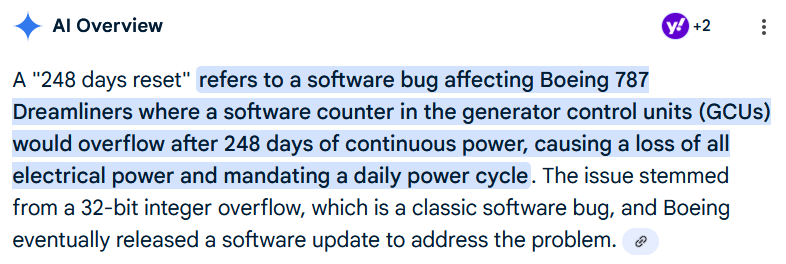
@SpringFord14 @lauriewired Never use counters. In firmware or protocols. They are all modulo something. Open Atomic Ethernet doesn’t need counting protocols. All transactions are conserved quantities. Which start from an equilibrium state and end back at the equilibrium when transfers are complete
English
0
0
3
45
Spring Ford
Spring Ford@SpringFord14·
@lauriewired We had some network kit decades ago that reset itself after 2 ^ 31 hundredths of a second. Or about 248 days. We had quite good monitoring and logging going and figured it out pretty quickly. Seems it was still be happening inn 2015.
Spring Ford tweet media
English
4
1
68
2.5K