“How much better would the web be if every site embraced Brutalist Web Design? How amazing would it be to have readable text, clearly-marked interaction points, unobtrusive advertising, all wrapped up in a fast-loading site you could read on any device?” brutalist-web.design
Erik Fair
25.5K posts
Erik Fair
@skeptech
Skeptical Technocrat, UNIX Hacker+software/network engineer since 1983, Internet Guy (20+ years of IETF work), Traveler, Interested Observer
Lake Tahoe, Nevada Katılım Temmuz 2008
630 Takip Edilen828 Takipçiler
Sabitlenmiş Tweet
Not sanguine about the "brutalist" name (any more than I'm overly fond of "graceful degradation" - turning off JavaScript is not a degradation, it's an improvement), but, "web designers", THIS:
John Arundel@bitfield
English
Erik Fair retweetledi

If the European welfare state looks like a pyramid scheme, its pharaohs are the “baby boomers”. We explain how the cohort has pulled off an intergenerational heist economist.com/europe/2026/05…
English

@ShamashAran The HP 48GX had no such impressing back. :(
Also how the hell are they so expensive on eBay?
English

There's actually stuff on the back of this calculator...

Sensurround@ShamashAran
this is who runs this account.
English
@Fuquet @dnlklr If you think that what's going on above ground is something, take a look at what's going on underground of that building: ircam.fr/en/research/pr…
English

@dnlklr What a disgusting sight.
Such a beautiful work of engineering surrounded by all those old, dirty ass buildings
English
Erik Fair retweetledi

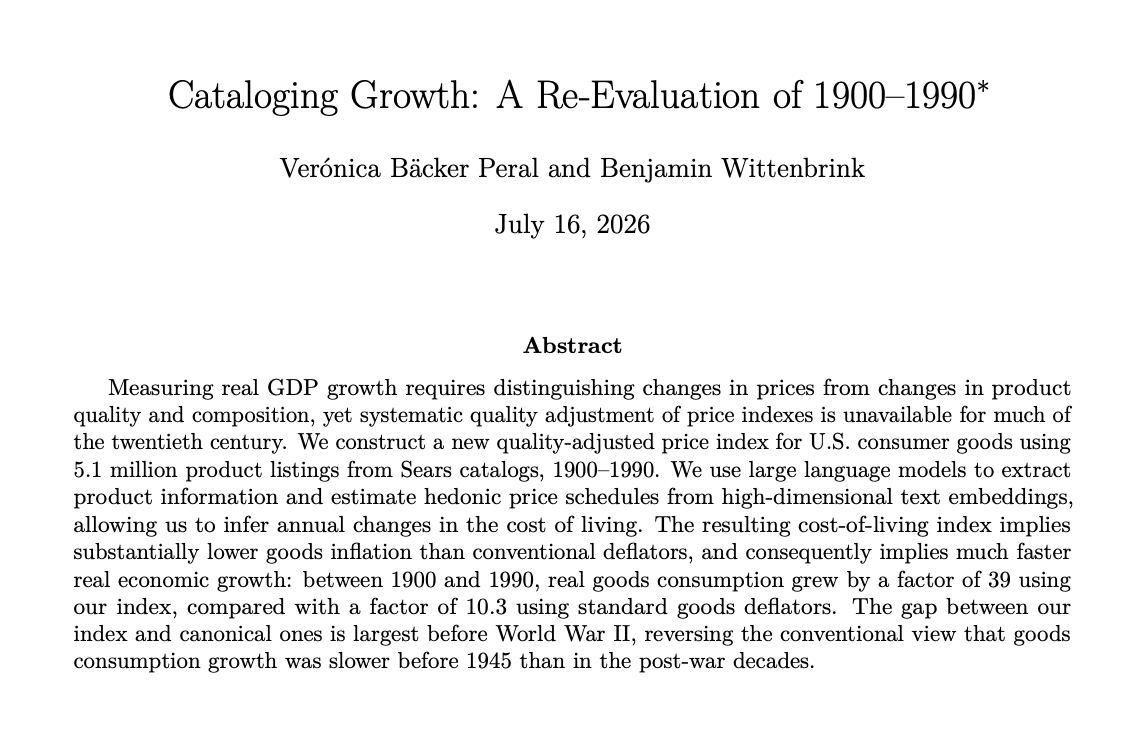
Excited to share our new working paper: how much did the US standard of living really rise over the twentieth century — and when? With @bhwittenbrink
Using 5.1 million Sears catalog listings, we build a quality-adjusted price index for consumer goods, 1900–1990. Two headline findings: growth was much larger than official statistics imply, and its peak came before WWII, not after. (1/9)

English
Erik Fair retweetledi

A Japanese engineer invented the QR code for one job, tracking car parts on a Toyota line, then his company chose to give the patent away for free, which is the only reason it ended up on every restaurant table on Earth.
His name is Masahiro Hara. The company was Denso Wave, a parts supplier owned by Toyota.
In 1992 the problem landed on his desk, and it was not glamorous. Workers on the factory floor were drowning.
Every car part had a barcode, but a barcode can only hold about twenty characters, so to track one component they had to stick five or ten barcodes on it.
A worker would stand there scanning a single part ten times in a row. Some of them were scanning close to a thousand barcodes a day. The job had stopped being about building cars and turned into pointing a scanner at stickers all day long.
And there was a second problem nobody upstairs cared about. This was a factory. Oil got on everything. A smudge of grease across a barcode and the whole thing became unreadable, and the line stopped.
Hara was asked to make the scanner faster. He looked at it for a while and realized the scanner was not the problem. The barcode itself was the ceiling. A line of black bars can only hold information going one direction, left to right.
He decided to build something that held information in two directions, up and down as well as across, so it could store hundreds of times more in the same little square.
Then came the part that sounds made up but is not.
Hara played Go on his lunch breaks, the old board game with black and white stones sitting on a grid. He was staring at the board one day and it clicked.
The grid of black and white stones was already a way to store information in two directions. That was the shape of his code.
But building the code was the easy half. The hard problem was speed, because the whole point was to be fast, and a scanner wastes most of its time just trying to figure out where the code is and which way it is turned.
The fix came to him on a train. He was looking out the window at buildings, and one building stood out from all the others because of its shape against the sky. That was the idea.
He put three little square targets in three corners of the code. The moment a scanner sees those three squares, it knows instantly where the code is and how it is rotated, even upside down, even at an angle.
Now here is the detail that shows how far he was willing to go. Those three corner squares only work if nothing else on the page looks like them.
If a magazine ad or a cardboard box happened to have the same black and white pattern nearby, the scanner would get confused and grab the wrong thing.
So Hara and his tiny two-person team went and surveyed printed material. Magazines. Flyers. Cardboard boxes. Piles of it, for days, reducing every picture down to its ratio of black to white area, hunting for the one ratio that almost never shows up in print anywhere. They found it. One to one to three to one to one.
That exact rhythm of black and white is baked into every corner square of every QR code on Earth, and it is there because it is the pattern the printed world almost never produces by accident.
Then he solved the oil.
He built the code so it carries a backup of its own information, spread mathematically across the whole square. You can tear off, smudge, or scratch out up to thirty percent of a QR code and it still scans perfectly, because the code rebuilds the missing piece from the copy it kept of itself.
A worker could get grease on a third of the label and the line would keep moving. This is the same math that lets a scratched CD still play and lets a spacecraft send data back across the solar system without asking to repeat itself.
He finished in 1994. He named it Quick Response, after what it does for the person using it, not after what it is.
And then Denso made the decision that actually mattered.
They held the patent. They could have charged a fee on every single scan, and given how many billions happen now, that would have made someone unimaginably rich.
Instead they announced they would not enforce their rights to collect royalties, and they published the specification openly so anyone could use it. Hara later said it was not even a big argument inside the company.
That one choice is the whole story. A code that costs nothing to use is a code everyone builds on. Airlines put it on tickets. Phone makers built readers into cameras.
Then a pandemic hit and the world needed a way to hand someone information without touching anything, and the free little square that a Toyota engineer built for greasy factory workers was suddenly on every menu, every payment, every door.
Hara still works there. He has said, more than once, that he never imagined it would spread this far, and that the part he is proudest of is that it got used to keep people safe.
The man built it to survive oil on a factory floor. It ended up surviving everything else too.
You have scanned his work a hundred times this year. Now you know whose it was.

English
@unclejerich0 If you're sure SpaceX is a fraud, short it, and shout your evidence from rooftops to all, so that your short position will be profitable! investopedia.com/terms/s/shorts…
English
@unclejerich0 All investment in startups are that way: you're investing in something that one expects, given reasonable evidence from solicitors, will both work & be profitable, someday (hopefully soon). Every investor gets to decide how credible any such investment is, and buy in (or not).
English
@unclejerich0 The SpaceX IPO raised $86 billion: en.wikipedia.org/wiki/Initial_p…
The company has a market capitalization of over $1 trillion (i.e., if you wanted to buy it, it'd cost at least that much to buy all the stock shares (assuming all holders would sell at market price).
English
@Noahpinion And don't forget infamous "Florida Man" … en.wikipedia.org/wiki/Florida_M…
English
Erik Fair retweetledi

Daylight Saving Time lengthens evenings and takes people further away from the natural cycle. Donald Trump is right to want it gone.
The House of Representatives has now voted in favour of introducing permanent standard time. Read our take from 2025 economist.com/leaders/2025/0…
English
@bendodge @LawyerDave1 @robertgraham And, once a city has “captured” such a tax revenue spinner, they can bilk it later because fixed capital like that is hard to move away from a rapacious jurisdiction.
English

Right, because $500m is better than $0. Let's say the normal tax would be $1b. Offer a 50% discount to avoid the project going somewhere else.
They can't [shouldn't] offer big breaks to a project that consume a lot of services because the municipality might lose money, but these things don't need lots of services.
English

Because data centers are an enormous TAX WINDFALL.
Data centers use almost no government services, because they pay for their own infrastructure upgrades.
But they pay taxes. Those taxes are massive windfalls for state and local governments.
It's building a vault for $50 billion in gold. You'd have to pay $2.5 billion in sales taxes to buy the gold, then hundreds of million a year on property taxes simply to own the gold.
All while not really impacting the community at all.
That's why governments give data centers tax incentives, to lure them to build there, for the free money.
Meta's deal requires them to pay 1% sales tax to the local county/parish. That's $500 million, a huge windfall for them to spend on schools and such. But it doesn't cost the county anything to have the data center there -- it's essentially free $500 million.
Joe Weisenthal@TheStalwart
One thing that I don't totally understand. Given the industry's voracious desires for more compute. Why are there places that still have tax incentives for their development. For all the backlash, is geographical capacity still not particularly scarce?
English
Erik Fair retweetledi

🚫No Drones Near Active Fires🚫
Please do not operate drones, near or over active wildland fires. Doing so impedes fire fighting aircraft in extinguishing fires and puts our pilots and crews in the air and on the ground in danger.
❗️If you fly, we can't fly.
#NoDroneZone

English
@cafreiman Forgot another apparently pervasive myth: capital invested in stocks, bonds, or even on deposit in banks is “hoarded.”
English
@octal And hope he was (or was not?) continuously playing Slim Whitman’s “Indian Love Call” in his office, or on his iPhone? youtube.com/watch?v=HBuk1H…

YouTube
English
Erik Fair retweetledi

Free Mac app WhatCable tells you what each of your USB-C cables can really do 9to5mac.com/2026/07/13/fre… by @benlovejoy
English

If you're new to my work, follow me @AlexEpstein for extreme clarity on energy, environmental, and climate issues from a humanist perspective. Also, subscribe to my newsletter, featuring lots of concise, powerful, well-referenced energy talking points. alexepstein.substack.com
English