curious

1.6K posts

curious

curious

@sometimeJokar

Occasionally funny

Katılım Ağustos 2018
1.1K Takip Edilen78 Takipçiler
Himanshu sharma
Himanshu sharma@pheonix_trader·
🟢Wait is finally over !!!!! ✅Giveaway of Model book -2 for 5 Star setup Containing 50 charts. ✅Elevate your Chart Reading Skills by Reviewing just 50 Charts. ✅50 detailed real - world Examples to Transform your Trading & Shorten your Learning curve. 📌Comment " Model Book & " Like + Retweet & DM me for 5 Star Setup Model book (Need to follow @pheonix_trader for DM)
English
465
306
455
16.4K
curious
curious@sometimeJokar·
@LiveFromALounge This is bank fraud, the law [in India, UK, US, Canada, AFAIK] takes a dim view of this, and bank fraud is broadly defined so good luck to whoever tries this. I'm not a lawyer and this is not legal advice
English
1
0
2
298
Ajay Awtaney
Ajay Awtaney@LiveFromALounge·
While my thoughts are that this is fraud, what are your thoughts?
Ajay Awtaney tweet media
English
6
0
16
5.9K
Miquel Gironès 🇦🇪🇪🇸🇵🇾🇧🇷🇲🇽🇨🇾🇵🇼
Most people don’t realize this: You don’t need to live in the US to get 💳 AMEX Gold 💳 Chase Sapphire Reserve 💳 AMEX Platinum ✈️ Business Class flights 95% OFF I’m from Spain originally and I'm able to access this entire system with a simple process... If you want to get access to this while the window is still open, Comment the word “US” and I’ll send you the guide to US banking as a non-American.
Miquel Gironès 🇦🇪🇪🇸🇵🇾🇧🇷🇲🇽🇨🇾🇵🇼 tweet media
English
33
3
23
4.6K
Miquel Gironès 🇦🇪🇪🇸🇵🇾🇧🇷🇲🇽🇨🇾🇵🇼
What people think 0% tax looks like: 🏝️ Offshore banks on a Caribbean island 🕵️ Secret accounts nobody can trace 📋 Complex multi-entity structures What 0% tax actually looks like: 🇺🇸 US LLC (registered in 48 hours) 🇵🇾 Paraguay tax residency (3 days on the ground 2x visits) 🏦 Money received in any bank you want The LLC is a pass-through. Your tax rate = your tax residency. Paraguay 🇵🇾 = territorial system. Foreign income = 0%. 2,000+ hours of research. This is the simplest 0% structure on earth. Comment 'LLC' and I'll send you the full guide.
Miquel Gironès 🇦🇪🇪🇸🇵🇾🇧🇷🇲🇽🇨🇾🇵🇼 tweet media
English
39
6
67
7.3K
curious retweetledi
Akshay Jogani
Akshay Jogani@kshayjogani·
Most people will read this as "RBI caps bank forex positions." The actual mechanism is worth understanding. Banks are running a basis trade between the onshore and offshore NDF markets. The rupee is under severe pressure (Iran war, oil above $100, FPI outflows), and the NDF market prices in more depreciation than the onshore rate where the RBI intervenes. That spread created an arbitrage: buy dollars onshore cheap, sell in NDF higher, pocket the difference. Old NOP rules measured net positions across both markets, so a bank long $2 billion onshore and short $2 billion in NDF shows a flat book. Technically compliant. Here's why this matters more than it sounds. The onshore market is where India's real economy settles. Every oil import, every FPI flow, every export receipt converts through the onshore deliverable market. The NDF is synthetic, no rupees change hands, it's a bet settled in dollar differences. So banks were adding real demand pressure in the market that matters and hedging it in one that doesn't directly touch the economy. The RBI was selling dollars to keep import costs manageable. Its own authorized dealers were buying those same dollars not for any real transaction, but to fund a spread trade. The central bank's reserves were depleting, the rupee kept weakening, the spread kept widening, and the arb kept getting more profitable. Banks were actively undermining the intervention of the institution that licenses them. The RBI's cap on the onshore leg at $100 million, regardless of NDF offsets, forces banks to sell dollars onshore. Estimated positions to be unwound range from $10-18 billion (Reuters) to $40 billion including options. The Rs 4,000 crore MTM loss number assumes a Re 1 spread blowout on $40 billion, which is a plausible worst case but not a certainty given NDF daily turnover is significantly higher. What is certain: concentrated dollar selling by banks in a market the RBI controls, over a tight window, at year-end. That should move the rupee in the onshore market.
Latha Venkatesh@latha_venkatesh

Reactions to the RBI cap on open positions in the onshore forex mkt -Bankers shocked by this sudden cap imposition -Say total positons that need to be wound down could be $40 bn, probabaly more if one counts options -If difference between $-rupee rate in NDF mkt & onshore mkt on Monday rises to say Re 1, mark-to-mkt losses for banks would be $40bnxRe1= Rs4000cr. -This Rs4,000 cr is between foreign, pvt & PSU banks -Being year-end this loss may have to be booked in FY26 P&L -Bankers are hoping RBI will tweak rules a little by tomorrow morning: -Very optimistic ask: RBI grandfathers current open positions, says rule applies to fresh positions only -Moderately optimistic hope: RBI gives 3 months time to bring down open positions to $100mln -Less optimistic hope: RBI extends time to bring down open positions to April 30, i.e. 1 month -Pessimistic position: RBI doesn't budge


English
10
27
136
26.6K
curious retweetledi
Farmer
Farmer@SowingAlphaSeed·
Scott is a co-founder of a $25B hedge fund and has less than 200 followers. Currently listening to a recent podcast he was on. "You end up with one third of your portfolio in one sector[, SaaS]. In credit, that's horrendous portfolio construction. In equity, I get it. You have convex upside. You can make a money multiple. Completely understand it. In ... credit where you were issuing the debt at 98 or 99 cents on the dollar and it's callable then at par, so you can make one or two points..., I think it's almost criminal portfolio management ... because defaults tend to cluster." youtube.com/watch?v=niAEze…
YouTube video
YouTube
Kieran Goodwin@kieranwgoodwin

Scott Goodwin .. no relation .. Widely considered to be a top 10 credit trader/investor RN. active in both public and private credit and CLOs Lives and breathes credit trading So his opinion is worth considering:


English
4
16
423
153.9K
Fat Conservative
Fat Conservative@KatrinaPresco1·
@chriswithans Apparently Ohio IS Germany. Everybody brings their quarter and if you park next to someone who is emptying their cart they will trade their cart for your quarter to save time.
English
28
2
559
36.4K
Chris
Chris@chriswithans·
I notice the Aldi experiment is failing in California. The Germans thought Californians could be like the meticulous old German people but no....hahaha. That's stupid. Instead of bringing a quarter to unlock a shopping cart, people are pulling apart the column to find a weak link cart to break out. Of course no one brings their own bags in to the store. That would require planning, something no Californian has. And the homeless will now just take an entire stack of shopping carts, all chained together, as their mobile home now. California is not Germany.
English
269
136
4.8K
484.9K
curious retweetledi
Analytic Flying
Analytic Flying@analyticflying·
Be careful complaining about airline ops on LinkedIn because you might just get a clear & concise explanation from Richard de Crespigny! That said, just another example how airlines can & should do a much better job explaining operational challenges & constraints.
Analytic Flying tweet media
English
24
49
840
55.8K
curious
curious@sometimeJokar·
@amit_i_am @greatindianmile If you want to book economy JAL and ANA have ticket sale prices every 2 months or so - INR 45-48 k return with free domestic flights in Japan. For business, JAL has an award ticket sale ongoing which makes the mileage needed quite cheap. Check pointsyeah [dot] com for options
English
1
0
2
270
Amitab(h) with no ab
Amitab(h) with no ab@amit_i_am·
25 countries so far ✈️— all on paid tickets. Now attempting my first serious miles redemption: Del → Tokyo 🇯🇵 And yes, it’s every bit the struggle @greatindianmile and others warned us about 😅 Here’s my current miles chessboard — let’s see if I can actually pull this off: Miles & Points Inventory • Existing Miles: AI, Cathay, QA — must use these • Points: Infinia: Best transfers - QA (via Fin), FB, Vietnam or SB EPM: AI or iShop Atlas: Excluding (earmarked for Accor) ❌ Routes I’m avoiding • United sweet spot — AI miles can’t transfer to any SA partner. Or is there a way to transfer AI miles? • JAL sweet spot — Want to burn QA Avios, but JAL isn’t showing on QA (AA shows space 🤔 → will call QA soon)🔍 Redemption Options on the Table: Option 1️⃣ DEL–HKG–DEL on Air India & HKG–Tokyo–HKG on Cathay ✅ Bonus: 3–4 day HK stopover 🔄 Transfer: EPM → AI 👍 Pros: Uses AI + Cathay miles 👎 Cons: No great Cathay transfer partner (Infinia 2:1 hurts). Btw, who's the best transfer partner for Cathay? Option 2️⃣ DEL–HKG–Tokyo & return via Qatar Avios 🔄 Transfer: Infinia → QA (via Fin) 👍 Pros: Clean redemption, solid value, no possibility of stopover at HK (without burning more) 👎 Cons: AI + Cathay miles stay unused, EPM points wasted for the time being Am I thinking about this in the right direction? 🤔 Or am I missing a smarter angle here? Tagging the miles brain trust 👇 @ameyakarve @CCMiles2Go @MilesMogul @dhimantn @aadil @VoyageBliss @ccg33k @SartanparaYash @FinPaal @imYadav31 @cards_wizard @DoBaniye @noyes99 @DealsDhamaka @suritalreja Let’s see if this redemption journey ends in Tokyo… or chaos. 🍿✈️
English
5
2
12
3.6K
curious retweetledi
🎵💖Loves classical music🎻🎹
The closing of the live version of "Sultans of Swing" is one of the most memorable moments in Dire Straits' history. Recorded on "A Night in London" (1996), this performance features an instrumental ending of about three minutes that does not appear on the studio recording, and that's precisely where the magic happens.
English
236
2.1K
10.5K
671.5K
curious retweetledi
Mathelirium
Mathelirium@mathelirium·
In 1996, James Sethian showed something almost unfair...you can find shortest routes through a messy world by letting a wave expand once...no trial paths, no search beams, just one growing front. Here’s how: we solve for an arrival-time field T(x,y) so that T literally means how long the wave needs to reach this point. The rule is ||∇ T|| = 1/F, where the medium is fast (F large) the front sprints, where it’s slow it trudges, and obstacles are speed ≈ 0, so the front wraps around them because that’s the only way forward. Then comes the satisfying part: once T exists, a path doesn’t need to search at all...drop a bead anywhere and let it follow ẋ ∝ -∇ T, it slides downhill on the time landscape and traces a globally fastest route back to the source. This “wave = optimal control” viewpoint is exactly what Tsitsiklis (1995) made precise from the Hamilton-Jacobi side...compute the value/arrival-time function and the optimal trajectories fall out from it. #FastMarching #EikonalEquation
English
60
214
2.3K
766.3K
Zion Don
Zion Don@MigaZionDon·
@schwabsauce @Cernovich Basically none of behavioral econ can be expected to replicate. Quite a project to unwind that from your worldview
English
1
0
9
369
curious retweetledi
KC-10 Driver ✈️ 👨‍✈️ B-737 Wrangler
My Eastbound Protocol: - Early push & taxi at 25 knots - Tell ATC “Mach .78”, then plug in .80 - Bother every controller for shortcuts - “We’ll slow down if it’s real bumpy” - Descend w/ a transition at 325 kts - Overshoot final at 220 kts - “Shit, gear down”
GIF
Speedbird Julie ✈️🍾🥂❤️⛸️@JSS779

My Eastbound protocol: - Spa time - Concorde Room lunch with white and red - Bellini with a side of DJ 1942 - Board early and pop in to see flight deck crew - Change into PJs - Bubbles before push back - Supper with red - Large Bailey's with ice - Sleep till landing CC @bscholl

English
51
24
570
64.3K
curious retweetledi
Boring_Business
Boring_Business@BoringBiz_·
In finance, there is not enough emphasis on creating simple models that are efficient and get you to a right conclusion quickly Most models created inside of large investment banks and private equity firms are running 8 different tabs that can flex 50 different scenarios The assumption tab alone is 300 rows and lets you change all the variables you can possibly imagine. It is always overkill And the worst part is that these models often lead you to no real takeaways. To put it simply, they sacrifice accuracy for precision Thought I would share some advice on how to keep your operating models efficient > identify the 3-5 variables that really matter in driving the business and the line items from your financial statements that drive those variables > run assumptions and sensitivity on those specific line items. those are the ones that really matter in how the business performs. For rest, use averages of last 3/5Y and flat line (keep consistent) prior year numbers where makes sense. Be thoughtful but do not overkill to sensitize variables that dont matter > some line items will always be key drivers of value in almost every company. Top line growth, gross margin, operating margin, capex, debt paydown, and buybacks can be good examples of line items you always want to spend some time thinking about. Changes in these line items are often the catalyst or thesis for buying a company. Will caveat that it can really vary by industry or company as well > keep your assumptions realistic. A lot of analysts will build a upside case with aggressive assumptions that will clearly never happen. There is no value in creating these scenarios or cases in your model. Same goes with downside cases. Keep your model within realms of what is actually plausible and what you think will happen > Make sure your model leads to a conclusion or insight. No point building an excel tool that actually doesnt tell you anything. The purpose of the model is so that you can take an action > Use comments as reminders to yourself or for a reviewer. Alt + F2 lets you leave comments in your excel model > Color code your model. Blue for hardcode, green for links, blacks for formulas. This is inefficient upfront but saves a lot of time for someone auditing the model, or using the model after you
English
34
82
1.2K
92.6K
curious retweetledi
sterling
sterling@__itsaras·
There's a half of the Icarus myth no one tells. Daedalus gave his son Icarus two warnings: 1. Don't fly too close to the sun; the wax will melt. 2. Don't fly too close to the sea; the sea spray will weigh down the feathers. Everyone remembers the first. Hubris. Overreach. We tell that story all the time. The second warning has been completely forgotten. And I think it's the one we actually need. When I look at students now, I don't see kids flying too close to the sun. I see kids being held too close to the sea. An education system that doesn't challenge them. That keeps them low, keeps them comfortable, keeps them "safe". And slowly, without anyone noticing, the weight builds on their wings. The sea doesn't burn. That's what makes it so dangerous.
English
124
5.2K
37.3K
1.8M
curious retweetledi
Mr. VIX
Mr. VIX@yieldsearcher·
As a credit guy, I obviously have a few cents to add here. Credit, by nature, is a brutally asymmetric product. Your upside is capped at P+I, while your downside can be a total writeoff, just like equities. Equity investors can afford a low hit rate as long as their winners compound enough to cover the sins of the rest. In credit, you can get 9 out of 10 calls right, but if the one you miss goes to zero, it can erase all the gains from the others and some more. Your underwriting and margin of safety need to be much tighter (which is probably why you always see me tend to err on the side of caution). This brings me to what I value most in trading: exit liquidity. Every investor is guaranteed to make mistakes, and the ability to cap losses is paramount, and often career-saving. And in public credit, that exit liquidity can be a lifesaver. Maybe not at the levels you want, but selling something at 50–60c is still better than riding it down to 10–20c. And public credit typically deals with multibillion-dollar capital structures from generally solid companies generating $200m–$1b of EBITDA. They may struggle in downturns, but they have the scale to justify their existence, which gives you something crucial in credit investing: floor value. The jury is still out on that “quality and scale” piece in private credit, which mostly involves borrowers with < $100m of EBITDA and capital structures under $500m. If your initial underwriting is wrong, your only exits are liquidation or becoming the new equity. That missing safety feature is exactly what will be tested in private credit during a downturn. And as I wrote above, in credit, idiosyncratic drawdowns are esp detrimental to one’s overall performance.
Kalani o Māui@MauiBoyMacro

BlackRock Private Credit CLO Fails Key Tests as Bad Loans Mount 👇🏼 Oops!

English
32
121
1.1K
325K
curious retweetledi
Lawrence Hamtil
Lawrence Hamtil@lhamtil·
Consumer staples guys watching semi stock action
Lawrence Hamtil tweet media
English
14
40
828
52.1K
curious retweetledi
"Online Rent-a-Sage" Bret Devereaux
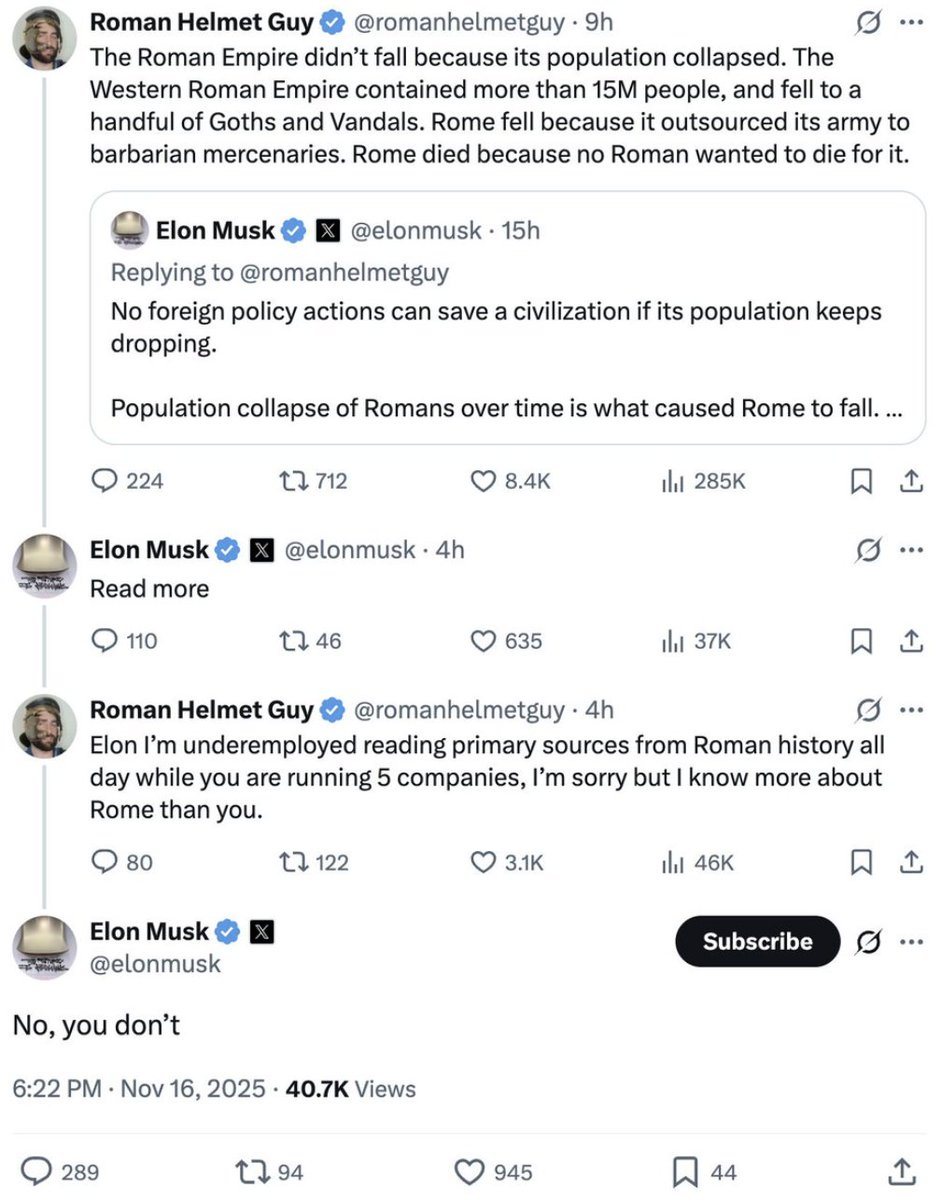
Since this is going to apparently get sent to me over multiple platforms: They're both wrong. Although it is difficult to track precisely, field survey archaeology strongly suggests population decline as a result following western Roman fragmentation, not a cause proceeding it.
"Online Rent-a-Sage" Bret Devereaux tweet media
English
9
75
428
29K