

J12
522 posts



Candace… every blue-collar man I know thinks you’re batshit crazy. There are husbands watching their wives disappear down this rabbit hole, and it’s destroying marriages. You laugh about it like it’s entertainment. It isn’t. It’s happening to real families in middle America, and you’re helping fuel it. Do better!
Candace Owens@RealCandaceO
@Veralitra Blue collar men tend to have common sense. Working with your hands has that effect.
English
@BlakeSNeff I think their biggest mistake was involving the supposed Pastor, Frank Turek. That dude is evil AF.
English

Candace cackles with laughter because she’s sent a Christian couple to the brink of divorce with her “theories.”
She claims to be Charlie’s champion, his “David.” Would Charlie gloat like this if someone said he caused their divorce?
This is a cancerous narcissist in action. People either recognize it or willfully delude themselves.
Candace Owens@RealCandaceO
New level of propaganda unlocked. 😂
English


$EOSE I'm massively overexposed and my position is absolutely hemorrhaging money every day, but after the last six months I'm so jaded and the daily price action is such a joke that I'm starting to find it genuinely entertaining in a highly masochistic sort of way...
GIF
English
@T_Jsudbury @chrismartenson @LindaG_RN @FenixAmmunition This bullet didn’t hit anything close to the spinal column of a 200 pound Deer, or 1000 pound Moose. And even if it didn’t clip his spine, a humans spine is 1/3 to 1/2 less robust than a Deers, and 1/5 to 1/10 less robust than a Moose. This is why physics is so important here.
English

@chrismartenson @LindaG_RN @FenixAmmunition Just to add to the conversation. I have had remington 150 grain core-lock bullets completely disintigrate upon hitting the spinal column of a 200 pound deer. I have also have had them pass completely through a thousand pound moose. Bullets will do wierd things sometimes
English

Try going to the experts like @FenixAmmunition. They have debunked your BS.
Chris Martenson@chrismartenson
Please do not use AI to 'solve' this. Please use your own common sense. But if you must, ask Ai "how far into soft tissue would a 150 grain Core-Lokt bullet have to travel before mushrooming or dsignificantly deforming. Next, in ballistic tests, and assuming having been fired from 140 yards, in inches, how far off its line of travel would such a round travel in the first 5" of penetration?"
English

@HomesteadAmeric @TigTiegen It literally exited his jaw and rentered his neck.
English


While a .30-06 is a powerful round, military wound ballistics data shows it can and has been stopped by bone in the neck without creating a large exit wound or an exit.
Historical U.S. Army studies on the .30-06 M2 Ball round documented multiple neck wound cases where the bullet was retained inside the body with no exit wound, particularly when it struck the cervical vertebrae early and fragmented or stopped internally.
When a high-velocity rifle bullet hits dense bone, it often fragments or deforms. This dissipates energy inside the body and reduces the chance of a clean, large exit wound. This is well-established in wound ballistics literature.
Forensic pathology also shows that retained bullets in neck wounds (especially when the round hits the spine) are documented in both military and civilian cases. The permanent wound channel can stay relatively narrow if the bullet doesn’t yaw dramatically before striking bone.
Saying “no .30-06 round could ever be stopped by the spine without an exit wound” is not supported by the ballistic and forensic record. These rounds are destructive, but real-world data shows more variability than Doc Malik is claiming.
Something being “fishy” requires more than just “this doesn’t match what I expect to see.”
Facts over feelings. Facts over opinions. That’s what conservatives used to stand on, before a lot of them started acting like the left when the facts don’t fit the narrative they want.
dailywire.com/news/how-the-3…
archive.org/details/lccn_6…
jamanetwork.com/journals/jama/…
Dave@Dave90233378
English
@HomesteadAmeric @MrRelatable88 That bullet travelled 4 times as long as Kirk’s, through more bone, out the body and back in, and eventually into the scapula - to compare the 2 is so idiotic I feel gay and violated doing so.
English


Can we all agree that a .30-06 didn’t do what we all saw on September 10th?
English
@MBPUnbearables @jv69814 @OwenBenjamin It exited his chin and back into his throat before making its way to his scapula.
English

@jv69814 @OwenBenjamin Was there an exit wound on MLK ?
English

Tomorrow I’ll use the exact 150 grain Remington round in my 30-06 and do some ballistics tests on stuff. If you guys would enjoy that.
The prosecution has now revealed what round they claim it was and of course it isn’t a tangible round from 1978. I havnt seen a single shill apologize or admit they were wrong for screaming about all the non existent very slow and weak 30-06 rounds it must have been.
Listen, I havnt been certified by a screaming war hawk who can barely tie his shoes with giant eye brows and a nervous tick, but what does it matter who pulls the trigger?
Facts don’t care about your feelings right Ben?
I’ll be the first to admit I’m not in a death cult attempting to bring about the end times with Trump leading the destruction of America as Cyrus or king David, I get that, but that only makes me MORE credible at reality based claims
English

@DatHotFiya @just_fedup Have you ever shot a deer? When the bullet hits nine it stop or deflects. This shot didn’t hit any bones it was right behind shoulder and went through. To the water.
English
I don’t care about the size of my audience, or yours. Popularity isn’t the arbiter of truth.
Joe Biden has 37 million followers.
So are you going to be a man and admit you lied about the rifle and the stock photo or not?
Ian Carroll@IanCarrollShow
@paramounttactcl Gary, I normally try not to point it out but look at the size of your audience buddy. I’m gonna be just fine.
English
@FenixAmmunition I guess we need to shoot some more political commentators in the neck then.
English

Nobody's afraid of anything, Ian. There's no point in "shooting stuff" that doesn't add any meaningful data to the conversation.
The problem is you don't know what you're talking about so everything looks like meaningful data to you.

Ian Carroll@IanCarrollShow
All I see is an ammo manufacturer scared to film himself shooting his own ammo because it might prove him wrong. So instead, he explains how you can’t cite green berets because of appeal to authority, you can only cite ammo manufacturers because of their authority. Go shoot some stuff bud. Whatchya scared of? Physics won’t lie.
English
@paramounttactcl Are we supposed to fire them in human necks? Or Superman necks?
English
“He fired them into pork roasts.”
Oh well… then that solves it.
How do these people take themselves seriously?
Ian Carroll@IanCarrollShow
Chris Martenson tested several varieties of core-lokt rounds on various targets and his results were through and through every time. None of the rounds were stopped by anything short of a concrete block behind the pork roast targets. I’m sure they can stop in animals plenty. The question at hand is how likely is this round to stop in a human neck.
English
@antoniobalogni0 @Cernovich fractured his spine, and lodged in his left shoulder area. This trajectory is detailed in the autopsy findings reported by Britannica and Wikipedia.
English

@Cernovich *Leaning over, bullet went through his jaw then OUT and back into his shoulder blade where it stopped.
English

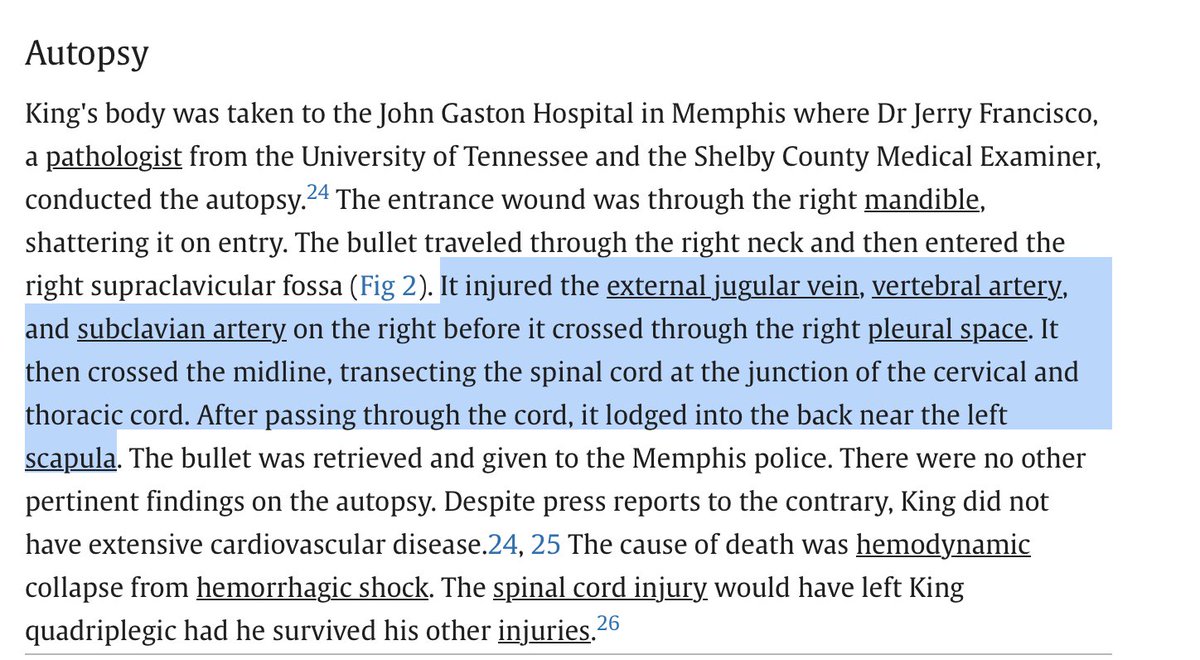

@antoniobalogni0 @Cernovich Hi Norm. Yes, the bullet that killed Dr. Martin Luther King Jr. exited and re-entered his body. The single rifle bullet struck the right side of his face, fractured his jaw, and exited his lower face. It then re-entered his body at the neck area, where it severed vital arteries,
English
@paramounttactcl Well done. Then you know exactly what it would do to a humanoid neck (not Superman’s).
English
@braxton_mccoy It punctured the skin and didn’t hit any internal organs and the Elk died? Tell me things that never happened for 1000 Alex.
English

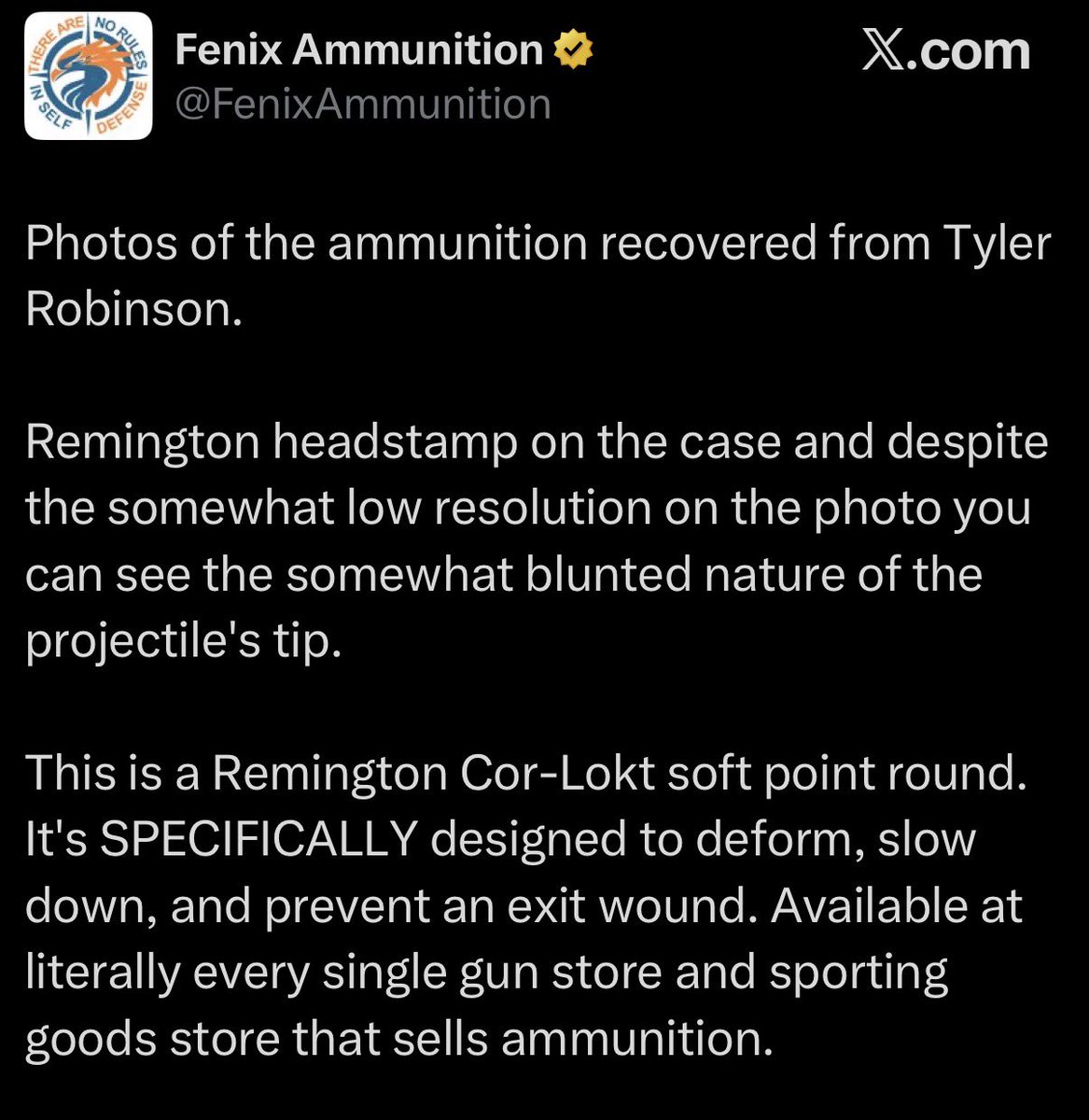
Also, my old man once shot a bull elk with 7mm Ultra Mag at around 100 yards. Hit it in the shoulder. Killed the elk but the bullet basically exploded under the hide on the entry side and didn't penetrate much at all. Around here Rem core-lokt is notorious for doing weird stuff
Fenix Ammunition@FenixAmmunition
Here's a cutaway of a standard soft point projectile. As you can see the copper jacket is extremely thin, around 0.020" or roughly 33% thinner than a credit card. Under that, you have lead. One of the reasons you need the copper jacket is because lead is so soft it wouldn't survive the muzzle velocity or twist rate of modern rifles if left completely bare. With a soft point the tip is left unjacketed so as to intentionally cause the bullet to deform. The lead gets squeezed inside the copper jacket causing it to split and peel open like a banana. This occurs whether your hitting soft tissue or a solid object, albiet to a different degree and with different effects. Copper and lead are, generally speaking, softer than human bones. When a soft point bullet (or a projectile of any type, really) hits bone you have absolutely no way to predict the outcome with any degree of certainty. Why do people have this weird idea that military guys are experts on ammunition? I've lost count of the number of military, police, and SWAT guys I've educated at various training classes and events out of the dumbest fuddlore you can possibly imagine. It's like saying a racecar driver automatically knows everything about all types of engines. It's just not remotely true at all, lol.
English

Well this held up pretty well.
x.com/fenixammunitio…

Gator Gar@gatorgar
Some speculation on Charlie’s assassination: The alleged rifle, a Mauser model 98 began production in Germany starting in 1898, and imports to the United States began in 1900. By 1945 around 126,000 were produced, approximately half of which were sold here. Although we don’t know the exact age of the specific rifle used in the shooting, the newer end of the spectrum puts it at 80 years old. We do know it belonged to Tyler Robinson’s grandfather. It’s fair to say that the bore of said rifle could be pretty worn out after 80 years of use, although again we don’t know how much it was used. We can assume however that when steel ages, and becomes pitted and oxidizes over time, the efficiency of the firearm would degrade. By how much? Hard to say, but let’s say “a little” (Studies from the Journal of Forensic Sciences, confirm reduced velocity from aged barrels decreases tissue penetration by up to 50%) Couple that with a subsonic round for target practice, or perhaps small game, and the assumed figure of “2500-2800 fps” is no longer realistic. We have no idea what the load was, or whether the shooter purchased the ammo himself or found it stored with the rifle, but the “slowest” potential projectile would have a velocity as low as 1,000 fps. A sniper also wouldn’t typically be aiming for the side of a target’s neck, and while a headshot is more difficult to make than a bodyshot, it’s also notably more lethal. Let’s suppose he was aiming for a headshot, and he set his sights for the correct distance to account for the bullets downward trajectory. He did say it was a “$2000 scope”. If this was the case, the actual shot was low by about 6 inches. Taking into account the 80 year old rifle, which could’ve also been poorly maintained, the load of the ammo, which we also don’t know and greatly affects velocity, and the lack of a headshot due to the bullet drifting downward, it becomes immediately more believable that the bullet was not traveling at the assumed 2500-2800 fps. Which makes the lack of an exit wound also, much more believable. I’ve watched every video and read every theory I can find on this event, and haven’t heard anyone mention any of these things, which are all well within the realm of possibility and support the feasibility of the official narrative. Why? Because they’re boring and less likely to generate ad revenue compared to sensationalized posts claiming “confirmed evidence” he was shot from behind, or by a man in the crowd with a palm gun, or by an exploding lavalier microphone on his shirt. In all likelihood some combination of factors like the ones I proposed here simply led to a suboptimal shot from a high powered rifle that still managed to accomplish the task at hand, albeit not precisely as intended. If you find this harder to believe than theories suggesting things like him being shot from behind by a member of his own staff, I don’t know what to tell you.
English
@VanceNate That’s a bullet that’s gone through way more than Charlie’s neck.
English

Not naming any names but this was predicted. Jacket separation, multiple fragments/wound paths, poorly/non bonded uncontrolled expansion bullet and rapid violent deceleration.
Erikaaa@ErikaCA47
🚨 Multiple BULLET JACKET FRAGMENTS pulled from the body of Charlie Kirk. Not exploding mic pieces.
English