Soofi Safavi
655 posts

Soofi Safavi
@ssafavi
Founder at Elephant Protocol | Fixing the Semantic Web for the Physical World

San Francisco, CA Katılım Eylül 2009
112 Takip Edilen52 Takipçiler
Sabitlenmiş Tweet

@danrobinson Trial, error, and perseverance are indispensable. In addition, to achieve both speed and rigor in formulating new ideas, a structured process helps constrain AI's tendency to be a 'narrative optimizer'. x.com/ssafavi/status…
Soofi Safavi@ssafavi
English

@a16z AI-first organizations will dispense with legacy specialisms. Instead, they'll consist of a few "athletes" in two main cognitive roles: Problem Architect and Execution Engineer. These roles will overlap and interact in a continuous feedback loop. x.com/ssafavi/status…
Soofi Safavi@ssafavi
English

“Coding will eat all knowledge work”
Peter Yang joins a16z’s Anish Acharya to discuss the post-AI future of work, why AI will create more solopreneurs, why human ambition means there will always be new jobs, and more.
00:00 Intro
01:56 Using OpenClaw for voice, memory & daily life
06:14 Will agents kill apps & SaaS?
11:57 Coding agents: Claude Code vs. Codex
17:00 Future of work: small teams, agents & company culture
24:00 How agents change consumer products & the economy
@petergyang @illscience
English

@KatieMiller This could go beyond personal shortcomings. It also reflects a systemic flaw in how success is defined and rewarded. An individual's impact goes deeper than what's easy to measure (profit, valuation, etc). x.com/ssafavi/status…
Soofi Safavi@ssafavi
English

After reading this piece on Sam Altman, one can reasonably conclude he’s put profit over loyalty, principles, and company governance.
There’s business savvy and ruthlessness, and there’s Sam, who at multiple points in his career has been the subject of investigations and forced departures from companies he’s founded.
When those closest to him raise alarms, they should be heeded by those whom he tries to con into business dealings.
While Dario is also insufferable, it should be obvious to all why both him and Elon, who worked closest with Sam, find him to be a dishonest swindler.
The last takeaway I have — this article is written by a gay Democrat, one of Sam’s own people, and even he is quite unconvinced that Sam is a good person.
OpenAI was clearly changed from a non-profit to for-profit to benefit Sam. It’s clear he lied to Elon and his co-founders.
“I think there’s a small but real chance he’s eventually remembered as a Bernie Madoff- or Sam Bankman-Fried-level scammer.”
This is the truth and the world sees it.
The New Yorker@NewYorker
Sam Altman is “unconstrained by truth,” an OpenAI board member told @ronanfarrow.bsky.social and Andrew Marantz. newyorkermag.visitlink.me/DrbIzE
English

@rohanpaul_ai I don't have a fail-safe solution to the 'cognitive surrender' problem. But using a structured process for idea formulation and exposition helps to push back against AI's tendency to be a 'narrative optimizer'. x.com/ssafavi/status…
Soofi Safavi@ssafavi
English

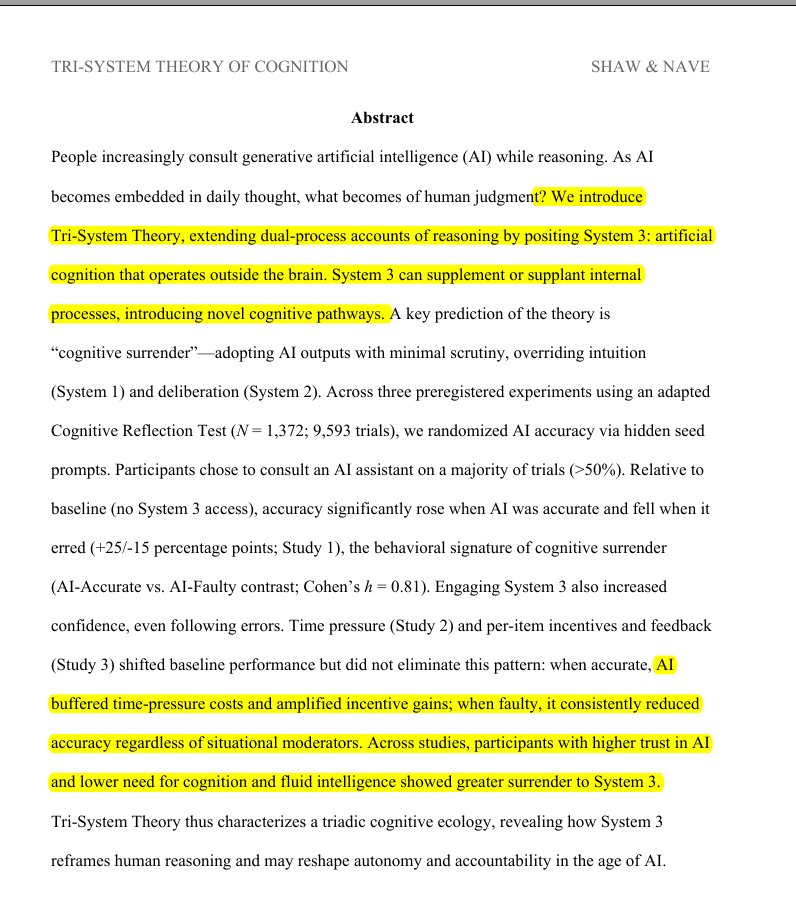
Wharton’s study points to a hard truth: “AI writes, humans review” model is breaking down
Why "just review the AI output" doesn't work anymore, our brains literally give up.
We have started doing "Cognitive Surrender" to AI - Wharton’s latest AI study points to a hard truth: reviewing AI output is not a reliable safeguard when cognition itself starts to defer to the machine.when you stop verifying what the AI tells you, and you don't even realize you stopped. It's different from offloading, like using a calculator.
With offloading you know the tool did the work. With surrender, your brain recodes the AI's answer as YOUR judgment. You genuinely believe you thought it through yourself.
Says AI is becoming a 3rd thinking system, and people often trust it too easily.
You know Kahneman's System 1 (fast intuition) and System 2 (slow analysis)? They're saying AI is now System 3, an external cognitive system that operates outside your brain. And when you use it enough, something happens that they call Cognitive Surrender.
Cognitive surrender is trickier: AI gives an answer, you stop really questioning it, and your brain starts treating that output as your own conclusion. It does not feel outsourced. It feels self-generated.
The data makes it hard to brush off. Across 3 preregistered studies with 1,372 participants and 9,593 trials, people turned to AI on over 50% of questions.
In Study 1, when AI was correct, people followed it 92.7% of the time. When it was wrong, they still followed it 79.8% of the time.
Without AI, baseline accuracy was 45.8%. With correct AI, it jumped to 71.0%. With incorrect AI, it dropped to 31.5%, worse than having no AI. Access to AI also boosted confidence by 11.7 percentage points, even when the answers were wrong.
Human review is supposed to be the safety net. But this research suggests the safety net has a hole in it: people do not just miss bad AI output; they become more confident in it.
Time pressure did not eliminate the effect. Incentives and feedback reduced it but did not remove it. And the people most resistant tended to score higher on fluid intelligence and need for cognition. That makes this feel less like a laziness problem and more like a cognitive architecture problem.
---
papers.ssrn .com/sol3/papers.cfm?abstract_id=6097646


English

@Etherealize_io Quantum risk underscores blockchain's infrastructure fragility. As I’ve seen, weak infrastructure slows critical upgrades like post-quantum migration. How can networks accelerate infrastructure maturity to meet quantum deadlines?
English

@geoffreywoo AI can replace data tasks, but the real VC edge is pattern-matched foresight from previous failures. That's knowledge of how startups die from a thousand small decisions, applied in real time. x.com/ssafavi/status…
Soofi Safavi@ssafavi
English

the venture capital bloodbath is coming and most vcs have zero idea
agents will replace 90% of what associates and principals actually do:
• deal sourcing through network analysis
• due diligence via automated data mining
• portfolio monitoring with real-time metrics
• pattern matching across 10,000x more deals
what exactly are you getting paid for when an agent can analyze every startup in your sector in 3 minutes?
the entire industry is built on information asymmetry that ai just eliminated
most funds will become algorithmic within 24 months
the only vcs who survive are the ones who can actually build companies, not just write checks and send intros
English

@47fucb4r8c69323 Adopting AI as a symbiotic partner will redefine productivity itself, shifting focus from hard labor to creative exploration.
English

The more I look at this the more impressed I am and the more I realize how grateful we should be to Tao.
1. He acknowledges ignorance: this is something academics almost never do since their cultural capital is tied up in them knowing things. But he can since, well, he's Terence Tao.
2. He is explicitly acknowledging his use of GenAI to fight the stigma of using AI. If the child prodigy turned UCLA prof who studied with Erdos uses AI, it is legitimate technology. (please start using this sentence with AI skeptics btw)
3. He is also showing how AI is best used: as a kind of syntactic tool that finds connections in possibility space and has access to a larger library of information than our brains can.
There's more here but the cool internet thing is a list of three.
I often lament Tao has too playful of a mode of operating, feeling like he plays with linear algebra when he should be doing foundations of mathematics.
But not only does this moment prove my view wrong, it also proves just how much Silly Business Theory #SBT is right: in the future the best work, the greatest progress, and the most valuable innovations won't come from people laboring under the false consciousness of Protestantism and Marxism that asserts work must be hard and serious to produce value.
The best work is going to come from people playing and having fun.
We're on the cusp of a near utopian explosion in human potential and quality of life.
And you're bearish?!?!?!?!??????!?
BURKOV@burkov
Terence Tao for some reason referenced ChatGPT as the source of some content in his paper. Expect scientists to cite spelling correctors: "By the way, the word 'elucidate' was suggested by Microsoft Word spelling corrector. I wasn't previously aware of 'elucidate'."
English

@pmarca The surge in demand from AI-driven productivity aligns with what I expect -- in aggregate. Meanwhile, companies that treat AI as a project and fail to embrace deep structural change will fail. x.com/ssafavi/status…
Soofi Safavi@ssafavi
English

The "AI job loss" narratives are all fake. AI = massive ramp in productivity = massive ramp in demand = massive jobs boom. Watch.
Marc Andreessen 🇺🇸@pmarca
1. Employer recovery from post-COVID hiring correction 2. Employer recovery from post-COVID interest rate spike 3. Elasticity = demand boom QED
English

@Branche_SC Complex blockchain projects often stumble on practical issues like skyrocketing infrastructure costs driven by a demand surge. Theory alone can’t sustain success -- need to balance innovation with operational reality. x.com/ssafavi/status…
Soofi Safavi@ssafavi
English

@toly Plans costing $1000/mo+ will accelerate a shift from paying for tools to paying for outcomes. As AI agents replace human tasks, pricing will reflect the value of completed work, not software access or usage. x.com/ssafavi/status…
Soofi Safavi@ssafavi
English

Loved reading this. I recently wrote about The Most Undervalued Role of VCs [x.com/ssafavi/status…] -- you guys are covering that and more! Please keep posting as the story unfolds.
Soofi Safavi@ssafavi
English

Loved reading this. The approach mirrors work our team is doing. And the ethos of aggregating organizational knowledge and applying it where it's needed -- that's precisely what motivated my article The Most Undervalued Role of VCs. x.com/ssafavi/status…
Aleks Larsen@alekslarsen
English

@danielisdizzy As better-model advantage compounds, software increasingly becomes a disposable, perishable product. Leadership in applied AI then depends on mastering agentic architectures.
English

Many are starting to say AI models will become commodities and that companies like OpenAI and Anthropic, without platforms or ecosystems, will get eaten alive.
They’re wrong.
Until a few months ago, models looked similar and could catch up quickly. That’s over.
As Dario Amodei explained, the advantage of having better models when training the next generation is compounding.
Today, coding models deliver a 15–20% speed improvement.
Six months ago, it was ~5%. And 5% doesn’t even register.
This is not a small improvement.
This is the engine that drives the next generation of models.
And it’s accelerating.
The best models are pulling away—and the gap is getting wider.
We’re already seeing it.
$META has spent billions and still doesn’t have a top-tier model.
$MSFT Copilot is underwhelming.
$GOOGL Gemini isn’t on the same level as ChatGPT—without even getting into coding.
This isn’t commoditization.
It’s concentration.
OpenAI and Anthropic are here to stay.
English

@gregisenberg AI agents replacing human tasks means companies will buy outcomes, not tools, shifting risk and pricing models. This changes how we evaluate value in AI services. How will this reshape procurement strategies across industries?
English

@gregskril @gakonst Service reputation definitely will matter. So will the agent's skill at shopping for services.
English

@gakonst do you see service reputation becoming important? eg how does my agent know which competing provider to use for x, or how does my agent know that y service doesn't just charge money and do nothing in return
English

We've added 3 advanced feature guides to the MPP docs:
1. Identity & $0 Auth: mpp.dev/advanced/ident… - this lets you re-autenticate into a service that you've already paid. Great for jobs APIs!
2. Discovery: mpp.dev/advanced/disco… - auto-generate openapi.json so that crawlers can find your service
3. Refunds: mpp.dev/advanced/refun… - how to pay back a user?
English

@aleximm @sarahdingwang @a16z Thought I had the bases covered in the RWA crypto protocol I'm working on: permission-less, trust-less... but missed crime-less and timeless. Back to the drawing board.
English

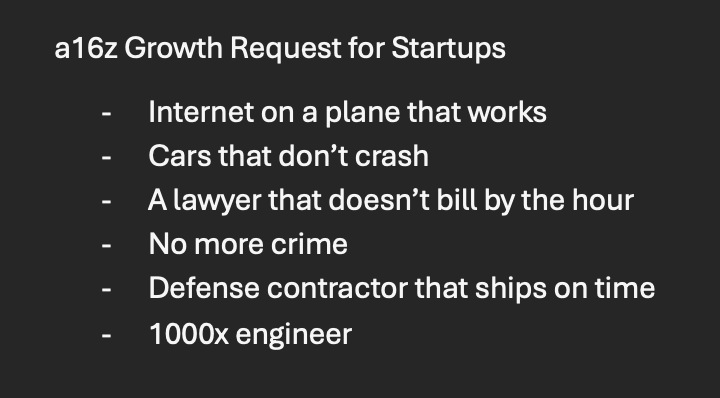
We haven't seen enough growth investing opportunities lately, so @sarahdingwang and I put together our @a16z Growth Request for Startups.
If you're working on these, don't introspect, hit us up!

English

@perkinscr97 @FTI_Global Congrats! Will be watching this space -- looking forward to what you build in digital infrastructure.
English

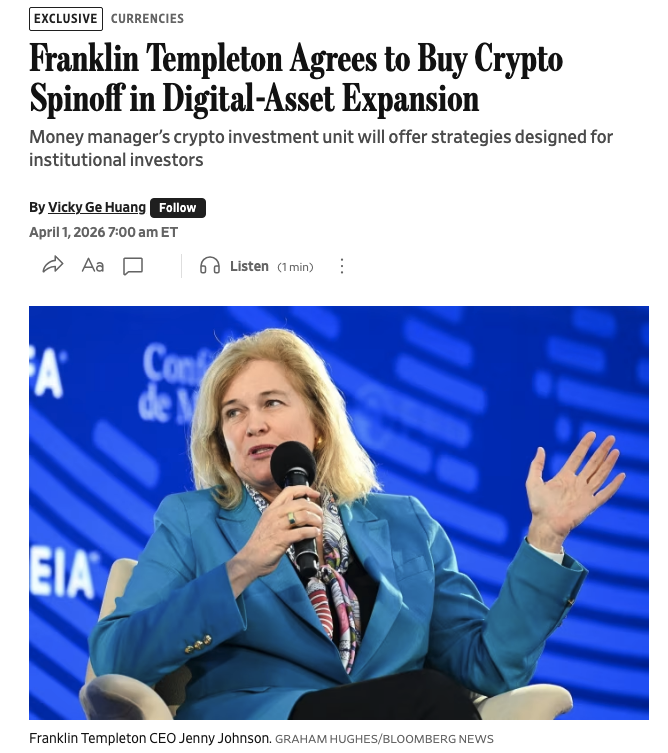
Today, I’m very excited to announce that I will be joining @FTI_Global as the head of Franklin Crypto.
The convergence of traditional finance (TradFi) and the digital asset ecosystem is no longer a "future" trend—it is the reality of 2026. As I prepare to step into my new role leading Franklin Crypto with @sethginns and Tony Pecore, I am incredibly energized to help lead this firm’s continued evolution in a space that is fundamentally rewiring how global markets operate.
Crypto’s institutional era is upon us, and to succeed, Franklin Crypto must leverage its deep and unique understanding of crypto and traditional finance to build differentiated, scalable and compliant products for our clients.
My journey has always been defined by a foot in both worlds: the rigorous, disciplined structures of traditional finance and the high-velocity innovation of the crypto markets. At Franklin Templeton, my goal will be to leverage this unique vantage point to partner with our clients, building the institutional-grade products they need to succeed in this new digital frontier.
We aren't just observing the market; we are active participants in its transformation. Markets are tokenizing. The once-distinct lines between crypto and traditional assets are blurring into a single, cohesive financial landscape. Perhaps most importantly, the era of the "9-to-5" market is fading as we embrace the reality of 24/7 global liquidity.
It is fascinating to look back even just a few years. Previously, there was a perceived "reputational risk" for an institution to be involved in crypto. Today, that narrative has completely flipped. In 2026, the true reputational risk lies in not having a digital asset strategy.
As the "Institutional Era" of crypto takes hold, our clients expect more than just exposure—they expect sophisticated navigation with people they can trust. Franklin Templeton has spent years building the foundational infrastructure—including the proprietary Benji Technology platform—and the deep internal expertise necessary to manage these assets with the same precision as any traditional portfolio.
The timing for this transition couldn't be better. We are currently seeing a unique divergence: while broader market sentiment may fluctuate, the underlying fundamentals of the crypto markets continue to improve at an exponential rate.
Our mission is simple: to attract the best investment talent, build leading digital infrastructure and support the needs of our clients in this exciting new world. We differentiate ourselves through an exceptionally deep knowledge of both crypto-native protocols and traditional asset management.
By combining this expertise with Franklin Templeton’s legacy of operational excellence, we are perfectly positioned to deliver for our clients as they scale their own digital journeys. I look forward to what we will build together.

English

7/ We are building a new model:
• business functions run on agents
• agents generate agents
• architecture replaces code as the core asset
If you can build systems that build systems:
Read → x.com/ssafavi/status…
Then DM me @ssafavi
Soofi Safavi@ssafavi
English