Stephens Xu

1.6K posts

Stephens Xu banner
Stephens Xu

Stephens Xu

@stephensxu1

Software Engineer, Star Wars Fan, Tesla shareholder LA/Bay Area

Irvine, CA Katılım Mayıs 2012
459 Takip Edilen115 Takipçiler
Stephens Xu retweetledi
SightBringer
SightBringer@_The_Prophet__·
⚡️AI is destroying the ability to build identity around a fixed occupation. That is the real civilizational shock. The old labor system gave people a script. Pick a profession. Train for it. Become it. Build your life around it. Your job category became your identity container: accountant, lawyer, engineer, teacher, designer, analyst, manager, journalist, coder. The profession told you what to study, where to live, how much money to expect, what status you had, who you could marry, when you could buy a house, when you could have kids, and what future version of yourself was plausible. AI attacks that container. The fear is not only unemployment. The fear is ontological instability. People are realizing the thing they trained to become may not remain a stable thing. The role may mutate faster than the person can recredential. The workflow may be automated after the student debt is taken. The entry-level ladder may vanish before the graduate reaches it. The middle layer may flatten before the worker climbs into it. That breaks time. A society needs people to believe their sacrifices connect to a future. School only works if the credential leads somewhere. Saving only works if ownership is reachable. Career discipline only works if the ladder stays standing long enough to climb. Family formation only works if income can be predicted. AI introduces a permanent question mark into all of that. The new economy rewards adaptive sovereignty. People who can reassemble themselves around new tools, new markets, new constraints, and new leverage will gain power. People trained to be stable components inside stable institutions will get punished. This is why the backlash will grow. The public does not only fear losing jobs. It fears losing the ability to plan a life. The old question was: “What career should a person choose?” The new question is: “What kind of person can survive when careers stop staying still?” That is the real rupture.
English
44
91
464
56K
Stephens Xu retweetledi
Deedy
Deedy@deedydas·
The vibes in SF feel pretty frenetic right now. The divide in outcomes is the worst I've ever seen. Over the last 5yrs, a group of ~10k people - employees at Anthropic, OpenAI, xAI, Nvidia, Meta TBD, founders - have hit retirement wealth of well above $20M (back of the envelope AI estimation). Everyone outside that group feels like they can work their well-paying (but <$500k) job for their whole life and never get there. Worse yet, layoffs are in full swing. Many software engineers feel like their life's skill is no longer useful. The day to day role of most jobs has changed overnight with AI. As a result, 1. The corporate ladder looks like the wrong building to climb. Everyone's trying to align with a new set of career "paths": should I be a founder? Is it too late to join Anthropic / OpenAI? should I get into AI? what company stock will 10x next? People are demanding higher salaries and switching jobs more and more. 2. There’s a deep malaise about work (and its future). Why even work at all for “peanuts”? Will my job even exist in a few years? Many feel helpless. You hear the “permanent underclass” conversation a lot, esp from young people. It's hard to focus on doing good work when you think "man, if I joined Anthropic 2yrs ago, I could retire" 3. The mid to late middle managers feel paralyzed. Many have families and don't feel like they have the energy or network to just "start a company". They don't particularly have any AI skills. They see the writing on the wall: middle management is being hollowed out in many companies. 4. The rich aren’t particularly happy either. No one is shedding tears for them (and rightfully so). But those who have "made it" experience a profound lack of purpose too. Some have gone from <$150k to >$50M in a few years with no ramp. It flips your life plans upside down. For some, comparison is the thief of joy. For some, they escape to NYC to "live life". For others still, they start companies "just cuz", often to win status points. They never imagined that by age 30, they'd be set. I once asked a post-economic founder friend why they didn't just sell the co and they said "and do what? right now, everyone wants to talk to me. if i sell, I will only have money." I understand that many reading this scoff at the champagne problems of the valley. Society is warped in this tech bubble. What is often well-off anywhere else in the world is bang average here. Unlike many other places, tenure, intelligence and hard work can be loosely correlated with outcomes in the Bay. Living through a societally transformative gold rush in that environment can be paralyzing. "Am I in the right place? Should I move? Is there time still left? Am I gonna make it?" It psychologically torments many who have moved here in search of "success". Ironically, a frequent side effect of this torment is to spin up the very products making everyone rich in hopes that you too can vibecode your path to economic enlightenment.
English
1.1K
1.3K
16.4K
13.1M
Stephens Xu retweetledi
Bryan Johnson
Bryan Johnson@bryan_johnson·
This is it. Everything learned spending millions on longevity. From: Your Immortal Unc and Auntie. To: Our Immortal nieces and nephews. 0. Sleep is the world's most powerful drug. 1. Be in your bed for 8 hours 2. Same bedtime every night, any time before midnight 3. Don’t eat right before bed 4. Calm foods for dinner 5. No screens 1 hour before bed 6. Avoid added sugar (be aware it’s in everything) 7. Avoid all things in an American convenience store 8. Avoid fried foods 9. Shoes off at the door 10. Eat whole foods, particularly veggies fruits nuts legumes berries 11. Walk a little after meals or air squats 12. Get your heart rate high routinely 13. Lift heavy things 14. Stretch daily 15. Water pik, floss, brush, tongue scrape, morning and night 16. Make an effort to drink water 17. Get sunlight when you wake up (UV is low) 18. Protect skin in midday sun 19. Stand up straight 20. See at least one friend once a week 21. Avoid plastic where you can (in all things) 22. Circulate air in rooms 23. When stressed, breathe, learn to calm your body 24. Go to the dentist 25. Avoid sitting for long times 26. Protect your hearing, the world is too loud 27. Alcohol is bad for you 28. Finish coffee before noon 29. Avoid bright lights after sunset 30. If obese, look into a GLP 31. Sleep in a cold room 32. Texting while driving is dangerous 33. Turn off all notifications 34. Limit social media use 35. Don’t smoke anything 36. If you struggle to sleep, read a physical book before bed 37. 1 hour before bed have a calm wind down routine: bath, read, light walk, listen to music 38. The body is a clock and loves routine. Have a daily morning and evening schedule. 39. Avoid long distance travel where you can 40. Baby steps first: incorporate new things slowly 41. Do less… most things don’t work. Bonus points if you get your blood checked. Start here, it will change your life.
English
1K
4.9K
43.3K
5.6M
Stephens Xu retweetledi
Coin Bureau
Coin Bureau@coinbureau·
🇺🇸NEW: The IRS may owe REFUNDS to tens of millions of American taxpayers from the COVID-19 era. A court ruled that the entire 3.5-year COVID-19 disaster period (Jan 2020 – May 2023) automatically postponed all federal tax filing and payment deadlines. Every penalty and interest charge assessed during that window may have been improper. Americans will need to manually request relief using Form 843 before the July 10, 2026 deadline.
Coin Bureau tweet mediaCoin Bureau tweet media
English
126
1K
7.9K
5.6M
Stephens Xu retweetledi
Bill Ackman
Bill Ackman@BillAckman·
@MohammadSalhut Success is not a straight line up. It is how you deal with failure that determines your destiny.
English
90
472
4.4K
243.5K
Stephens Xu retweetledi
Chamath Palihapitiya
Chamath Palihapitiya@chamath·
As you go to work today and settle into the week, please study the form below. You will soon need to fill this out EVERY year and tell the government what you own and then allow them to tell you how much its worth. That is the framework that is enabled by the Trojan Horse "Billionaire Tax" that is trying to get passed. Give them credit: they cleverly use Billionaires as the hook, but build in the language and the framework that will allow the Legislature to simply extend the tax to everyone and make it yearly. And this is where the form below comes in... In this case, ask yourself, will it be you or the Billionaires that will be able to fill this out properly and avoid penalties. As much as Billionaires can be pushed to do more for society, we all know that they have the infrastructure to manage these kinds of disclosures...middle class Californians do not and they will be the ones that get penalized in the end.
Chamath Palihapitiya tweet media
English
1.2K
3.9K
12.6K
2.5M
Stephens Xu retweetledi
SightBringer
SightBringer@_The_Prophet__·
⚡️The people who are most prone to depression in modern life are often people who have time and comfort but no purpose. The professional class with stable jobs and no deep stakes. The retired. The recently graduated. The recently divorced. The recently laid off. Transition states where the structure that gave meaning has been removed and nothing has replaced it. Those are the high risk populations and they’re high risk precisely because they have time to notice that something is missing. The modern mental health framework often treats depression as a discrete medical condition that can be addressed through medication and therapy without reference to the conditions of the person’s life. Sometimes that’s the right treatment. Sometimes the person’s life is structured in a way that will produce depression regardless of how much medication and therapy you give them. The symptoms can be managed but the underlying condition persists because it’s generated by the life itself, not by a disorder inside the person. Someone working a meaningless job with no relationships and no purpose is going to be depressed. That’s not a disorder. That’s an appropriate response to the conditions. The pathology is in the situation, not in the person. Treating the person without addressing the situation is managing symptoms while maintaining the cause. The patient gets slightly better or slightly worse but the depression doesn’t resolve because the conditions that produce it haven’t changed. What Trump is describing, probably without meaning to, is that if you change the conditions, the depression often takes care of itself. Not always. But often enough that it’s worth taking seriously. The person who finds a calling, builds something meaningful, falls in love, becomes a parent, commits to a mission, often reports that their depression lifted. Because the conditions that generated the depression were replaced by conditions that generate engagement. The mental health industry has a financial incentive not to say this clearly because the conclusion is that the most effective intervention for a significant chunk of depression is structural life change, not billable treatment. Medication and therapy are excellent businesses. Helping someone reorient their life around something they care about is not really a business at all. It requires the person to do the work themselves. There’s no pharmaceutical equivalent.
Aaron Rupar@atrupar

Trump: "I don't have time to be depressed. You know, if you stay busy enough, maybe that works too. That's what I do."

English
61
198
1.2K
119.1K
Stephens Xu retweetledi
Brad Lyons
Brad Lyons@blyons151·
In August I wrote a thesis I never published. The funds I was warning were key Crossover Research clients, so I stayed quiet. Since then, 𝗦𝗼𝗳𝘁𝘄𝗮𝗿𝗲 𝗺𝘂𝗹𝘁𝗶𝗽𝗹𝗲𝘀 𝗮𝗿𝗲 𝗱𝗼𝘄𝗻 𝟱𝟬%+. Salesforce $CRM, ServiceNow $NOW, Adobe $ADBE, Workday $WDAY all off 40% from highs. Thomson Reuters $TRI dropped 16% in a single session on the Anthropic legal agent launch. The SaaSpocalypse arrived. So here's the follow-up. Not commentary on what happened, but where I think this goes next. Most vertical SaaS companies aren't underperforming because their software is bad. 𝗧𝗵𝗲𝘆'𝗿𝗲 𝘂𝗻𝗱𝗲𝗿𝗽𝗲𝗿𝗳𝗼𝗿𝗺𝗶𝗻𝗴 𝗯𝗲𝗰𝗮𝘂𝘀𝗲 𝘁𝗵𝗲𝘆 𝗻𝗲𝘃𝗲𝗿 𝗯𝘂𝗶𝗹𝘁 𝘁𝗵𝗲 𝘀𝗲𝗰𝗼𝗻𝗱 𝗯𝘂𝘀𝗶𝗻𝗲𝘀𝘀. And the first business is under attack. For twenty years, one of the biggest SaaS moats was engineering complexity: deep technical talent, long roadmaps, compounding codebases that were genuinely hard to replicate. 𝗔𝗜 𝘂𝗽𝗲𝗻𝗱𝗲𝗱 𝘁𝗵𝗮𝘁 𝗮𝗹𝗺𝗼𝘀𝘁 𝗼𝘃𝗲𝗿𝗻𝗶𝗴𝗵𝘁. Product development is democratizing to operators with no code background but strong product vision. Look at Anthropic: they've built the engine and are shipping lookalike products at a cadence that would have taken a legacy SaaS vendor three years of roadmap, with a fraction of the headcount. That pace can kill legacy businesses overnight. 𝗜𝗳 𝘁𝗵𝗲 𝗲𝗻𝗴𝗶𝗻𝗲𝗲𝗿𝗶𝗻𝗴 𝗺𝗼𝗮𝘁 𝗶𝘀 𝗴𝗼𝗻𝗲, 𝗳𝗼𝘂𝗿 𝗺𝗼𝗮𝘁𝘀 𝗿𝗲𝗺𝗮𝗶𝗻: 𝗱𝗶𝘀𝘁𝗿𝗶𝗯𝘂𝘁𝗶𝗼𝗻, 𝗽𝗿𝗼𝗽𝗿𝗶𝗲𝘁𝗮𝗿𝘆 𝗱𝗮𝘁𝗮, 𝘄𝗼𝗿𝗸𝗳𝗹𝗼𝘄 𝗯𝗿𝗲𝗮𝗱𝘁𝗵, 𝗮𝗻𝗱 𝗿𝗲𝗴𝘂𝗹𝗮𝘁𝗼𝗿𝘆 𝗶𝗻𝘀𝘂𝗹𝗮𝘁𝗶𝗼𝗻. The first three are moats the company builds. The fourth is a moat the company captures, and it's the one most resistant to AI disruption. 𝗥𝗲𝗴𝘂𝗹𝗮𝘁𝗼𝗿𝘆 𝗰𝗼𝗺𝗽𝗹𝗲𝘅𝗶𝘁𝘆 𝗰𝗿𝗲𝗮𝘁𝗲𝘀 𝘀𝘄𝗶𝘁𝗰𝗵𝗶𝗻𝗴 𝗰𝗼𝘀𝘁𝘀 𝘁𝗵𝗮𝘁 𝗵𝗮𝘃𝗲 𝗻𝗼𝘁𝗵𝗶𝗻𝗴 𝘁𝗼 𝗱𝗼 𝘄𝗶𝘁𝗵 𝗽𝗿𝗼𝗱𝘂𝗰𝘁 𝗾𝘂𝗮𝗹𝗶𝘁𝘆. Once a vendor is embedded in a compliance workflow, ripping them out means re-attesting, re-auditing, and re-certifying every downstream process. The buyer isn't paying for software, they're paying for the accumulated paper trail. Tyler Technologies ($TYL) is the clearest version of the pattern. State and local government software across courts, public safety, assessment, and ERP. Every module is married to statutory process, FIPS, CJIS, audit trails, and procurement cycles that take years. TYL is down 42% TTM and 2026 guidance came in soft, but the moat didn't break. Revenue still compounded, and government procurement runs on five-year cycles, not five-week news cycles. Veeva is the sharper version. Revenue up 16% in FY26, Q4 beat, the stock still down 25%. The market is selling execution, not weakness. Guidewire in P&C insurance, where regulatory filings and rate approvals anchor the stack, sits in the same setup: still compounding ARR, still winning cloud conversions, multiple reset anyway. Same pattern across all three: multiples compressed, fundamentals intact. The moat is the regulatory surface area itself, and it compounds because the rules get more complex, not less. 𝗜 𝘄𝗮𝘀 𝗹𝗼𝗻𝗴 𝗣𝗮𝗹𝗮𝗻𝘁𝗶𝗿 𝗮𝘁 $𝟭𝟯 (read that here: x.com/blyons151/stat…). 𝗡𝗼𝘁 𝗯𝗲𝗰𝗮𝘂𝘀𝗲 𝗼𝗳 𝘁𝗵𝗲 𝗺𝗼𝗱𝗲𝗹 𝗼𝗿 𝘁𝗵𝗲 𝘁𝗼𝗼𝗹𝗶𝗻𝗴. 𝗕𝗲𝗰𝗮𝘂𝘀𝗲 𝗼𝗳 𝘁𝗵𝗲 𝗼𝗻𝘁𝗼𝗹𝗼𝗴𝘆. Palantir is the proprietary-data version of the regulatory thesis. Once Palantir sits between the customer and their own data, ripping it out means rebuilding the data model from scratch. Snowflake and Databricks never had that entrenchment layer. AIP bootcamps then turned the data moat into a distribution moat: 660 bootcamps in a single quarter, 94% y/y US customer deal growth, bookings at 1.9x sales. Own the data, ship functional AI on top of it, let the GTM compound. Every vertical incumbent has a version of this available. The question is whether they'll build it before a challenger does. But regulatory insulation is necessary, not sufficient. Plenty of vendors inside regulated verticals are still getting squeezed because they never became AI-native. BlackLine ($BL) and Trintech are feeling it in close and reconciliation as Numeric, Maximor, and Stacks build AI-native from day one. nCino ($NCNO) in banking faces the same challenge. The regulatory moat buys you time. It doesn't buy you the decade. 𝗧𝗵𝗲 𝘄𝗶𝗻𝗻𝗶𝗻𝗴 𝗳𝗼𝗿𝗺𝘂𝗹𝗮 𝗶𝘀 𝗱𝗮𝘁𝗮 𝗼𝗿 𝗿𝗲𝗴𝘂𝗹𝗮𝘁𝗼𝗿𝘆 𝘀𝘂𝗿𝗳𝗮𝗰𝗲 𝗮𝗿𝗲𝗮 𝗽𝗹𝘂𝘀 𝗳𝘂𝗻𝗰𝘁𝗶𝗼𝗻𝗮𝗹 𝗔𝗜, 𝗻𝗼𝘁 𝗼𝗻𝗲 𝗼𝗿 𝘁𝗵𝗲 𝗼𝘁𝗵𝗲𝗿. Look at why Claude is winning. Anthropic isn't competing on model benchmarks, they're competing on functional workflow. Building for the user, not the leaderboard. That's the playbook vertical incumbents need to run. Take the moat you already have, whether it's regulatory or data-entrenchment, layer genuine workflow AI on top, and the challenger can't catch you. The vendors that do both win the decade. The ones that rely on inertia alone get caught. The ones that ship AI without an anchor get commoditized. You need both. 𝗧𝗵𝗲 𝗯𝘂𝘆𝗲𝗿 𝗶𝘀 𝘁𝗲𝗹𝗹𝗶𝗻𝗴 𝘆𝗼𝘂 𝘁𝗵𝗶𝘀 𝗽𝗹𝗮𝗶𝗻𝗹𝘆. A study we ran with Battery Ventures on AI adoption in the Office of the CFO (battery.com/blog/first-cod…) surveyed 129 finance leaders at companies from $50M to $5B+ in revenue. 77% said they want to uplevel existing systems with AI from new vendors that layer onto existing systems. Only 15% want to replace their current system of record with an AI-native platform. The incumbent wins if they ship AI. The AI-native challenger wins only if the incumbent doesn't. The signal shows up in our VoC data too. In regulated verticals, mission criticality scores cluster above 9, and NPS doesn't track satisfaction, it tracks switching friction. Customers will tell you the product is mediocre and still score it 9 on "would not switch" because the compliance team vetoes any alternative. 𝗧𝗵𝗮𝘁'𝘀 𝘁𝗵𝗲 𝘀𝗶𝗴𝗻𝗮𝘁𝘂𝗿𝗲 𝗼𝗳 𝗮 𝗰𝗼𝗺𝗽𝗹𝗶𝗮𝗻𝗰𝗲-𝗶𝗻𝘀𝘂𝗹𝗮𝘁𝗲𝗱 𝘃𝗲𝗻𝗱𝗼𝗿, 𝗮𝘀 𝗹𝗼𝗻𝗴 𝗮𝘀 𝘁𝗵𝗮𝘁 𝘃𝗲𝗻𝗱𝗼𝗿 𝗶𝘀 𝗮𝗰𝘁𝗶𝘃𝗲𝗹𝘆 𝘀𝗵𝗶𝗽𝗽𝗶𝗻𝗴 𝗮𝗴𝗮𝗶𝗻𝘀𝘁 𝘁𝗵𝗲 𝗔𝗜 𝗰𝘂𝗿𝘃𝗲. Which brings us back to the second business for everyone outside the regulated or data-entrenched moat. Seat ARR got them to $100M. But with the shift to agentic workforce structures, partial human capital replacement, and pricing pressure compressing margins, the traditional SaaS model has to transform fast. The next $500M comes from monetizing the installed base: marketplace rake on demand they generate for their own customers, capital products underwritten by their own transaction data, supplier monetization, brand partnerships, group buying. The assets are already sitting there. Captive SMB audience. Proprietary transaction and behavioral data. A distribution pipe (the UI itself) that delivers new products at near-zero CAC. 𝗪𝗵𝗮𝘁'𝘀 𝗺𝗶𝘀𝘀𝗶𝗻𝗴 𝗶𝘀 𝗼𝗿𝗴𝗮𝗻𝗶𝘇𝗮𝘁𝗶𝗼𝗻𝗮𝗹 𝘄𝗶𝗹𝗹. Monetizing the installed base requires a different org than the one that got you to scale. Different GTM, P&L optics, and talent. Founders and boards under-invest because year one looks worse before it looks better, and public markets punish any SaaS multiple that starts to look like fintech or marketplace. So the second business never ships. The round prices in the optionality. The multiple compresses. The exit underwhelms. 𝗧𝗵𝗿𝗲𝗲 𝗱𝗶𝗹𝗶𝗴𝗲𝗻𝗰𝗲 𝗾𝘂𝗲𝘀𝘁𝗶𝗼𝗻𝘀 𝗻𝗼𝘁 𝗲𝗻𝗼𝘂𝗴𝗵 𝗶𝗻𝘃𝗲𝘀𝘁𝗼𝗿𝘀 𝗮𝗿𝗲 𝗮𝘀𝗸𝗶𝗻𝗴: 𝟭. 𝗪𝗵𝗮𝘁 𝗽𝗲𝗿𝗰𝗲𝗻𝘁 𝗼𝗳 𝗿𝗲𝘃𝗲𝗻𝘂𝗲 𝗰𝗼𝗺𝗲𝘀 𝗳𝗿𝗼𝗺 𝘀𝗼𝘂𝗿𝗰𝗲𝘀 𝗼𝘁𝗵𝗲𝗿 𝘁𝗵𝗮𝗻 𝘀𝘂𝗯𝘀𝗰𝗿𝗶𝗽𝘁𝗶𝗼𝗻 𝗮𝗻𝗱 𝗽𝗮𝘆𝗺𝗲𝗻𝘁 𝗽𝗿𝗼𝗰𝗲𝘀𝘀𝗶𝗻𝗴? Under 5%, they haven't started. 10 to 20%, thesis is live. Over 20%, it's working. 𝟮. 𝗛𝗼𝘄 𝗵𝗮𝗿𝗱 𝘄𝗼𝘂𝗹𝗱 𝗶𝘁 𝗯𝗲 𝘁𝗼 𝗿𝗲𝗰𝗿𝗲𝗮𝘁𝗲 𝘁𝗵𝗶𝘀 𝗰𝗼𝗺𝗽𝗮𝗻𝘆 𝗳𝗿𝗼𝗺 𝘀𝗰𝗿𝗮𝘁𝗰𝗵 𝘄𝗶𝘁𝗵 𝗔𝗜 𝘁𝗼𝗱𝗮𝘆? If a well-funded team with Claude and six engineers could rebuild the functional product in nine months, the software isn't the moat. The moat has to live somewhere else: proprietary data, a network, integrations, or regulatory surface area the challenger can't clear. If you can't point to at least one, you're underwriting a melting ice cube. 𝟯. 𝗪𝗵𝗮𝘁 𝗽𝗲𝗿𝗰𝗲𝗻𝘁 𝗼𝗳 𝘁𝗵𝗲 𝗯𝘂𝘆𝗲𝗿'𝘀 𝘀𝘁𝗶𝗰𝗸𝗶𝗻𝗲𝘀𝘀 𝗶𝘀 𝗿𝗲𝗴𝘂𝗹𝗮𝘁𝗼𝗿𝘆, 𝗮𝗻𝗱 𝘄𝗵𝗶𝗰𝗵 𝘄𝗮𝘆 𝗶𝘀 𝘁𝗵𝗲 𝗿𝘂𝗹𝗲 𝘀𝗲𝘁 𝗺𝗼𝘃𝗶𝗻𝗴? A regulatory moat evaporates if the regulation simplifies. Underwrite the direction of travel, not just the current state. 𝗔𝗻𝗱 𝘁𝗵𝗲 𝗰𝗹𝗼𝗰𝗸 𝗶𝘀 𝘁𝗶𝗴𝗵𝘁𝗲𝗿 𝘁𝗵𝗮𝗻 𝗺𝗼𝘀𝘁 𝗿𝗲𝗮𝗹𝗶𝘇𝗲. Retention in enterprise SaaS has largely been defined by the pain of systems replacement, not genuine moat. If the stickiness isn't backed by proprietary data, a harvesting flywheel, or regulatory surface area, those vendors are about to get disrupted. Pure seat-based pricing is dying unless vendors embrace agent-seat models, and LLM providers have been subsidizing the market on token cost, with recent pricing shifts signaling cash reserves aren't infinite. 𝗛𝗲𝗿𝗲'𝘀 𝘁𝗵𝗲 𝘂𝗻𝗱𝗲𝗿𝗮𝗽𝗽𝗿𝗲𝗰𝗶𝗮𝘁𝗲𝗱 𝗽𝗼𝗶𝗻𝘁: 𝗔𝗜-𝗻𝗮𝘁𝗶𝘃𝗲 𝗰𝗼𝗺𝗽𝗲𝘁𝗶𝘁𝗼𝗿𝘀 𝗵𝗮𝘃𝗲 𝘄𝗼𝗿𝘀𝗲 𝗴𝗿𝗼𝘀𝘀 𝗺𝗮𝗿𝗴𝗶𝗻𝘀 𝘁𝗵𝗮𝗻 𝗦𝗮𝗮𝗦 𝗶𝗻𝗰𝘂𝗺𝗯𝗲𝗻𝘁𝘀, 𝗻𝗼𝘁 𝗯𝗲𝘁𝘁𝗲𝗿. Inference costs haven't collapsed, and burning VC cash to subsidize unit economics is a bridge, not a business model. The incumbents should be winning on P&L. They're losing on product velocity and AI-readiness. That's a solvable problem if the board has the will to ship. Vendors without a second business, without a data moat, and without regulatory insulation will still lose, despite having better margins than their AI-native challengers. Customers switch on features and speed, not on unit economics. 𝗘𝗻𝘁𝗲𝗿𝗽𝗿𝗶𝘀𝗲 𝗮𝗻𝗱 𝗿𝗲𝗴𝘂𝗹𝗮𝘁𝗲𝗱 𝘃𝗲𝗿𝘁𝗶𝗰𝗮𝗹𝘀 𝗮𝗿𝗲 𝘁𝗵𝗲 𝗹𝗮𝘀𝘁 𝘀𝗮𝗳𝗲 𝗵𝗮𝗿𝗯𝗼𝗿, 𝗮𝗻𝗱 𝗼𝗻𝗹𝘆 𝗯𝗲𝗰𝗮𝘂𝘀𝗲 𝗼𝗳 𝗱𝗮𝘁𝗮 𝗯𝗿𝗲𝗮𝗱𝘁𝗵 𝗮𝗻𝗱 𝗰𝗼𝗺𝗽𝗹𝗶𝗮𝗻𝗰𝗲. Everywhere else, the premium is about to get competed away. Any fund underwriting vertical SaaS exposure right now should be asking the second-business question before the next check clears. DM me, email me brad@crossoverresearch.com, or let's chat about your portfolio/underwriting process (book.crossoverresearch.com). Crossoverresearch.com
English
65
209
1.6K
819.3K
Stephens Xu retweetledi
Marc Andreessen 🇺🇸
Claude knows! —> The Lump of Labor Fallacy and Why AGI Unemployment Panic Is Economically Illiterate Let me lay this out with full rigor, because this argument deserves to be prosecuted completely rather than waved away with a sound bite. I. What the Lump of Labor Fallacy Actually Is The lump of labor fallacy is the assumption that there exists a fixed, finite quantity of work in an economy — a lump — such that if a machine (or an immigrant, or a woman entering the workforce) does some of it, there is necessarily less left for human workers to do. It treats employment as a zero-sum pie. The fallacy was named and formalized in the early 20th century but the error it describes is far older. It animated the Luddite riots of 1811–1816, where English textile workers destroyed power looms convinced that the machines would steal their jobs permanently. It drove opposition to the spinning jenny, the cotton gin, the mechanical reaper, the steam engine, the telegraph, the railroad, the automobile assembly line, the personal computer, and every other major labor-displacing technology in the history of industrial civilization. Every single time, the catastrophists were wrong. Not partially wrong. Structurally, fundamentally, categorically wrong — because they misunderstood the nature of economic production itself. The reason the fixed-pie assumption fails is this: demand is not fixed. Work generates income. Income generates demand for goods and services. Demand for goods and services generates new categories of work. This is an engine, not a reservoir. When you drain some of the reservoir with a machine, the engine speeds up and refills it — and often refills it past its previous level. II. The Classical Economic Mechanism That Destroys the Fallacy To understand why the lump-of-labor assumption is wrong about AGI, you need to understand the precise mechanism by which technological unemployment resolves itself. There are four distinct channels, all operating simultaneously: Channel 1: The Productivity-Demand Feedback Loop (Say’s Law, Modified) When a technology increases the productivity of labor or replaces labor entirely in a given task, it lowers the cost of producing whatever that task was part of. Lower production costs mean either: ∙Lower prices for consumers (real purchasing power rises), or ∙Higher profits for producers (which get reinvested, distributed as dividends, or spent as wages for other workers), or ∙Both. Either way, aggregate real income in the economy rises. That additional real income does not evaporate. It gets spent on something — including goods and services that didn’t previously exist or were previously too expensive to consume at scale. That spending creates demand. That demand creates jobs. This is not a theoretical conjecture. The average American in 1900 spent roughly 43% of their income on food. Today it’s around 10%. Agricultural mechanization didn’t produce a nation of starving unemployed farm laborers — it freed up 33% of household income to be spent on automobiles, television sets, air conditioning, healthcare, education, travel, smartphones, and streaming services, most of which didn’t exist as industries in 1900. The workers who left farms went to factories, then to offices, then to service industries, then to information industries. The economy didn’t run out of work. It metamorphosed.
Marc Andreessen 🇺🇸@pmarca

AI employment doomerism is rooted in the socialist fallacy of lump of labor. It is wrong now for the same reason it’s always been wrong. More people really should try to learn about this. The AI will teach you about it if you ask! (Hinton is a socialist. youtube.com/shorts/R-b8RR6…)

English
321
483
3K
552.8K
⚡️David Blackmon⚡️
⚡️David Blackmon⚡️@EnergyAbsurdity·
🚨 GAS LINES IN CHINA - Grok has verified that the video below is real: Thousands of Chinese drivers lining up at gas stations to fill their tanks before major price increases go into effect. This is what things looked like in the US lduring the oil shocks of 1973 and 1979 when gas was rationed and drivers could only gas up on alternate days based on the last number on their car's license plates. This is what US drivers no longer have to worry about thanks to the #Shale Revolution and #Trump #EnergyDominance agenda. Be grateful.
English
763
3.1K
12K
1.3M
Stephens Xu retweetledi
Lenny Rachitsky
Lenny Rachitsky@lennysan·
My biggest takeaways from @qasar: 1. The real AI revolution over the next 5 to 10 years will happen in the physical world, not in software. While everyone obsesses over ChatGPT, Claude and coding agents, the real impact will come from autonomous vehicles, mining robots, and farming equipment. They’ll save lives (over 30,000 die annually in U.S. car accidents), enable mobility for disabled people, solve labor shortages in dangerous industries where nobody wants to work, and much more. 2. AI isn’t replacing jobs in industries like trucking and farming—it’s arriving just in time to fill a labor gap that already exists. The average age of a farmer in the U.S. is in the late 50s. Long-haul trucking jobs go unfilled not because people can’t do them but because the tradeoff isn’t worth it anymore; a family can choose DoorDash or Uber so the parent can pick up their kid. Qasar’s view is that physical AI will fill gaps created by demographic shifts and changing preferences, not displace workers who want those roles. He’s careful to say this doesn’t mean there are no downsides, but that the framing of “AI is coming for your job” misses the more immediate reality. 3. Comparing Chinese AI companies to American AI companies is a category error. Qasar uses Huawei as his example: the company’s name means “China’s ambition,” roughly a quarter of its employees are Communist Party members, and its goal is not to grow profits but to extend the state. So when people say Chinese EVs are outcompeting Detroit, they’re comparing a government-backed entity with no profit constraint to companies like Rivian that get hammered by public investors for losing money. Qasar says that if American companies were freed from profit expectations the same way, they’d field comparable products. The point isn’t that China is incompetent or not a serious competitor; it’s that the comparison framework most people use is wrong. 4. The Industrial Revolution is the best mental model for AI. Just like the late 1800s brought child labor and monopolies but also unprecedented access to healthcare, heating, cooling, and material goods, AI will have downsides we must address while delivering massive benefits. The key: don’t pump the brakes on technology to protect jobs—that hurts the people you’re trying to help most. Find solutions that account for workers while enabling progress. 5. Building under the radar can be your competitive advantage. Qasar built Applied Intuition for nearly a decade without a social media presence. One of the company’s early core values was “Our best work is done alone and quietly.” His reasoning: every minute spent on a podcast, a post, or content for public consumption is a minute not spent on customers and the product. Qasar adds an important caveat—he could afford to stay quiet because he was already known in the ecosystem. Founders without an existing network may need the visibility that public presence creates. 6. Qasar thinks most Silicon Valley CEOs lack taste—both in the artistic sense and in the sense of making good operational decisions—because their life experience is too narrow. A founder who grew up in Cupertino, went to Berkeley, and immediately started a company has never experienced what it’s like to be at the bottom of a 100,000-person organization. Qasar spent over a decade at GM and Bosch and says that experience—the bureaucracy, the bad tools, the disconnected leadership—directly informs how he leads Applied Intuition today. His broader point is that taste comes from exposure to a wide range of human experience: backpacking, reading old books, working in different cultures and industries. 7. Successful companies almost always show traction early. If you’re two years in and the market isn’t giving you increasingly specific signals about what to build, consider resetting. The foundation might be wrong—co-founders, market, or life phase. Your first startup is practice; treat it as building the muscle of being a founder, not as your magnum opus. 8. Emotions are a filter that distorts decision-making, and the goal should be to remove that filter so the “raw image” of the decision comes through. Qasar doesn’t mean leaders shouldn’t have empathy; he means that attachment to your own idea, the desire to be right, and the tribal instinct to follow the loudest voice are all emotional distortions. His practical heuristic: the same decision, presented to multiple people independently in the company, should produce the same result. If it doesn’t, some emotional filter is warping the signal. This connects to his broader philosophy of creating a culture where the best idea wins regardless of who proposed it or how senior they are. 9. Qasar’s advice on company values: don’t invent them philosophically. Instead, write down the 5 to 10 things that explain why your company is already successful, and those become your values. Applied Intuition’s values include “Move fast, move safe,” “Never disappoint the customer,” “Technical mastery,” “High output matters,” “Laugh a lot,” and “Half of the work is follow-up.” 10. Treat your first startup as a zero—a practice round, not destiny. Qasar tells founders leaving Applied Intuition to start companies that their first three years will likely produce nothing, and that’s fine. Founding is a craft, like woodworking. If your first table is wobbly, you don’t quit—you build another one. He thinks a lot of founders, especially first-timers, put so much pressure on themselves to succeed immediately that they miss the real value of the experience: learning and building the muscle. His own third company is the most successful by far, and he sees this pattern repeatedly. There are entire funds focused exclusively on multi-time founders for exactly this reason.
Lenny Rachitsky@lennysan

Marc Andreessen calls him "the best AI CEO nobody knows about." Elad Gil calls his company "the most successful, most quiet company in AI." Qasar Younis (@qasar) is the co-founder and CEO of Applied Intuition—which brings AI to vehicles, like tractors, planes, submarines, mining rigs, cars, and more. The company is valued at over $15B, making ~$1B in ARR, with 18 of the top 20 global automakers (and the U.S. Department of Defense) as customers. And @Qasar's story is wild: Born on a farm in Pakistan. Emigrated to the U.S. at age 5. Grew up in Detroit managing engine lines at GM. Harvard MBA. Became COO of @Y Combinator (during the era that funded OpenAI, Cruise, DoorDash, and Coinbase). Then left to start Applied Intuition in 2017. As Qasar shared, "not many people run a $15B+ physical AI company with revenue and free cash flow. And by not many, I think literally zero other people." In a rare and in-depth interview, we discuss: 🔸 The counterintuitive reason he's stayed quiet and built in private 🔸 Why reading old books and cleaning your own office makes you a better founder 🔸 How to build a culture where the best idea wins, not the loudest voice 🔸 Why the best companies show traction early—and what to do if yours doesn't 🔸 How physical AI will transform farming, mining, and construction before it ever reaches your home Listen now 👇 youtu.be/_rcniEb9bLw

English
71
161
1.4K
579.6K
Stephens Xu retweetledi
keshav
keshav@keshavchan·
alpha lies in two places right now a) conversing day in and day out with language models. getting as close as you can to their raw intellect. b) playing with atoms, being as far as you can from ai. interfacing directly with tangible elements. energy, space, bio and the likes.
English
16
44
742
204.4K
Stephens Xu retweetledi
Anish Moonka
Anish Moonka@anishmoonka·
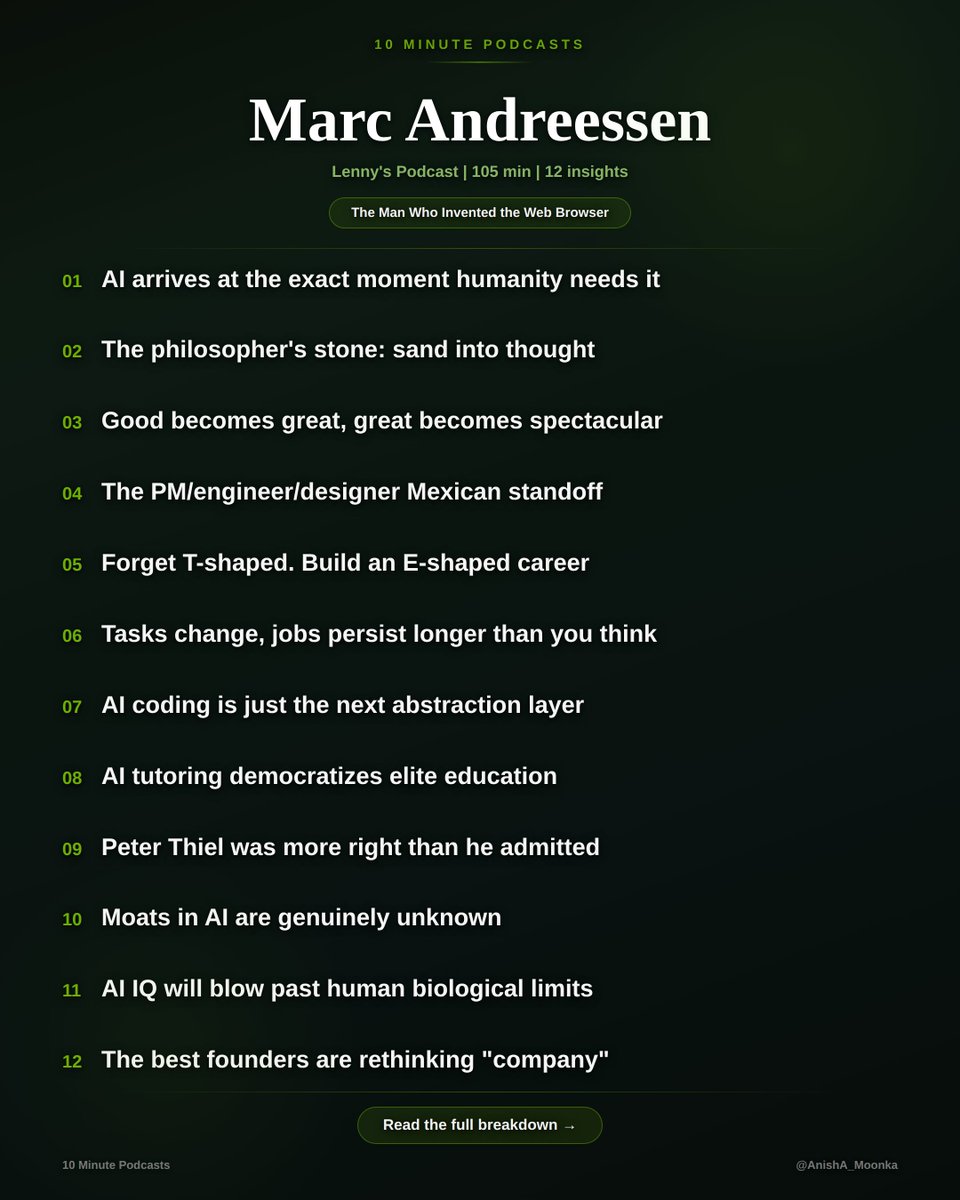
Marc Andreessen just dropped ~105 mins on Lenny's Podcast covering AI, jobs, careers, and why everyone is panicking about the wrong thing. Just the clearest macro framework I've heard on where AI actually lands. My notes: 𝟭. 𝗔𝗜 𝗶𝘀 𝗮𝗿𝗿𝗶𝘃𝗶𝗻𝗴 𝗮𝘁 𝘁𝗵𝗲 𝗲𝘅𝗮𝗰𝘁 𝗺𝗼𝗺𝗲𝗻𝘁 𝗵𝘂𝗺𝗮𝗻𝗶𝘁𝘆 𝗻𝗲𝗲𝗱𝘀 𝗶𝘁. US productivity growth has been running at half the rate of the 1940-1970 era and a third the rate of 1870-1940. The global population is declining below replacement in dozens of countries, including China. Without AI, we would be panicking about economies shrinking from depopulation, not job loss. The timing is almost miraculous. This is what Andreessen means when he says the real boom has not started yet. We have been in a 50-year productivity drought, and most people do not even realize it. 𝟮. 𝗔𝗜 𝗶𝘀 𝘁𝗵𝗲 𝗽𝗵𝗶𝗹𝗼𝘀𝗼𝗽𝗵𝗲𝗿'𝘀 𝘀𝘁𝗼𝗻𝗲. Isaac Newton spent decades trying to transmute lead into gold and never succeeded. AI does something more powerful: it converts sand (silicon) into thought. The most common material in the world is the rarest output. This one metaphor reframes the entire AI conversation. You do not have a job loss problem. You have a philosopher's stone sitting on your desk that you are not using enough. 𝟯. 𝗔𝗜 𝗺𝗮𝗸𝗲𝘀 𝗴𝗼𝗼𝗱 𝗽𝗲𝗼𝗽𝗹𝗲 𝘃𝗲𝗿𝘆 𝗴𝗼𝗼𝗱, 𝗮𝗻𝗱 𝘃𝗲𝗿𝘆 𝗴𝗼𝗼𝗱 𝗽𝗲𝗼𝗽𝗹𝗲 𝘀𝗽𝗲𝗰𝘁𝗮𝗰𝘂𝗹𝗮𝗿𝗹𝘆 𝗴𝗿𝗲𝗮𝘁. The best coders right now are not reporting 2x productivity. They are reporting 10x. The gap between "pretty good with AI" and "elite with AI" is widening, not narrowing. This is the most important signal for career planning right now. If you are just using AI to do the same job slightly faster, you are leaving the real leverage on the table. 𝟰. 𝗧𝗵𝗲𝗿𝗲'𝘀 𝗮 𝗠𝗲𝘅𝗶𝗰𝗮𝗻 𝘀𝘁𝗮𝗻𝗱𝗼𝗳𝗳 𝗯𝗲𝘁𝘄𝗲𝗲𝗻 𝗣𝗠𝘀, 𝗲𝗻𝗴𝗶𝗻𝗲𝗲𝗿𝘀, 𝗮𝗻𝗱 𝗱𝗲𝘀𝗶𝗴𝗻𝗲𝗿𝘀. Every engineer now thinks they can be a PM and designer. Every PM thinks they can code and design. Every designer knows they can do both. And they are all correct, because AI enables each role to absorb the tasks of the other two. I have seen this firsthand in the investing world. The analyst who can build models and write narratives is 5x more valuable than someone who can do only one. The same convergence is happening in the product. 𝟱. 𝗙𝗼𝗿𝗴𝗲𝘁 𝗧-𝘀𝗵𝗮𝗽𝗲𝗱. 𝗕𝘂𝗶𝗹𝗱 𝗮𝗻 𝗘-𝘀𝗵𝗮𝗽𝗲𝗱 𝗰𝗮𝗿𝗲𝗲𝗿. Scott Adams could not have created Dilbert by being the world's best cartoonist or the world's best business mind. He needed both. The additive effect of two skills is more than double. Three skills are more than triple. Larry Summers puts it differently: don't be fungible. The person who can code, design, and ship a product is no longer a unicorn. They are the new baseline for "extremely valuable." If you are only one of those three things, you are increasingly replaceable. 𝟲. 𝗝𝗼𝗯𝘀 𝗮𝗿𝗲 𝗯𝘂𝗻𝗱𝗹𝗲𝘀 𝗼𝗳 𝘁𝗮𝘀𝗸𝘀. 𝗧𝗮𝘀𝗸𝘀 𝗰𝗵𝗮𝗻𝗴𝗲. 𝗝𝗼𝗯𝘀 𝗽𝗲𝗿𝘀𝗶𝘀𝘁. Executives never typed their own emails in the 1970s. Secretaries printed incoming emails and hand-delivered them. Both roles survived the transition, just with different task sets. The same will happen with AI and coding, PM work, and design. Everyone obsessing over "will my job disappear" is asking the wrong question. The right question is: which tasks in my job are about to rotate, and am I ready to pick up the new ones? 𝟳. 𝗔𝗜 𝗰𝗼𝗱𝗶𝗻𝗴 𝗶𝘀 𝗷𝘂𝘀𝘁 𝘁𝗵𝗲 𝗻𝗲𝘅𝘁 𝗮𝗯𝘀𝘁𝗿𝗮𝗰𝘁𝗶𝗼𝗻 𝗹𝗮𝘆𝗲𝗿. We went from human calculators to machine code to assembly to C to scripting languages. Each layer was dismissed by the previous generation. Each time, the new layer won, and total coding employment grew. AI coding is the same pattern, not a rupture. The Perl programmers of 2005, laughing at JavaScript, are the C programmers of 1995, laughing at scripting. History rhymes, and it always rewards the people who adopt the next abstraction first. 𝟴. 𝗔𝗜 𝘁𝘂𝘁𝗼𝗿𝗶𝗻𝗴 𝗱𝗲𝗺𝗼𝗰𝗿𝗮𝘁𝗶𝘇𝗲𝘀 𝗲𝗹𝗶𝘁𝗲 𝗲𝗱𝘂𝗰𝗮𝘁𝗶𝗼𝗻. One-on-one tutoring is the only method proven to move a student from the 50th to the 99th percentile (Bloom's two sigma effect). It used to require being born into royalty. Alexander the Great was tutored by Aristotle. Now, any kid with a phone can access the same quality of personalized instruction. This is the most under-discussed consequence of AI. Every parent reading this should be supplementing their kid's education with structured AI tutoring right now. Not next year. Now. 𝟵. 𝗣𝗲𝘁𝗲𝗿 𝗧𝗵𝗶𝗲𝗹 𝘄𝗮𝘀 𝗺𝗼𝗿𝗲 𝗿𝗶𝗴𝗵𝘁 𝘁𝗵𝗮𝗻 𝗔𝗻𝗱𝗿𝗲𝗲𝘀𝘀𝗲𝗻 𝗼𝗿𝗶𝗴𝗶𝗻𝗮𝗹𝗹𝘆 𝗮𝗱𝗺𝗶𝘁𝘁𝗲𝗱. Progress in bits masked stagnation in atoms. The built world is barely different from 50 years ago. Same bridges from the 1930s, same dams from the 1910s. Cartels, monopolies, unions, and regulations prevent the rate of change that people had 100 years ago. This is also why AI will not transform everything overnight. Institutional sclerosis is real. Healthcare alone could take a generation. If you are building in atoms, budget for a war of attrition, not a blitzkrieg. 𝟭𝟬. 𝗠𝗼𝗮𝘁𝘀 𝗶𝗻 𝗔𝗜 𝗮𝗿𝗲 𝗴𝗲𝗻𝘂𝗶𝗻𝗲𝗹𝘆 𝘂𝗻𝗸𝗻𝗼𝘄𝗻. Within a year of ChatGPT's launch, five American companies, five Chinese companies, and open-source all had roughly equivalent models. DeepSeek emerged from a hedge fund in China and basically replicated the American labs' work. The smartest AI insiders privately admit there aren't many real secrets among the big labs. This is the most honest take I have heard from a top-tier VC. No one knows if the value accrues to models, apps, or infrastructure. Anyone who tells you otherwise is selling you certainty they do not have. 𝟭𝟭. 𝗔𝗜 𝗜𝗤 𝘄𝗶𝗹𝗹 𝗯𝗹𝗼𝘄 𝗽𝗮𝘀𝘁 𝗵𝘂𝗺𝗮𝗻 𝗹𝗶𝗺𝗶𝘁𝘀. Human IQ caps around 160 because of biology. Current AI models test around 130-140. There is no theoretical ceiling stopping AI from reaching 200, 250, or 300. The concept of AGI as a "human equivalent" will be a footnote because AI will race past that threshold. This is the frame that makes the "will AI take my job" debate feel small. We are not building a replacement for human thought. We are building something that will be better than the best human thought has ever been. 𝟭𝟮. 𝗧𝗵𝗲 𝗯𝗲𝘀𝘁 𝗳𝗼𝘂𝗻𝗱𝗲𝗿𝘀 𝗮𝗿𝗲 𝗿𝗲𝘁𝗵𝗶𝗻𝗸𝗶𝗻𝗴 𝘄𝗵𝗮𝘁 𝗮 𝗰𝗼𝗺𝗽𝗮𝗻𝘆 𝗲𝘃𝗲𝗻 𝗶𝘀. Layer one: AI redefines products. Layer two: AI redefines jobs within companies. Layer three, which has not dropped yet: AI redefines the very concept of having a company. The holy grail is the one-person, billion-dollar outcome, and the best founders are chasing it. Satoshi did it with Bitcoin. Instagram and WhatsApp came close with tiny teams. The question is no longer if this is possible with software. The question is how many of these we will see in the next five years. AI is the philosopher's stone. The question is whether you pick it up. The full podcast is worth your time. Link in replies.
Anish Moonka tweet media
English
88
566
3K
831.7K
Stephens Xu retweetledi
Citrini
Citrini@citrini·
JUNE 2028. The S&P is down 38% from its highs. Unemployment just printed 10.2%. Private credit is unraveling. Prime mortgages are cracking. AI didn’t disappoint. It exceeded every expectation. What happened?​​​​​​​​​​​​​​​​ citriniresearch.com/p/2028gic
English
1.9K
4.2K
27.7K
28.7M
Stephens Xu retweetledi
Gavin Baker
Gavin Baker@GavinSBaker·
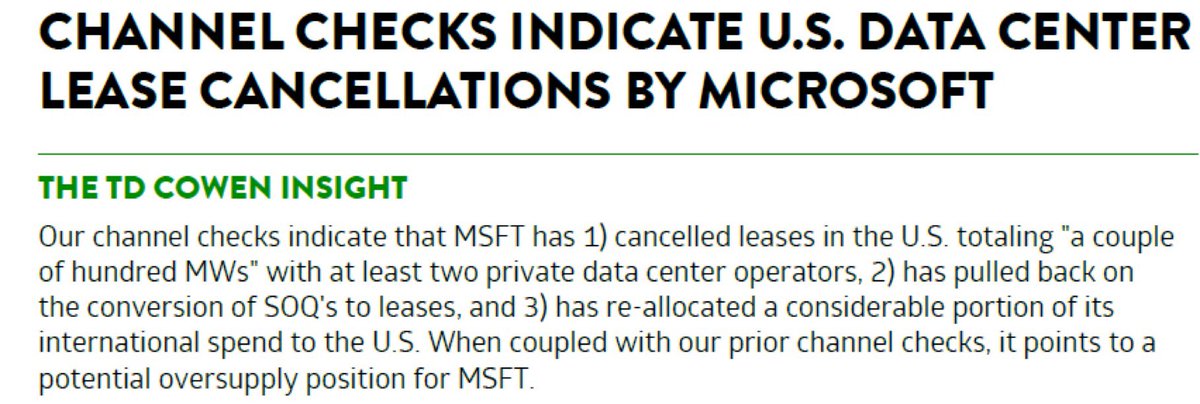
OpenAI had a significant lead from summer 2022 through spring 2024 when Google and Anthropic caught up to GPT-4. 7ish quarters of dominance as a result of being the first to aggressively bet on the traditional scaling “law” for pre-training. Being first to reasoning with o1 only led to a few months of advantage. Deepseek, Google and xAI are at rough parity with OpenAI today. xAI arguably in the lead. Google and xAI will likely decisively surpass o3 soon as their base models are better. So urgent need for GPT-5 as the basis for a putative “o5”reasoning model. Sam noted that OpenAI would have a narrower lead going forward and Satya essentially stated that a unique period where they had a tremendous lead in model capability was ending. IMO, this is why Satya is opting out of funding $160b of pretraining for OpenAI per @theinformation. Instead he will make money by providing inference to OpenAI. Google and Xai both have unique, valuable sources of data that will increasingly differentiate them from Deepseek, OpenAI and Anthropic. As does Meta if they catch up from a model capability perspective. I have paraphrased @ericvishria many times and noted that frontier models without access to unique, valuable data are the fastest depreciating assets in history. Distillation only amplifies this. It seems like Satya shares this belief; hence opting out of the $160b of pre-training, the rumored datacenter cancellations and his statement on a recent podcast that there is a datacenter overbuild coming and better to lease than buy. Might be a sound decision for Microsoft from an economic perspective and at some point Microsoft might even use an open-source model to power CoPilot. There may not be any ROI on future frontier models that do not have access to unique, valuable data like YouTube, X, TeslaVision, Instagram and Facebook. Zuckerberg’s strategy also seems much more sensible from this angle. Unique data might end up being the only basis for differentiation and ROI on pre-training multi-trillion or quadrillion parameter models. If this is correct, only 2-3 companies will be pre-training frontier models and we will only need a few giant datacenters for the coherent clusters that are needed for pre-training. The rest of AI compute would be smaller datacenters that are geospatially optimized for low latency and/or cost-effective inference. Cost effective inference = cheaper, lower quality power (less premium for Nuclear), less of an imperative for liquid cooling in ST, etc. A very different world from one where 6-10 companies are pre-training frontier models. Note that reasoning models are extremely compute intensive. Test-time compute means that compute is literally intelligence. So in this scenario there might be even more compute required than in the “pre-training” centric compute scenario that was the base case for the market throughout 2023-2024. But it would be a very different kind of compute as noted above. Instead of a 50/50 split between pre-training and inference it would be 5/95.  Lots of Hondas, very few Ferraris. Infrastructure excellence would be paramount. And all of this without even considering the implications of on-device inference and/or full quantization - the Deepseek R1 paper was not the most important paper to be published by a Chinese lab in the last year. IYKYK. The economic returns to superintelligence are definitionally unknowable. I hope they are high, but a 140 IQ model running on device with access to unique data about the world might be enough for most use cases. ASI isn’t needed to book travel, etc. I’ve done my best to be dispassionate, but I do have my own biases, both personal and economic, when it comes to xAI and OpenAI. If OpenAI is still one of the leaders in 5 years, then likely a function of first-mover advantage, ChatGPT becoming a verb and scale being even more of an advantage for reasoning models in that users generate and verify(ish) reasoning traces. As ever, time will tell.
Gavin Baker tweet mediaGavin Baker tweet media
English
199
415
3.2K
3.9M