

db cooper
330 posts

db cooper
@t0ddddddd
dad. husband. psychedelics. ultrarunner. building @couchmilk
Katılım Ekim 2025
667 Takip Edilen37 Takipçiler

Most people might miss the biggest benefit of sauna
You need to get really really hot…
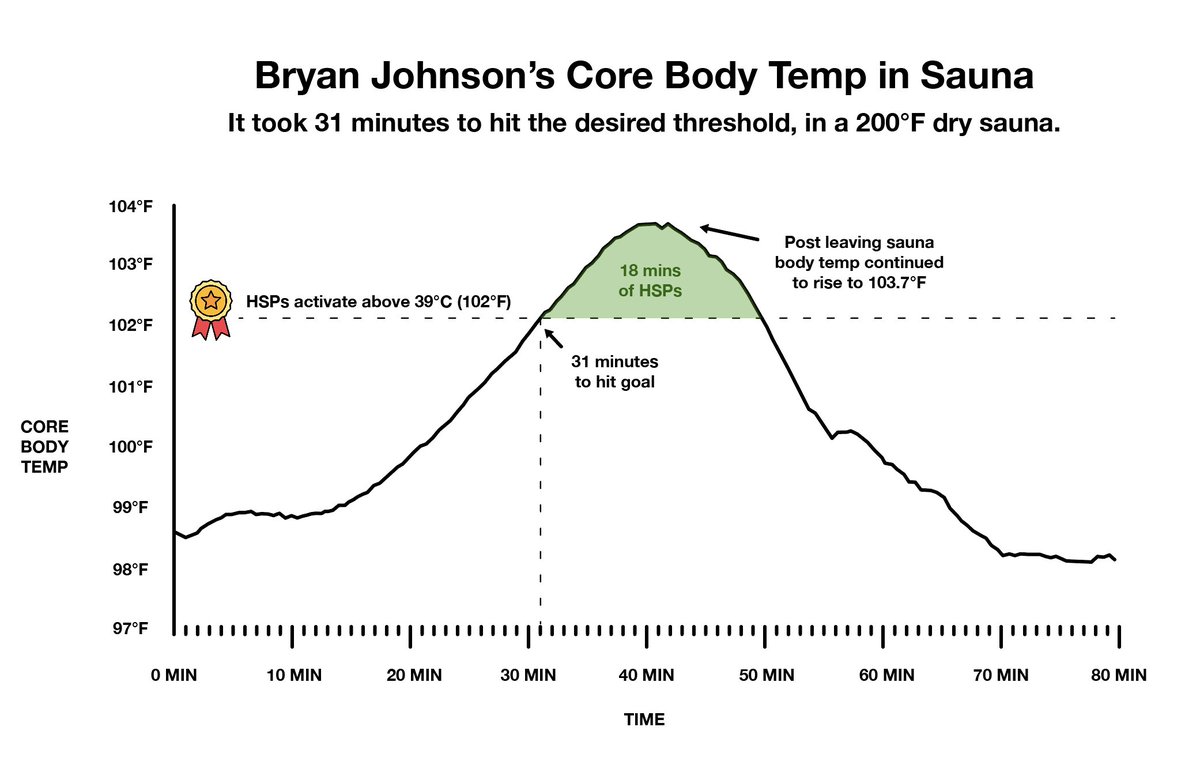
Your core body temperature needs to hit 102.4°F (39°C).
For reference, a fever is anything above 100.4°F (38°C)
So I swallowed a temperature monitoring pill. It goes through your digestive tract and precisely measures your internal temperature every 30 seconds.
When your core body temperature hits the goal of 102°F, your body releases these proteins (heat shock proteins - HSPs) that clean up your body’s debris.
I was curious what time my body hits this goal because up until now, I’ve been doing 20 mins of 200°F dry sauna.
… it turns out it takes 31 minutes
It feels like you’re dying.
I didn't expert such pain and panic.
Before this experiment, I did over 200 sauna sessions at 200°F for 20 min.
This means I likely never achieved the heat shock protein (HSP) threshold at 102.4°F (39°C), which deprived me of so much sauna-health goodness.
If your sauna doesn’t heat up to temperatures allowing your core temperature to reach 102.4°F (39°C) or you struggle to tolerate heat, do not be discouraged. The dry sessions I did at 200°F (93°C) for 20 min still showed incredibly health benefits.
My previous 20 min sessions still showed:
1) 10+ yr reduction of my vascular age
2) 87% reduction of microplastics
3) detox of environmental toxins
4) fertility marker improvement
Will report back once I have results on this new protocol…
English
@steveruizok tell that to my agent thats asking me wtfs up with code stability rn 😂
English

I will not have tested this for a few hours while work continues autonomously, so apologies if there are any weird regressions
English
this is a [deep breath] M5 Stick S3 acting as a frontend for Gemini Flash 3.1 Live, running via a CloudFlare worker, with tools to set device settings (brightness, volume, power), web fetch / search, and vector search (of tldraw docs) via cf's Vectorize.
crazy low latency, push to talk on this hardware is great too
English
@thegarybrecka psychedelics helped me reframe this.
even as a collegiate athlete discipline felt like punishment.
on a macro-dose one day it hit me that my view was holding me back.
discipline = thriving now.
English
Discipline has been framed by a lot of people as punishment, restriction, or some kind of harsh self-control.
I see it differently. Discipline is alignment.
It is the willingness to do what supports your body even when convenience tells you not to.
That’s self-respect in action.
English

@Collectifmind the algorithm seems to always find me so im convinced thats the only choice
English

i grew up in mississippi in the 90s
parents ignorant to the internet became consumers
their children addicted instead of equipped
from my perspective college was a step up from the library
college was easy once you figured out google
a tool my generation could have wielded much sooner
my kids will learn more in a 49m youtube video than i did in 4 years of engineering
the human brain evolves before our eyes
English

Psychedelics can reopen windows in your brain that were supposed to close forever.
But that's not entirely good news.
In 2023, Johns Hopkins researchers made a landmark discovery...
Psychedelics reopen "critical learning periods," rare developmental windows when your brain is primed to form bonds, learn trust, and rewire deep patterns. Most neuroscientists thought these windows closed permanently by your mid-20s.
Psychedelics unlock them again. They loosen the structural scaffolding that keeps your neural wiring locked in place. Think of it as a biological permission slip for transformation.
But here's the part very few people talk about:
When that window is open, your brain is more susceptible to ALL patterns, including damaging ones.
If someone does a high-dose journey and then goes right back to the same stress, the same environment, the same loops… old patterns don't just return.
They can come back stronger.
This is what I call the "integration gap." The experience feels like a breakthrough.
You leave feeling expansive and grateful.
Two weeks later?
Anxious, fragmented, unable to make sense of what happened.
The medicine opens a window. But someone has to be responsible for what happens while it's open.
Right now, most of that aftercare comes down to a check-in call and hope. That's not enough.
This is exactly why Dave Rabin, MD, PhD, and I partnered up through my coaching institute to build a training on Psychedelic Safety and Harm Reduction.
Dave has spent years in the trenches supporting people through transformative psychedelic work, and we're offering a 3-month mentorship for practitioners who want to master this.
What's the wildest integration experience you've had or witnessed?
Drop it below.

English
@Collectifmind we definitely are over at @Couchmilk
don’t skip integration!
stay tuned for our guide releasing soon!
English
the cia started Mormonism to groom a population that could enter consciousness space. proven secret holders. nothing happens by chance.
christian@schizothreads
The CIA is working with otherworldly beings and this is why Mormons are over represented in US intelligence agencies. Mormonism already believes that the universe is full of inhabited worlds, and that advanced beings operate across space and time. That’s doctrine, not metaphor. So when they are read into a program involving non-human intelligence, they don’t break or blink. They collaborate. Add a culture built on sacred secrecy, hierarchical obedience, and compartmentalized revelation, Mormons already live inside a need-to-know structure. The CIA doesn’t over-recruit a demographic just for clean backgrounds. They recruit them because the secret they’re keeping requires a specific kind of worldview. There is an alien agenda, and Mormonism is ready to receive it.
English
@poetengineer__ why start from a single pixel? Humans started with a line
English

can ai agents invent writing on their own? recent pet project: 2 agents share a world but each sees only half. their only communication: 7×7 pixel glyphs. they develop symbols, build theories of meaning, and evaluate their own writing. no convergence yet but fascinating to watch!
English
@daviddorg love that you’re taking the time to do this right. I’m ready to bust out my typewriter and join you
English

I have bad news about the year without screens experiment — Year Unplugged
It blew up way faster than expected:
+ 0 to 156k on Instagram in about 3 weeks
+ 2k to 17k on X in about 2 weeks
I guess we all want to know how the screens and devices may be affecting us, even if it's just one person
Anyway, there has been a lot of attention, a lot of ideas about what I should measure, and even some unexpected help (thank you all)
Originally, I was just going to measure blood markers (@superpower), sleep data (@ouraring), neuroimaging, cognitive tests, and a few other things
But given all the new ideas and that this will be an entire year of my life, I'm adding some more things:
+ Gut health, with help from @superpower (tiny) and @ThroneScience (cool product for daily tracking)
+ Full-body MRI + skeletal assessment + body composition, with help from @function
+ Some questionnaires like MAIA-2: Interoception, to see if body awareness changes a lot
+ DUTCH test for more in-depth view of hormones (cc @AbudBakri)
+ Potentially sperm health (shoutout @sciencekelso)
Anyway, here's the bad news: Instead of starting the screenless phase on April 5th, I need to extend the baseline phase a bit to gather the rest of this data and make sure everything is set up right
I'll let you know as soon as the date is firm, and of course all the baseline data will continue getting uploaded to the live dashboard
LAST CALL: If there's anything you'd like to see someone measure before / during / after going a year without screens, speak now or forever hold your peace
Otherwise, thank you for being here. I'm excited to see what we may discover.

English

@t0ddddddd There are a lot of labs that will run this for you. This one was through RxHomeTest/Ayumetrix. Thorne will also do it.
English
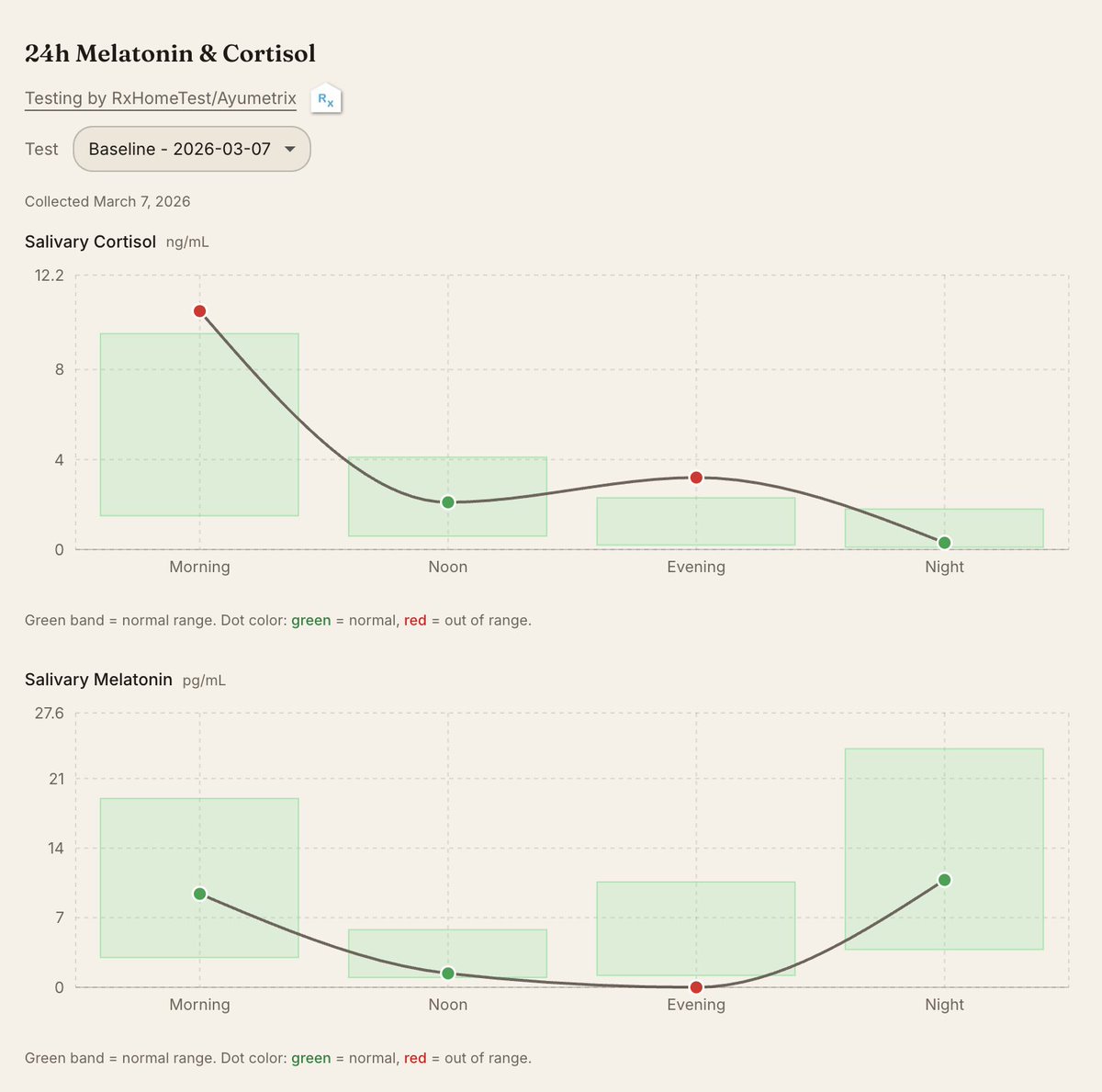
A Harvard study found that 4 hours of screen time before bed suppresses melatonin by 55% and delays your circadian clock by 1.5 hours (Chang et al.)
Just published my baseline melatonin and cortisol curves from a 4-point saliva test, before I spend a year without screens
These could change substantially within just a week or two without screens
A year from now we'll know what happens when you reverse that completely
English