

Mike
7.3K posts

What SONG has GREAT use of an ORGAN???
English
@RussellEgan @cjoye Sarah Ferguson did not ask Chalmers one question about the explosion in public services payrolls but gave Angus Taylor a hard time about pledges to cut the public services costs. The ABC is truly corrupt and a Labor party stooge.
English

Labor is off the rails.
christopher joye@cjoye
This is crazy: the federal government is using all the NDIS savings and almost all the NDIS savings + tax increases to pay itself due to a massive $19.6 billion cost blow-out on the bureaucracy over the next four years compared to forecasts in last year’s budget. Put another way, over the four overlapping Budget years from 2025–26 to 2028–29, the government has increased the cost of running the bureaucracy by $19.6bn — enough to consume virtually all (99%) of the $19.8bn in NDIS savings it claims, 93% of those savings plus its negative-gearing/CGT tax grab, and 14.5 times the property/investor tax increase itself... "The average staffing level increases from 215,900 this year to 217,300 in 2026-27. Since the Albanese government came to power in 2022, the size of the public service has ballooned by a quarter." afr.com/policy/economy…
English
@cageeone @cjoye @mickworld221 @ABaceolive @AlboMP @JEChalmers @AustralianLabor They keep saying that this budget about helping younger people into housing and yet all their own forecasts say house prices will increase by 2% and earnings by 3%. So house prices will stay at 10 x income and young people will get $250 in 2 years time. Joke.
English

@mickworld221 @ABaceolive @cjoye Not only rich people. Impacts any person who has thought about their kids, including how to protect them once you’re gone. Horrible policy decision by @AlboMP and @JEChalmers - yet another way that they’ve whacked the younger generation hardest with this @AustralianLabor budget
English

The Albanese government has blindsided the financial sector with a surprise “death tax” on wills and estates, triggering urgent calls for clarification from wealth advisers.
Under new budget measures, family trusts are set to be hit with a minimum 30 per cent tax rate. The new rule will also apply to the most common form of estate planning trust: the Testamentary Discretionary Trust.
theaustralian.com.au/wealth/budget-…
English

How many times can Sarah Ferguson interrupt Angus Taylor and not lose her job? #abc730
English
@ChrisEconomist @_warrenhogan But the gov said this budget was all about housing and intergenerational equity. Their own forecast tells us that house prices will continue to grow so will remain around 10 times income. So unless they are lying about price expectations this budget just increases taxes.
English

THERE'S LOTS TO LIKE IN THIS BUDGET
BUT BUDGET REPAIR OVER THE REST OF THE DECADE RELIES OF WAR-AND-INFLATION DRIVEN WINDFALLS
AND THE RBA WILL STILL BE WATCHING STATE AND FEDERAL GOVERNMENT SPENDING PRETTY CLOSELY
There’s a lot to like in this budget. Australia has had important crisis-fighting budgets in the past few decades – think of COVID and the global financial crisis.
What we haven’t had is a budget that tackles some of the ‘to do’ list that Treasury and the Productivity Commission have had in their top drawers for decades.
This does that.
No, I don’t love every policy change. And nor has enough been done. But the broad direction of what has been done is good.
Yet these headline grabbing policies actually start small and slow. Their impact in the next few years will be modest.
So how is it that deficits are set to be $45bn lower over the coming five years?
That improvement is excellent news. But in a budget with a blizzard of new policy changes, the big drop in the deficit is pretty much explained not by policy decisions, but by a benevolent economy
It’s the latter that’s doing the doing the heavy lifting in terms of budget repair. Simply put, a combination of war and inflation – plus a small top up from higher-than-expected migration – delivered a bigger economy for the taxman to tax.
As the budget papers spell out, that’s delivered a revenue windfall of $41bn over five years – providing more than nine out of every ten dollars of bottom line improvement.
And there’s an additional thing to note. The year that had been expected to see the biggest improvement in the bottom line thanks to those economic changes – the financial year just about to start – actually saw very little change in the budget bottom line.
Although the tax windfall reaches its peak in the coming year – at a hefty $18.8 bn – it is largely eaten up by a similar lift in spending.
Just a few months ago the government estimated its spending in the coming year would be $811bn. Now that is seen $18bn higher, at $830bn. Five months ago the nominal increase in spending in the coming year was estimated at a tight 3.1%. It’s still projected to be rather lower than it was, but it now sits at 5.3%
Lots of that increase in spending is understandable. NDIS costs blowouts have continued in recent months, while defence costs are lifting too. There’s more money for the PBS. A bunch of spending goes up when inflation goes up. A weaker economy will push up the costs of unemployment and other benefits.
Yet that jump in the cash spend heading into the Australian economy in the near term may raise an eyebrow or two at the Reserve Bank, especially as it comes atop recent spending increases by the states.
The bottom line? There’s some much needed courage here – and that’s to be applauded.
But the changes in the budget aren’t what drive the big improvement in the budget over the rest of this decade. As usual, better news is due to a windfall. And although the Reserve Bank will breathe a sigh of relief that there isn’t a big ‘cost of living ‘ spend here, nor can it safely ignore what state and federal governments are doing. Those governments are still more a part of the problem than they are a part of the solution.
English
@bowtiedstocks They have fixed the intergenerational wealth divide by giving young people $250 a year starting in 2 years time. Job done.
English
This is the craziest budget speech I’ve ever witnessed
I didn’t think they would actually follow through on all of this
Significant additional taxes on risk capital going forward
This will have the opposite effect of their purported intention of reducing the intergenerational wealth divide
Chalmers is outright dangerous, like a madman
English
@AvidCommentator Don’t forget that they are fixing intergenerational inequity by giving her $250 in 2 years time.
English

This is Emily (hypothetical).
She is 22 years old and works part time at a supermarket while at uni, she is very frugal and puts most of her pay into index fund ETF's.
When she sells those she will be slugged at 30% minimum capital gains tax, despite being a low income earner.

English

China is increasingly dominating high-tech industries, while the low-value manufacturing sectors that powered the country’s rise are becoming less important economic drivers on.wsj.com/4nxJsyL
English
@Tom__Capital Yeah but they are fixing intergenerational inequity by giving young people $250 in 2 years time. Job done !
English

$AUDUSD
Adjust those forecasted GDP figures for immigration and growth is exceptionally weak
GDP fcast in 26/27 at 1.75% is pretty much the same rate as the population increase, so GDP is effectively stagnant or negative
Australia has been in a " per capita recession" for the past two years and looks like it's set to continue
For those (especially Labor voters) that don't understand the above, immigration is acting as a "buffer" that prevents the headline GDP number from turning negative, but it is masking the underlying reality that the average person's economic share is declining.
Thanks @JEChalmers 🖕
Reserve Bank of Property@RBASHAGGER
Dear god
English

President Donald Trump will have his annual medical checkup at a hospital near Washington on May 26, the White House said Monday night bloomberg.com/news/articles/…
English
@LalitaMathias @cjoye Of course they will. If they want to continue to increase spending then they have to continue to increase revenue.
English

@cjoye For this budget only. Nothing is secure. Governments will tinker with everything and in time, including your owner/ occupied home.
English
The single biggest winner from the budget: the tax-free owner-occupied home, which is where people will put their money. After the budget doubles the capital gains tax on productive businesses/assets from circa 23.5% to 46-47%, investors will understandably pull money from businesses, shares, commercial property and rental housing and plough it into their tax-free owner-occupied home. It's a great way to push up the prices of these houses. On the other hand, cutting negative gearing while also doubling CGT makes investing in rental properties extremely unattractive. It hammers the capital gain upside on any asset: shares, commercial property, the small or medium sized business you built, venture capital and private equity. It will give Australia the most unattractive capital gains tax in the WORLD (see table below)! So the government's policies will (1) push up owner-occupied house prices, (2) push up rents, and (3) reduce the capital available for investing in any small, medium or large sized business that is driving employment, innovation, growth and productivity/prosperity. Investors will go to other countries where they pay half the capital gains tax, or less. Since these pollies have never worked a day of their lives in the private sector, it is no surprise that when they decide to completely and unilaterally rewrite the entire tax system for all investors and businesses -- after promising before the last election more than 50 times NOT to change the capital gains tax and negative gearing rules -- that they would blow the entire Aussie economy up... Your best bet will be to buy a house, live in it, and hope they keep dropping 500,000 new people into the country every year to pump-up prices...

English
@timewarp999 on that logic, just keep increasing taxes cause there are no impacts on incentives...
English
@SincDavidson @cjoye A collapse would be a good thing. Why should the young be expected to wait 20 years for slow change ? When house prices are exploding upwards and doubling every 7 years people stupidly think that’s good. Now that they will collapse they start to whinge.
English

He'll be lucky to get away with not blowing up the economy in the next 12 months as housing prices collapse.
Negative equity, mortgage stress, wealth effects ...
Financial Review@FinancialReview
Is Jim Chalmers' budget the type of reform that will improve the economy over the next 30 years or just the next three? ebx.sh/RcAnqZ
English
@_warrenhogan @AntipodeanMacro Probably. That may be a good thing. The quickest way to fix inter generational inequality is to orchestrate a 25% decline in house prices like Canada and NZ. Young adults should not be expected to wait 10-15years of slow changes.
English

@AntipodeanMacro Does this create any incentive to liquidate assets in next 12 months?
English

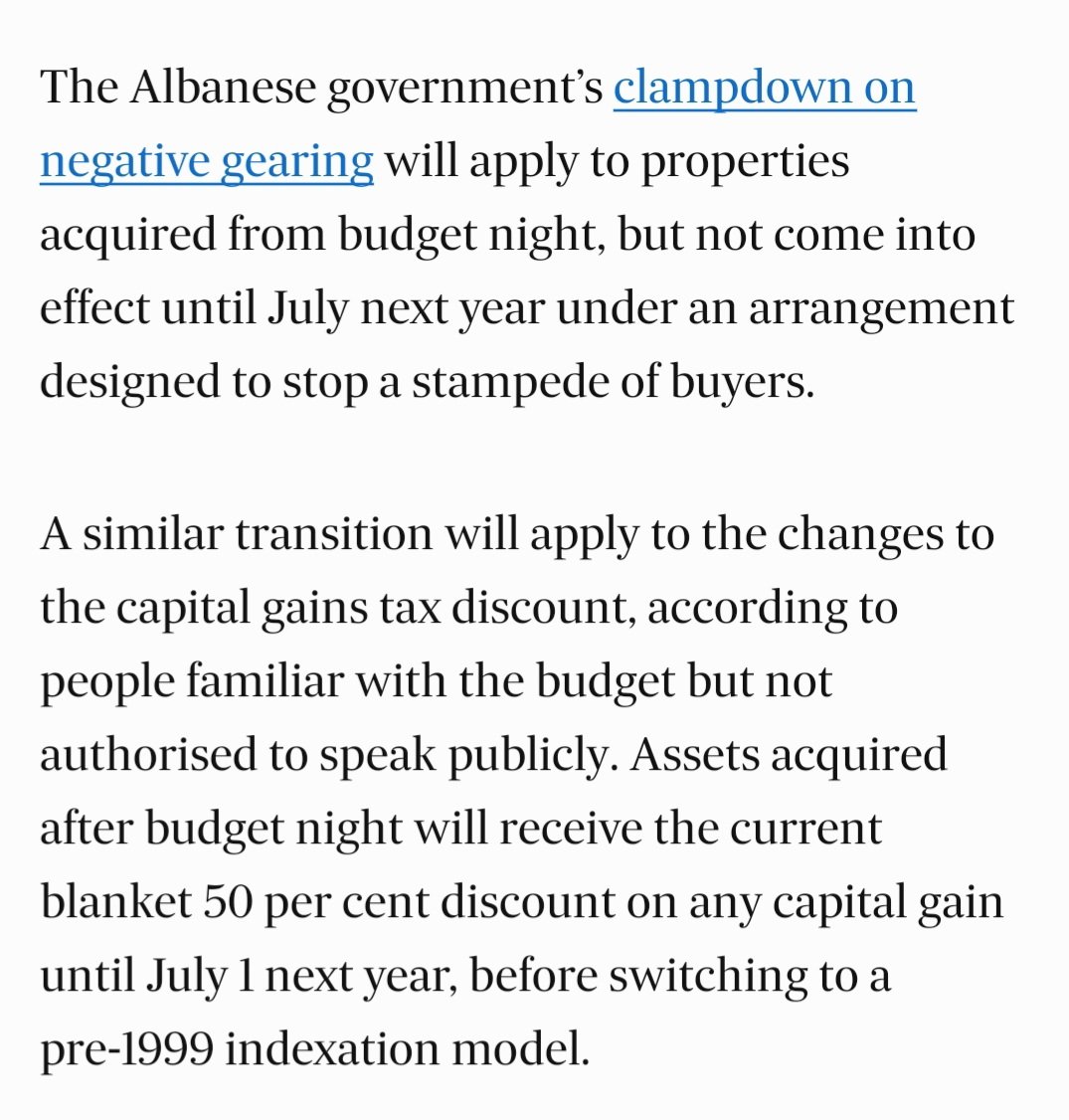
@justinspratt @cjoye The Australian dream has been dead a long time. What possible good can come from a country where families and owned occupiers have to pay 10 times income for a home. No matter how hard you work you will always be a renter or mortgage slave.
ON is now reading the last rites.
English

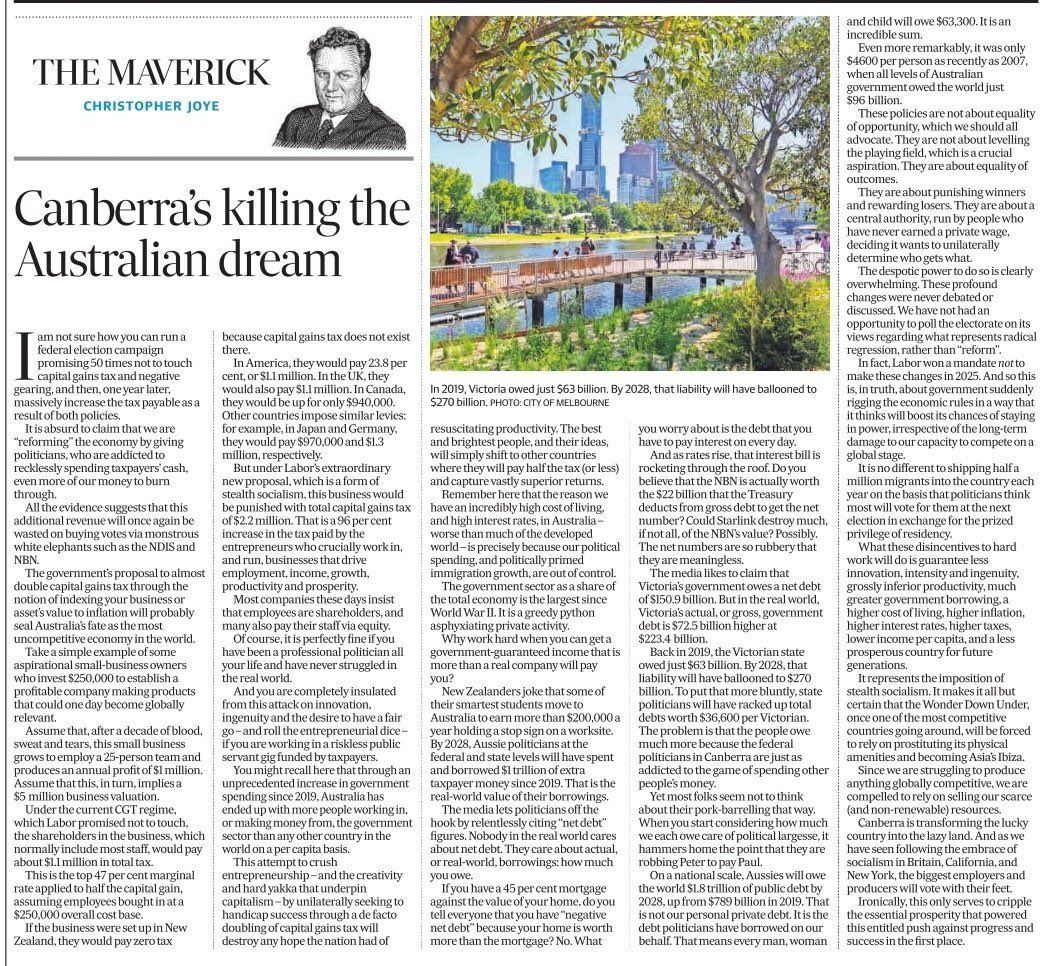
Labour Govt playing with Australia’s economic future.
great post by @cjoye in AFR.
sadly, the age old story of politicians stealing from the productive to pay for their mismanagement.
English
@markbouris @cjoye You also don’t build a stronger country by forcing families and owner occupiers to pay 10 times their income for a home. You end up with a nation of mortgage slaves and renters . The slaves are revolting by voting for ON.
English

What’s everyone’s thoughts on the budget this week?
Feels like too many Australians are working harder than ever just to stand still.
You don’t build a stronger country by making it harder for workers, business owners and families to get ahead.
English
What GUITARIST do YOU recognize after ONE note???

English


@jesushobo @peter_tulip Yes I am serious. Thousands of people losing their equity does in high density developments does nothing for a stable housing market. High density apartment sales off the plan are a scam to fleece buyers but is somehow presented as a solution affordability.
English
@timewarp999 @peter_tulip How is them losing money not good for affordility are you serious
English

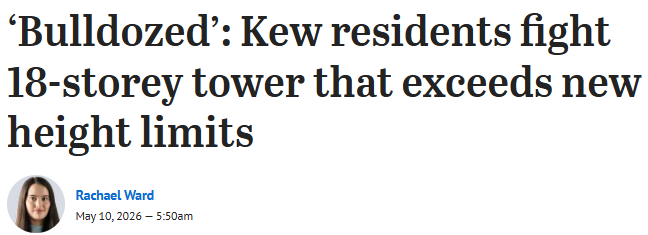
The media keep giving NIMBYs a megaphone.
Without even mentioning the reason for new buildings.
The Age is oblivious to the housing affordability crisis. For which the solution is increased density in inner suburbs.
theage.com.au/national/victo…
English