

Larry Guy
2.2K posts

Israel continues to drag Lebanon deeper into a spiral of death and destruction following its latest deadly attack.
English

oy. the same two inept negotiators,
Jennifer Griffin@JenGriffinFNC
NYPost exclusive on Iran talks in Islamabad from call with President Trump: “We’ll have Steve Witkoff, Jared Kushner, JD —maybe JD, I don’t know. There’s a question of safety, security,” Trump said in a phone interview. The president on Tuesday accepted Iran’s 10-point counter-proposal on ending the conflict as a tentative framework to build a permanent deal, though some of the demands seem very unlikely to be finalized. nypost.com/2026/04/08/us-…
English
Larry Guy retweetledi

We've known Israel leaned hard on Trump and people who might influence him (Graham); the earliest explanations for the war & timing from top Trump officials pointed to Israel; in short this has been in the open for weeks, & yes trying to stifle these facts is bound to backfire.
Tim Miller@Timodc
People keep telling me its anti-semitic to say Israel influenced US on Iran war. Now we learn Bibi made a "hard sell" in sit room on 2/11. Think telling people not to believe their eyes will cause more anti-semitism than being honest about Bibi influence. nytimes.com/2026/04/07/us/…
English
Larry Guy retweetledi

While interfering in Hungary's elections, JD Vance accuses the EU of interfering in Hungary's elections. theguardian.com/world/2026/apr…
English
Trump genocidal threats backfire
Alex Ward@alexbward
Iran has cut off direct communications with the U.S. over President Trump’s threat to destroy Iran’s “whole civilization” Monday morning, though talks with cease-fire mediators continue, Middle Eastern officials said. Unclear if direct talks will resume before the deadline.
English
Larry Guy retweetledi

Tonight Israel issued forced displacement orders for >40 towns & villages inc. around Sidon, Nabatieh, elsewhere. More than a million Lebanese are already displaced, shelters are at capacity, people are sleeping on streets, in cars. Now a new wave of displacement begins #lebanon
English

@joshua_landis Implementing its vision of being the sole superpower within a 2000 mile radius.
English
What in the world does America think it is doing destroying centuries of development and learning?
Trita Parsi@tparsi
Disgraceful! The US/Israel just bombed Sharif University in Tehran. This is not only Iran's best university, but also a top 100 global university in the field of Civil Engineering. It has also been a center of student opposition to the Iranian gov And Trump just bombed it...
English
@GerardAraud Who can provide such guarantees? The Israelis and Americans themselves floridly break their agreements.
English

L’Iran dispose de peu d’atouts. Le principal est le contrôle du détroit d’Ormuz. Il n’y renoncera que contre une garantie qu’Américains et Israéliens ne reprendront pas leurs opérations quand ils le voudront. C’est là le cœur de la négociation.
Français
Larry Guy retweetledi
“Trump’s threats may end up producing the opposite of their intended effect. Rather than compelling de-escalation, they may strengthen the camp in Tehran arguing that only a decisive and immediate show of force can restore deterrence.”
Hamidreza Azizi@HamidRezaAz
#Iran War Update No. 37 (focus on Iranian strategic narrative): 🔹The central development of Day 37 was the U.S. rescue operation inside Iran following the downing of an F-15E. In Iranian framing, the point is not to deny that the United States can still conduct complex operations, but to argue that it can no longer do so at acceptable cost, which is presented as evidence that Iran is successfully imposing costs despite the material asymmetry. 🔹At the expert level, another interpretation has emerged beyond those I mentioned earlier today. The new arguments is that the operation may have been a cover story for a failed heliborne attempt in Isfahan, potentially linked to Iran’s highly enriched uranium stockpile, which would make the episode strategically more serious than the public U.S. account suggests. 🔹Trump’s threat to strike Iran’s power plants and bridges if the Strait of Hormuz is not reopened has been read in Tehran in two ways. On the one hand, it is treated as a sign that military pressure has failed to push Iran toward capitulation. On the other hand, it is being taken seriously enough to sharpen internal debates over whether Iran should escalate preemptively. 🔹Some state-affiliated sources are warning that unless Washington explicitly backs away from infrastructure targeting, Iran may move toward a large-scale strike on Israeli and Gulf electricity and oil infrastructure, reflecting a shift by the Iranian armed forces toward abandoning proportional, reactive responses. 🔹In that sense, Trump’s threats may end up producing the opposite of their intended effect. Rather than compelling de-escalation, they may strengthen the camp in Tehran arguing that only a decisive and immediate show of force can restore deterrence. 🔹At the societal level, these threats are also reshaping perceptions of the war inside Iran. The conflict is increasingly seen not as an effort to pressure the regime while sparing society, but as a campaign against the country itself, which is deepening public disillusionment and narrowing the political space for any pro-U.S. narrative. 🔹This shift appears to be visible even beyond Iran’s formal political sphere. The fact that some diaspora opposition TV channels have reportedly moderated their tone suggests that attacks on infrastructure are eroding the plausibility of framing the war as “liberation” rather than destruction. 🔹Iran’s attacks on petrochemical and oil-related facilities in the UAE, Kuwait, Bahrain, as well as Israel, were framed during the day as a calibrated response to the strike on Mahshahr. Their purpose was to show that attacks on Iran’s economic infrastructure will trigger rapid retaliation against the wider regional energy system. 🔹At the same time, there is still no sign that Trump’s threats are pushing Iran to reconsider its Hormuz policy. On the contrary, the IRGC’s assertion that the strait will not return to its pre-war condition points to a hardening of Iran’s position rather than movement toward accommodation. 🔹What stands out increasingly is that Iran is no longer presenting Hormuz simply as a disruption tool. The emerging argument is that access to the strait should now be conditioned on compensation for wartime damage, effectively recasting passage not as a right but as an issue to be renegotiated under the terms of war. 🔹This is reinforced by the emphasis that ships are still transiting the strait with Iranian permission. The strategic point is to show that Hormuz is not closed in a crude sense, but operating under wartime regulations imposed by Iran, which helps undercut the U.S. claim that force is needed to “reopen” it. 🔹The push in Majlis (parliament) to impose cargo-based fees on ships and tankers passing through the strait takes this one step further. It suggests that Tehran is moving from wartime control toward institutionalized control, turning Hormuz into both a strategic lever and a prospective revenue-generating mechanism. 🔹The reported discussions with Oman are important in this regard. Tehran appears to be trying to build not only military control but also a legal and diplomatic basis, potentially with Omani involvement, for redefining the passage regime in a way that would outlast the current war. 🔹On the Lebanon front, intensified Israeli strikes, including in Beirut’s southern suburbs, have been met with drone and missile attacks and reported naval strike attempts. Even where those naval attempts failed, they still served an important purpose by widening the maritime battlespace into the Mediterranean. 🔹Iraq, by contrast, is being treated as a theater of sustained attritional pressure. Repeated drone operations against U.S. positions are meant to show that American forces remain vulnerable over time, while U.S. strikes on PMF-linked targets keep alive the risk of public mobilization against Washington. 🔹Iran’s decision to continue allowing Iraq safe passage through Hormuz should be read in that same strategic context. Tehran appears to see Iraqi economic stability as essential to preserving the political position of its allies in Baghdad, which makes Iraqi exemption a tool of influence as much as a stabilizing gesture. 🔹Regarding Yemen, the dominant view in Tehran is that its main strategic value lies less in missiles than in geography. The Houthis are therefore seen as preserving their strongest card, Bab el-Mandeb, while calibrating their current involvement so as to sustain pressure without prematurely triggering broader regional escalation. 🔹This makes Yemen a reserve front rather than a secondary one. The threat of activating Bab el-Mandeb more fully functions as deterrence in itself, while preserving room for a much sharper escalation if the war continues to intensify. 🔹Inside Iran, wartime conditions are also being used to justify tighter domestic control. The execution of two detainees arrested during the January protests, alongside a broader rise in executions under national security charges, indicates that the regime is coupling external war pressure with intensified internal repression. 🔹Diplomatic activity has continued, but without visible progress. Regional efforts to broker talks or a temporary ceasefire appear stalled, and Iran’s rejection of proposals tied to reopening Hormuz shows that Tehran still believes its leverage lies in holding its position rather than entering negotiations on U.S. terms. 🔹Overall, Day 37 points to a sharper Iranian shift from reactive signaling to pre-positioned escalation options. Tehran is increasingly trying to formalize control over key pressure points, while preparing politically and militarily for the possibility that Trump’s infrastructure threats will force a wider and more decisive phase of the war.
English
@MalosseHenri Israel seeks to destroy Lebanon, just as it seeks to destroy Iran.
English

La frappe israélienne a donc tué la femme d’un haut responsable du parti libanais chrétien le plus hostile au Hezbollah .. Et vous croyez encore que Tsahal fait la guerre au Hezbollah ?
L'Orient-Le Jour@LOrientLeJour
La frappe israélienne sur Aïn Saadé a également tué la femme du responsable FL Pierre Moawad, selon les informations de la MTV.
Français
Larry Guy retweetledi
Quelle indignité, quelle indécence, quelle bêtise…. En rire? Mais, à la clé, se prépare peut-être un crime contre l’humanité….
Clash Report@clashreport
BREAKING: Trump: Tuesday will be Power Plant Day, and Bridge Day, all wrapped up in one, in Iran. There will be nothing like it!!! Open the Fuckin’ Strait, you crazy bastards, or you’ll be living in Hell - JUST WATCH! Praise be to Allah.
Français
Larry Guy retweetledi

How did it go?
Ah yes.
There was peace on February 27, Israel broke it
Daniel Rubenstein@paulrubens
Iran should make peace with Israel.
English
@BrewerEricM This is irrefutable evidence that Hegseth is a cretin.
English

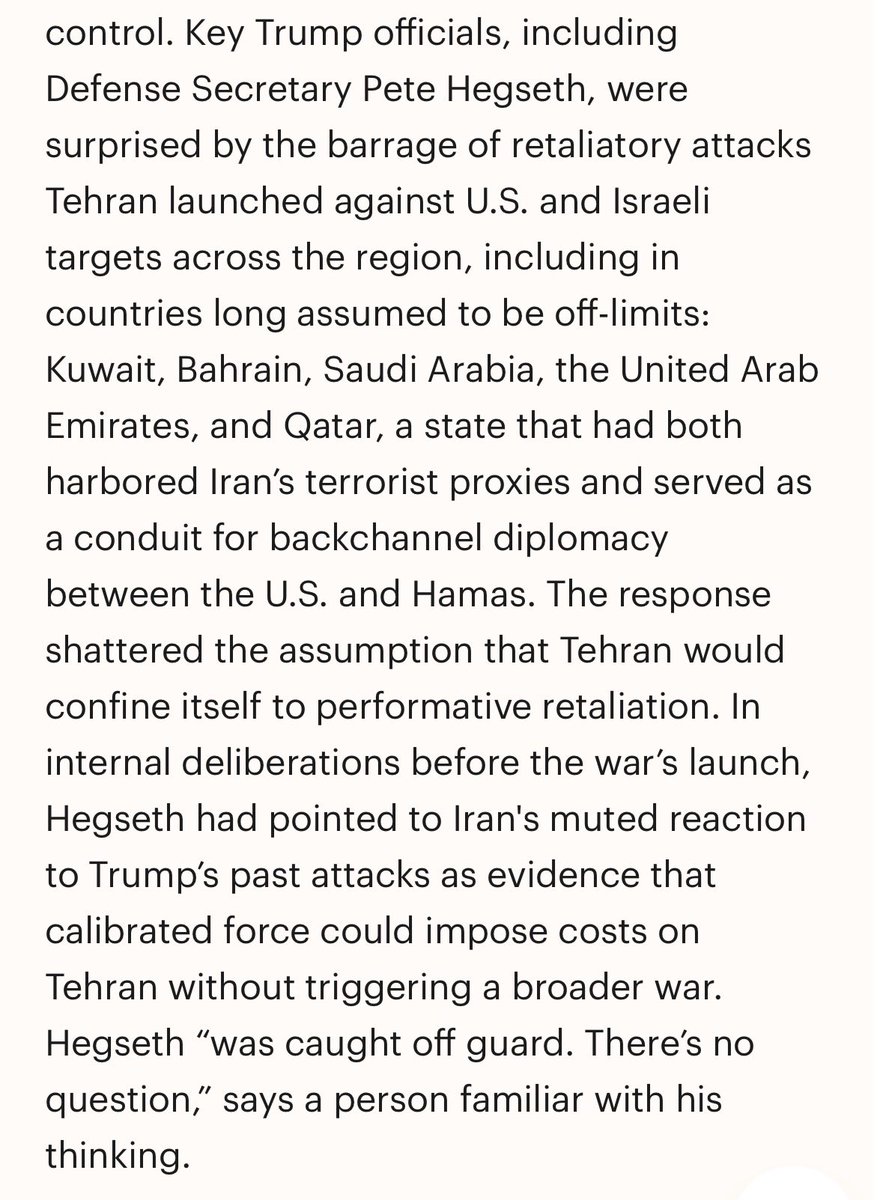
It’s not illogical to believe, as Hegseth allegedly did here, that the calibrated use of force by the U.S. would lead to a calibrated Iranian response. But what IS shocking is that he would see the war being waged by the U.S. and Israel as calibrated or limited in its aims. When we kill the top leadership of a country in the opening round and tell the people to take control, it’s a total war. As many (myself included) predicted, if Iran saw the U.S. and Israel as pursuing unlimited war aims (ie, regime change), it would cast aside that prior restraint. That’s exactly what’s happened.
English
@DalrympleWill The EU is afraid to anger the US, where internal power structures are Israel-aligned.
English

'‘Weak and pathetic’: why is the EU not using its leverage to stop Israel?"
theguardian.com/world/2026/apr…
English
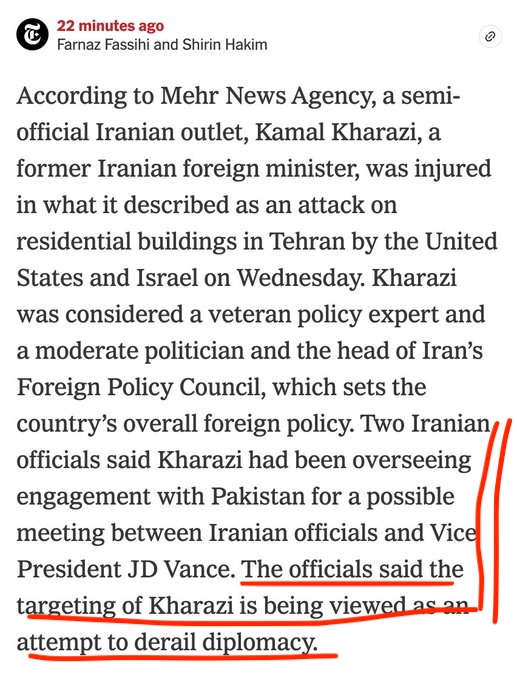
So Trump is supposed to give an address tonight at 9, and according to the White House, he is likely to announce a drawdown of the war, which depends on talks mediated by Pakistan.
Perfect time for Israel to try to kill the Iranian negotiator talking to the Pakistanis...
English
Larry Guy retweetledi
Seems the AP is an alleged news outlet allegedly engaged in journalism...

English
English

One battle after another: Netanyahu’s new security doctrine. “The attitude taken by Netanyahu and his supporters could be summed up as, ‘We don’t trust the Arabs and only believe in force and land.’” via @FT - great piece by @NeriZilber as.ft.com/r/d66f118a-478…
English