Wm. G. Fisher

1K posts

Wm. G. Fisher banner
Wm. G. Fisher

Wm. G. Fisher

@Cyfed

🇺🇸🇬🇧 Observer of geopolitics, economics, and oil & gas markets.

London, United Kingdom Tham gia Haziran 2010
312 Đang theo dõi94 Người theo dõi
החדשות - N12
החדשות - N12@N12News·
בישראל צפויים להציע לאמריקנים לבחון הקמה של בסיסים בארץ - העתקה של בסיסים ממקומות אחרים במזרח התיכון וגם הקמה של מתחמים חדשים, זאת על מנת לנצל את הימצאות הכוחות שכבר כאן ועל רקע השינויים האזוריים והאתגרים הביטחוניים המתמשכים @shapira_nitzan
עברית
29
25
275
139.1K
Iran Nuances
Iran Nuances@IranNuances·
Foreign ministers of Pakistan, Turkiye, Egypt and Saudi Arabia convene in Islamabad, a 4-way meeting trying to bring an end to the ongoing war in the region.
Iran Nuances tweet media
English
1
0
12
2.5K
Wm. G. Fisher
Wm. G. Fisher@Cyfed·
@WarMonitor3 Let's not forget that the US supplies weapons and intelligence to Ukraine against Russia. We can all recognise that as self defence, although Russia doesn't see it that way. Especially when it used to attack Russian energy assets.
English
0
0
0
278
WarMonitor🇺🇦🇬🇧
I can't believe this is not a bigger story, Ukrainian intelligence has reported Russian military intelligence fed Iranian military targeting data for the strikes that resulted in multiple service members and aircraft being destroyed in Prince Sultan airbase in Saudi Arabia.
English
607
1.4K
9.1K
283.7K
Wm. G. Fisher
Wm. G. Fisher@Cyfed·
@AdamMossoff @BenWeinthal When will the Strait of Hormuz be opened? Most of Asia wouldn't agree with your analysis as their economies are in paralysis.
English
2
0
19
985
Adam Mossoff
Adam Mossoff@AdamMossoff·
The U.S. and Israel are achieving in just a matter of weeks what it took Allies a couple years to do with their strategic bombing campaign against the Nazis in WW2. I'm also confident that the customers of the NY Times, Washington Post, CNN, etc. will not learn of this and other military achievements because it doesn't fit their narrative that we're losing our ineffective military operation against the Islamic regime of Iran. The media is actively misleading the American public. The media also bemoans the massive loss of trust in them as an essential institution in our society. They should take a long look in the mirror when they talk about the causes of the loss of this trust.
Imtiaz Mahmood@ImtiazMadmood

All three of Iran's largest steel plants were struck simultaneously last night. Mobarakeh. Esfahan. Khuzestan. 70% of Iran's steel output. Gone in one night. Iran built its steel industry specifically to survive sanctions. Israel hit the sanction hedge. - @MarioNawfal

English
330
1.1K
5K
425.1K
Wm. G. Fisher
Wm. G. Fisher@Cyfed·
@Glinner @BenWeinthal Not hatred of Jews. Disagreement with extremist Israeli policies is not the same as hating Jewish people. Accusations of “Jew hatred” can be used, through the choice of words, to create division and justify extremist actions.
English
0
0
0
39
Marco Foster
Marco Foster@MarcoFoster_·
HAPPENING NOW: A MASSIVE crowd has gathered in Boston, MA for a No Kings Day protest against convicted felon Donald Trump and his corrupt regime
English
1.6K
11.6K
41.1K
2.4M
Nader Itayim | ‌‌نادر ایتیّم
CBS: 🇺🇸🇮🇷 Washington to send the USS George Bush aircraft after carrier to engage in military ops against Iran. By the time it reaches the region, the US will have three nuclear-powered aircraft carriers operating within striking distance of Iran. That's significant. #oott
قناة الجزيرة@AJArabic

#عاجل | سي بي إس نيوز عن مصادر: واشنطن سترسل حاملة الطائرات يو إس إس جورج بوش لمنطقة العمليات العسكرية ضد #إيران

English
1
12
21
9.7K
Wm. G. Fisher
Wm. G. Fisher@Cyfed·
@NickKristof @lrozen 90 missiles per year is the "minimum sustainment rate" at which the U.S. has been ordering and receiving missiles in recent years. Recent budgets for FY25 and FY26 actually requested even fewer, shifting focus toward "recertifying" older missiles rather than building new ones.
English
0
0
0
44
Wm. G. Fisher
Wm. G. Fisher@Cyfed·
@NickKristof @lrozen That's not accurate. 600 missiles per year is the estimated maximum capacity of the existing production lines if they were fully funded and running at 100%. It is not the number currently being built, but rather the limit of what the current infrastructure could produce today.
English
2
0
1
390
Nicholas Kristof
Nicholas Kristof@NickKristof·
In just four weeks in this unnecessary Iran War, the US has used up 850 Tomahawk missiles -- which at present production rates will take 15 years to replace. Resulting low stockpiles of weapons reduce our deterrent capacity in East Asia and elsewhere. washingtonpost.com/national-secur…
English
27
137
263
20.2K
Wm. G. Fisher
Wm. G. Fisher@Cyfed·
@JimHansonDC @BenWeinthal Europe didn’t create the conditions that made it vulnerable to a potential closure of the Strait of Hormuz. That situation arose from actions taken by Israel and the United States, with limited consideration for the broader impact on other countries.
English
0
0
0
31
Dan Lamothe
Dan Lamothe@DanLamothe·
@TaraCopp @noahjrobertson @AlexHortonTX One official characterized the number of Tomahawks left in the Middle East as “alarmingly low,” while another said that without intervention, the Pentagon is closing in on “Winchester” — military slang meaning out of ammunition — for its supply of Tomahawks in the Middle East.
English
11
57
232
71K
Dan Lamothe
Dan Lamothe@DanLamothe·
SCOOP: The U.S. military has fired more than 850 Tomahawk cruise missiles in four weeks of war with Iran, burning through the precision weapons at a rate that has alarmed some Pentagon officials and prompted internal discussions about how to make more available.
English
53
292
1.2K
852.2K
Wm. G. Fisher đã retweet
Raz Zimmt
Raz Zimmt@RZimmt·
Some insights on Iran’s situational assessment nearly a month into the campaign: A. Iran is interested in a ceasefire. However, from its perspective, there is a worse scenario than a ceasefire, namely, a temporary ceasefire. Following the 12-day war in June, senior Iranian officials and commentators warned that it would only be a temporary ceasefire and that the U.S. and/or Israel would resume attacking Iran in the near future. Tehran is not prepared for endless cycles of war and therefore insists on ending the current campaign with guarantees that no further attacks will occur. B. Surrender has never been part of the Islamic Republic’s lexicon and is not on the table even a month after the outbreak of the war. Regardless of the Iranian leadership’s current assessment of its situation, it is not willing to concede to American demands. This is also tied to the identity of Iran’s current leadership, which is largely composed of veterans of the Islamic Revolutionary Guard Corps, whose formative experience is the Iran–Iraq War. Iran’s leaders belong to hardline circles that not only viewed the 8-year war as a national trauma shaping their strategic outlook, but also adopted the revisionist narrative of a “stab in the back,” according to which Khomeini was forced to “drink the poison chalice” after being betrayed and misled by politicians led by Akbar Hashemi Rafsanjani and Mir-Hossein Mousavi, who compelled him to accept a ceasefire with Iraq. Will the new leadership in Tehran nevertheless be willing to make certain compromises that Iran rejected prior to the war? Possibly. Will it eventually conclude that it cannot bear the costs of the war and become willing to make even more far-reaching concessions? Perhaps. But for now, this is clearly not on the agenda. C. To this should be added Tehran’s current assessment, which is based on several assumptions: 1) They believe that, after the initial blow they suffered in the early days of the war, they have managed to adapt to the situation. 2) They assess that there is currently no significant threat to regime stability. The growing number of reports citing intelligence assessments and leadership circles in Washington and Jerusalem that the war will not lead to the collapse of the Iranian regime, alongside the adjustments made by security forces to attacks on IRGC bases, Basij headquarters, and internal security forces, reinforce this assessment in Tehran. 3) Tehran has adopted a “mindset of achievement” (and perhaps even a sense of victory), based on the belief that not only will the Islamic Republic survive the war, but that it can leverage its asymmetric capabilities—foremost among them the (partial) closure of the Strait of Hormuz and attacks on critical infrastructure in Gulf states—as a strategic leverage. This could enable Iran not only to return to the pre-war status quo but also to establish a new regional architecture based on recognition of its sovereignty over the strait, and possibly even the withdrawal of U.S. forces from the region, taking into account Iran’s regional standing and its capacity to inflict damage on the global economy. 4) In Tehran’s assessment, the two main escalatory options available to the U.S. are strikes on Iran’s energy and electricity infrastructure, and a ground operation to seize control of the strait or one of the islands (Khark or Abu Musa). Iran does not ignore this possibility, but believes that its own escalation could at the very least disrupt American plans. In the event of strikes on Iranian infrastructure, Iran has the capacity to retaliate in ways that would severely damage critical infrastructure across the region. In the case of a ground operation (even if successful), it is doubtful that it would allow for the immediate reopening of the strait. Seizing Khark Island would expose U.S. forces to Iranian fire, and it is uncertain whether the high economic cost to Iran would translate into immediate Iranian concessions, as Tehran may be able to absorb the economic consequences for weeks or even months while continuing to impose high costs on U.S. forces, regional states, and the global economy. Even a successful operation in the strait itself would not necessarily prevent Iran from continuing to threaten tanker traffic, for example, by drones, and this alone provides a level of deterrence that could prevent the resumption of activity in the strait even in the event of a successful U.S. military operation. In sum, Iran is open to diplomacy, negotiations, and possibly even significant compromises—but without relinquishing minimum demands, including guarantees against the resumption of hostilities, sanctions relief (which could be framed as reparations), and the preservation of certain nuclear capabilities, especially missile capabilities. If an agreement with the U.S. cannot be reached based on Iran’s position, Tehran is prepared to continue a prolonged war of attrition, based on its assessment that its resilience and stamina are greater than those of the U.S. and its regional allies. In any case, from Tehran’s perspective, the cost of total capitulation remains far higher than the risks of continuing the war.
English
28
141
438
196K
Wm. G. Fisher
Wm. G. Fisher@Cyfed·
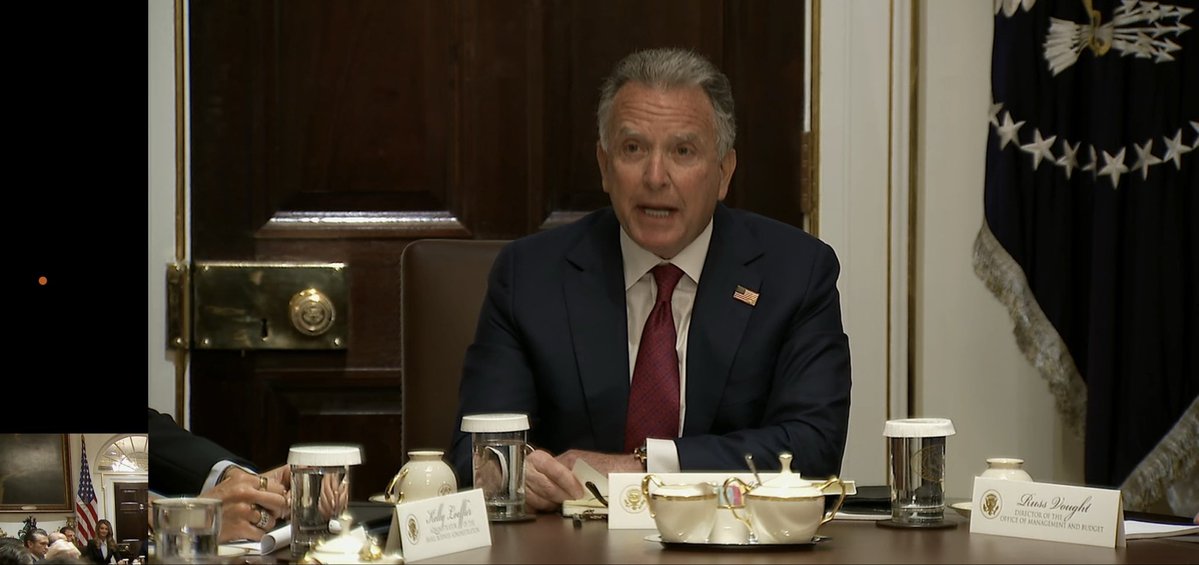
@JenniferJJacobs Steve Witkoff was the most visibly shaken speaker at yesterday’s cabinet meeting, delivering his remarks from a prepared script.
English
0
0
0
86
Jennifer Jacobs
Jennifer Jacobs@JenniferJJacobs·
Witkoff in cabinet meeting confirmed Pakistan is passing messages from US to Iran. "I can report to you today that we have, along with your foreign policy team, presented a 15 point action list that forms the framework for a peace deal. This has been circulated through the Pakistani government, acting as the mediator," @SEPeaceMissions said.
Jennifer Jacobs tweet media
English
41
272
939
128.3K
Wm. G. Fisher đã retweet
Ryan Scott (Horse)
Ryan Scott (Horse)@TheFlowHorse·
Can’t help but think of this Sun Tzu quote with everything going on: “Victorious warriors win first and then go to war, while defeated warriors go to war first and then seek to win”
English
13
30
335
21.1K
Phil Stewart
Phil Stewart@phildstewart·
Fed's Cook says the balance of risks has shifted toward inflation due to Iran war
English
2
7
34
46.6K