Arthur Uhimov

976 posts

Arthur Uhimov banner
Arthur Uhimov

Arthur Uhimov

@ArthurUhimov

Executive Director, Strategic Research Development at Columbia University’s Zuckerman Mind Brain Behavior Institute @ZuckermanBrain @columbia

New York, NY Katılım Nisan 2010
2.5K Takip Edilen758 Takipçiler
Arthur Uhimov retweetledi
Shae McLaughlin
Shae McLaughlin@shae_mcl·
It’s estimated that the Protein Data Bank (PDB) cost around $13B to create. Alphafold was only possible because of it. If we want ML to solve biology, we should be funding the creation of databases and the development of new assay technologies. ML is nothing without data.
English
39
172
1.3K
154.1K
Arthur Uhimov retweetledi
Ishmail Abdus-Saboor
Ishmail Abdus-Saboor@IshmailSaboor·
My favorite service of the year. Selecting awardees for the BWF PDEP fellowship - the next generation of postdocs from diverse backgrounds who will lead inclusive labs and build community.
Ishmail Abdus-Saboor tweet media
English
0
5
43
1.6K
Arthur Uhimov
Arthur Uhimov@ArthurUhimov·
Highly recommended for grant red-teaming! q.e.d breaks your proposal into its underlying claims, flags inferential gaps and overstated conclusions, and proposes fixes. Pre-submission, private, ~30-minute turnaround. The kind of pointed critique you'd want from a tough study-section reviewer without the two-week wait for feedback from colleagues or the dreaded 9-month delay from having to resubmit.
Oded Rechavi@OdedRechavi

Important announcement!!!🫵💥💫 Would you have a tooth pulled if it helped your chances to get an important grant funded? Absurd question (obviously), but the situation right now is so bad funding-wise, that I bet some of you actually considered it for a second… Well, don’t get desperate - we created a new tool that might help! (keep your teeth!) I’m excited to announce that as of today we are officially releasing “QED for Grants” for everyone. What started off as an extension of our existing paper review platform, grew in the last few months to an entirely new design. We’ve been working like crazy on this, and although we have more things we want to add in the (very near) future, we decided to release our AI for grants NOW, earlier than planned. It’s not perfect, no AI is, but for the first time, when I run my own grants through @qedscience, I feel it gets the research, finds real problems, and gives me very useful feedback that I can implement before submission. It’s like sending it to 20 scientists from my domain, knowing they’ll agree to dedicate their entire week to carefully read and comment on every line. It’s very important to write your own grants yourself, it makes you think hard and you learn a lot from doing it, and q.e.d’s system is designed to preserve these positive aspects and augment them - you get feedback on your own writing, we don’t write for you!! But at the same time, a typical PI spends many months every year writing proposals and sadly only a tiny fraction gets funded, even if the ideas are good. When you are forced to submit an unreasonable amount of grants the quality of the writing drops, and rejection rates increase. Not because the essence is bad. It’s simply too competitive right now (the cuts made it so much worse) and if your proposal is not super clear and tight, and if it’s not a perfect fit for the grant you’re submitting, you’re doomed. Our grant solution is not an authoring, text-generating tool. It gives you constructive feedback on your writing (it comments on the deep things, not grammar and typos). It’s meant to help you with the questions that torment you late at night (“is this a good fit?”, “Is this novel enough?”, “Did I miss something?”). Tens of thousands of you already use q.e.d to improve your manuscripts and critically read papers, we built the grant tool by the same principles (you’ll identify many of the features that you told us you like). We’ve processed thousands of proposals, learned where things fail, where reviewers get stuck, why good ideas come out weak. We interviewed hundreds of scientists, and also experts who work in funding agencies and university research authorities, and implemented their feedback (we’re constantly looking for more feedback). Our AI is always happy to give you constructive (and polite!) critique, and it will go through your grant line-by-line, forcing you to improve clarity, flag weak points, and push the whole thing to a higher standard. We study, in scale, what gets funded and what doesn’t, and what is the perfect fit for each type of grant. So please, use it, pressure-test it, tell us where it fails, and together we’ll improve it every day to put you in the best position for actually testing your ideas in the real world. As always with q.e.d, the system is completely secured and private, and we are NOT training on your data (see the FAQ on our website). Please like, retweet, and share with your favorite colleagues! (link to the platform below in the thread👇)


English
1
2
6
2.9K
Arthur Uhimov retweetledi
q.e.d Science
q.e.d Science@qedScience·
Scientists spend 100+ days a year writing grants. Almost none get funded. Not because the ideas are bad, but because the system is broken, and you fall in the cracks. Today we launch qed for grants, an AI reviewer that makes YOUR proposal stronger before you submit (it doesn’t replace you, you do the writing). Novelty. Logic. Methodology. Fit for the call. Making sure nothing is missed. Early access open. 🔒🩶 @nivmast @OdedRechavi
English
8
35
197
29.9K
Arthur Uhimov retweetledi
LomvardasLab
LomvardasLab@LomvardasLab·
Congrats to our colleague @ColumbiaBiochem Hashim Al-Hashimi for this great accomplishment!!! 12th active member of the department elected in the academy!
National Academy of Sciences@theNASciences

We are thrilled to announce the election of 120 members and 25 international members to the National Academy of Sciences in recognition of their distinguished and continued achievements in original research. Congratulations to our new #NASmembers and welcome to the Academy! 🎊

English
3
2
14
1.7K
Arthur Uhimov retweetledi
Roots of Progress Institute
Roots of Progress Institute@rootsofprogress·
Announcing Progress Conference 2026 Hosted by @rootsofprogress with @abundanceinst @foresightinst @JoinFAI @HumanProgress @IFP @TheIHS and @WorksInProgMag. Speakers include @tylercowen @dmitri_dolgov Michael Kremer, John Martinis, Stephen Winchell. Oct 8-11 • Berkeley, CA Other fantastic speakers: @A_G_I_Joe @jasoncrawford @erika_alden_d @kesvelt @_alice_evans @bobbyfijan @Gena_I_Gorlin @akoustov @moxie @AndrewMillerYYZ @Brendan_McCord @patio11 @ryanzip @UrbanCourtyard @KelseyTuoc @brianpotter @rSanti97 @noor_siddiqui @mspringut @Vernon3Austin @Scott_Wiener … and more to come. A big thanks to our early sponsors: @coeff_giving @AsteraInstitute @JaneStreetGroup Ken Broad @WorksInProgMag @LENSDetect @MNX_fi @ArchbridgeInst @GoodSciProject @TheIHS @CirculateSD @feeonline (Sponsorship opportunities still available). Four days of intellectual exploration, inspiration, and interaction that will help shape the progress movement into a cultural force. Tracks this year explore Human Talent & Potential, AI & Robotics, and Security & Resilience. Participants will attend talks on topics ranging from drone delivery to housing construction to psychology and philosophy of builders, organize and run unconference sessions, mingle in garden, and more. Thursday and Sunday are add-on days, with optional gatherings for interest groups and other activities like factory tours to Bay Area startups. We're excited to continue this regular gathering of the progress community. Let's get together again in Berkeley this fall!
Roots of Progress Institute tweet media
English
12
63
386
166K
Arthur Uhimov retweetledi
Ishmail Abdus-Saboor
Ishmail Abdus-Saboor@IshmailSaboor·
This program transformed my career. Give it a shot! @hhmi_science's #FreemanHrabowski Scholars Program offers early career faculty up to $10M over 10 yrs, + salary & benefits. Postdoc? This year's comp has a program for you too. Opens 11/3! bit.ly/4vhC0LA
English
0
19
95
10.8K
Arthur Uhimov retweetledi
Oded Rechavi
Oded Rechavi@OdedRechavi·
Every PI
English
11
103
814
155.4K
Arthur Uhimov retweetledi
q.e.d Science
q.e.d Science@qedScience·
@NIH award rates just hit historic lows. Every submission has to be sharper. But 70% of researchers still use AI for writing polish. Only 19% for methodology or statistics. The pressure is rising. The tools are stuck at the surface❗😓📉
English
0
3
8
3.7K
Arthur Uhimov retweetledi
Oded Rechavi
Oded Rechavi@OdedRechavi·
I think I’ll start posting about the lessons I’m learning as part of this new thing I’ve been doing (my attempt to change the landscape of scientific publishing and consequently how science is done) One lesson I’ve learned (and also unlearned…) is that it’s very convenient to put all the blame on journals. I’ve done it myself for years. And yes, many of the criticisms are valid. They make way too much money at our expense and are often not very good at distinguishing good science from bad science. Some of them (not all of them! There are good journals too!) bring very little value and can even slow scientific progress. They can be inefficient and biased, and journal names are a very poor substitute for quality. But the more I work on this, the harder it is for me to believe that journals are the only problem (even specifically when it comes just to publishing science). Universities are equally at fault. And I don’t just mean that we, the scientists doing the reviewing, are part of the problem (which we are, obviously). I mean the institutions we belong to, and the way they make decisions. Hiring, promotions, funding allocation - these processes are often opaque, subjective, and not particularly scientific. They are slow, inefficient, and they rely on journal brands as a shortcut. I used to think journals were driving this, but it’s obviously more like a loop. Journals could not stay the way they are if universities changed how they evaluate quality, because they would lose much of their justification to exist. But universities do not evaluate science directly, because there is too much of it and not enough experts available and time (or money to pay reviewers). So they rely on journal prestige, while journals rely on institutional reputation. Where you do your science ends up mattering more than what you discover, and this affects publication, which affects funding, which determines whether you can even pursue your ideas. This can be exploited, of course, but I don’t think institutions (or the responsible faculty/management) behave this way because they are evil or greedy. They do it because evaluating science properly is ridiculously hard and time-consuming, and the system does not reward doing it well. But the important question is can we change the way our universities work, or is it an impossible task? What I've learned working on this problem is that we can. In addition to engaging with management we can influence the system in other ways. In many cases we don’t need their approval. We are the ones who form the committees. I believe we can break the loop, if we target the mechanism of science evaluation. Journals will keep their power, shortcuts will keep dominating, and the same biases will keep reproducing themselves unless we change how we evaluate science (how we do review). If we can find ways to critically evaluate science at scale, rigorously and transparently, we can change how decisions are made.
English
18
47
205
43.7K
Arthur Uhimov retweetledi
Denis Wirtz
Denis Wirtz@deniswirtz·
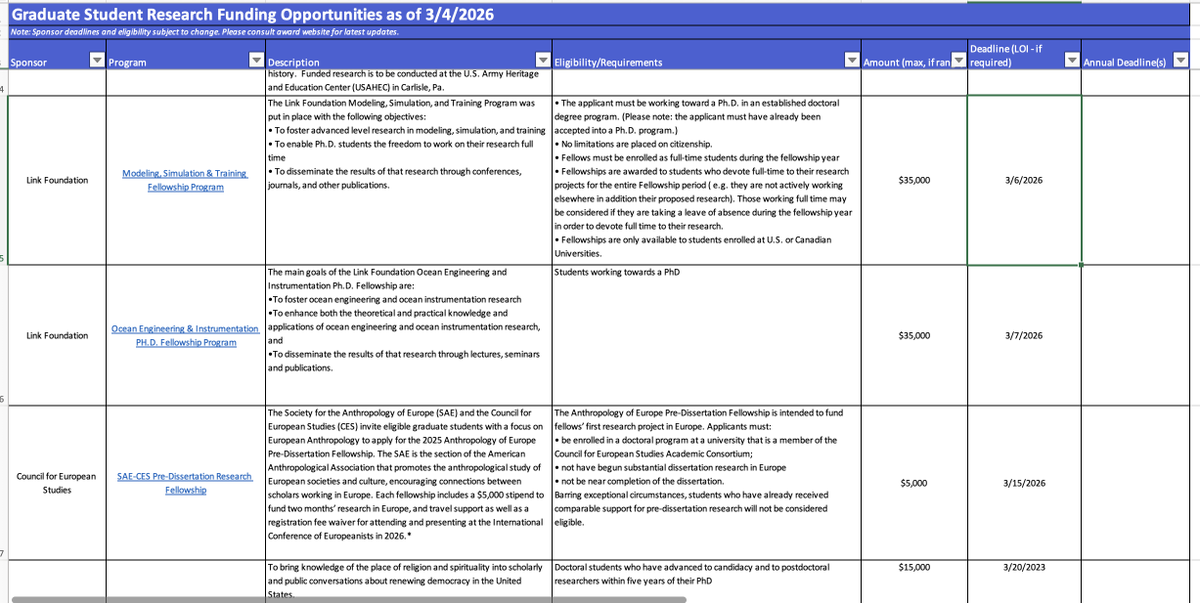
Download our updated database of PhD fellowships. We list 177 fellowships. For each entry, we provide the amount of the fellowship, deadline, eligibility/requirements, description, etc Download this database here: research.jhu.edu/rdt/funding-op…
Denis Wirtz tweet media
English
1
144
463
42.6K