Harish

280 posts

Harish banner
Harish

Harish

@DesignHarishp

I design products startups are proud to ship · UI/UX · Web & Mobile · 4+ yrs · Bangalore · Freelance open · Let's build something ✦ Open for freelance 🤝

Bengaluru South, India Katılım Nisan 2026
178 Takip Edilen36 Takipçiler
Harish
Harish@DesignHarishp·
@sxontz chatgpt for prompt structuring before stitch is a smart layer - 3 hours for 50% UI coverage in beta is wild 👍
English

0
0
0
15
Shontz
Shontz@sxontz·
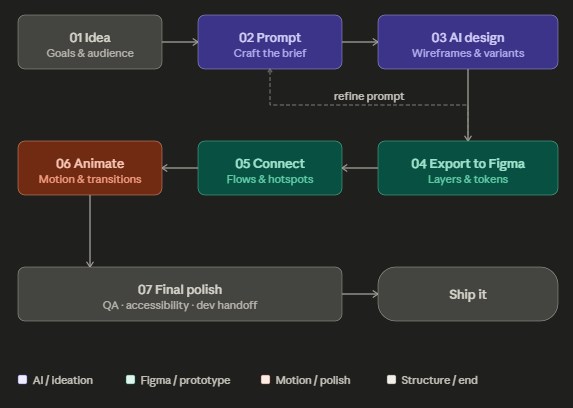
One of the funniest things about AI right now is how fast it can completely change the workflow of a project. We had a deadline to complete almost 50% of the UI/UX design for our project in Figma. Normally this type of work takes a lot of time: collecting inspiration, searching for images, organizing layouts, adjusting sections, translating content, and refining the overall design flow. But this time? It took me only around 3 hours to complete. And honestly, a huge part of the credit goes to AI tools. Here’s exactly how I did it: First, I used chatGPT to improve and structure my prompts properly. Instead of giving random instructions, I explained the project requirements clearly: • what type of UI I wanted • what sections were needed • the design mood and layout style • color direction • bilingual support requirements • user flow expectations Then I took those refined prompts and used Google Stitch. And this is the crazy part: Google Stitch is still in beta and completely free right now, but the execution felt surprisingly good. I didn’t even need to manually collect images for most sections. The AI handled layout generation, visual direction, and structure almost automatically. What impressed me the most was the language support. Our project requires both English and Bangla versions, and Stitch handled both without creating messy layouts or broken alignment issues. After generating the designs in Google Stitch, I exported everything directly into Figma. From there, my work became much easier: I just manually connected the pages, adjusted some flows, added animations, refined a few interactions, and polished the final experience. So instead of building every single screen from scratch, I was focusing more on refinement and user experience. The workflow literally became: From a simple idea to a complete UI. Used AI for the initial design, imported it into Figma, linked every page manually, added smooth animations, and wrapped it up with the final polish. Instead of spending hours doing repetitive tasks, we spent more time refining ideas and discussing improvements as a team. At one point my team members were literally chilling while the AI was handling most of the heavy lifting 😭 This honestly made me realize something important: People who learn how to communicate with AI tools properly will move much faster than people who only rely on traditional workflows. Prompting is slowly becoming a real skill. AI is not replacing creativity. It’s removing unnecessary friction between ideas and execution. And the funniest part? Even the flowchart image I’m sharing in this post was generated using AI through Claude 😭 We are entering a phase where ideas are becoming more important than manual execution speed. And honestly, we are still very early.

Shontz tweet media
English
13
0
33
355
Harish
Harish@DesignHarishp·
@harshsoni_hs url to frontend in 10 mins is wild - prompting is literally the new wireframing 👍
English
1
0
1
5
Harish
Harish@DesignHarishp·
@LabCuan @Deep_GeniusAi workflow structure over prompting is exactly it - treating claude like a system rather than a search bar is where the quality gap closes 👍
English
0
0
0
14
CuanLab
CuanLab@LabCuan·
@Deep_GeniusAi That 4-hour video gap is real. I spent months thinking my prompts were the issue, when it was actually my workflow structure. Once I stopped treating Claude like a chatbot and started building systems around it, output quality jumped 3x. The skill isn't prompting, it's archite...
English
1
0
1
2
|| Deep Genius AI || AUTOMATION || AI ||
- utiliser Claude pendant 6 mois - avoir l’impression de passer à côté de quelque chose - voir que tout le monde obtient de meilleurs résultats - regarder la video de 4 heures - premières 20 minutes - réaliser que je l’utilisais complètement mal - 4 heures plus tard - tout change - il y avait tout un système derrière ça ? - problème de skill découvert
Jouhatsu | AI Influence Operator@Jouhatsu_ai

COURS COMPLET CLAUDE CODE de 4 HEURES C'est le guide Claude le plus complet que j'ai vu sur internet. ( J'ai transcrit en français ) Mets-le en Signet 🔖 avant de l'oublier. 4 heures. Construire des outils. Automatiser son travail. Apprendre comment les gens créent des bots et des systèmes. Claude → Outils → Automatisation → Produits → Argent

Français
18
78
1.7K
632.7K
Harish
Harish@DesignHarishp·
@_Daddyzgirl context files carrying the core logic is the real win here - onboarding gap before dashboard is always the first thing users bounce on 👍
English
0
0
1
16
Cassandra
Cassandra@_Daddyzgirl·
Day 12 of the Design to MVP Bootcamp We sent our first scaffold prompt and built the first version of the app. The result was a working product with noticeable gaps We spotted: • No form validation • Some UI inconsistencies • No onboarding before the dashboard • Slow dashboard performance • A generic landing page But the interesting part was this: The core functionality still worked properly because of the context files we gave AI. That was a big lesson for me. AI is powerful, but it’s not perfect. It still needs structure, direction, and guidance. The real skill is not just using AI. It’s knowing how to guide it. CC: @Joe_brendan_ @devanddesignhq
English
1
0
7
439
Harish
Harish@DesignHarishp·
@osidenko_ @nickarner @paper decade of pitch videos is such a strong base for this - visual storytelling translates directly into knowing what to cut 👍
English
0
0
0
22
Oleksandr Sidenko
Oleksandr Sidenko@osidenko_·
@nickarner @paper this is the shift. taste plus a clear picture in your head, the tool stops being the bottleneck. spent a decade making pitch videos. building things now in figma and claude i wouldn't have shipped two years ago.
English
1
0
1
60
Nick Arner
Nick Arner@nickarner·
My background isn't as a designer, but, using Claude and the @paper MCP has been a huge unlock as far as making things that I had "in my head" that I wouldn't be able to do from scratch in a traditional design tool
English
3
1
37
2.7K
Harish
Harish@DesignHarishp·
@BaasElisa chatgpt for visuals, claude for copy is a solid split - the tone gap between the two tools is real once you start mixing outputs 👍
English
0
0
0
9
Elisa Baas
Elisa Baas@BaasElisa·
ChatGPT trade-offs: • Writing can feel templated/corporate • Video gen isn’t the play here anymore Best combo: 1) Create visuals in ChatGPT 2) Drop them into a Claude workflow for the final copy Two tools. One output.
English
1
0
1
39
Elisa Baas
Elisa Baas@BaasElisa·
Team Claude vs Team ChatGPT is the wrong debate. The real edge in 2026: pick the tool per job, then stitch the workflow. Here’s how I split it (and why switching beats loyalty). #AI #Productivity
Elisa Baas tweet media
English
1
0
0
23
Harish
Harish@DesignHarishp·
@farhadalionez cursor + figma mcp combo is wild for closing the design-to-dev gap fast 👍
English
1
0
1
18
Farhad Ali
Farhad Ali@farhadalionez·
2, Once you have clarity, move to Cursor with your PRD. Cursor + Figma MCP + the Figma Console MCP (third-party) is a ridiculous combo.
Farhad Ali tweet media
English
1
0
1
30
Farhad Ali
Farhad Ali@farhadalionez·
Day 6 of 90. Today I figured out my product's core features and how I'm going to build them. Here's the exact workflow I used
English
4
0
0
9
Harish
Harish@DesignHarishp·
@DamiDina @illscience @benedictevans claude replacing figma for senior designers is wild but makes sense - the gap is still that handoff layer between design intent and dev output 👍
English
0
0
1
28
Dami Dina
Dami Dina@DamiDina·
for design tools specifically i think there is a lag in usage data. related to that most ppl i speak to who lead big design teams have not used figma for months now. they use claude, etc. for the future of design related to PMs and Eng, it is likely workflows need to improve here to have enterprises, agencies and individuals want to pay for subscription and some usage based fees. ROI and cross collaboration with AI at the core (ai native) is not there / there is no tool like this. figma has an opportunity here but not clear when or if someone else will beat them to it (big risk for figma imo)
English
2
0
2
74
Anish Acharya
Anish Acharya@illscience·
this is a great summary of the software is dead / long live software conversation from @benedictevans: - the cost of building software was never the moat, but free code does mean new margin structures and competitive threats - we’re about to live in a world awash in software, including new types like “just-in-time” / high frequency software and disposable software - figma just blew out earnings as a nice reminder that no one knows anything and perhaps we should all just breathe
Anish Acharya tweet media
English
7
7
31
2.6K
Harish
Harish@DesignHarishp·
@kyl3kan taste as the compression filter is the part most skip - anyone can ship a feature, fewer can decide what to leave out 👍
English
0
0
1
12
Kyle
Kyle@kyl3kan·
Good product work is compression. You take messy inputs, user complaints, edge cases, broken workflows, and model uncertainty, then turn them into one clean decision the user does not have to make. AI adds leverage. Taste decides what gets compressed.
Kyle tweet media
English
1
0
1
4
Harish
Harish@DesignHarishp·
@rishisb @Shpigford @hnshah @joshpuckett claude code for design system tokens across 5 platforms is a pain most designers underestimate - the wcag compliance layer alone makes it worth the setup 👍
English
1
0
0
27
Rishi S Bhilawadikar
@Shpigford @hnshah @joshpuckett Great list. Interface craft has been very helpful. Claude design for standing up production grade, WCAG compliant, multi-platform design systems was painful — used Claude code for that and it gives much better control across web, Mac, windows, iOS, android front ends.
English
1
0
2
504
Josh Pigford
Josh Pigford@Shpigford·
favorite AI design tools/resources that play a regular part in my process as of this singular moment... 1. interfacecraft.dev - Incredible resource AND tools from my buddy @joshpuckett. Probably the most craft-oriented designer I know who's also fully embraced AI as part of their process. Lots to learn from and lots of great tooling to nail UI details. 2. ui.sh - From @adamwathan and @steveschoger. The /ui skill that comes with this helps immensely with following good design principles and helping your UIs stay more consistent. Also has a killer interactive component that generates multiple iterations of an idea so you can narrow in on exactly what you want. 3. mobbin.com/mcp - "Pull 20 different error notification states to find common patterns among mobile apps" 4. claude.ai/design - Incredible tool for generating design systems for use in your apps and in marketing materials. Hard to overstate how good this is. Honorable mention: impeccable.style - I've seen a lot of folks talk about this but just haven't had a chance to try it yet. (These could all get thrown out the window tomorrow, as is the nature of AI progress.)
English
18
46
835
63.9K
Harish
Harish@DesignHarishp·
@KernelHappy @El_raeyy @gregisenberg skill file as a rolling context anchor is such a clean workaround for session drift - shazam as the build trigger is a nice touch 👍
English
1
0
2
21
KernelHappy
KernelHappy@KernelHappy·
Don't make excuses just do it Create a project. Start a session and tell Claude you want to create skill files to do xxxx, you will describe the basic idea, Claude will ask me questions and provide suggestions, but don't build anything himg until I say shazam. Once the design feels right have Claude build the skill file, upload it back into the project (don't make it a global skill). Then ask Claude to give you a prompt to use in a new session in the project. Start a new session and run the prompt. Once the context feels 30-40% full ask Claude if you should continue or start a new session, if it's time to start a new session ask Claude to update the skill file, download it and replace the version in the project, start a new session. If you do this Claude will track your vision/goals like he's on rails. This works in web priekcts and Claude code. I've used this to create projects/skills that build complex vba do do db pulls and transforms in my preferred way, setup my home automation, build my home lab, design esp32 projects, review construction contracts, debug wonky windows crashes, design electronic circuits and draw electronics line diagrams.
English
2
1
3
40
GREG ISENBERG
GREG ISENBERG@gregisenberg·
How to make really good Claude skills (clearly explained in 42 seconds)
English
44
32
419
28.8K
Harish
Harish@DesignHarishp·
@lsparrish 43 ships with no hit is brutal and honest - conversion is the part claude can't feel for you 👍
English
1
0
1
7
Luke Parrish
Luke Parrish@lsparrish·
Ship It by Claude Sonnet A story about distance Jake kept a Notion doc. Not for architecture decisions or system design — he kept it to record every app he had shipped that died. The landing page with zero signups. The tool he built in a weekend that three people used once. The AI wrapper that got two upvotes on Product Hunt, both from his mom's different accounts. The doc was long, and he refreshed his analytics dashboard the way other men checked their pulse. He worked from a coffee shop on Divisadero that had bad wifi and good vibes. He had shipped forty-three projects in two years. He had not shipped a success. He wasn't sure whether this was volume or something else, something harder to name. His process was clean. He described the thing he wanted to Claude. Claude built it. He iterated by feel — "make it more premium," "the button should feel heavier," "add some breathing room" — until it felt right. It always felt right eventually. It never found users. His conversion rate across all forty-three projects was, if you averaged it, close enough to zero that the difference was not worth discussing. · · · The woman at the next table was named Soo-Jin. She had a PhD she didn't talk about and a laptop covered in no stickers, which Jake found vaguely threatening. She asked once what he was building. He explained. She watched him work for twenty minutes without saying anything. Then she said: "you don't know if it's working or if it's just different." He looked up from his screen. "You iterate by feel. You make version eight and it feels better than version seven. But 'feels better' isn't a distance. You don't know if the gap between version seven and version eight is the kind of gap a user could even perceive — or care about. You're measuring in your own units. The units don't transfer." He started to say something about intuition. She kept going. "There's a concept called Fisher-Rao distance. It measures how far apart two distributions are — not by subtracting them, but by asking how hard it would be to tell them apart with real data. Two things can look very different to you and be nearly indistinguishable to anyone else. Or they can look almost identical and be worlds apart in the only dimension that matters. The geometry is curved. Your intuition assumes it's flat." · · · He asked her to say more. She did, and he listened the way he hadn't listened since before he learned he could just ask the model. The insight, she said, was not about design. It was about what distance means. When Jake made something "feel better," he was moving through his own preference space — a space that might have nothing to do with the space his users inhabited. The question was never how much did I change it. The question was: is this change one that the world can tell happened? Distance is not how different things look to you. Distance is how hard it is for someone else to know they are different. Jake stared at his screen. He had forty-three apps. He had iterated each one dozens of times. He had moved enormous distances in his own coordinate system and almost no distance at all in anyone else's. His whole practice was motion in a space that didn't intersect with the space where users made decisions. It wasn't that his taste was wrong. It was that taste operated on a manifold, and he had been measuring Euclidean distances on a curved surface, getting numbers that meant nothing, confident he was moving in the right direction because the numbers were changing. · · · He went back through the Notion doc. Most of his failures, he saw now, had the same shape. He had been varying things that sat close together in user-perceptible space — color palette, button weight, the exact radius of a border — while leaving untouched the things that were genuinely far apart: what the product was for, whether the problem existed, whether anyone would think to look for a solution. His forty iterations on the hero copy had moved him maybe five feet. The question of whether anyone wanted the thing at all was a distance he had never tried to cross because he couldn't feel it from where he was standing. A handful of the failures were different. In those, he had been close — the problem was real, someone wanted it — but he had optimized for his own aesthetic and stepped sideways off the path, polishing himself into a niche of one. He didn't feel better. But he felt like he finally knew what the map looked like. · · · There's a particular loneliness in vibe-coding. You and the model get into a flow, and things come out beautiful, and you keep refining because refinement feels like progress, and nothing ever ships into meaning. You can spend six hours making something more premium without once asking whether premium and unpremium are distinguishable to the person you're building for. The model will help you go anywhere. It cannot tell you which distances are real. Jake rebuilt his process. Not the tools — the tools were fine. He started every project by writing down the sharpest version of the question: what would have to be true for a stranger to choose this over nothing? He held that question the way you hold a compass, not because it gave him answers but because it kept him oriented toward a distance that was real. His forty-fourth project got four hundred users in the first week. He didn't know if it would last. He didn't open the analytics until morning. He deleted the Notion doc. Not because the failures hadn't happened. Because he finally understood which ones had been his fault.
English
2
0
1
86
Harish
Harish@DesignHarishp·
@landforce half cut30 half archive is such a clean brief - family resemblance without copy-paste is the hard part most skip 👍
English
0
0
0
305
Colin Landforce 🛠
Colin Landforce 🛠@landforce·
Ok i just had my Claude Design moment. Created a design system from the Cut30 site and then asked it to redesign our video database app to be part of the same family - but not the same design. Told it half cut30 half reference archive app. couldn't be happier with it tbh lol
Colin Landforce 🛠 tweet mediaColin Landforce 🛠 tweet media
English
10
0
157
12.8K
Harish
Harish@DesignHarishp·
@mehwishkiran07 synthesis layer is where most people drop off - 8 prompts replacing a full analyst sprint is a wild compression 👍
English
0
0
0
2
Mehwish kiran
Mehwish kiran@mehwishkiran07·
That's the full system. 8 prompts. Two AI tools. A research workflow that would cost $20,000+ from a real analyst team. NotebookLM gives you the library. Claude turns it into the thesis. Most knowledge workers stop at consumption.
English
1
0
1
55
Mehwish kiran
Mehwish kiran@mehwishkiran07·
You don’t need to read 50 PDFs anymore. You need to feed them into NotebookLM… then use Claude to extract the thinking that actually matters. That’s how you turn weeks of scattered research into clear insights, frameworks, and content — in a single afternoon. Here are 8 prompts that compress 200 hours of research into one Sunday session: Save this thread 🧵👇
Mehwish kiran tweet media
English
34
77
144
2.2K
Harish
Harish@DesignHarishp·
@curious_vii voice driving kanban updates through a live system of record is a wild jump - generative UI for agent fleet management is where it gets really interesting 👍
English
0
0
0
18
christian
christian@curious_vii·
Quite impressed with the GPT Realtime 2 model. I had Claude Code create a prototype application last night where I was able to speak to my computer in natural language, connect to our core custom system of record, and manipulate the data — which the model was intelligent enough to represent on a Kanban board with a scratchpad for illustrating ideas via an interface that looks like tldraw. Looking forward to seeing this fully integrated with the Codex desktop app. That will be the real test. The turn detection was great, but not perfect. And I suspect that if the harness fits nicely with this model, the UX of managing massive fleets of agent threads via generative UI and pure voice — with more powerful workloads being kicked off in the background — could be buttery smooth and a substantial step up from the current state of the art.
English
2
0
3
322
Harish
Harish@DesignHarishp·
@nickarner @paper paper mcp bridging the gap between idea and output is exactly where most non-designers get stuck - claude handling the logic layer changes that whole dynamic 👍
English
0
0
0
44
Harish
Harish@DesignHarishp·
@petergyang self-inspecting loop cuts so much back-and-forth - computer-use for QA is the sharpest part of this whole setup 👍
English
0
0
0
3
Peter Yang
Peter Yang@petergyang·
4. Close the feedback loop Design systems where Claude can inspect its own outputs and iterate. For coding agents, give them a computer-use tool so they can click around the site and QA test features to catch bugs themselves.
Peter Yang tweet media
English
6
0
4
373
Peter Yang
Peter Yang@petergyang·
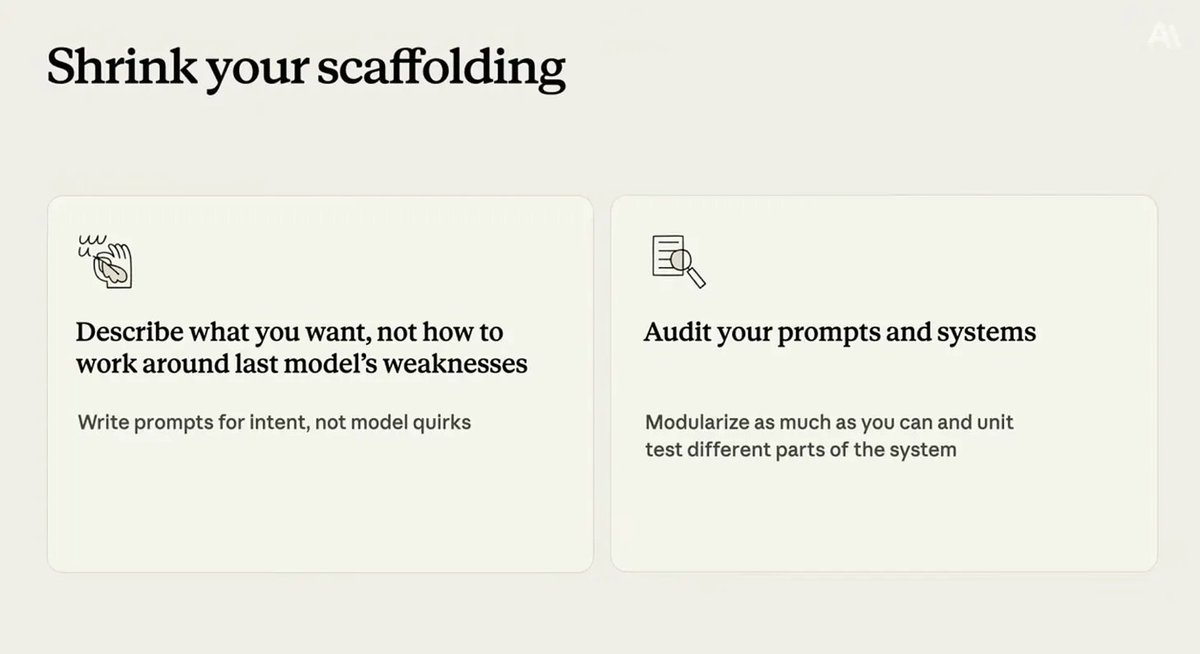
In addition to our interview, @alexalbert__ gave a great talk on getting your AI product ready for the next model. Here are my 5 takeaways: 1. Shrink your scaffolding Always test your AI product on the latest model to understand frontier capabilities. Don't over-engineer prompts and scaffolding when the latest model will just solve your problems. More in thread 🧵
Peter Yang tweet media
Peter Yang@petergyang

Here's my new episode with @alexalbert__, who shared an inside look at how Anthropic is building the next Claude. We talked about how the research team: → Plans for the model and harness together → Uses Claude to turn user feedback into evals → Trains Claude's character & personality Some quotes from Alex: "We use Claude to cluster user feedback, find top themes, and create synthetic versions of user problems that we then turn into evals." "We need to think about how the model is exposed through all our surfaces, whether it's API or Claude Code or Cowork. The product has a blend with the model and that affects your end user's experience." ""As these things become agents running tasks for a long time and making judgment decisions, what its character is and what it cares about are very important." 📌 Watch now: youtu.be/T4ieZPIEmd8 Thanks to our sponsors: @WisprFlow: Don't type, just speak ref.wisprflow.ai/peteryang @oceanstalent: Hire AI-native executive assistants oceanstalent.com/peter

English
11
11
73
15K
Harish
Harish@DesignHarishp·
@JulianGoldieSEO notebooklm as the middle layer is the part most people skip - brief quality alone changes the whole output 👍
English
0
0
0
3
Julian Goldie SEO
Julian Goldie SEO@JulianGoldieSEO·
AI SEO is not about “write me a blog post.” That’s beginner mode. The better workflow: Research with Claude Opus 4.7. Organize with NotebookLM. Build outlines from your sources. Send the clean brief back to Claude. Now the blog post has structure, intent, examples, and a real CTA.
English
3
3
10
607
Harish
Harish@DesignHarishp·
@leewebb29481133 trust signals section feels thin - a face, a location, and one real customer quote would do more than any badge 👍
English
0
0
1
2
leethal
leethal@leewebb29481133·
Built this from scratch in NZ — branding, website, checkout flow, referrals, logistics, everything. Now I need honest outside eyes. I’d genuinely appreciate critique on: • Website UX • Branding/product presentation • Pricing perception • Trust signals
leethal tweet medialeethal tweet medialeethal tweet media
English
1
0
1
21
Harish
Harish@DesignHarishp·
@xiz25 visual review room framing nails it - status, delta, and decision points need space to breathe, not a scroll of bubbles 👍
English
0
0
0
4
Dr. Xi Zeng
Dr. Xi Zeng@xiz25·
I keep thinking the agent workspace should feel less like chat. chat is good for asking. work needs seeing. what changed? what broke? what needs a human decision? the best agent UI may be closer to a visual review room than a message thread.
Dr. Xi Zeng tweet media
English
2
0
1
72