

Ian Lim
1K posts
Ian Lim
@IanCLim
AI health | prev AI + neuro @stanford
NYC Katılım Şubat 2015
923 Takip Edilen1.3K Takipçiler
Ian Lim retweetledi

Today we're launching Era and announcing $11M in funding.
We're building the intelligence layer for a new ecosystem of AI devices — the platform that lets any device manufacturer, brand, designer, or creator make objects that think, respond, and act in their own style.
We're entering a Cambrian explosion — new form factors, new creators, new objects worth desiring. Made by people who've never had the tools to make them, before today.
Welcome to the new Era.
Backed by @AbstractVC, @BoxGroup, @topology_vc, @betaworks, @CollaborativeFund, @MozillaVentures, and @AIResidency.
Era@eraworlds
We’re officially in our new Era.
English

We've close over $1B in deals for our customers 🤯 Just getting started
Ryan Daniels@ryanjdaniels
📣 Update: we raised our $60m Series B from @Lux_Capital, @IndexVentures and @01Advisors, with participation from @sequoia, @eladgil and @BainCapVC . When we came out of stealth 283 days ago, we had negotiated contracts worth $30m for our clients. As of last month, that number is over $1 billion. We work with the most ambitious companies in the world, including @tryramp, @clay and @RogoAI. Today, we want you to hear from some of them directly. Contracts are the rails of commerce. @crosbylegal is a hybrid AI law firm that gets them signed 80% faster. We’re announcing our Series B to keep scaling the dream law firm.
English

@venturetwins Boy oh boy wait till you hear about what @IanCLim is cooking up
English

I cannot wait until an AI agent can just navigate the healthcare system for me.
It's like a part time job if you've got anything going on - endless phone calls (during business hours!), portal messages, and follow-ups.
I feel like it's beyond time to delegate this 🫠
English
Interact has had a profound impact on my life.
If you're a young technologist, take a few hours this weekend to apply.
joininteract.com
English
English

Ecstatic to announce Merge Labs! 🧠🚀
I’m honored to work alongside my co-founders—Tyson Aflalo, @mikhailshapiro, @sandroherbig, @alexblania, and @sama on bridging biological and artificial intelligence. They’re *the* team to take on a mission this ambitious.
We’re grateful to have partners like @OpenAI who share a long-term view on what it takes to build foundational technology.
If you want to work on hard, foundational neurotech problems, come build with us.
English

$12.8M annualized 6 months after incorporation
Pocket Jacks Capital@rl_env
Don’t ask Sequioa about Applied Compute’s revenue
English
@billyhumblebrag Hit this same issue. Started doing weighted pull ups at same max reps which works well
English

Ian Lim retweetledi



Over the past week, @arcinstitute published three new discoveries that I’m very proud of.
• The world's first functional AI-generated genomes. Using Evo 2 (the largest biology ML model ever trained, which Arc released in partnership with @nvidia in February), Arc scientists took advantage of the fact that Evo 2 is a generative model to produce completely new sequences for complete phage genomes. That is, they used AI to produce wholly new, never-before-seen-by-nature genomes. They experimentally synthesized these genomes and showed that these AI-generated phages actually work, killing E. coli bacteria with high efficacy.
• Germinal, an AI system for creating new antibodies. Antibody design is one of the great problems of medical biology given their obvious importance and usefulness for creating therapeutics. (Antibodies are tiny particles that help the immune system identify pathogens and other harmful intruders. See also the recent Works in Progress article on this topic: [1].) Today, designing effective antibodies is very expensive and slow. Germinal is a cheap and fast way to produce drug candidates, with success rates of up to 22%. This means that one can go from having to screen thousands of candidates in the lab to screening perhaps a few dozen. It's early, but I suspect that better methods for designing antibodies will be a very big deal for disease treatment in the coming years.
• Today, we published a paper showing that “bridge editing”, which Arc scientists first introduced last year, can make precise edits in human cells that are up to 1 million base pairs long, and without relying on intrinsically unpredictable cellular repair machinery (which CRISPR requires, often leading to editing mistakes). They showed that it’s possible to use this editing to cut out the DNA repeats that cause Friedreich’s ataxia (a neurological disease), an approach which should also be relevant to Huntington’s and other similar disorders. One particularly cool thing about it is that it’s possible to specify every nucleotide within the extended editing window, meaning that recursive bridge edits could potentially be a powerful way to reprogram even biological traits that are caused by many genetic mutations. (Genetic therapies today target single mutations.)
Arc is pretty new. Its doors opened in mid 2022, and it's now 300 people. I’m excited about these discoveries because they show that a number of our hopes in starting Arc are starting to pay off:
• AI/ML and computation are at the center of all three. That is obviously true for the first two, but the mobile genetic element behind bridge editing was also discovered as a result of a complex computational search. One of our premises in starting Arc was the belief that the intersection of software/AI and experimental wet lab biology should enable great things. (And besides requiring great computational work, all three of these also required strong wet lab work, tightly coordinated under a single physical roof.)
• We’ve been toying with the idea that a handful of technologies are enabling a new kind of “Turing loop” in biology: sequencing advances (including single-cell sequencing) give us new ways to read; transformers and AI gives us new ways to think; and functional genomics (such as bridge editing) give us new ways to ways to write. This trio of discoveries span each part of this loop, and we’re hopeful that there’ll be compounding returns in improving each part.
• Arc is a non-profit, which we hoped would make collaborating with others easier, since we can avoid worries about financial return. This is indeed proving important, and all three of these projects involved close partnership with others. Germinal was done in partnership with @SynBioGaoLab at Stanford; Evo 2 was trained in partnership with Nvidia. Bridge editing was jointly published with a structure from the @HNisimasu Lab at the University of Tokyo. Arc tries to make its discoveries useful (see the Evo 2 Designer[2]) for others, and the code behind the computational projects is open source, hopefully making it easy for others to spot new opportunities for collaboration and partnership in the future. Most of all, Arc itself is an ongoing collaboration with @UCSF, @UCBerkeley, and @Stanford.
• With Arc, we wanted to enable better bottom-up and top-down work. With the fully flexible, no-strings-attached funding that we provide to investigators, we want to enable completely unexpected discoveries and avenues of investigation. With our institute initiatives (around creating a virtual cell and curing Alzheimer’s), we want to bring to bear a scale and level of coordination that’s usually difficult in basic science. Germinal is a “surprise” discovery that didn’t involve top-down coordination, whereas Evo 2 is the result of ambitious high-level planning and funding.
• Humanity has never cured a complex disease (a category that includes most neurodegenerative diseases, most cancers, and most autoimmune diseases), and my hope is that Arc can help change this. It’s also clear that AI will revolutionize biology, and I hope that Arc can effectively aggregate the ingredients needed to fully capitalize on its promise. I’m biased, but I think some of the coolest biology in the world is currently being done at Arc. (They’re always hiring if you’re interested.)
While I’m a cofounder of Arc, I spend almost all my time on Stripe, where we spend our time building economic infrastructure for the internet. All credit for Arc’s progress should go to the remarkable scientists and staff who’ve made Arc their home or who’ve chosen to collaborate with us. (You can read more about these particular discoveries in these threads: [3], [4], [5].) I’m also very grateful to the amazing Stripe employees who’ve built the company that makes Arc’s ongoing work possible, and to the millions of customers who’ve chosen to partner with Stripe. John and I feel fortunate to be able to support Arc’s work to the extent that we do.
Maybe this is reading too much into it, but I sometimes feel that there’s a commonality between @arcinstitute and @stripe. Both biology and economic infrastructure involve reasoning about complex systems with many levels of emergent effects, and in both cases building the right tools can have almost unboundedly large benefits. Even though progress in both tends to take a long time, it also feels like the next five years in both will be some of the most interesting in living memory.
(If economic infrastructure is your jam, we have a whole slew of fantastic announcements coming up at Stripe Tour in New York next week. Tune in!)
English

People talking about triple triple double double like comparing weightlifting routines
I have my companies on a strict 5x5 routine. Well I actually think you should be doing 3x5 and making sure the founder is on GOMAD. Are you optimizing for volume or long term strength??
English

who are the most interesting founders/products in education right now? i'd love to say hi.
English

There are 3 main reasons the cultures + behaviors of young people in SF and NYC are so different (from a 22 y/o who’s lived, worked, and raised money in both):
1. Upbringing. If you grew up near SF, odds are you were raised in a single detached home, it was sunny year-round, your family had a car. College is fun, and after that you never really leave the bubble. When you turn 22, you live in a group house with your friends, make fast cash (esp. tech), order takeout daily. You never really grow up.
NY throws you into the deep end. Most people I met from NYC were raised in cramped apartments, brutal winters, homelessness was everywhere. You took transit and saw many different types of people. Even if you lived in Queens, you still had to enter Manhattan and see the income disparities in Central Park head-on. California lets you shelter away from "bad areas." New York doesn’t.
2. Networking. In SF, every interaction starts with “what are you building?” before they know your name. It’s transactional by default. You’re evaluated into buckets of cofounder, investor, or someone irrelevant. Connections are built on utility and speed - go to any VC event and it's like the Hunger Games competing for an investor's attention ('move fast and break things' attitude bleeds into social interactions).
NYC forces cross-pollination but also layered networks. Deals are struck between business partners who have trusted each other for decades, you don't ask for angel investment until you've truly warmed up to someone. Meeting in-person is really about getting to know them, and you're not competing for their attention in the moment. Money, introductions, and everything else happens in between interactions. Sometimes this feels "networky" - fake corporate laughs and niceties do happen, but even then there's much more depth and sincerity than "speed dating" with potential cofounders.
3. Mentorship. This is the biggest gap. SF is young and allergic to hierarchy. That sounds freeing, but it leaves a vacuum. Most young founders rely on their peers, without long-term guidance or apprenticeship. You get high on power and feel like you know everything because everyone around you is in the same life stage.
But what do you know when you're 20?
Even when people do seek older mentors, they converge on parasocial relationships with the same recycled handful of famous founders and investors whose essays and tweets become gospel. That’s how monoculture forms.
NY still has layers. Sometimes this comes in the form of corporate hierarchy and old money, which has its problems, but observing these layers teaches you humility, discipline, and diversity of thought. You directly meet and work with people in their 40s, 50s, 60s who don’t care about being cool on Twitter but who’ve built companies, run institutions, and lived through downturns. Sometimes it's tactical advice, but most importantly, it teaches you to be a better person.
My most formative moments were in New York City. It's where I truly became a functional young adult.
I had mentors ranging from their late 20s all the way to their mid 70s. They taught me how to raise money and build products, sure, but also how to host tea ceremonies, roast my own coffee beans, tell the difference between a $50 and $5,000 wine. We spent hours discussing how art is curated and valued and what it was like doing business during the Cold War era. One of my mentors created the AMEX Cobalt Card. Another had preserved paintings retrieved from the Titanic.
I took this richness for granted at the time, but looking back, it's the reason I have independence of thought and can appreciate things outside my immediate field of work. I'm endlessly grateful for my time there.
I’ve seen all the recent memes about how SF is full of “whimsy,” like an endless college campus. Funny at first, but it gets tiring. This is why.
English
CTRL Labs wristband may be the most underrated piece of technology in the last decade
near@nearcyan
feeling really bad for the Meta OS team
English

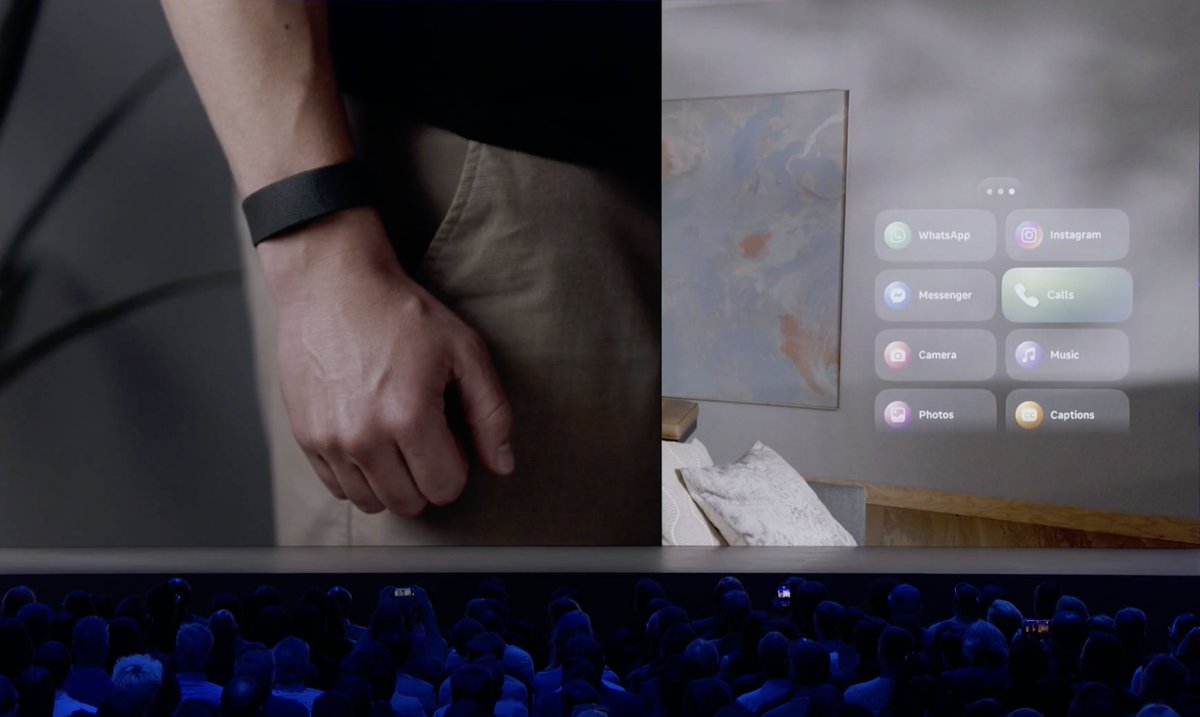
The Neural Band was the main product I worked on at CTRL-labs/Meta, as a small part of a big effort to create a new interface
A low latency on-device model trained at massive scale, in a custom wearable, powering an intricate interaction design..
that ultimately feels simple ✨
English

6 months, 25 million revenue agents & 3 trillion tokens later... Rox is now globally available 🌎
Just as coding agents 10x’d engineering, revenue agents 10x customer work.
With Rox, humans are evolving to orchestrators while agents manage the end-to-end customer lifecycle.
Even in Beta, Rox powered Global 2000 leaders in banking, hardware, construction, and sovereign AI, while serving dominant AI winners like @tryramp and @cognition.
Rox delivers ROI in 90 days and is built with the best.
Thank you to @OpenAI, @nvidia, @perplexity_ai, @awscloud, @vercel, @Snowflake, and @stripe for helping us scale.
English
this feels like the most directionally correct approach to AI generated interfaces so far, very impressive demo
Geoffrey Litt@geoffreylitt
If you're thinking about AI-generated UIs, recommend checking out JELLY by @YiningCao3, @peilingjiang, and @HaijunXia. My favorite kind of work: both a compelling system/demo AND a bigger idea that people can build on! talk video: youtube.com/watch?v=X3cf1U… paper: dl.acm.org/doi/10.1145/37… tldr: vibe-coded UIs aren't ideal for users generating software, because it's hard to steer the generation and keep things consistent. They propose solving this by first generating a more structured model of the user's needs, including a data schema that the user can see/edit. Then UIs get generated based on this schema, but it feels more like fluidly composing premade widgets in a task-specific way than building a new "application". Reminds me of @alexobenauer's work on an itemized OS and @jasonyuan's Mercury concept, as well as the Embark system that I worked on. The demos feel compelling and magical, but there's also enough technical meat to see how this is actually feasible today with LLMs. Really cool. Things I'm not so sure about: - I like formality on demand: super unstructured representations (text, drawings) and only adding structure when needed. It seems like Jelly jumps straight to rigid relational models. Good fit for some tasks but not all. I wonder about fitting in less-structured bits and then structuring on-the-fly with LLMs. (As a mitigating factor: the fact that you can edit the schema live on the fly does help a lot, blurring the line between using and creating the software. And structure is really useful for things like different views of the same info) - I'm curious how much the exposed schema ends up really being useful to users for understanding. Their own user study found the majority of users just relied on the UI rather than the schema. Feels like there's a lot more work to do here to achieve deeper interpretability. The challenge of "how do you tell users what software does without showing code" is endlessly deep...
English

We started @laborup_usa with a simple belief: America can’t rebuild its industrial base without rebuilding how we hire the people who power it.
We raised $7.7M to build the defining AI solution that is Solving America's $1 Trillion Manufacturing Labor Crisis.
I sat down with @dasha_shunina at @Forbes too share more. Link in comments⬇️
And to our investors, we're proud to be on this mission with you @nvpcap @torch @thresholdvc @westboundequity @rex_woodbury @heartland @JeffDean @evancharles @jeff_jordan @marketplaceshq @Wemimo11 and more folks not on twitter!
English
@annarmitchell took a class (introsem!) with John Hennessy on this and it was phenomenal. spent a day at the computer history museum and another day at google
looks like they stopped offering it in 2022 ):
explorecourses.stanford.edu/search?view=ca…
English
Wild how little CS programs cover Silicon Valley history. In my Stanford degree, closest was a throwaway “ethics in tech” class. Learning SV's roots -counterculture, defense etc. - would do far more for ethical behavior than "ethics in tech" & widen the aperture of what to build.
English