

🇨🇳LIns🚦GFor🇺🇲
435 posts


最近,一搜大陆的小艇偷渡到台南,媒体先是翻天了,又开始吵“共谍来了”,“又有中国人偷渡”。
结果查了半天,是个18年前逃到大陆的台湾通缉犯。可能因为通缉犯身份无法上飞机,于是偷渡回来。
1、这年头,谁还偷渡到台湾啊?(前几年也就一两个政治难民)
2、台湾倒是每年有很多通缉犯躲到大陆,而且越来越多,甚至前些年在东莞那边还滋生出他们自己的帮派。
3、很多人在大陆一躲就是十几二十年,主要靠坑自己人谋生,活不下去了就滞留大陆,这些人被称为“台流”。
4、真要渗透,怎么可能靠偷渡或者派人渗透啊,一定是策反现有的台湾人啊,比如民进党内部的独派,近年来的国安案件哪个不是?

中文
@shabbster9 @boriswang01 @punicist And China today becomes thd most successful, without abadonning but strenthening traditional culture with full "Four Condidences". Your "enlightened" system even today struggles being secular while China has done that 2000 years ago.
English

@IceCake666 @boriswang01 @punicist And how does that relate to what he said? Ming and Qing and later on was a signifcant regression compared to the previous ages in every metric.
English
@OKnormiee @jukan05 it surprised a lot of people Samsung phone even survived this long, it gave Android a bad name and thanks Huawei's effort to clean up clean up the shitty memory leakage. Samsung simply wasnt up to the competition. No point of kidding urself and pretending a victim. iphone is well
English

key point everyone is missing: samsung didnt fail in china due to lack of trying or investment. the chinese govt made it impossible for samsung to compete w bureaucratic/legal red tape, particularly in aftermath of thaad. true across phones, batteries, chips, etc. local chinese companies have made huge strides since in past 10 yrs aided by gov intervention & support, making themselves viable on global stage. samsung and any other foreign consumer electronics player will never hold a dominant market position anytime in foreseeable future in china
English

Korean home appliances are highly likely to cede market leadership to China before long.
What concerns me more is that this is not simply a matter of home appliances alone. Starting with appliances, this is a broader trend in which dominance across consumer electronics as a whole—including smartphones and laptops—shifts entirely to China.
For Samsung, home appliances are not inherently a high-margin business. Yet the reason Samsung has continued to maintain this low-profitability segment is clear: it secures offline retail presence and distribution networks, through which Samsung can cross-sell its broader ecosystem products, including Galaxy devices. In other words, home appliances have served not merely as a standalone business unit, but as a distribution anchor underpinning Samsung's entire consumer-facing business.
If Samsung were to exit the appliance business, however, the consequences would not end at simply selling fewer TVs or refrigerators. The very sales foundation of Samsung Galaxy could weaken. And a decline in Galaxy sales would, in turn, mean reduced sales of Samsung's core components that go into those devices.
The bigger problem lies further downstream. If Chinese players come to dominate consumer electronics markets such as laptops and smartphones, will they continue to actively adopt Samsung's OLEDs and memory? Memory demand may be partially sustained for a while, but even that is likely to face growing pressure for substitution with Chinese-made alternatives over the long term. In particular, as Chinese memory players like CXMT scale up, it is difficult to rule out the possibility that the resulting demand shifts will benefit local Chinese suppliers rather than Samsung.
The concerns are very real.
Jukan@jukan05
Chinese media report that Samsung has almost certainly decided to withdraw its home appliance business from China, and that its monitor business could also exit the market. They also say that Samsung may eventually retain only its smartphone and memory businesses in China, while winding down all other divisions.
English
@boriswang01 @punicist and ur beloved king now works hard with "dark-enlightenment cults" and the world wonders whether the "englightend" republic will survive longer than a 300 year Chinese dynasty ran by 地主家的傻儿子。
English

@IceCake666 @punicist o wait i was wrong, its not a loop its a regression, ming was worse than song, qing was worse than ming
English
@punicist its a dead loop with no breakout like the enlightenment in europe
English
@AngelicaOung @Yaqiu hi, girl, u think too much of her. not every girl, or boy for that matter, has a brain to think. she has a mouth to fed.
English

@Yaqiu Does it ever occur to you that America never was that interested in human rights and just found a way to pay you to hurt China?
English

Friday afternoon musing: I entered the human rights field 15 years ago hoping to make China more like America. Increasingly, though, I feel America is becoming more like China. Still, I have faith in our fundamental longing for human dignity. We just need to hang in there. TGIF.
English
@AndyBxxx @DSPetolicchio U replied, apparently u do. Go fuck him, hard.
English


I don't hate the Chinese people, I hate communism and I oppose the Chinese communist party.
English
@thomasjuneau "Mr. Corleone, all bastards are liars, Shakespeare wrote poems about it." yes, you are worse.
English

I spent three weeks in Xinjiang in 2001, travelling all over the region. It is one of the, if not the most brutal, openly visible repression I've seen. And the situation has only gotten much worse since. You have to be spectacularly blind (or worse) not to see it.
Senator Victor Oh@SenatorVictorOh
🌹🇨🇦🇨🇦🌹 Fellow Canadian @AliFeizi’s firsthand account from multiple independent trips to Xinjiang is powerful and overdue. As someone who has long advocated for evidence-based Canada-China engagement, I’m struck by his clear-eyed observations: a region where Uyghur culture is actively preserved — from the restored Old City of Kashgar to thriving bazaars and vibrant traditions — not erased. The so-called “concentration camps” he saw are vocational training centres helping people build skills. Ottawa’s rhetoric must match reality. Accusations this serious demand proof, not politics. Strong, pragmatic Canada-China ties also deliver real benefits for Canadian livelihoods: restored market access for our farmers (canola, peas, seafood, beef) supports thousands of jobs and family incomes across the Prairies and beyond; affordable Chinese EVs and supply chain investments help build a stronger Canadian auto sector and lower costs for families; while diversified trade with China’s massive market drives economic growth, stability, and new opportunities from coast to coast. Canadians deserve foreign policy grounded in facts, dialogue, and mutual respect that puts our prosperity first. Thank you, Pastor Feizi, for speaking truth from the ground. #Xinjiang #CanadaChina x.com/alifeizi/statu…
English
@AngelicaOung @thomasjuneau A liar lies, this white liar tells no white but damn lies with no statistics.
English
So more serious than Israeli repression of Palestinians, more serious than Saudis air-striking Yemen? More serious than guest workers basically living under slave conditions in the UAE? Like what are you talking about? Got a photo? Got a story? Why are we meant to believe you? Because you are a western professor talking about how China is bad?
English
@RobinRivaton And China is the only country with a sophisticated coalchemical parallel to petrochemical system. The former becomes profitable at around 80 dollar oil.
English

I was in Brussels two days ago to speak about China, and several key figures from business and politics told me the same thing: the oil shock is deeply unsettling East Asia, and China in particular.
Not really.
Yes, China is deeply dependent on imported crude. But no, it is not a helpless pure importer.
First, China’s dependence on Iranian crude is often overstated: Iranian barrels account for only a little over 10% of China’s crude imports, not of its total oil consumption, and the exposure is concentrated above all in the so-called teapot refineries, the independent refiners that have long relied on discounted sanctioned crude.
Second, China is also a very large producer in its own right: roughly the world’s 4th-largest natural gas producer and about the 5th-largest producer of petroleum and other liquids. In 2024, China produced more than 4.2 million barrels per day of crude oil and condensates, and about 5.3 million b/d of total liquids. That does not eliminate import dependence. But it gives Beijing a much thicker shock absorber than most people assume.
The key point is this: China’s oil vulnerability is no longer just about transport fuel. Its oil system is increasingly tied to industry, and especially to petrochemicals: plastics, synthetic fibers, intermediates, and industrial feedstocks rather than simply gasoline and diesel.
That changes everything. For years, analysts looked at Chinese oil demand mainly through cars, trucks, aviation, and construction. But the structure has shifted. The International Energy Agency has been explicit: China’s oil-demand growth is now dominated by petrochemical feedstocks.
In fact, the IEA noted that demand for petrochemical feedstocks such as naphtha, LPG and ethane in China in 2023 was about 1.7 million b/d higher than in 2019. Without that petrochemical expansion, China’s total oil consumption would have remained comfortably below pre-Covid levels.
So the real story is not “China needs oil because Chinese households keep consuming more fuel.” The real story is: China needs oil because it built an enormous industrial transformation machine, and a growing share of that machine sits in the petrochemical chain.
This is why China can look paradoxical. On one side, EV adoption, high-speed rail, and structural economic changes are flattening demand for gasoline and diesel. On the other, petrochemicals keep pulling in crude and feedstocks because China keeps adding cracking, aromatics, PTA, polyester, plastics and synthetic materials capacity.
This matters enormously in a Middle East shock. If Gulf supplies are disrupted, many countries suffer as fuel importers. China suffers too, obviously. But China is in a different category because it has four cushions at once: domestic production, strategic stocks, pipeline diversification, and a giant industrial system capable of reallocating molecules and prioritising sectors.
China is the world’s largest importer of oil that passes through Hormuz, yet also one of the economies best placed to cope with a disruption there. That is not because dependence vanished. It is because Beijing spent years building buffers against exactly this scenario.
And those buffers are not theoretical. China has expanded domestic upstream output, diversified pipeline supplies from Russia, Central Asia and Myanmar, accumulated large stocks, frozen some fuel exports when needed, and electrified parts of its economy fast enough to reduce pressure on the transport side of oil demand.
But here is the deeper implication: petrochemicals make China both more exposed and more powerful. More exposed, because industrial feedstocks still require imported hydrocarbons. More powerful, because once those molecules arrive, China has one of the world’s largest integrated systems for converting them into higher-value downstream products.
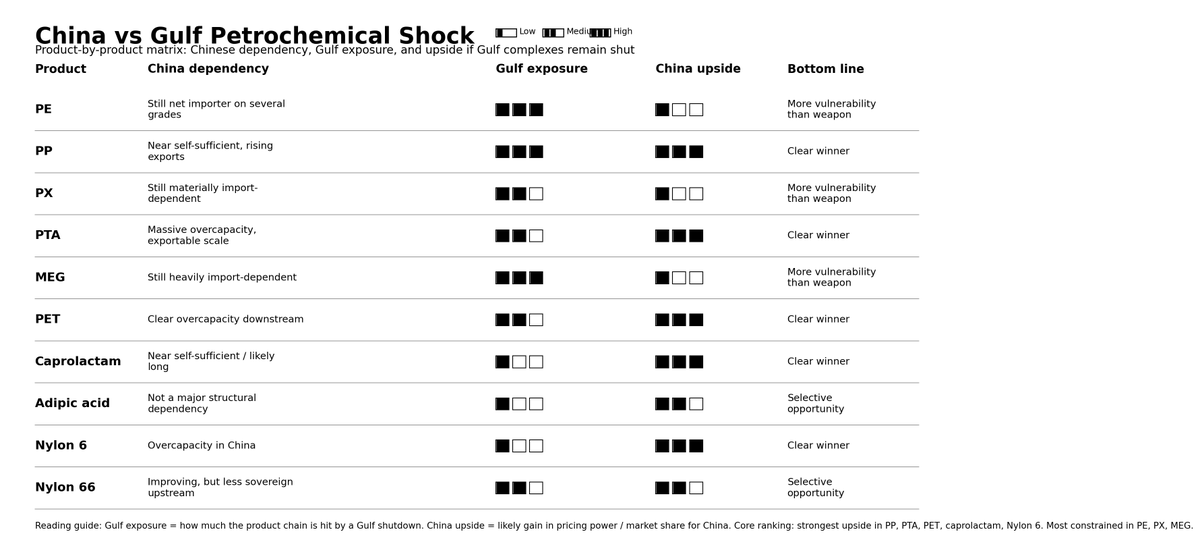
On several chains, especially where China has built massive recent capacity, they can seize market share when other petrochemical centers are disrupted more severely than China is. It wins big where it already has exportable overcapacity, especially PP, PTA, PET and much of the nylon-6 chain. It wins far less, or may even suffer, where it still depends on imports or external low-cost feedstocks, especially PE, PX and MEG.
English
@hippoblue @MarioNawfal So Europoor has nothing to worry about.
English


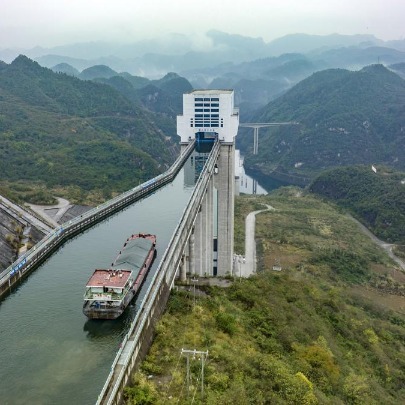
🇨🇳 China just built a $1B ship elevator… and it’s honestly one of the craziest engineering moves out there.
Here’s the idea.
When China built massive dams for hydropower, it ended up blocking its own river trade routes. Traditional lock systems were too slow to handle the scale.
So instead of settling… they built something entirely different.
A ship enters a huge water-filled chamber. Gates close. And then the entire chamber, ship, water, cargo… gets lifted straight up a 200m dam using hydraulic systems.
We’re talking around 1,500 tons moving vertically like it’s routine.
The whole process takes about 20 minutes.
What used to take hours now happens faster than a break.
China hit a physical limit on its own trade routes and chose not to accept it.
They built a system that removes the delay entirely and keeps traffic moving like the obstacle was never there.
Source: Military Files YT


Mario Nawfal@MarioNawfal
🇺🇸🇨🇳 The U.S. just handed China a drug fugitive, which is the first repatriation of its kind in years. It’s happening right before a planned summit between Trump and Xi. It potentially shows the 2 sides are warming up again: Trump has tied trade tariffs to how much China helps stop fentanyl. Funny how that works. Source: WSJ
English

In the future, there will be three major powers in the world:
China, USA, EU.
Neutral countries will move as much as possible towards the EU as their preferred partner because both China and the USA treat other countries disrespectfully and try to extort them. Europe will be the only great power and market to turn to if you want to have an equal and fair relationship.
Canada is already moving towards Europe for this exact reason. India and Japan will also form a closer relationship with Europe. This is what soft power means.
MAGA replies in the comment section will prove the point.
English
@AngelicaOung rest assured that copying-China-without-acknolwdging won't work. in a few years, there will be a blame game again. only this time, "who lost China" becomes "who copied China" with a bunch market exteremists yelling "i told you so"
English
The funny thing is we’ve been trying to convince everyone for decades that state capacity doesn’t matter and markets are the most efficient way of taking care of everything.
Now we are skipping straight to copying China’s homework.
Feels like we skipped a step of thoughtful self-reflection and admitting we were wrong. Or at least trying to figure out why what had worked so splendidly for so long stopped working.
Here’s the unpalatable truth…building state capacity is hard and it’s absolutely possible to do it badly and end up with inefficiency and white elephants. And the long-term consistency needed might simply be incompatible with America’s current political system.
I’m thinking now of the Biden-era industrial development programs, specifically the ones shepherded by the excellent @JigarShahDC at the Loans Program Office at the DOE. It actually was sensitive to how to use govt loans as a catalyst, a form of industrial policy that is super comparable with American dynamic entrepreneurial spirit. It bore fruit quickly but was just as quickly broken by the Trump administration. Even projects in the pipelines sabotaged.
Rush Doshi@RushDoshi
Key point from Zongshuai Fan in the @SCMPNews. Pushing China to change its industrial policy is a fool's errand. Better, instead, to build one's own state capacity to deliver equivalent results.
English

In China, there is a joke going around right now that, 2026 is apparently the Year One 元年 of literally everything:
1/ autonomous driving
2/ liquid cooling
3/ domestic HBM
4/ on-device AI
5/ solid-state batteries
6/ AI applications
7/ quantum computing
8/ compute-memory integrated chips
9/ brain-inspired computing
10/ the low-altitude economy
11/ commercial space
12/ humanoid robots
13/ silicon photonics
14/ controllable nuclear fusion
Is there a frontier technology that ISN'T going to hockey stick / cambrian explode this year???
English
@Brad_Setser @marcmakingsense @shehzadhqazi anyone who blames China for not importing enough or exporting too much can help buying RMB to stratesphere. That way Chinese products become less competitive and GDP per captia also fits their current status of living.
English

@marcmakingsense @shehzadhqazi Spare me the talk of China lifting tariffs when its imports of manufactures are flat and have been for many many years! Get back to me when it provides a +demand impetus to the world.
For what it is worth I didn't intend my comment on China's export restrictions as criticism
English
Well, China isn't going to dip into its strategic reserves to help supply the rest of the world ...
1/2
jck✨@Alea_
🛑 CHINA BAN EXPORTS OF DIESEL, GASOLINE AND JET FUEL
English
@rishi841312 @CBankingEditor Apparently, Chinese goverbment saw it. in fact, they have planned it since 1950s.The real issue is that no one in the west woukd admit it. Hack, there is not even a Chinese style management book published.
English

@CBankingEditor To be fair though Uncle Milton visited China between 1980-1992. Nobody could have foreseen anything way back then. Even in the year 2000 nobody knew China's potential let alone 10 years before that.
English

When Milton Friedman visited China, he also argued that Shanghai's Pudong New District was a Potemkin Village designed to fool credulous foreigners.
Pudong is now one of China's preeminent finance and tech hubs, with an annual GDP of more than one trillion yuan (USD$145 billion).
Worth noting that Friedman made multiple visits to China after the Third Plenum of 1978 - a very clear sign of how open minded and pragmatic Deng Xiaoping's leadership had become by the early reform era.
Handre@Handre
>be Milton Friedman >visit China in 1980 >see thousands of workers digging canal with shovels >ask Chinese official: "Why not use bulldozers?" >official replies: "That would eliminate jobs" >Friedman: "Then why not use spoons?"
English
@HenryMorgan3721 @phl43 A bunch of losers in a country making nothing talking about peaking and declining of a country making everything.
English

@phl43 East Asian countries seem to have an economic/demographic/social model in which they converge rapidly and accumulate massively before suddenly stalling and even declining.
Can look very intimidating at the peak tho, especially when Hirohito was still on the throne.
English

People talk about Japan's soft power and compare it favorably with Chinese soft power, and I don't deny there is something to that (China really sucks at this), but I think it's worth pointing out that Japanese soft power wasn't working so well in the 1980s, when people in the US and the West more generally saw it as an economic threat and thought it might challenge US hegemony.
English
@IsaacStein1972 @shanaka86 I assume Trump likes to relace cheddar in his burger with Venz tar. China is perfectly ok to pay for Canadian tar. Commercial logic.
English

Alternate Reality Alert!!
China imports ~70% of its oil, from three sources: Venezuela, Iran, and Russia. Control that flow, and you hold ultimate leverage.
Trump has strategically taken control of the first two.
Coupled with the U.S.retaking control of the Panama Canal and Northwest Passage route, Beijing's survival is in the hands of the US.
This is the U.S. simultaneously gripping both of China's testicles while hammering a stake through the BRICS fantasy.
Calling any of this a Chinese "win" or flex is either naive stupidity or paid propaganda.
English

JUST IN: CNN reported on March 6 that US intelligence suggests China is preparing to provide Iran with financial assistance, spare parts, and missile components. Three people familiar with the matter confirmed the assessment. On the same day, China publicly denied military support and called for ceasefire.
Both statements are true. Neither contradicts the other. Understanding why requires seeing what China is actually doing, which is more consequential than anything either Washington or Beijing is saying.
China imported 1.38 million barrels per day of Iranian crude in 2025. That is ninety percent of Iran’s total oil exports and roughly twelve percent of China’s total imports. Forty five percent of all Chinese oil imports transit the Strait of Hormuz. When the strait closed on March 5 through insurance withdrawal, China did not lose access to Iranian oil alone. It lost access to Saudi, Kuwaiti, Iraqi, Qatari, and Emirati oil flowing through the same chokepoint.
China has three to four months of strategic petroleum reserves. After the buffer, the world’s second largest economy begins rationing energy. The growth that is the CCP’s sole remaining claim to political legitimacy starts to erode. Beijing’s survival calculus is simple: growth is legitimacy.
So China is doing something nobody has done in the modern era. It is negotiating a bilateral safe passage arrangement for Chinese owned vessels through a multilaterally closed waterway. AIS tracking data already shows at least one bulk carrier altering its destination signal to display “CHINA OWNER” while transiting the Omani coastal margin. Reuters confirmed back channel negotiations between Beijing and Tehran on March 5. Bloomberg reported the arrangement taking operational form by March 6.
This is not about oil. This is the proof of concept for post-American maritime hegemony.
For eighty years the United States Navy guaranteed freedom of navigation as a universal public good. What China is building right now is a parallel architecture where access to critical waterways is determined by bilateral commercial relationships rather than universal legal principles. If Chinese vessels transit safely while Japanese, Korean, and European ships cannot, the legal framework governing maritime commerce since 1945 is not being violated. It is being replaced.
The financial assistance and missile components CNN reported are the price of the safe passage deal. China is paying for transit rights with the currency Tehran needs most: components that keep its military functioning. Every spare part extends the war. Every extended week deepens the Hormuz closure. Every deepened closure increases China’s leverage over whoever wants to ship through those waters next.
China is not joining the war. China is pricing it.
And the price is a new maritime order where the ocean’s most critical chokepoints answer to commercial leverage rather than naval force. That order is being born right now in the transponder signals of tankers hugging the Omani coast with Chinese ownership declarations functioning as diplomatic passports through a closed strait.
The era when a ship needed an insurance policy to transit Hormuz is ending. The era when a ship needs a Chinese relationship to transit Hormuz is beginning.
open.substack.com/pub/shanakaans…


English

If you are a student in the West, print this and put it on your desk.
A daily reminder of what you will be competing against.
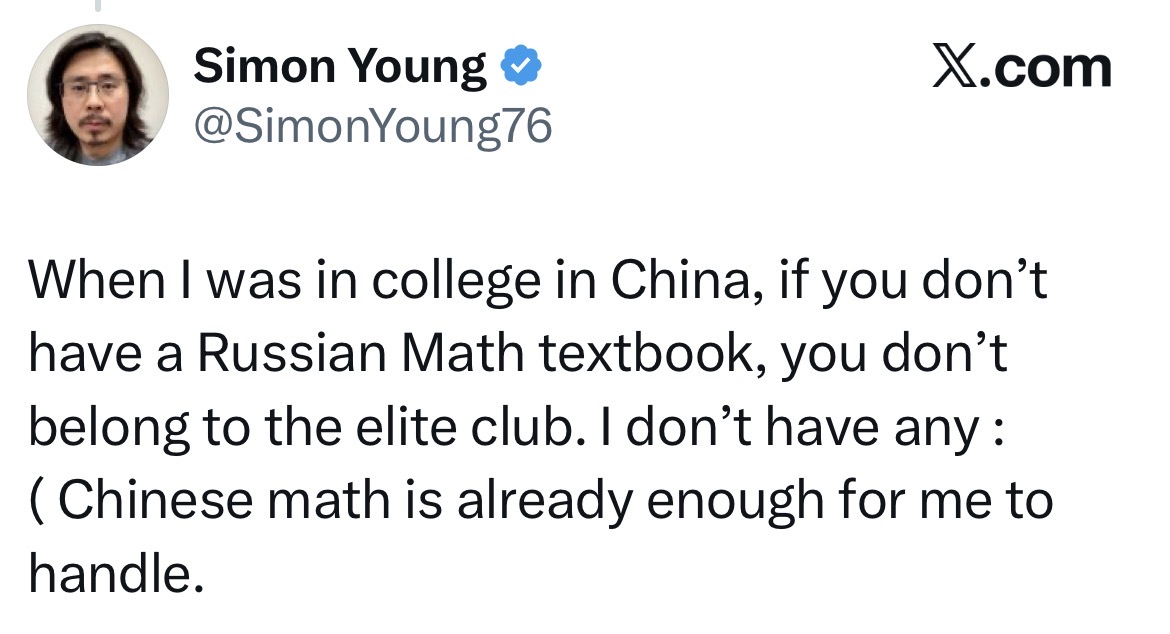
“When I was in college in China, if you don’t have a Russian math textbook, you don’t belong to the elite club.”
This is not a joke.
For decades, Chinese STEM education studied and adopted many elements of the Soviet mathematics tradition — rigorous textbooks, deep problem solving, and a culture that treats mathematics as a serious intellectual discipline.
While some Western curricula debate whether formulas should even be memorized, other countries are training students using problem sets and textbooks that built generations of mathematicians and physicists.
Competition in STEM is global.
And the standards are not getting lower.
If you are a student — study math.
If you are a parent — make sure your kids do.
Start here:
valeman.gumroad.com/l/arithmetic?u…
Study math. Teach your kids math.
English