Jonika Weerasekare

151 posts

Jonika Weerasekare

Jonika Weerasekare

@JonW1993

@MayoClinicSom @UCD_IM IM PGY-3

Sacramento, CA Katılım Ekim 2025
90 Takip Edilen29 Takipçiler
Jonika Weerasekare
Jonika Weerasekare@JonW1993·
@aribindi @joshmcgoo Mixed shock. Oftentimes see CI of 1.4, low SVR, low EF, high pcpw/rap. Norepi + Dobutamine is a reasonable choice here. Was not talking about pure cardiogenic shock.
English
0
0
0
27
Vamsi Aribindi
Vamsi Aribindi@aribindi·
@JonW1993 @joshmcgoo If you give norepi to a patient with a cardiac index of 1 and SVR of 2000, I don't think you're going to have a good outcome. Not all shock is septic shock...
English
1
0
0
30
LCDG
LCDG@LCDG2026·
@JonW1993 @NephroP Incredibly important.. good use of a Class III device.
English
1
0
1
37
Philippe Rola
Philippe Rola@ThinkingCC·
@JonW1993 Totally agree with your point. 5 though? I would think that may have been underestimated by angle… have not seen many 5’s with sub 3 crts…
English
1
0
3
567
Jonika Weerasekare
Jonika Weerasekare@JonW1993·
Classic auscultation signs really have limited utility in high resource health care settings. Important to combine pocus with traditional physical exam and clinical reasoning. Have seen countless patients with VTIs of 5, low CI but ok cap refill and adequate organ function
Philippe Rola@ThinkingCC

@Inamanotherapy @khaycock2 @NephroP Every time i examine. Pocus is just part of a comprehensive exam. Touch, cap refill, but i won’t use a surrogate (S3/4 or percussing heartt borders) when i can look and see…


English
2
0
4
1.4K
Jonika Weerasekare retweetledi
NephroPOCUS
NephroPOCUS@NephroP·
Indeed. If there’s a hemodynamic question, there’s probably an indication for a #POCUS-assisted physical exam. POCUS is a clinical skill, so arguing “clinical skills vs POCUS” is meaningless when it is (should be) a part of your skillset. Let's move past the square wheels!
NephroPOCUS tweet media
Philippe Rola@ThinkingCC

@Inamanotherapy @khaycock2 @NephroP Every time i examine. Pocus is just part of a comprehensive exam. Touch, cap refill, but i won’t use a surrogate (S3/4 or percussing heartt borders) when i can look and see…

English
1
3
18
3.1K
Jonika Weerasekare
Jonika Weerasekare@JonW1993·
@IM_Crit_ Septal flattening during diastole suggests volume overload (rvvo). Classic teaching is fluids in right sided MI but I fail to see how fluids is going to help someone with rvvo. Answered dobutamine.
English
0
0
13
3.8K
IMCrit
IMCrit@IM_Crit_·
ICU - Board Review Qs: 60 yo pt admitted to the ICU because of inferior STEMI. Emergency cath: 100% proximal RCA occlusion treated successfully with stenting One hour post-PCI: dyspnea/anxiety - BP: 94/70, HR: 60/min (sinus). Phys exam: JVD (+), clear lungs, cool extremities
English
17
29
225
128K
Dr. Chacón-Lozsán F .'.
Dr. Chacón-Lozsán F .'.@franciscojlk·
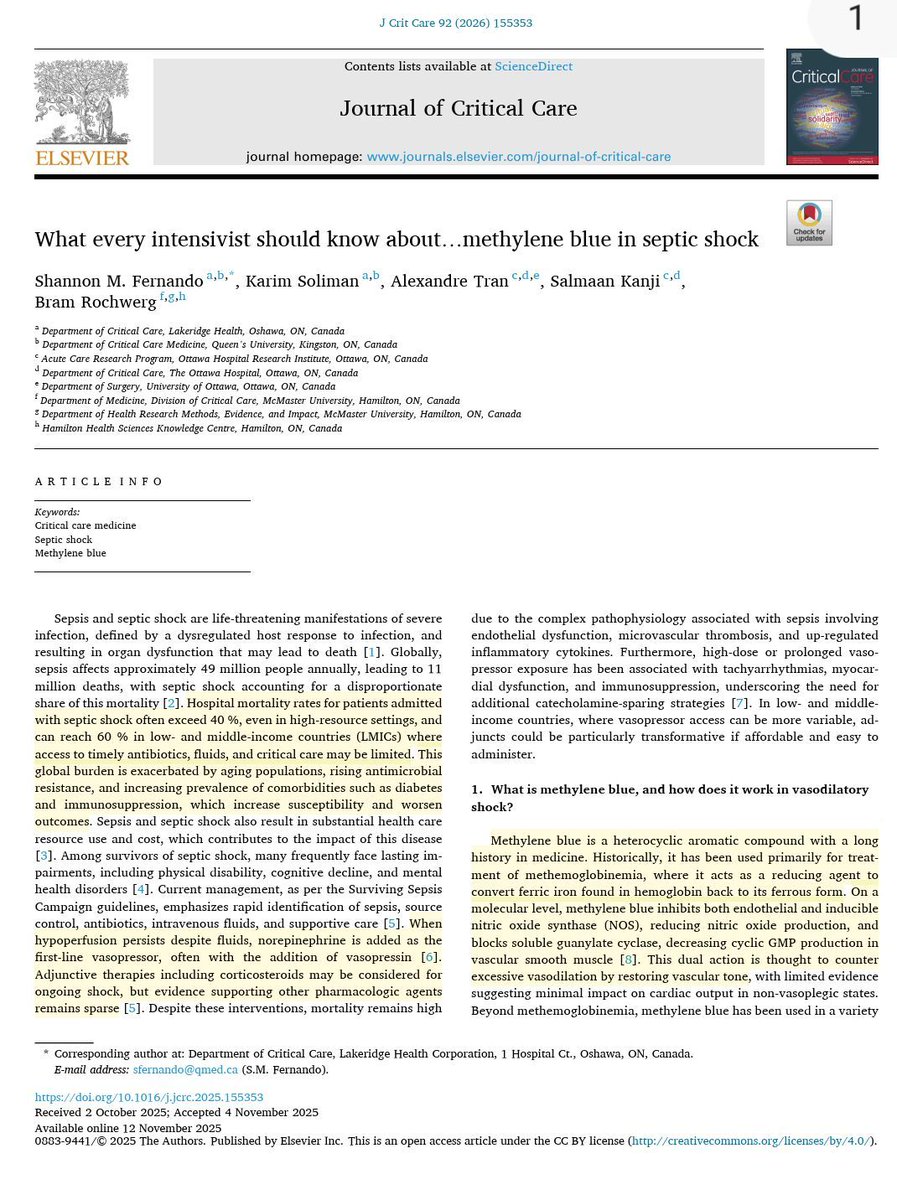
💙 Methylene blue in septic shock: miracle, myth… or misunderstood tool? We all know the scenario: 👉 Refractory vasoplegic shock 👉 Escalating norepinephrine 👉 Vasopressin, steroids… still hypotensive At some point, the question comes: Should we use methylene blue? ⚡ Mechanism Septic shock = NO-driven vasoplegia Methylene blue acts by: ❌ Inhibiting nitric oxide synthase (NOS) ❌ Blocking soluble guanylate cyclase ⬇️ Reducing cGMP ➡️ Restoring vascular tone 👉 A true catecholamine-sparing strategy 📊 What does the evidence say? Reality check: Use in practice is rare (~0.5% of septic shock patients) Often used as late salvage therapy Dosing strategies = highly variable But RCT signals are interesting: ↓ Vasopressor duration ↓ ICU / hospital length of stay Possible ↓ mortality (low certainty) 👉 Evidence is promising… but still weak 🚨 The clinical dilemma Timing is everything: Early use → potential physiologic benefit Late use → often too late to change trajectory 👉 Current practice is probably backwards ⚠️ What about safety? Potential concerns: Serotonin syndrome (with SSRIs) Pulmonary vasoconstriction G6PD-related hemolysis Interference with pulse oximetry 👉 Most serious effects seen with high doses 🧠 Take-home message > Methylene blue is not a “magic drug” but it may be a physiology-driven adjunct in vasoplegic shock ❓The real questions are: Who benefits? When to give it? At what dose? 🚀 Where we’re heading Ongoing trials (e.g., BLUSH trial) will clarify: ✔️ Early vs late use ✔️ Optimal dosing strategy ✔️ True impact on mortality 👉 This could redefine vasoplegic shock management 💡 Clinical reflection Next time you face refractory shock, ask: 👉 Is this still “fluid + catecholamine problem”… 👉 or already a NO-mediated vasoplegia problem? 📚 Reference Fernando, S. M.et al. Journal of Critical Care, 92, 155353. doi.org/10.1016/j.jcrc…
Dr. Chacón-Lozsán F .'. tweet media
English
3
64
248
15K
Jonika Weerasekare retweetledi
Francisco Soto, MD, MS, MBA
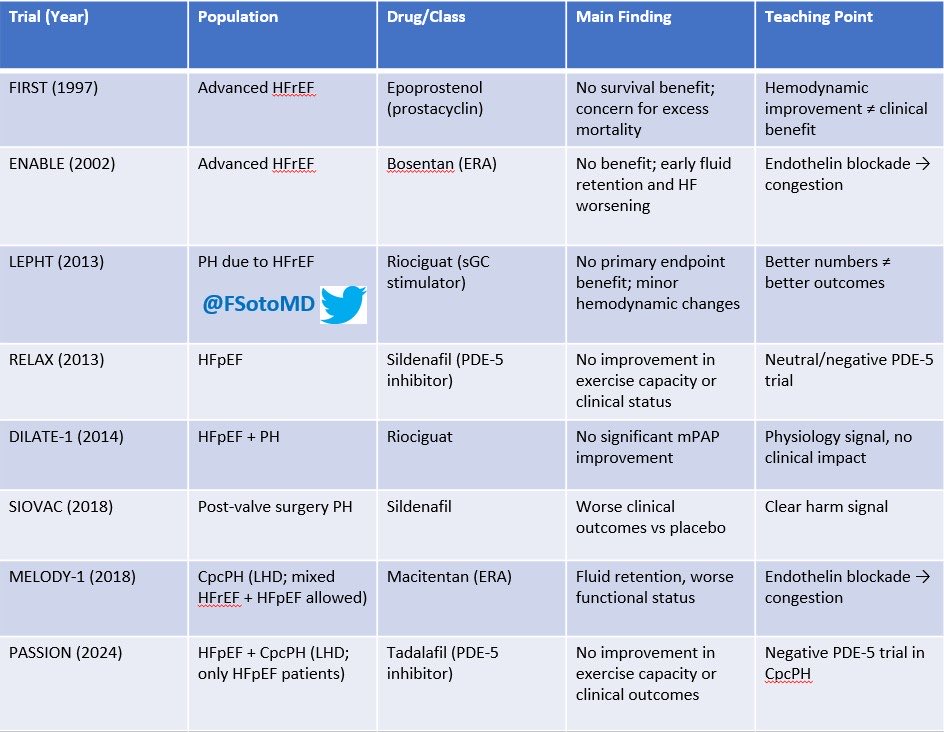
1/6 Sotatercept in Combined Pre/Post Capillary PH (CpcPH): CADENCE (Gomberg-Circulation 2026) A🧵 (8 min read) But first. 🔹Pulm vasodilators NOT approved for PH with ⬆️ left ♥️ pressures (wedge >15; Group 2 PH). Individualized approach recommended. Humbert (2022) 🔹In group 2 PH (PH LHD), pulmonary vasodilation risks “flooding” the left ♥️ and lungs, d/t ⬆️ wedge and impaired LA relaxation 🔹Studies: no benefit or ⬆️ risks (table 👇🏻)
Francisco Soto, MD, MS, MBA tweet media
English
2
9
20
3.7K
Jonika Weerasekare retweetledi
the EMCrit Crew
the EMCrit Crew@emcrit·
EMCrit 422 - SSC 2026 Guidelines: The good, the Bad, and the UGLY - a discussion with lead author, Hallie Prescott A fantastic interview on how the SSC guideline sausage was made and the areas I found contentious [#FOAMed for now] emcrit.org/422
the EMCrit Crew tweet media
English
0
29
80
6.9K
Dr. Chacón-Lozsán F .'.
Dr. Chacón-Lozsán F .'.@franciscojlk·
🤔When does septic shock become “refractory”? We have used the term for years. But until now, we never truly agreed on what it means. A new joint Delphi consensus from SCCM and ESICM finally brings structure to one of the most critical, and most ambiguous concepts in intensive care And the message is powerful: Refractory septic shock is not defined by blood pressure. It is defined by failed physiology. Three key takeaways stand out. ->First, tissue perfusion is at the center of the definition. Not MAP. Not urine output. But persistent hypoperfusion: Elevated lactate Prolonged capillary refill time Even after adequate resuscitation. This is a major conceptual shift: we are moving from pressure-based resuscitation → perfusion-based resuscitation. ->Second, dose matters more than the number of drugs. The consensus highlights a threshold: norepinephrine equivalents > 0.5 µg/kg/min Not how many vasopressors you use, but how much support is required to maintain circulation. This reframes severity in a much more physiologically meaningful way. ->Third, and perhaps most important: Refractory shock requires proof that you did everything right first. Before labeling a patient as refractory, you must demonstrate: 1.Adequate fluid resuscitation 2.Lack of fluid responsiveness 3.Exclusion of other shock types using critical care ultrasound ->Only then, failure becomes “refractory.” There is also what the consensus rejects, and this is equally important: No fixed lactate cutoff No ScvO₂ No urine output No strict MAP threshold Because reality is more complex than a number. 🤓Final definition: Refractory septic shock is persistent hypoperfusion in a fluid-unresponsive patient requiring high-dose vasopressors after appropriate resuscitation and after excluding other causes of shock. Why this matters? This is not just semantics. A clear definition means: Better patient stratification More meaningful clinical trials Earlier recognition of the sickest patients And ultimately, more targeted therapies Because not all septic shock is the same. And the sickest patients deserve a name, and a strategy. 📃Reference Leone M Intensive Care Medicine. 2026. doi.org/10.1007/s00134…
Dr. Chacón-Lozsán F .'. tweet media
English
2
41
113
18.5K
Jonika Weerasekare
Jonika Weerasekare@JonW1993·
@NephroP But then you have get to get a stopcock 😂 nice image though. if the tip is in RA = fantastic and I’m writing ok to use. Also won’t get so many dang alarms with crrt compared to it being in svc
English
0
0
1
69
Jonika Weerasekare
Jonika Weerasekare@JonW1993·
@NephroP Good image. That is what I am hoping to see when I place a dialysis line.
English
1
0
1
77