
Sabitlenmiş Tweet
Justin
415 posts


Justin
@JustinDiraddo
buying & building companies at https://t.co/6Snknr6Fde | founded https://t.co/530YFHCyHj
Boston, MA Katılım Aralık 2018
1.2K Takip Edilen198 Takipçiler

Some founders feel this and it forges them. Others feel it for ten years and it quietly empties them out. Both are real. The trick is being honest with yourself about which one you're living.
Posts like this can also become their own kind of trap. Your VCs will tell you the only path is to keep grinding because that's what's good for them, not necessarily what's good for you. There are usually more options than you've been shown.
If you ever want to explore what comes next, that's what we do at Curiousholdings.com
Hubert Thieblot@hthieblot
You became a founder. You quit the 9-to-5. You raised a little money. Everyone called you "brave" over drinks. You spent your nights building and your days pitching "the future," convinced that the next launch would change your life forever. Then a year passes. Flatline traction. $0 salary. Your co-founder quit via Slack. Your girlfriend left for someone with a 401k and a "stable" future. Your friends are posting house keys while you’re staring at a bowl of ramen, rehearsing the same tired lies to your parents about why the "big break" is just around the corner. Is this the end? You start wondering if you made a mistake. No. You keep telling yourself every founders went through this at some points. But you don’t stop. Logic says quit. Your ego says run. But there’s a sickness in you that won't let go. You’d rather fail at this than succeed at anything else. You tell yourself it’s just one more launch, one more pivot, one more "yes." You’re not delusional; you’re committed. You’ll miss this. Not the stress, but the electricity. The raw doubt that forced you to grow. The quiet fire of building while the world slept. The pure, unrefined dopamine of that very first user. These aren't just "hard years", they are the years that forge you. One day, when the bank account is full but the mystery is gone, you’ll find yourself wishing you could feel this hungry again. They all do.
English
Some founders feel this and it forges them. Others feel it for ten years and it quietly empties them out. Both are real. The trick is being honest with yourself about which one you're living.
Posts like this can also become their own kind of trap. Your VCs will tell you the only path is to keep grinding because that's what's good for them, not necessarily what's good for you. There are usually more options than you've been shown.
If you ever want to explore what comes next, that's what we do at Curiousholdings.com
English

You became a founder.
You quit the 9-to-5. You raised a little money. Everyone called you "brave" over drinks. You spent your nights building and your days pitching "the future," convinced that the next launch would change your life forever.
Then a year passes.
Flatline traction. $0 salary. Your co-founder quit via Slack. Your girlfriend left for someone with a 401k and a "stable" future. Your friends are posting house keys while you’re staring at a bowl of ramen, rehearsing the same tired lies to your parents about why the "big break" is just around the corner.
Is this the end? You start wondering if you made a mistake.
No. You keep telling yourself every founders went through this at some points. But you don’t stop.
Logic says quit. Your ego says run. But there’s a sickness in you that won't let go. You’d rather fail at this than succeed at anything else. You tell yourself it’s just one more launch, one more pivot, one more "yes."
You’re not delusional; you’re committed.
You’ll miss this.
Not the stress, but the electricity. The raw doubt that forced you to grow. The quiet fire of building while the world slept. The pure, unrefined dopamine of that very first user.
These aren't just "hard years", they are the years that forge you. One day, when the bank account is full but the mystery is gone, you’ll find yourself wishing you could feel this hungry again.
They all do.
English
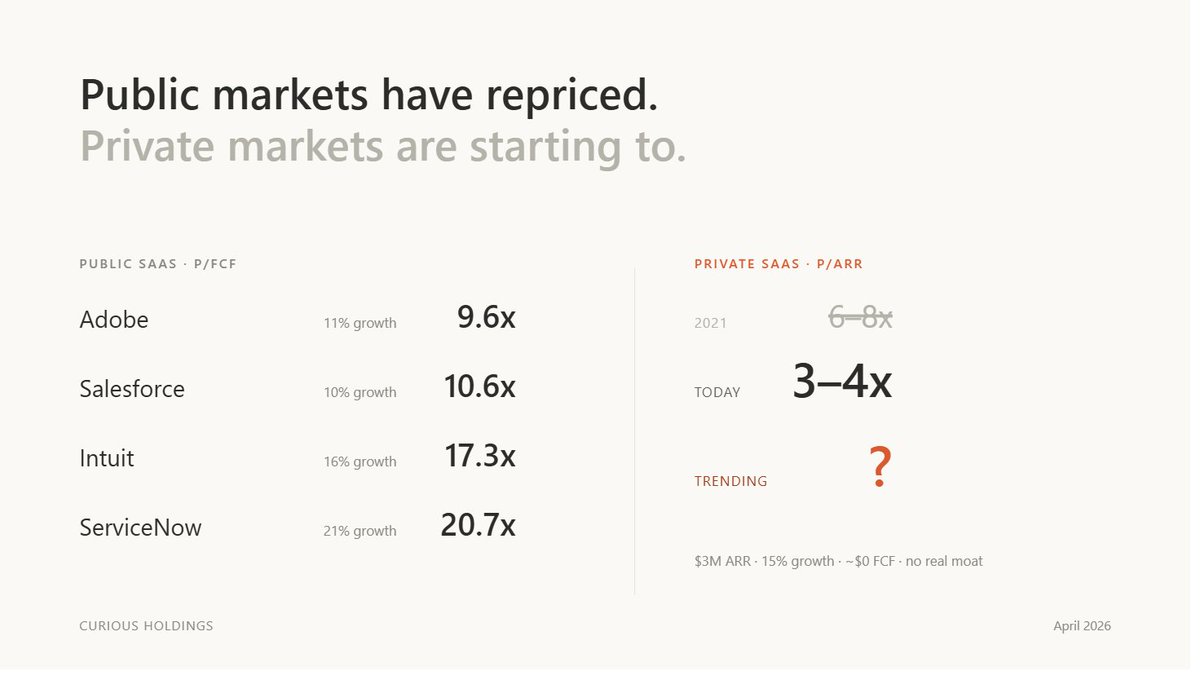
Salesforce is trading at 10x FCF.
Adobe at 9.6x.
ServiceNow at 20x.
Intuit at 17x.
These are the most durable, profitable, moat-protected SaaS businesses on earth, and the public market has decided they're worth low-teens multiples of free cash flow.
Now look at the private markets. A $3M ARR vertical SaaS growing 15% with no real moat still gets pitched at 6-8x ARR like it's 2021.
Private markets lag public markets. They always have. The repricing happens 18-24 months later, deal by deal, until the new reality sets in.
We're in that lag right now. If the best public SaaS companies in the world are trading at 10x FCF, the math on a $3M ARR private SaaS doesn't pencil at 6-8x ARR. That's not us being cheap, that's the public market telling you what these businesses are actually worth.
The hard part is your VC sold you a story from a different cycle. The 50x ARR rounds in 2021 weren't real prices, they were a moment. A lot of founders are still anchored to that number and don't realize the ground moved underneath them.
English
We all know software has a survivorship bias toward the winners. The losers get forgotten.
But there's another group nobody talks about: the winners who quietly kept working for a decade after the spotlight moved on.
The wireframing tool every designer used in 2011. The CI/CD platform whose logo meant "the build passed." The live chat widget that invented the category before the billion dollar versions showed up.
Still here. Still profitable. Still serving customers who'd be upset if they disappeared.
Surviving that long in SaaS is harder than growing fast for 3 years on venture money. The founders who pulled it off don't get the credit they deserve.
Those are the founders we spend our time with at Curious.
English
Tech twitter has convinced a generation of founders that $2M ARR is failure.
It isn't.
$2M ARR at 70% gross margin with modest growth is a real business. It's better than 95% of the small businesses in this country by any objective measure. The HVAC company owner down the street would trade you straight up and never look back.
The reason it feels like failure is the venture model needs you to be at $20M to matter. So when you're at $2M, the people who funded you stop returning emails, the people who write about software stop covering you, and the conferences stop inviting you to speak.
That's not your business failing. That's you not being interesting to a specific group of people whose entire job is chasing outliers.
If your customers love you, your team is paid, and you go home at a reasonable hour most days, you didn't fail. You just built a different thing than the one you set out to build.
That's worth something. We think it's worth a lot.
English
My best advice to venture backed founders stuck at $1M ARR with a heavy pref stack: hard pivot or sell.
Your investors care about the effort. If you tried your best, it's ok to move on.
Grinding it out is the real cost. 5 years of an $80k founder salary while your Series A investors moved on three funds ago. Every year you spend trying to dig out of a cap table that won't let you win is a year you're not building in the fastest growing industries on earth.
I've seen almost zero cases where a founder dug themselves out of this. Maybe it happens. Luck aside, I haven't seen it.
If selling is the right call, that's what we do at Curious. All cash, 30 to 45 days, permanent hold.
English
Everyone pays attention to the SaaS company that just raised a Series C.
Nobody pays attention to the one that's been quietly profitable for 12 years, serving customers who'd riot if it disappeared.
There's a wireframing tool every designer used in 2011. A CI/CD platform whose logo basically meant "the build passed." A live chat widget that invented the category before the billion dollar versions showed up.
They're all still here. Still running. Still matter.
Software has a survivorship problem, but not the one people mean. We don't ignore the companies that died. We ignore the ones that lived.
Surviving 10 or 15 years in SaaS is harder than growing fast for 3 on venture money. It means real retention, real utility, and a founder who kept showing up long after the spotlight moved on.
Nobody asks these founders what they want next. Keep grinding or shut it down aren't the only two options.
That's why Curious Holdings exists. We buy B2B SaaS companies between $1M and $5M ARR, all cash, and hold them forever. No flip, no earnout, no bridge round dressed up as an exit. Just a real home for the companies that built the categories everyone else is now chasing.
English
Curious Holdings acquires B2B SaaS companies with $1M to $5M in ARR across the US and Canada. All cash, permanent hold, and we operate what we buy.
When I talk about Curious, a question always comes up: why did we build it?
The simple answer: founders.
The software M&A world is full of models that work fine for capital and poorly for the people who built the thing. Roll-ups optimizing for a flip. PE shops loading companies with debt. Strategics letting products quietly die inside the mothership. We kept looking at how those deals actually landed for founders and kept coming back to the same question.
The real question wasn't "what's the right buy box?" It was "who do we actually want to work with for the next decade?"
The answer was always founders. The people who built something from zero, sold through the hard years, and now need a real home for what they built. Not a process. Not a 3-year earnout. Not a bridge round dressed up as an exit.
Curious sits at the center of that. We buy the company in cash, we run it, and we stay close to the founder after the deal closes. Sometimes they stay on in a new seat. Sometimes they move to the next thing and we pick up where they left off. Either way, the handoff actually works.
That's why we acquired UserVoice, BuildFire, Convox, Polymer, and AvenueHQ. Working with the founders and operators behind each of those companies has been the best part of the job.
More companies and founders coming soon.
English
Talked to a founder this week:
Raised: $10.4m across seed and Series A
Last valuation: $42m post
Current ARR: $2.1m
Growth last 12 months: 4%
Gross margin: 71%
Team: 9
Runway: 12 months of cash
Years since Series A: 3
This company could be a real business, but it’ll never return the fund.
The founder keeps grinding, thinking his investors care. But his investors have already moved on to companies that are working.
Some founders also like the “founder lifestyle.” They stay stuck with low salaries because they want to be called founders, and not employees.
Nikesh Arora shared what Masayoshi Son told him: “You’re spending too much time on the mistake. Don’t bother. Your time is better spent with the winners.”
The investors keep not writing the company off because it’s a call option for them. If it works, great. If not, they have others.
But the team keeps showing up and grinding to return the invested capital.
Any sale won’t clear the preferred stack, so they don’t sell.
They can’t shut down. It’s a running business with customers and a team.
They can’t raise. 4% growth doesn’t justify it.
They can’t quit. They’ve been underpaid for five years and have no savings.
They’re stuck, metaphorically and structurally.
Curious Holdings is built for founders on the wrong cap table. All cash, 30 to 45 days from LOI, permanent hold. No earnouts, no rollover, no bridge round dressed up as an exit.
The goal isn’t to be the only option on the table. It’s to be one of the good options, so founders can actually choose.
English
@vasuman @iamansood Sorry I had to rush on the UI, was spending too much time with your mom
English

I'm not allowed to tweet about Varick anymore because we can barely keep up with demand
But we are hiring
If you're an elite senior engineer, consider joining one of the fastest growing applied AI companies in the world, for top 1% comp
Team includes leaders from Meta, Citadel, Stanford, and more
Application link below
English

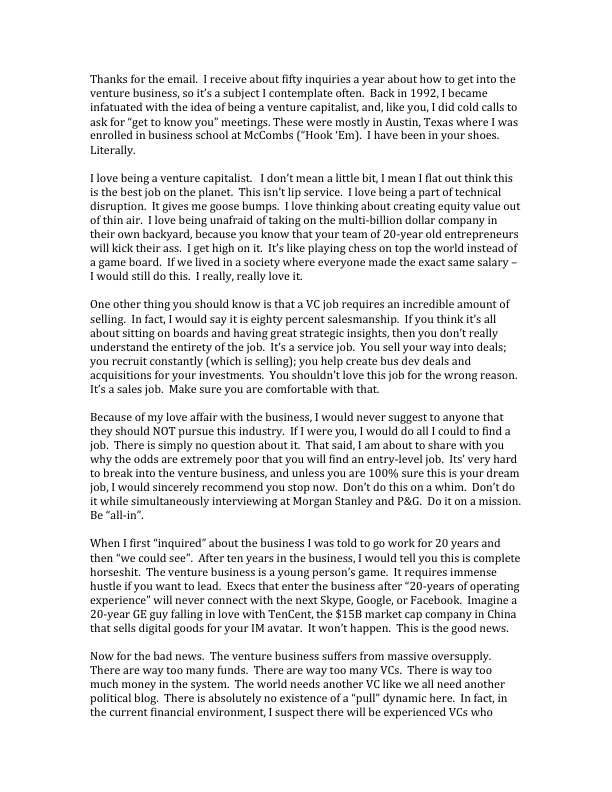
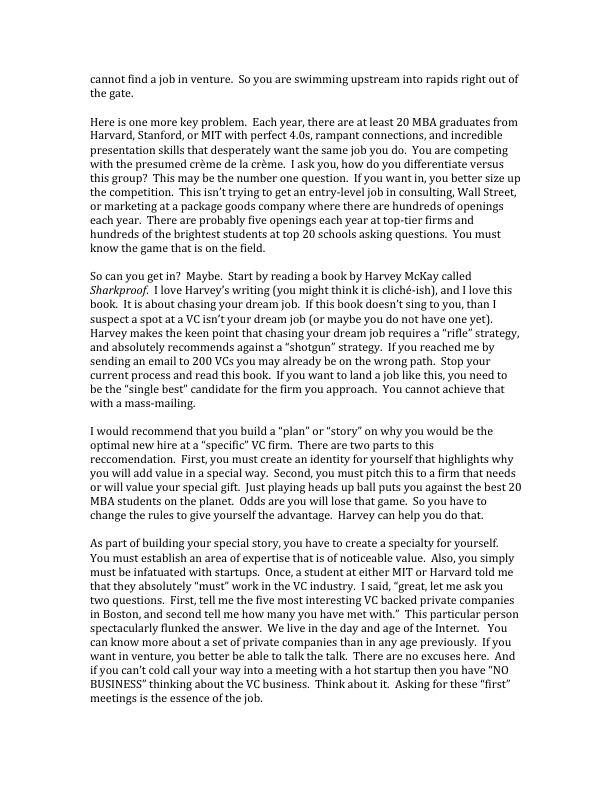
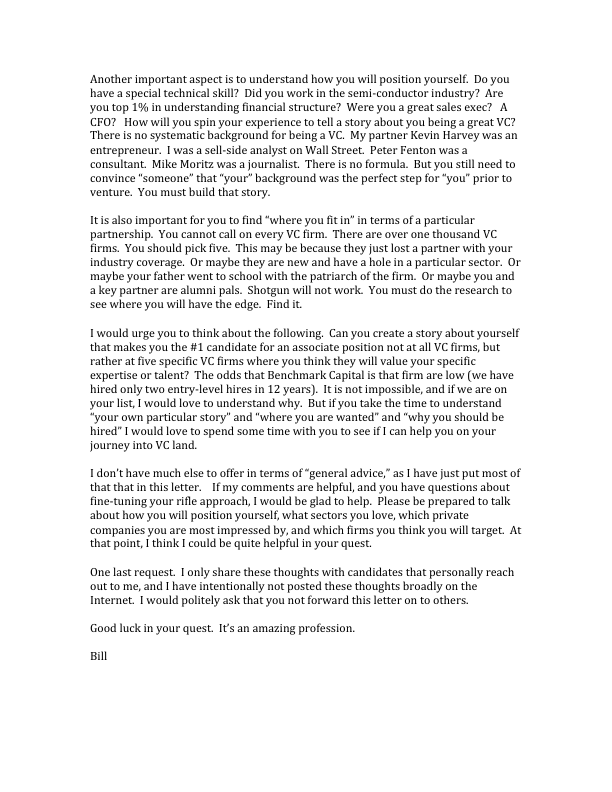
"So You Want to be a VC"
Im enjoying this week in Boston visiting students promoting my new book - Runnin Down a Dream. Not surprisingly, many ask me about trying to break into venture capital. I wrote a letter answering this question 15 years ago. I would send it out when people inquired. I'm making it public for the first time - with zero modifications.
1) I think it holds up well
2) make sure and read my new book also
3) I probably can't help with followups (as suggested in the letter)
Hope you find it useful. Good luck!
English
Justin retweetledi

Justin retweetledi
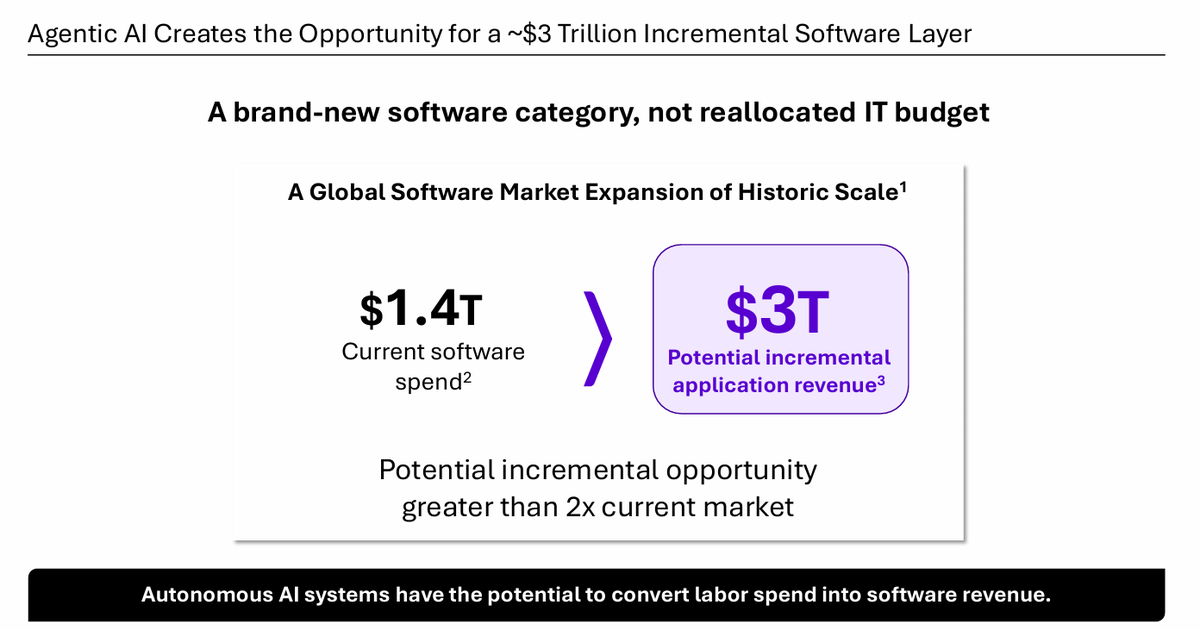
The Opportunity
Autonomous AI systems could convert labor spend into software revenue, creating an entirely NEW software layer.
Current global software spend: $1.4T
Potential incremental TAM: $3T+
This is brand-new software category expansion....more than 2x the current total addressable market.
English
Justin retweetledi

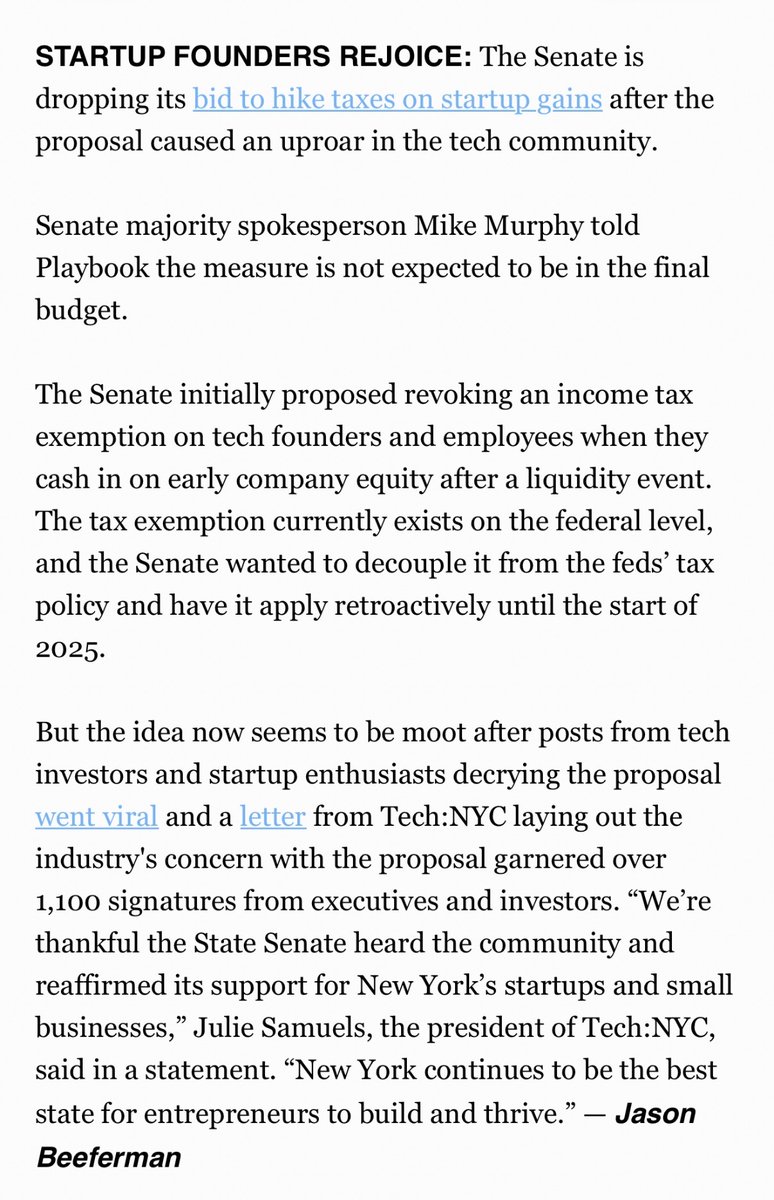
Big news for NY startups! QSBS is here to stay.
From @politico: the idea now “seems to be moot” following strong, coordinated engagement from across the tech community—including a @TechNYC letter with 1,600+ founders, early employees, and investors.
This is a clear example of what’s possible when the ecosystem shows up together. We’re grateful to everyone who spoke out and helped ensure policymakers understood what was at stake.
New York remains the best place to build. 🗽
English
Justin retweetledi
A proposed change to QSBS in NY has demonstrated how quickly and willing the New York tech community is to work together to support our ecosystem. At stake is a major shift in policy that would tax startup gains at up to 14.8% in New York City, retroactively, just as other states move to attract founders and capital. The tech industry is one of the largest and fastest-growing areas of New York's economy, accounting for 41% of the city’s net new jobs since 2019.
Builders are paying attention, and they are mobile. The decisions made now will shape where companies are started, where talent stays, and where the next generation of innovation happens.
Founders and investors who care about the future of building in New York, add your name by tomorrow at noon: docs.google.com/forms/d/e/1FAI…
English
Justin retweetledi

QSBS isn't a loophole. It's the only tax break in America that requires you to have created something from nothing. New York is about to eliminate it. Here's why that should matter to everyone, not just founders.
cc: @nihalmehta @dhaber @juliepsamuels @davidu @zachweinberg @Trace_Cohen @yrechtman @WillManidis @mattturck @mansourtarek_ @brexton @BillAckman @packyM
Michael Bloch@michaelxbloch
English


We were Clay's largest user at one point in time, hitting their platform 17.3 million times per week. Last month we replaced them entirely with a $200/mo Claude Code subscription.
I can't write code. Neither can James, my VP of Growth who built the replacement.
Here's the full story.
Clay is a GREAT product and I TRULY think most people should use it. But we hit their ceiling.
50,000 row limit per table.
12.5 million row cap per workspace.
Tables that take days to actually delete.
Clicking "run all" thousands of times and waiting days for things to clear out.
So
When you're processing millions of leads, all the above become the bottleneck of your entire business.
James had never touched Claude Code before. Three weeks after learning it, he built our entire core system.
With Clay, processing 1 million leads took 27 hours.
And it would error out often enough that we would always have to plan on hitting the “run all rows” button again on 20+ clay tables. IYKYK
but
Our new system waterfall enriches 1 million leads in 5 seconds. 272,000 leads PER SECOND.
AND On top of the core engine, we vibe coded a Google Maps scraper that pulls leads zip code by zip code across all 32,000 US zip codes.
AND An AI lead finder that hits 95% contact match rates where Apollo gives you about 30%.
AND Ad library scrapers for Google and LinkedIn.
AND An AI campaign analysis system.
AND An auto-refill system so clients never run out of leads mid-campaign.
One we started building with Claude, we just couldn’t stop
Now we have the data ready for clients sending 5 million emails a month within 1 week of signing the contract.
I put together the full system blueprint -- every tool, the tech stack, a Clay vs custom comparison, and a 6-step playbook for building your own. Plus a video walkthrough where I show you the live system and how each tool actually works.
Retweet or Reply CODE below and I'll DM it to you.
English