々▵
674 posts


Is there a public chart that displays a bandwith of # of BTC available, at any given time?
@_Checkmatey_ @btcjvs @sminston_with @TheRealPlanC
English

@bramk @_Checkmatey_ @btcjvs @sminston_with @TheRealPlanC “Supply shock” bros might have been right all along 😂
English

@bramk @_Checkmatey_ @btcjvs @sminston_with @TheRealPlanC What would be really cool would be to interview someone with deep knowledge of market plumbing/structure to understand at what levels of spot “BTC available” the asset has to materially reprice to support the paper market
English

@alistairmilne This 100pct is the key point. Structural, uncorrelated and indiscriminate bid for a supply inelastic asset riddled by mass fuckery. At what level of exchange supply do we start seeing fireworks?
English

@Trollstein @Strategy @TNorth Interesting. Even more consequential is what this does to exchange balances given supply inelasticity…
English

We now have both a 1M & 2M @Strategy BTC target on the @TNorth website
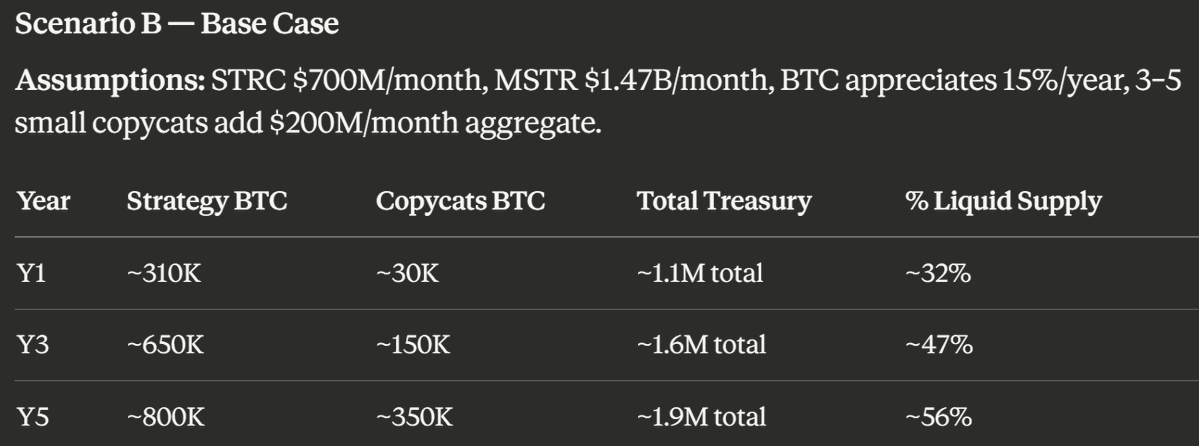
Strategy is ~580 days from 2,000,000 BTC
Base case: Monday, November 15, 2027
780,897 of 2,000,000 BTC (39.04%)

Grain of Salt@Z06Z07
Here the math and article behind how @Strategy gets to 2M Bitcoin in 2027. It’s really not that hard. $STRC and $MSTR x.com/z06z07/status/…

English

How much STRC does Strategy have to issue to drive Bitcoin to $1,000,000?
Realistically, something like 0.5% to 1.5% of a $300T global debt market is the zone I’d watch, with ~0.6% to 1.2% as a very clean base case.
Here’s the logic.
Bitcoin is about $71,680 right now, and circulating supply is about 20.01 million BTC, which puts current BTC market cap around $1.43T.
At $1,000,000 per BTC, market cap would be about $20.01T. So the gap to close is roughly $18.58T.
If you did the dumb, literal accounting version where every fresh dollar of STRC capital only created one extra dollar of BTC market cap, Saylor would need capital equal to about 6.19% of $300T.
That is the upper-bound, brute-force answer, and it is way too conservative because markets do not reprice that linearly.
The reason the real answer is lower is that Bitcoin has a flow-to-market-cap multiplier.
Recent academic work explicitly defines a “crypto multiplier” as the market-cap response to investor inflows and says major cryptocurrencies likely have large multipliers because most coins are held as investments, not used for payments.
Separate flow research on spot BTC ETFs also finds that ETF inflows have a persistent positive effect on BTC prices, which reinforces the basic idea that fresh capital can move market value by more than one-for-one.
So if you model that $18.58T repricing gap through different multipliers, you get this:
20x multiplier: about $0.93T of net BTC buying, about 0.31% of $300T
10x multiplier: about $1.86T, about 0.62%
5x multiplier: about $3.72T, about 1.24%
3x multiplier: about $6.19T, about 2.06%
If STRC-style issuance became a major global fixed-income product, Saylor probably does not need 6% of the debt market.
He more likely needs something in the neighborhood of 0.5% to 1.5% captured cumulatively over time, assuming Bitcoin reprices reflexively as float tightens.
That range corresponds roughly to a 10x to 5x effective market-cap multiplier, which feels aggressive but not insane for an asset with scarce liquid supply and persistent corporate/ETF demand.
There is one more wrinkle. STRC is not a zero-cost funding source. Strategy says STRC currently carries an 11.50% variable annual dividend, payable monthly in cash. If Strategy wanted to reserve, say, roughly 2 years of dividend coverage on new issuance, then only about 77% of gross proceeds would actually go into BTC.
Under that assumption, the gross debt-market share needed rises to roughly 0.80% in the 10x case and 1.61% in the 5x case.
And just to show how early this still is, Strategy’s site currently shows STRC notional at about $5.355B, which is only about 0.0018% of $300T.
So to do this through STRC alone, the machine would need to scale by hundreds of times from here.
$1M Bitcoin via STRC alone probably implies capturing around 1% of the global debt market, give or take, not 6%.
6% is the static-accounting answer. ~1% is the reflexive-market answer.
High liquidity, low volatility, high yield.
There's nothing like it.
It's a good thing the best product wins in the marketplace.
English

@PeterSchiff @RonSwanonson What happened before that Peter you absolute wombat?
English

@RonSwanonson Because gold rose so much before the war and Bitcoin fell.
English

@LawrenceLepard @dmweisberger I hope you are right. But Trump and Bessent have shown a shocking level of ineptitude so far. My money is on them somehow fumbling the bag (yet again)
English

@dmweisberger I think he gets confirmed fast. War dictates it. Bessent will tell Trump to drop suit against Powell.
English

Important clue: we will build a narrative to cut rates.
*Walter Bloomberg@DeItaone
HASSETT: OUTLOOK FOR FED HAVING ROOM TO CUT RATES IS GOING TO BE VERY SOLID
English

Strategy at current pace (~43K BTC/month) absorbs 3.185x monthly mined supply.
That ratio alone is staggering.
20% of the highly Bitcoin liquid supply gets absorbed in under 5 months at current pace.
The stress case is survivable with years of dividend coverage, and critically, prior absorption is permanent.
Coins don't come back.
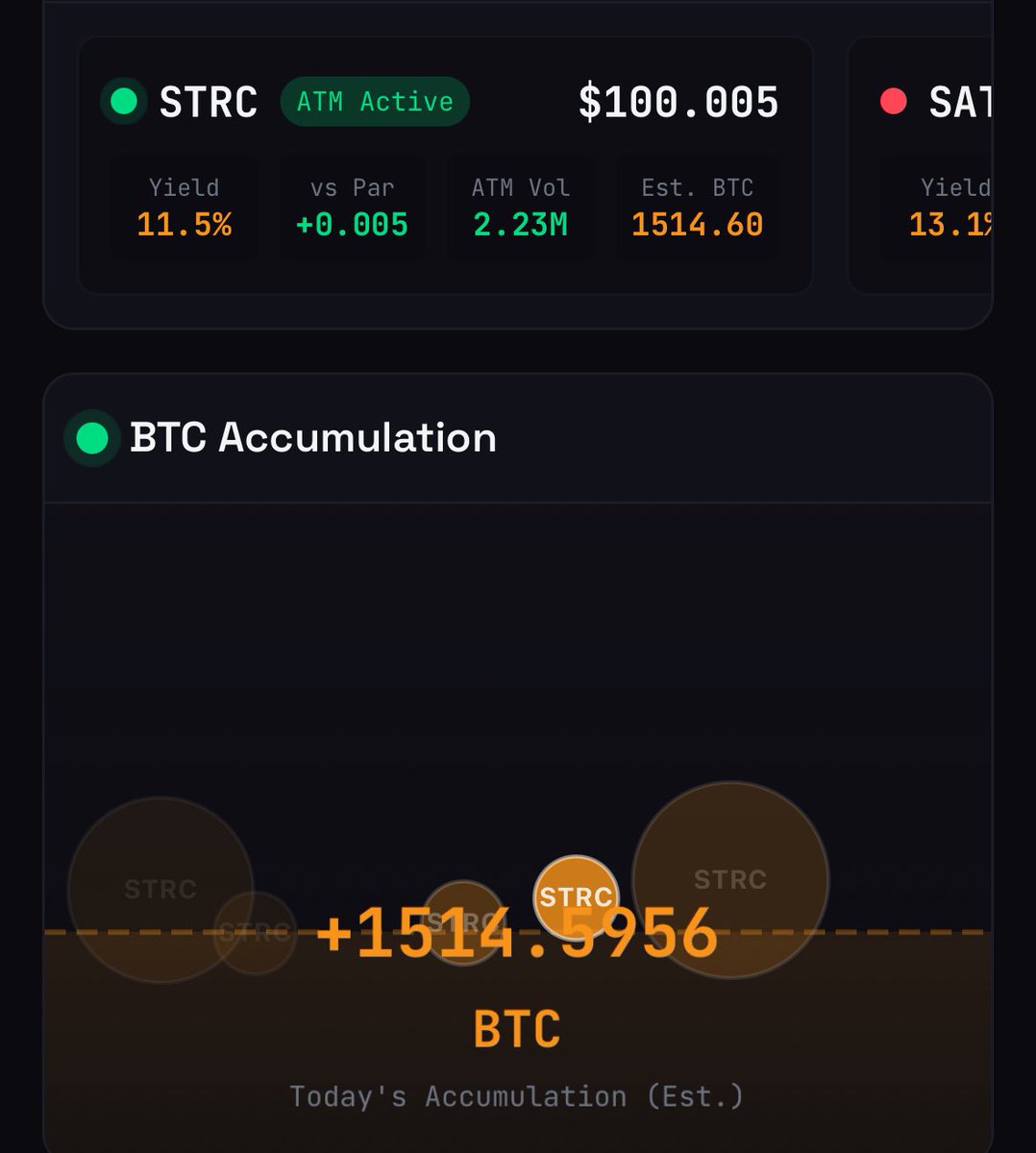
STRC hitting $333M volume yesterday with one penny of volatility is the clearest signal the instrument is working as designed.
What this means for Bitcoin over a 5 year timeframe is staggering.
Digital credit is what pushes Bitcoin to $1,000,000.

English

@bleighky @TimKotzman @PunterJeff @Z06Z07 @TNorth Sharpe Ratio is an irrelevant metric for an asset whose returns are not normally distributed. But why let facts get in the way? (Before you ask, I do think $STRC is the biggest story in finance today)
English

Tradfi is going to have a collective mental breakdown when $STRC hits a sharpe ratio of 40. I can't wait 🤣
@PunterJeff @Z06Z07
English

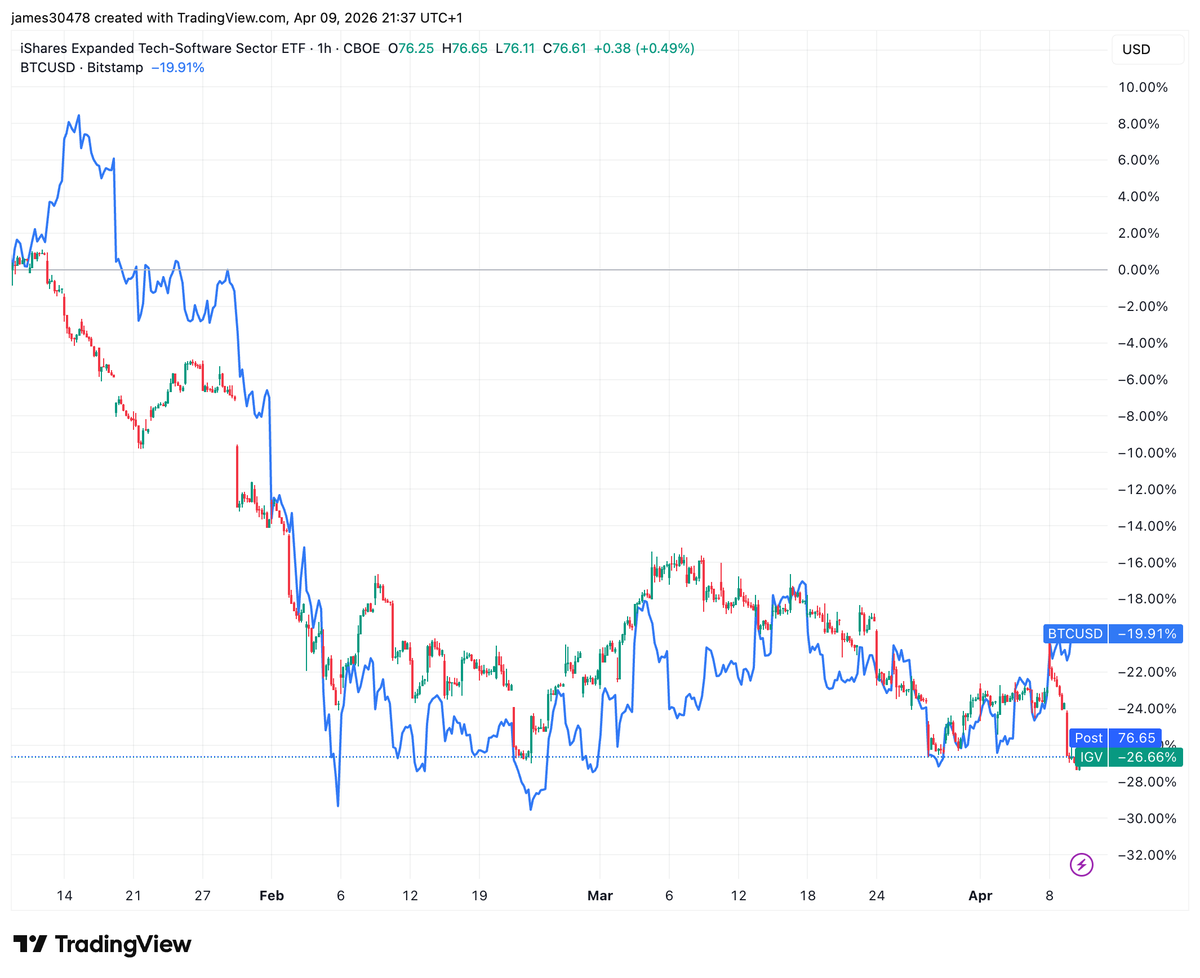
@dotkrueger I think Luke will buy in just below where he sold. After we conclusively decouple from software and he realises the significance of STRC
English

Both Bitcoin and IGV initially made their lows on February 5. Since then, IGV has gone onto make new lows twice.

James Van Straten@btcjvs
The middle East war has changed a lot of things
English

@Pledditor @jemimajoanna publicly took the piss out of @balajis for saying that when the rules-based order collapses, the code-based order rises. Life comes at you fast
English

Actually big news.
Bitcoin wins over gold here, because gold can be seized.
Bitcoin wins out over stablecoins, because Iran needs (not wants) the censorship resistant characteristics + Iran is purposefully trying to exit supporting the US dollar system in protest of the war.
Tree News@TreeNewsFeed
[🌲] Iran to charge tanker transit tolls in Bitcoin, says Hosseini — FT
English

@RichardByworth @saylor @phongle Yeah, ex Div is on the 14th (in 6 days). Last month, 6 days before ex Div (Mar 6th) STRC bought ~ 2.1k BTC. Interesting to see how much more we do today. My guess is 50pct (~3k including after market)
English

@DrJStrategy James I am waiting for your big brain, 5D chess take on how Trump’s plan is benefiting the people who voted for him
English

In my latest Market Insights I counter the growing consensus narrative that King Dollar is dead and the petrodollar is broken. Far from signaling the end of US monetary hegemony, the Iran conflict and recent moves in Venezuela are consolidating an Americas‑centric energy bloc under US strategic control. As the Western Hemisphere tightens its grip on secure, price‑setting marginal barrels, crude trade, contracts, and hedging are being drawn back into dollar‑centric markets.
Contrary to consensus, the war has not dismantled the petrodollar system; it has re‑anchored it in American energy dominance, reinforcing rather than eroding the dollar’s role at the center of global finance. At the same time, China is progressively losing access to the very cheap, heavily discounted oil that underpinned its hedged energy and geopolitical strategy, further tilting the energy‑currency balance back toward the United States.
Wellington-Altus@wellingtonaltus
The New Great Game is taking shape—a U.S.-China rivalry over energy, AI infrastructure, and the dollar. In his April #MarketInsights, @DrJStrategy weighs in on Bretton Woods 2.0, King Dollar, and what it means for investors: ow.ly/FJoQ50YBbHh #Investing
English