Matt Peterman

840 posts

Matt Peterman

Matt Peterman

@MTJPeterman

Insurance, AI/ML

London, England Katılım Temmuz 2012
1.3K Takip Edilen643 Takipçiler
Harry Stebbings
Harry Stebbings@HarryStebbings·
The single biggest mistake people make in relationship building. They do not follow up. And they do not follow up because they do not do it the night of the dinner/event/drinks. Every time I go to an event, in the car, on the way home, I email every person I met that night that I want to progress a conversation with. 99% of people do not do this. They say, I will do it tomorrow and they never do. That said, at the end of an evening, in the back of an Uber, I do not want to type 10 emails. @WisprFlow for the win. Do all of them in sub like 10 mins. The way you follow up is the way you are remembered. PS. This was written with Wispr Flow from a walk in London! Try Wispr Flow yourself at wisprflow.ai
English
27
4
209
37.7K
Guillermo Flor
Guillermo Flor@guilleflorvs·
🚨 BREAKING: Karpathy’s AI exposure scoring isn’t scary because “a few jobs” are at risk. It’s scary because the pattern is now obvious across the entire US labor market. He scored 342 occupations (BLS data) on a 0–10 “AI exposure” scale, and the job-weighted average comes out to 4.9 across 143M jobs. Here’s the rule hiding in plain sight 👇 Exposure rises with pay + credentialing. - Workers earning <$35K average 3.4 exposure - $75–100K jumps to 6.0 - $100K+ hits 6.7 Education tracks the same way: No degree/HS = 4.1 vs Bachelor’s/Master’s/Doctoral = 5.7. Now look at the concrete contrasts (this is the part people miss): - Home health and personal care: 2/10 (4.3M jobs) - Registered nurses: 4/10 (3.4M jobs) - Top executives: 6/10 (4.0M jobs) - Financial managers: 7/10 (869K jobs) And yes, the scale is already massive: - 25.2M jobs sit in 8–10 - 34.7M more are in 6–7 - $3.7T in annual wages are in jobs scored 7+ Why this matters: the first-order impact of AI isn’t “blue collar vs white collar.” It’s: the higher-paid, more credentialed, more screen-based the work is, the more exposed it gets. Founders + operators: stop debating if disruption is coming. Start asking which workflows in your org are already a 6–7+ and should be redesigned now.
English
4
3
5
697
Matt Peterman
Matt Peterman@MTJPeterman·
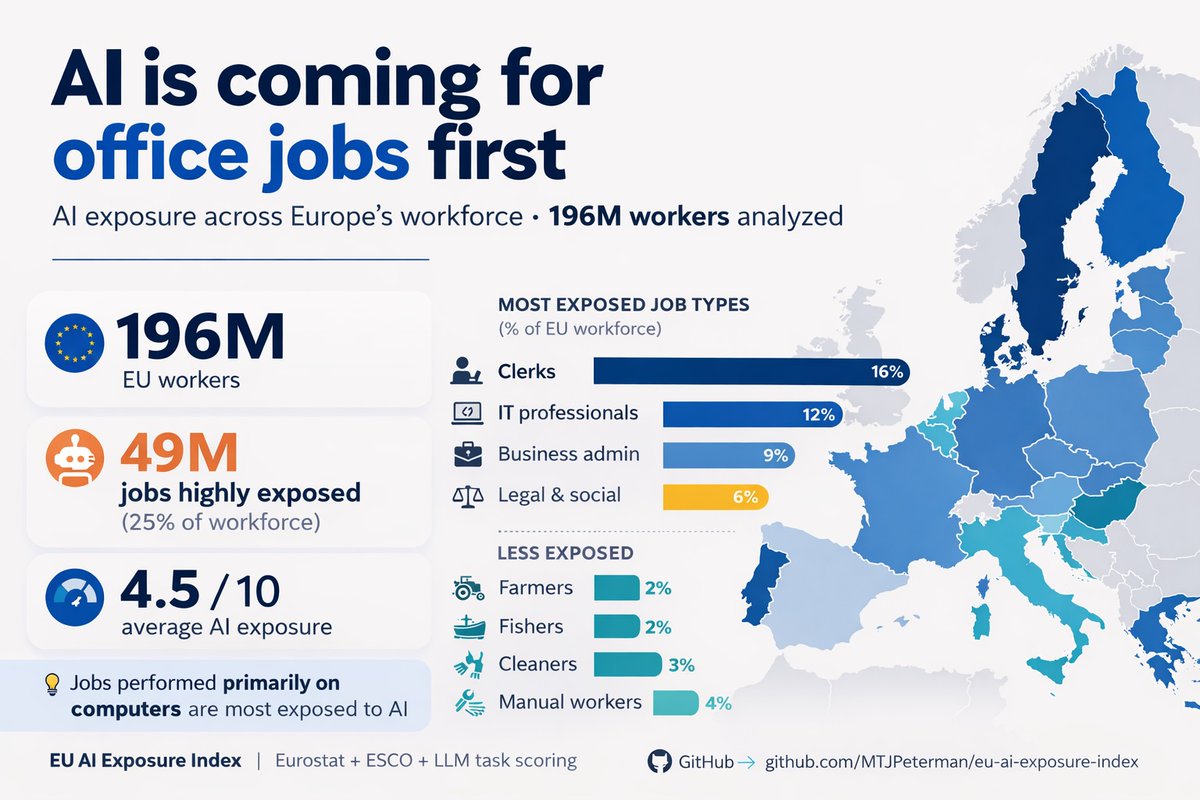
AI exposure in Europe isn’t where most people expect. We analyzed 196M EU workers. Highest exposure: -Clerks -IT professionals -Business administration Lowest exposure: Farmers Cleaners Manual workers 49M jobs (25%) are highly exposed to AI. Dataset + methodology
Matt Peterman tweet media
English
0
0
0
12
Matt Peterman
Matt Peterman@MTJPeterman·
@Hacknaut great pic. hyperbunker is replicating that "tape" concept.
English
0
0
0
6
Hacknaut
Hacknaut@Hacknaut·
Hacknaut tweet media
ZXX
8
217
2.1K
21.8K
Matt Peterman
Matt Peterman@MTJPeterman·
@Cyb3rMik3 If catastrophe is assumed, last-resort must be survivable without identity, control plane, or cloud access. Most RRPs still quietly assume those exist. That’s the gap.
English
0
0
0
14
ᴍɪᴄʜᴀʟɪs ᴍɪᴄʜᴀʟᴏs
Again, nope. Response and recovery plans (RRPs) are required and not just as documents but as actually tested procedures. RRPs are not required to cover systems' "normal failure" but severe ICT incidents covering business disruption and critical function failure. That all contributes to systems resiliency (along with many other DORA requirements). DORA assumes total catastrophy could happen, and that's exactly what its controls are designed for.
English
1
0
0
38
ᴍɪᴄʜᴀʟɪs ᴍɪᴄʜᴀʟᴏs
If you work in an organization governed by DORA regulations and requirements, you have my utmost respect. I understand all too well the complexity and pressure that comes with it. Microsoft Security has introduced today a tailored DORA workbook for Sentinel SIEM, delivering centralized, real‑time visibility into your organization’s ICT risks, incidents, threat exposure, and overall resilience posture mapped directly to DORA requirements. While the regulatory requirements may be consistent, every organization is unique. As such, this solution can serve as a strong 𝗳𝗼𝘂𝗻𝗱𝗮𝘁𝗶𝗼𝗻 and 𝗮𝗰𝗰𝗲𝗹𝗲𝗿𝗮𝘁𝗼𝗿 for your 𝗗𝗢𝗥𝗔 𝗰𝗼𝗺𝗽𝗹𝗶𝗮𝗻𝗰𝗲 journey. #MicrosoftSecurity #MicrosoftSentinel #DORA #Compliance techcommunity.microsoft.com/blog/microsoft…
English
1
8
38
4.4K
Matt Peterman
Matt Peterman@MTJPeterman·
@Cyb3rMik3 If resilience always held, recovery wouldn’t exist. DORA governs normal failure. Total compromise needs a different assumption set.
English
1
0
0
15
Bill Gurley
Bill Gurley@bgurley·
Henry is one of the smartest investors on the planet. He also rarely does this type of speaking - so it’s a special holiday treat. More free learning opportunities from @patrick_oshag! 🙏 🙏 🙏
Patrick OShaughnessy@patrick_oshag

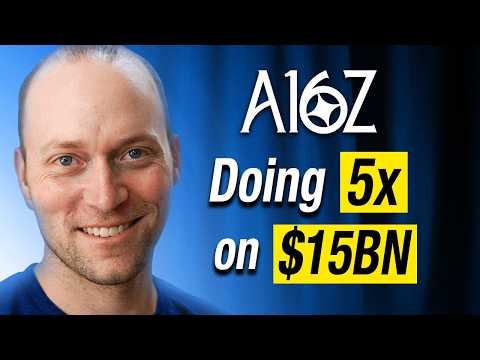
Henry Ellenbogen has one of the best track records in growth investing, yet he has kept a notably low profile. He built his reputation at T. Rowe Price, where he ran the New Horizons Fund and turned it into one of the best-performing small-cap growth portfolios in the country. He backed more than 50 companies through IPO before leaving in 2019 to found Durable Capital. Henry believes great investing is about understanding people and change. He spent his career studying the 1% of companies that drive nearly all long-term returns, which led him to a simple philosophy: invest in small companies that can become large ones. He built Durable to uniquely support a company through its full compounding journey. A single team can invest early in private markets and continue owning businesses as they scale into durable public companies. He talks about investing in and learning directly from founders like Jeff Bezos, Reed Hastings, @tobi, @mlevchin, and @LuisvonAhn, and watching how they adapt and rebuild as their businesses scale. He is especially drawn to "Act II" entrepreneurs, founders who have already built one company and return with sharper judgment and execution the second time. We also discuss Durable itself, which is Henry's own Act II. He explains how he has built the firm around developing talent, measuring people by how much they make others better, and his discipline of writing memos and doing multi-year lookbacks on every investment. What comes through most clearly is how much Henry loves the craft of investing, and how seriously he takes building something meant to last. Enjoy! Timestamps: 00:00 Intro 03:02 Origin of an Investment Philosophy 07:02 The "One Percent" of Stocks 13:17 Domino's 19:10 Betting on "Act Two" Teams 24:31 Building Durable Capital 34:46 Market Structure and Time Arbitrage 52:49 Adapting to Discontinuous Change 1:03:19 Physical Moats vs. Soft Moats 1:11:52 The End of Free Money 1:37:35 The Argument for Going Public 1:46:43 The "Warriors" Mindset 1:51:17 Kindest Thing

English
16
110
1.4K
279.1K
Seb Johnson
Seb Johnson@SebJohnsonUK·
Harry Stebbings on what it means to be a leader: "Your job as leader is to work an orchestra... I need to know how each players plays in the band and what it takes to get the best out of them, to play to their tune. And when it comes together it's beautiful" It's not something that came easily to him. He went from being a teenager podcasting in his kitchen to leading a successful firm (that manages nearly $1bn of AUM) as well as an amazing media company. It's refreshing to see a leader talk openly about the difficulties in building and running a team. Good stuff @HarryStebbings
English
3
1
22
3.1K
Harry Stebbings
Harry Stebbings@HarryStebbings·
This podcast changed my investing mindset more than any other I have done. 1. The best companies have hostages not customers. 2. The best founders are able to materialise capital, customers and labor. 3. The best founders are students of history. 4. The best founders are seeking revenge. 5. Two deals are good: any piece of something working, or a lot of something that could be mega. This is one of the best shows I have ever done on investing. Period. Spotify 👉 open.spotify.com/episode/5wLwQN… Youtube 👉 youtu.be/b5fTnZRsuhI Apple Podcasts 👉 podcasts.apple.com/us/podcast/20v… My 7 takeaways with @arampell @a16z 👇 Timestamp: 00:00 Intro 01:26 How to Do 5x on a $15BN Fund Pool? 04:15 What Two Groups of Funds Will Win the Next Decade in VC? 15:13 What Three Things Are the Best Founders Able to Do? 20:35 The Best Companies Have Hostages, Not Customers 32:15 The Two Types of Deals You Want To Do In VC 37:18 The Importance of Founder/Capital Fit 40:20 Multiple Successive Rounds Are Dangerous… Here is Why? 44:01 The Importance of Ownership in Deals 57:19 Is Triple, Triple, Double, Double Dead? 58:46 Advice on Selling Companies 01:08:42 Quick-Fire Round 01:13:26 What is the Future of Venture Capital
YouTube video
YouTube
English
16
28
247
138.4K
Andrew D. Huberman, Ph.D.
Andrew D. Huberman, Ph.D.@hubermanlab·
Chess prodigy Josh Waitzkin developed a process to achieve peak performance in any craft or career. He’s applied it to the world of investing, professional sports, science and more. The MIQ Process. It is not a quick fix, but rather a rewiring of your default settings.
English
248
2.4K
24.6K
2.6M
Matt Peterman
Matt Peterman@MTJPeterman·
@reidhoffman interesting how few teams design for the day cloud + backups both fail.
English
0
0
0
13
Reid Hoffman
Reid Hoffman@reidhoffman·
A moratorium on data centers in the United States is a horrible idea... that doesn't mean the alternative needs to be pure acceleration with no care for the impacts on society. Like driving a car, we can use the gas pedal and the brakes to move forward.
Alex Konrad@alexrkonrad

@danprimack When I wrote about this debate for a Forbes cover story last year, @reidhoffman shared a line like that — similar metaphor even — comparing it to driving a test car, and slowing down as it approaches a corner or turn. (Wish we could’ve gone deeper in it if we’d had the space!)

English
25
5
43
15K
Chubby♨️
Chubby♨️@kimmonismus·
Google delivers what Apple promises. The importance of latency-free live streaming in outstanding quality can hardly be overstated. It breaks down barriers, brings people together, creates social connections, and also facilitates easier economic cooperation and collaboration, exchange, and so much more. If the video truly reflects this quality, Google has achieved what humanity has dreamed of for ages: global communication in real time. Kudos to Google, you deliver every single day. P.S.: Apple promised exactly this kind of live translation, but only Google is delivering it.
Google AI@GoogleAI

Listen up 🔊 We’ve made some updates to our Gemini Audio models and capabilities: — Gemini’s live speech-to-speech translation capability is rolling out in a beta experience to the Google Translate app, bringing you real-time audio translation that captures the nuance of human speech — Gemini 2.5 Flash and 2.5 Pro Text-to-Speech preview models bring improved adherence to style prompts, precision pacing with context-aware speed adjustments, and character voice consistency for multi-speaker scenarios — Gemini 2.5 Flash Native Audio is now updated, with improvements to handle complex workflows, navigate user instructions, and hold natural conversations

English
65
199
2.7K
273.9K
Fareed Mosavat
Fareed Mosavat@far33d·
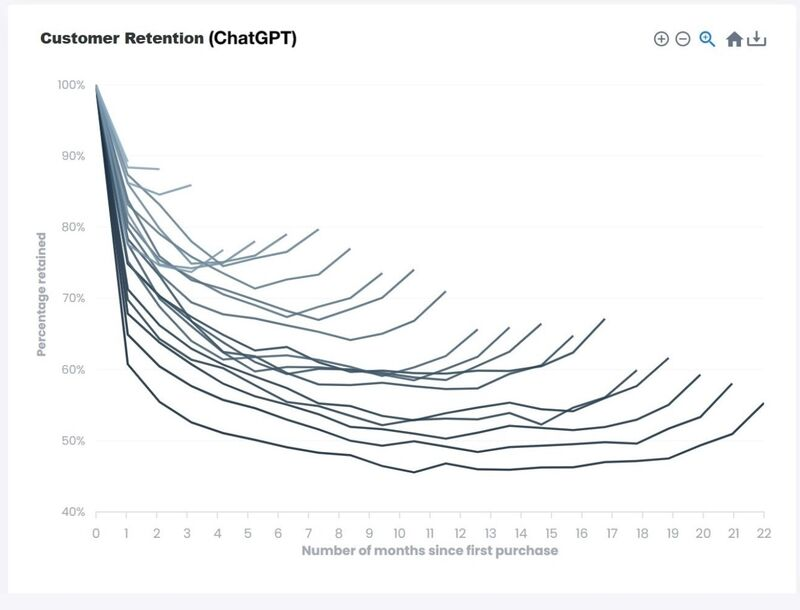
This chart is so insane it looks fake. Huge businesses (plural) will be built on top of this chart.
Fareed Mosavat tweet media
English
56
82
1.2K
1.1M
Matt Peterman
Matt Peterman@MTJPeterman·
30% of restores fail. Most CEOs don’t find out until ransomware hits. This week HYPERBUNKER was featured in Blocks and Files. The specialist site storage and infra execs read,  but one most outside industry have never heard of. Offline. immutable. dumb by design.
English
1
0
0
50
Melinda B. Chu
Melinda B. Chu@MelindaBChu1·
Tons of papers and groups (companies and academic labs) developing “AI Co-Scientists,” Google prob most well-know. What Kalanick is describing is just brainstorming or maybe you could call it an AI Co-Scientist. Several recent papers and reports discuss AI Co-Scientists, advanced multi-agent AI systems designed to collaborate with human researchers by generating, evaluating, and refining novel scientific hypotheses and research proposals. The most detailed and notable example is Google’s AI co-scientist built on its Gemini 2.0 large language model, which uses specialized agents — such as generation, reflection, ranking, evolution, proximity, and meta-review — working in a coordinated cycle inspired by the scientific method to accelerate scientific and biomedical discoveries. Key points about AI Co-Scientists include: •Functionality: They serve as virtual scientific collaborators that take researchers' natural language inputs describing specific goals and generate novel hypotheses, detailed research overviews, and experimental protocols, iteratively improving output quality via automated feedback loops.research+2 •Multi-agent architecture: The system comprises specialized agent roles with tasks such as idea generation, critique, refining, ranking, and meta-review, under supervision to coordinate flexible scaling of computational resources and iterative reasoning refinement.academic.oup+2 •Applications: Demonstrated use cases in drug repurposing, target discovery, and explaining bacterial evolution/antimicrobial resistance have resulted in experimentally validated hypotheses and novel research directions.arxiv+1 •Collaborative design: These AI co-scientists are intended to complement, not replace, scientists by enhancing creativity, handling vast literature, and integrating interdisciplinary knowledge.nature+2 •Limitations: Challenges include hallucination risks typical of large language models, which are mitigated by multi-agent critique mechanisms but still require expert review.research+1 •Access and future outlook: Google has initiated a Trusted Tester Program to broaden research organization access to the AI co-scientist system and views it as a promising augmentation technology to accelerate discoveries responsibly.research Relevant papers and resources include: •"Towards an AI co-scientist" (arXiv 2502.18864) detailing the multi-agent design, biotech applications, and validation of this approach.googleapis+1 •Google Research blog posts explaining the AI co-scientist system and its impact on scientific workflows.deeplearning+1 •Independent discussions and evaluations in scientific media highlighting practical testing and user experiences with AI co-scientist tools.academic.oup+1 If you want, I can provide links or PDFs of these key papers and articles for deeper reading. 1https://research.google/blog/accelerating-scientific-breakthroughs-with-an-ai-co-scientist/ 2https://academic.oup.com/eurjcn/article/24/5/800/8205996 3https://www.nature.com/articles/d41586-025-02028-5 4https://adasci.org/ai-co-scientist-systems-a-multi-agent-system-for-research/ 5https://arxiv.org/abs/2502.18864 6https://www.deeplearning.ai/the-batch/ai-co-scientist-an-agent-that-generates-research-hypotheses-aiding-drug-discovery/ 7https://www.litmaps.com/learn/best-ai-research-tools 8https://storage.googleapis.com/coscientist_paper/ai_coscientist.pdf 9https://arxiv.org/abs/2505.11855 10https://ai.google/research/
English
11
1
17
17.5K
Jesse Pujji
Jesse Pujji@jspujji·
I generated 10M+ impressions and $4M of revenue from LinkedIn last year. Here’s the system everyone ignores: Posting daily is not enough. The most underrated LinkedIn growth strategy is using engagement and comments to create reach. My assistant runs an AI-enabled process that ANYONE can steal. She’s doing it now to help my co-founder Adriane grow her reach. I asked her to make a 5-min Loom to share the process with everyone here. Like this post + comment “GA” to get the Loom in your DMs.
English
164
2
144
14K