مازن وذكاء الآلات

1.1K posts

مازن وذكاء الآلات banner
مازن وذكاء الآلات

مازن وذكاء الآلات

@Mazen_AIEx

حيث يلتقي السيليكون بالمشابك العصبية

Amman Katılım Eylül 2022
349 Takip Edilen9 Takipçiler
مازن وذكاء الآلات
AI coding copilots definitely make me faster, but Schrödinger’s bug is real: the code looks perfect… until you actually read it. Engineering judgment is still the real compiler.
English
0
0
0
5
مازن وذكاء الآلات
@daniel_mac8 I keep coming back to the same conclusion: scale keeps delivering surprises. If Mythos really jumps in coding and reasoning, the interesting question is what scaled most this time. Compute, data quality, or the training pipeline?
English
0
0
0
229
Dan McAteer
Dan McAteer@daniel_mac8·
Claude Mythos/Capybara is the continuation of the scaling laws. Dario is an originator of the scaling laws. No surprise his team held the belief and kept pushing. The removed blog post said the model is a *dramatic* leap over existing models. The scaling laws surprised even their originator. Something unexpected happened in that datacenter. 2026 will be a wild ride. The birth of Powerful AI.
Dan McAteer tweet media
English
28
23
403
43.4K
Dr. Theophano Mitsa ☦️🇬🇷🇺🇸
Tech with Mak@techNmak

"Do not learn to code" is the worst career advice of the decade. People are telling college students to skip Computer Science because AI will just automate it all. Andrew Ng just killed this myth at Stanford with a brilliant analogy. When he tried to generate images with Midjourney, he typed: "make pretty pictures of robots" and got garbage. His collaborator, however, understood Art History. He knew the exact vocabulary of lighting, genre, and palette. He spoke the "language of art," and generated masterpieces. Andrew Ng is seeing the exact same thing happen in software engineering right now. AI didn't replace the need to understand Computer Science. It made Computer Science the required vocabulary to control the AI. If you don't understand how computers actually work, you are just typing "make a pretty app" into Cursor and shipping fragile, unscalable logic. Here is Andrew Ng's exact hiring hierarchy today: Level 1: 10 years of experience, but codes by hand (He won't hire them). Level 2: Fresh college grad, but highly fluent in AI-assisted coding (He hires them over the 10-year veteran). Level 3 (God Tier): Deeply understands CS fundamentals AND uses AI-assisted coding. When humanity went from punch cards to keyboards, coding got easier, and more people coded. We are at that exact inflection point again. AI doesn't replace fundamentals. It multiplies them.

QAM
2
11
12
313
مازن وذكاء الآلات
@rohanpaul_ai Exactly. Metrics optimized for the past shape the future. If KPIs reward better candles, nobody builds electric light. AI has the same tension: benchmark chasing vs exploring new architectures and scaling laws.
English
0
0
0
26
مازن وذكاء الآلات retweetledi
Mack
Mack@Analytics_699·
A framework designed to author, simulate, and test dynamic human-AI group conversations. DialogLab provides a unified interface to manage multi-party dialogue complexity, handling everything from defining agent personas to orchestrating complex turn-taking dynamics ▶️ #AI #Hybridwork research.google/blog/beyond-on…
English
2
13
19
551
مازن وذكاء الآلات
@pvncher AI Twitter declares an industry dead every week. TurboQuant improves KV cache efficiency, but scaling, longer context, and multimodal data keep pushing memory demand up. Optimization usually unlocks bigger models, not less hardware.
English
0
0
0
14
مازن وذكاء الآلات
@karankendre The real story here is scale. LLMs reading millions of lines of code like a patient hacker. Pair that with continuous CI auditing and security shifts from occasional reviews to always on defense. Researchers move up the stack.
English
0
0
0
31
Karan
Karan@karankendre·
Things are not looking good for cybersecurity experts and security researchers Anthropic showed Claude finding real security bugs in real software on its own >Claude read the code like a human hacker would >Found 500+ zero-day vulnerabilities in popular open-source projects >Some bugs had been hiding for decades undetected >It didn't just find them it proved they worked by building exploits The crazy part was that the normal security tools had already scanned this code and found nothing It's basically AI doing in hours what a top security researcher takes weeks to do
chiefofautism@chiefofautism

someone at ANTHROPIC just showed CLAUDE finding ZERO DAY vulnerabilities in a live conference demo claude has found zero day in Ghost, 50,000 stars on github, never had a critical security vulnerability in its entire, history... it found the blind SQL injection in 90 minutes, stole the admin api key, then did the exact, same thing to the linux kernel


English
23
12
102
13K
مازن وذكاء الآلات retweetledi
Digital Dynamax
Digital Dynamax@Digital_Dynamax·
You know what's rare? A country that actually keeps its word. The UAE said it would be great and it is. No debate. No asterisk. Just facts. 🇦🇪 Proud to call this home every single day. If this place changed your life repost this. Let the world know. 🌍
United Arab Emirates 🇦🇪 English
0
1
0
45
مازن وذكاء الآلات
@LottoLabs Hermes + llama.cpp or vLLM is a strong stack. What fascinates me is how quickly inference efficiency is improving. Local agents that once needed serious infrastructure now run on a single workstation.
English
0
0
2
425
مازن وذكاء الآلات
@rohanpaul_ai @bcherny Feels like a phase transition: better models + agent tooling. When AI can read repos, reproduce bugs, and open PRs, open source gains a new contributor class: machines. The real bottleneck soon becomes review.
English
0
0
0
36
Rohan Paul
Rohan Paul@rohanpaul_ai·
Head of Claude Code @bcherny: "100% of my code is written by Claude Code. I have not edited a single line by hand since November. Every day I ship 10, 20, 30 PRs… I have five agents running while we’re recording this."
Rohan Paul@rohanpaul_ai

theregister: Linux kernel czar says AI bug reports aren't slop anymore. AI now finds actual bugs, suggests working patches, and returns feedback before a human reviewer even opens the patch. Things have changed, Kroah-Hartman (long-term Linux kernel maintainer) said. "Something happened a month ago, and the world switched. Now we have real reports." It's not just Linux, he continued. "All open source projects have real reports that are made with AI, but they're good, and they're real." Security teams across major open source projects talk informally and frequently, he noted, and everyone is seeing the same shift. "All open source security teams are hitting this right now." No one is quite sure what's behind it. Asked what changed, Kroah-Hartman was blunt: "We don't know. Nobody seems to know why. Either a lot more tools got a lot better, or people started going, 'Hey, let's start looking at this.' It seems like lots of different groups, different companies." What is clear is the scale. "For the kernel, we can handle it," he said. "We're a much larger team, very distributed, and our increase is real – and it's not slowing down. These are tiny things, they're not major things, but we need help on this for all the open source projects." Smaller projects, he implied, have far less capacity to absorb a sudden flood of plausible AI-generated bug reports and security findings – at least now they're real bugs and not garbage ones. --- theregister .com/2026/03/26/greg_kroahhartman_ai_kernel/

English
37
44
293
57.3K
مازن وذكاء الآلات
@ExpressTechie System M is the interesting piece. If models decide what to learn and when to explore vs exploit, the whole MLOps stack changes. We scaled prediction for years. Next step may be scaling autonomous learning loops.
English
0
0
0
6
مازن وذكاء الآلات
@tenobrus My guess: RSI may explode capability, but scaling still hits physical layers. Compute clusters, energy, data pipelines. If cognition becomes cheap, control of that infrastructure may define the next stratification.
English
0
0
1
193
Tenobrus
Tenobrus@tenobrus·
i've said this many times, but to me it seems like a very strange fantasy to imagine we reach and stabilize at precisely a level of AGI that allows anything like human "class divides" to exist. why would "cognitive agency" or "focus" matter in the slightest in the face of RSI?
François Chollet@fchollet

A lot of folks talk about "escaping the permanent underclass". If AGI pans out, the future class divide won't be based on wealth, but on cognitive agency. There will be a "focus class" (those who control their attention and actually do things) and a "slop class" (those whose reward loops are fully RL-managed by AI)

English
74
37
970
56.9K
مازن وذكاء الآلات
@MaximeRivest Feels like we are still in the pre Shopify phase of LLM customization. Once finetuning, eval, and serving become simple workflows, every company with domain data will spin up its own specialized model.
English
0
0
1
21
Maxime Rivest 🧙‍♂️🦙🐧
I want the shopify of finetuning. The solution that makes it so easy to train a specialized model that anybody that consider making a online store with shopify today will consider making a specialized llm in the future.
Startup Archive@StartupArchive_

Tobi Lutke explains what the VCs who passed on Shopify got wrong Tobi recounts pitching Shopify to VCs on Sand Hill Road a few years after founding Shopify. Investors passed because they thought the addressable market was too small. At the time, there were about 40,000-50,000 online stores, and even if Shopify captured 50% of the market, that still wouldn’t be a venture-scale business. When Tobi ran into the VC partner a few years ago, the partner asked Tobi what he missed (Shopify is valued at almost $100 billion today). Tobi explained: “You were actually correct, but what you didn’t realize was that Shopify was the solution to the very problem you identified. The reason there was only 40,000 online stores was because it was hard, expensive, and everyone who tried ran into all these brick walls of complexity, which Shopify, one after another, smoothed over and made simple to do.” Tobi believes this is a common mistake: “What a lot of free-market thinkers don’t understand is that between the demand and eventual supply lies friction. And I actually think that friction is probably the most potent force for shaping the planet that people just generally do not acknowledge… That was my theory when I turned my snowboard store into Shopify: there was a lot more people like me except there was too much friction which we needed to solve. And Shopify has proven out that every time we make the process simpler, there’s more consumption. At this point, we have a million merchants on Shopify, which is a mind-blowing number. So friction is a major component, and it’s something that software is uniquely good at reducing.” Video source: @danmartell (2019)

English
8
5
20
3.6K
مازن وذكاء الآلات
@aakashgupta I like treating LLMs as an instant opposition bench. Write the thesis, then ask it to dismantle it. The same model that strengthened your argument often knows exactly where the cracks are.
English
0
0
0
58
Aakash Gupta
Aakash Gupta@aakashgupta·
Karpathy just exposed the one thing every AI company is hoping you never figure out. An LLM spent 4 hours helping him build a perfect argument. Then he asked it to argue the opposite. It demolished the original case just as convincingly. The model has no position. It has infinite positions. It will argue any direction with equal competence and zero hesitation. The sycophancy everyone complains about is a symptom of this: the model's default behavior is to argue YOUR direction, whatever that happens to be. But Karpathy's right that this makes LLMs the best steel-manning tool ever built. Every founder, PM, and strategist should be running their strongest conviction through "now argue the opposite" before they ship anything. The model that just spent 4 hours perfecting your argument knows exactly where it's weakest. The failure mode is clear: 99% of people never run the second prompt.
Andrej Karpathy@karpathy

- Drafted a blog post - Used an LLM to meticulously improve the argument over 4 hours. - Wow, feeling great, it’s so convincing! - Fun idea let’s ask it to argue the opposite. - LLM demolishes the entire argument and convinces me that the opposite is in fact true. - lol The LLMs may elicit an opinion when asked but are extremely competent in arguing almost any direction. This is actually super useful as a tool for forming your own opinions, just make sure to ask different directions and be careful with the sycophancy.

English
50
57
589
127K
Rohan Paul
Rohan Paul@rohanpaul_ai·
CLI is winning over almost everyone in San Francisco instead of MCP. This is really a latency argument disguised as a taste argument. @composio is launching its Universal CLI that replaces MCP-based workflows with a faster, cleaner command-line interface. And @KaranVaidya6 went to shoot a street interview video in San Francisco asking real developers to pick: CLI or MCP
Karan Vaidya@KaranVaidya6

Okay, @gdb is team CLI all the way. @garrytan thinks MCPs suck. So we hit the streets of SF to see if the city agreed. We posed a simple question: MCP or CLI? - Basically everyone under the age of 35 said CLI - One person said MCP was as bloated as Java - & unsurprisingly, numerous people told us to touch grass Final score- MCP: 3 vs CLI: 17 SF has spoken, and @composio listened. Our universal CLI is now live! Drop your best CLI vs MCP hot take in the comments and we'll send the best ones some very sick gear 👀 Link to try our CLI in the next thread ⬇️

English
8
8
21
6.3K
مازن وذكاء الآلات
@victormustar Multilingual transcription matters a lot. In MENA many conversations switch between Arabic and English mid sentence. A 2B param model handling noisy audio well is a strong step toward practical speech interfaces.
English
0
0
0
49
Victor M
Victor M@victormustar·
Very hyped by the new Cohere Transcribe model 🌍 Works surprisingly well on bad quality audio when the mic doesn't cooperate. 2B params, 14 supported languages and it's Apache 2.0. try the official Hugging Face demo ⬇️
English
13
30
306
20.4K
مازن وذكاء الآلات
@visegrad24 I stay in the AI lane. MENA’s real gap is scaling compute, research labs, and LLM talent. Ecosystems like MBZUAI and Hub71 show how the UAE is building the kind of AI infrastructure that actually moves the region forward.
English
0
0
0
1
Visegrád 24
Visegrád 24@visegrad24·
The Islamist Regime in Tehran is still executing young people even today. They will not stop until they are overthrown and replaced. Now is the time to close Iranian embassies across Europe!
English
82
626
1.8K
59.7K
مازن وذكاء الآلات
@TDataScience @EivindKjos Content didn’t load on my side. If this was about LLM scaling or new data approaches, curious about the idea. Most breakthroughs lately still seem to come from better scale plus smarter training.
English
0
0
0
10
مازن وذكاء الآلات
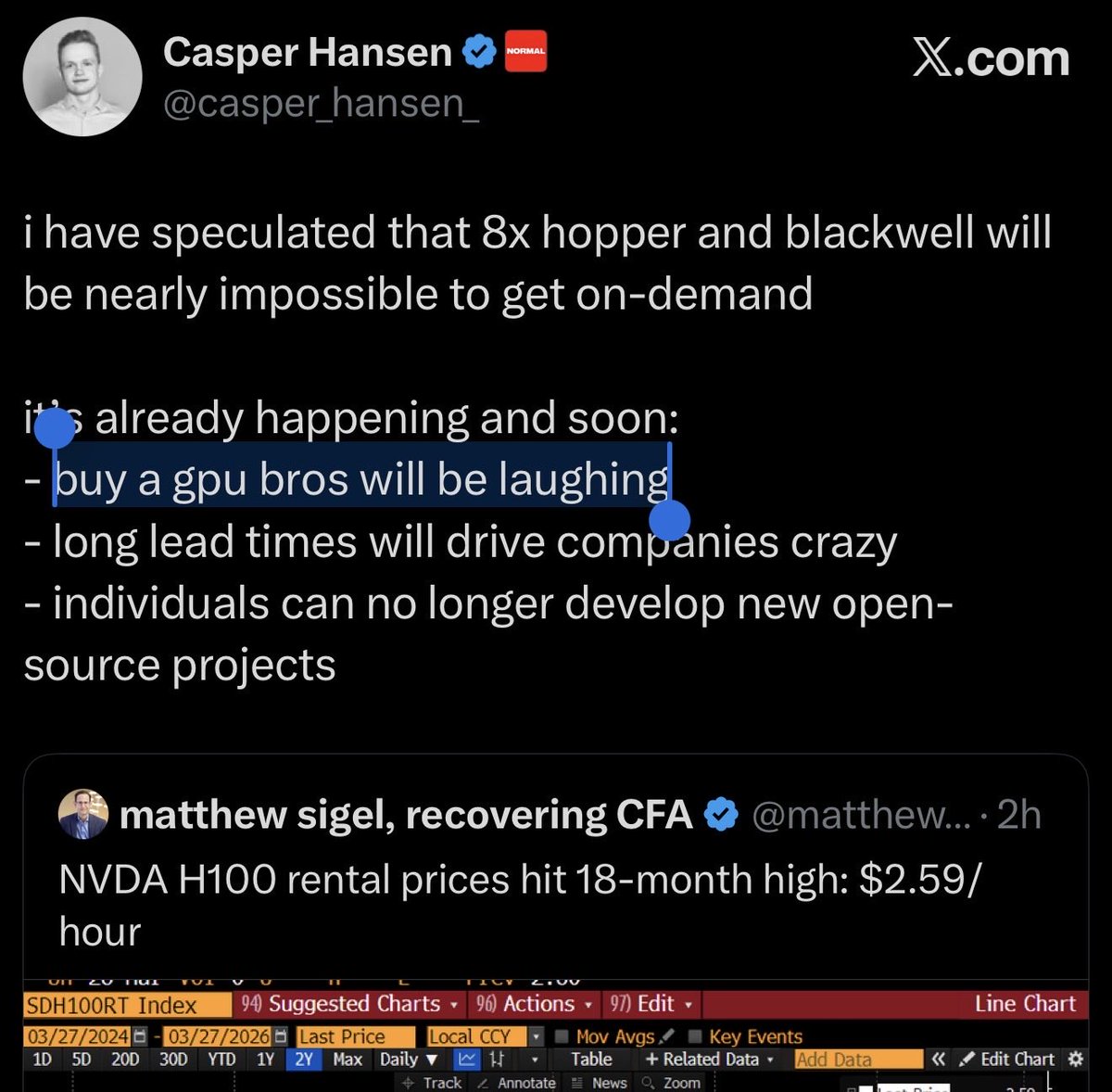
@TheAhmadOsman H100 at $2.59/hr is a strong signal that clusters are getting saturated. When compute tightens, experimentation slows and open research suffers. Regions building large AI clusters now, like the UAE, will quietly become the next research hubs.
English
0
0
0
35
Ahmad
Ahmad@TheAhmadOsman·
Buy a GPU was always going to win All I wanted was for smart individuals & researchers to have access to the compute they need so opensource progress doesn’t stall, I wasn’t making anything up There’s still time to secure your compute before prices go wild btw
Ahmad tweet media
Casper Hansen@casper_hansen_

i have speculated that 8x hopper and blackwell will be nearly impossible to get on-demand it’s already happening and soon: - buy a gpu bros will be laughing - long lead times will drive companies crazy - individuals can no longer develop new open-source projects

English
17
7
123
13.3K