gw

556 posts

gw banner
gw

gw

@bgwfoct

Katılım Mart 2013
1.5K Takip Edilen25 Takipçiler
gw
gw@bgwfoct·
@Joyce_Karam you'd think a regime which massacres its own population doesnt really care about how many likes it gets on Arabic social media?
English
0
0
0
36
Joyce Karam
Joyce Karam@Joyce_Karam·
No matter how this war ends, the level of Arab Gulf mistrust/public anger at Iran regime is a new reality for Tehran to reckon with. Arabic social media tells a very different story than English posts. There is no going back to pre-Feb. 28.
English
572
604
3.2K
486.6K
gw
gw@bgwfoct·
@Domestique___ Well done to him but that was anything but casually
English
1
0
14
946
Domestique
Domestique@Domestique___·
Track champion 🇳🇱 Harrie Lavreysen casually crushing a watermelon with his legs 😅 📽️ Zappsport
English
5
17
260
57.4K
gw
gw@bgwfoct·
@atrupar he looks like Maduro in the weeks before his arrest
English
0
0
0
79
Aaron Rupar
Aaron Rupar@atrupar·
Trump at wartime
English
433
907
3.8K
367.1K
gw
gw@bgwfoct·
@RymMomtaz the first Eastern leader... last I heard Ukraine is not in Western Europe
English
3
0
4
5.9K
gw
gw@bgwfoct·
@TheStalwart if this helps China get rid of plastic bags, the Iran war will have at least one silver lining.
English
0
0
2
416
Joe Weisenthal
Joe Weisenthal@TheStalwart·
Member of the Odd Lots Discord says nurdle prices already surging in China
Joe Weisenthal tweet media
English
25
50
509
85.7K
gw
gw@bgwfoct·
@macrokurd "i feel that's overpriced"... overpriced by which assets exactly? anywhere I look, all I m seeing are pretty average valuations, priced for benign outcomes
English
1
0
1
170
MacroKurd
MacroKurd@macrokurd·
One thing that seems to be a common view is ''there is no deal coming, they are too far apart''. I feel that's overpriced. Rhetoric is always extreme as you start negotiation phases and demands/stances start far apart. That's how you aim to maximise your gains/minimise losses.
English
3
2
24
7.2K
gw
gw@bgwfoct·
@ilangoldenberg the 15 points peace plan makes it more, not less, difficult for trump to now unilaterally declare victory without Iran agreeing on any of them.
English
0
0
6
1.6K
Ilan Goldenberg
Ilan Goldenberg@ilangoldenberg·
A few thoughts nearly a month into this war. It’s most likely not ending any time soon and we’re headed for more escalation. 1. Despite all the talk of diplomacy, we are nowhere near a deal with Iran. The gap between the two sides remains enormous – very much in line with what we saw during previous Trump negotiations with Iran in both the first and second terms, all of which ultimately failed. There’s very little evidence that anything meaningful has changed. At its core, the U.S. position still looks less like a negotiating framework and more like a surrender document for Iran: no nuclear program, no ballistic missiles, no regional proxy activity. Iran’s position is equally maximalist in the opposite direction – essentially demanding a full U.S. military withdrawal from the Gulf. That’s not a starting point for diplomacy; it’s a recipe for stalemate. 2. But the much more important story right now isn’t diplomacy – it’s the thousands of U.S. troops being mobilized and moving toward the Middle East. That movement strongly suggests preparation for further escalation, with Kharg Island emerging as the most likely target. For any objective observer, the likely Iranian response to a U.S. move on Kharg is obvious: escalation, not capitulation. Tehran would almost certainly respond by expanding attacks on energy infrastructure across the Gulf rather than “crying uncle.” 3. Which is why it’s so striking – and frankly baffling – to see oil prices trending downward. Markets appear either deeply complacent or willfully ignoring the reality of what we are facing: the very real possibility of months more of this disruption to energy markets and increasingly complex knock on effects for energy production and distribution. 4. The Gulf states, for their part, are in a rough spot. They did not want this war, but now that it is underway, they are increasingly convinced it must end in a way that weakens Iran’s ability to threaten regional energy infrastructure and maritime routes. The problem is that even as they articulate that goal, there is no clear or realistic pathway to achieving it. And when this war eventually ends unsatisfactorily and with Iran still able to threaten Gulf energy infrastructure there is likely to be significant frustration and anger in the Gulf directed at the United States. That has the potential to shape the long-term trajectory of U.S.--Gulf relations. 5. Meanwhile, support for the war remains very high inside Israel. That shouldn’t be surprising. Israeli society is still profoundly shaped by the trauma of October 7, and that trauma continues to drive both public opinion and policy choices. It’s worth remembering that in the United States, it took years after 9/11 for public opinion to shift on Iraq and the Global War on Terror. Israelis are only about two and a half years removed from October 7. We are still very much in the early phase of that cycle, where security concerns and a sense of existential threat dominate decision-making. 6. I’d also watch out for Lebanon. There is a real possibility of a large-scale Israeli ground invasion into southern Lebanon. History suggests that such operations do not produce lasting strategic success, but that has not prevented them from being attempted repeatedly. Israel’s 20-year occupation of southern Lebanon in the 80s and 90s, along with multiple subsequent wars, underscores the limits of military solutions in that arena. And yet, under current conditions, this Israeli government is driving towards another large-scale ground operation. While the war with Iran is what’s driving global economic and strategic consequences, a major ground war in Lebanon could generate far greater human suffering. 7. Another major, and often underappreciated, consequence of this conflict is the long-term impact on the U.S.–Israel relationship. The fight over the JCPOA during the Obama administration created a lasting fissure within the Democratic Party that has since expanded. This might do the same in the Republican Party. Right now, you can see the beginnings of elite-level debate and division among conservative foreign policy voices and influencers, even if that hasn’t yet translated into a shift among Republican voters. History suggests that elite debate often precedes broader public realignment. A decade from now, it is entirely plausible that Republicans could be as internally divided over Israel policy as Democrats are today. That would represent a profound shift in American politics—and in the bilateral relationship. 8. Meanwhile, in the United States public support for the war is already showing signs of erosion. Initial polling was weak, in large part because the administration did little to prepare the American public for the scale and risks of the conflict. There was a brief uptick as partisan consolidation kicked in and Republicans rallied behind the president. But as the conflict drags on and the costs become clearer, those numbers are starting to decline again. We’ve already likely hit peak support for the war and that was still less than 50%. 9. So what is the most realistic path out of this? At the moment, it is not a negotiated diplomatic breakthrough. The positions are simply too far apart, and the conflict dynamics are moving in the opposite direction. The most plausible off-ramp involves the president declaring that U.S. objectives have been achieved, announcing an end to U.S. military involvement, promising to restraint Israel and making clear we will stop if Iran ceases attacks on regional neighbors and does not resume it’s nuclear program. Iran would likely continue limited attacks for a short period, but it would also face significant international pressure to de-escalate. Over time, that pressure could help bring the conflict to a close, even if the outcome falls far short of a comprehensive or satisfying resolution. This is not an ideal outcome. It does not resolve the underlying issues, and it leaves many risks unaddressed. But in the current environment, it may be the only realistic option available. Better to accept this likely outcome today rather than six months from now.
English
32
146
451
114.6K
gw
gw@bgwfoct·
@gbrew24 Iran want the war to end in the same way Ukraine and Putin have wanted the war to end since February 2022. They were already talking peace in March that year.
English
0
0
1
71
Gregory Brew
Gregory Brew@gbrew24·
Iran response to the US diplomatic push is mostly suspicious, cautious, defiant. Do they want the war to end? Yes But on their terms. And not in a way that leaves the door open to more US or Israeli attacks.
English
18
25
168
24.4K
gw
gw@bgwfoct·
@JavierBlas @opinion oman crude collapsed $45 today... this is not jawboning by Trump, something else is going on.
English
0
0
2
372
Javier Blas
Javier Blas@JavierBlas·
COLUMN: Call it the art of oil-market jawboning. The White House is, so far, winning the fight over the oil market’s narrative. But verbal, ahem, barrels don’t keep refineries running. Jawboning will soon lose its potency in a longer war. @Opinion bloomberg.com/opinion/articl…
English
45
126
722
405.4K
Danny (Dennis) Citrinowicz ,داني سيترينوفيتش
Prospects for U.S.–Iran Negotiations A. There have likely been indirect message exchanges between the parties, but no substantive negotiations are currently underway. B. The gaps between the sides remain extremely wide. Iran appears to be operating from a position of perceived strength following the recent conflict, and is demanding both security guarantees against future attacks and compensation for war-related damages. C. Former President Trump seems to assume that the figure he is “engaging” with like Parliament Speaker Mohammad Bagher Ghalibaf has the authority to deliver on core U.S. demands. In reality, this assumption is flawed. Decision-making power in Iran is concentrated elsewhere, primarily with the Supreme Leader and the Islamic Revolutionary Guard Corps (IRGC). D. At this stage, the likelihood of a breakthrough is low unless Washington is prepared to make significant concessions. From Israel’s perspective, there appears to be limited concern for now due to the wide gaps, but if an agreement is reached, it is unlikely to meet Israeli requirements, and Israel may have limited ability to block it. E. Trump faces a difficult set of options. Reaching a deal would require meaningful concessions to the Iranian regime on core issues. Alternatively, military options whether strikes on infrastructure, limited operations (e.g., Kharg Island), or broader moves such as controlling the Strait of Hormuz that would be highly complex and carry no guarantee of success. F. Iran’s internal dynamics further complicate negotiations. Power is heavily influenced by the IRGC, the Supreme Leader’s functional capacity is uncertain, and the prevailing narrative inside Iran is one of resilience and defiance against the U.S. and Israel. G. The Strait of Hormuz adds another major layer of complexity. It is highly unlikely that Iran will roll back its position regarding control and leverage over this strategic chokepoint, particularly given its economic significance. H. Given all of the above, the chances for a near-term diplomatic breakthrough remain low. Trump may choose to extend his ultimatum, but the core strategic dilemma will likely intensify again as the deadline approaches. #iran
English
27
136
407
87.7K
Javier Blas
Javier Blas@JavierBlas·
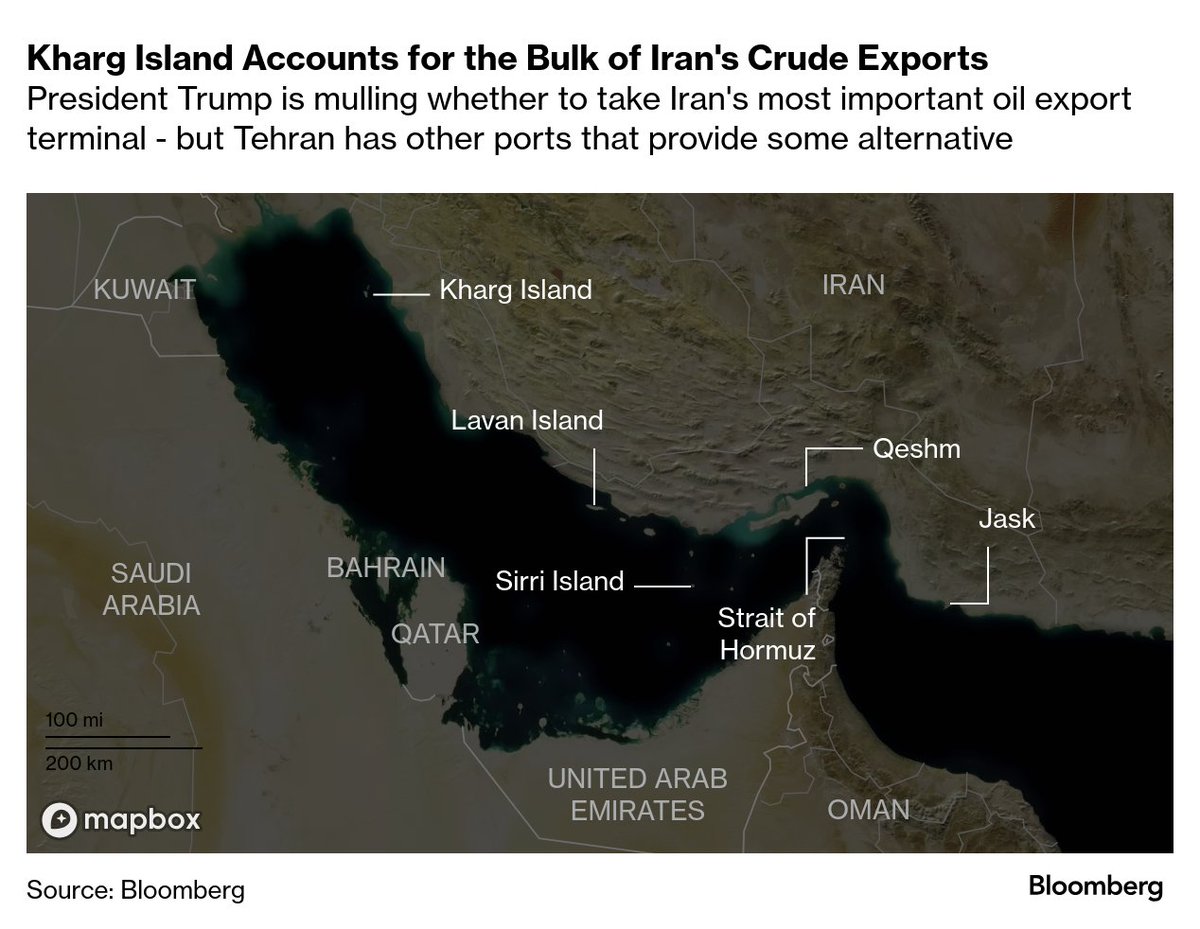
KHARG ISLAND — a thread: Trump has talked about taking Iran's Kharg Island for 40 years. The problem? Capturing it won't shut down Iran’s entire oil export system. And thus it won't lead to Hormuz re-opening fast enough. 🧵1/10 @Opinion FREE-TO-READ: bloomberg.com/opinion/articl…
Javier Blas tweet media
English
66
549
1.7K
385.2K
gw
gw@bgwfoct·
@michaelh992 the tl;dr point here is everyone is losing a result of Trump's ill-judged "excursion". no one disputes Iran is losing too. but who is losing more, relative to starting expectations, the US or the Iranian regime?
English
0
0
0
430
Michael A. Horowitz
Michael A. Horowitz@michaelh992·
A lot of the analysis on the success or failure of the US-Israel war against Iran revolves around one point: The US and Israel set the bar too high (regime change), and as a result Iran simply has to survive to win. This is a good talking point (and certainly sounds good). But, as is often the case good-sounding points tend to mask more complex realities. So let’s dive a bit more into that point: 1. In the simplest term, if the goal of the US and Israel is to (1) force regime change, or (2) capitulation by forcing Iran to agree to all of their demands, then achieving none of those is certainly a defeat (at least a temporary one) for Israel and the US. 2. Does this mean Iran “wins”? This is a regime that killed dozens of thousands of its own citizens, just weeks ago. The protests started because of the rising inflation and corruption. It started within a constituency (the bazaar merchants) who are typically more pro-regime. Iran will face even more dire economic circumstances. 3. The regime will harden (another of those “good sounding” talking point that generally marks the end of the argument, when it really should just be a mid-point). The IRGC will have even more power, and likely elected Mojtaba as a figleaf. Even if Mojataba dies or is killed, they will elect some similar (someone they can maneuver). Reformists are out - Pezeshkian showed he amounts to nothing. The system is irreformable, bound to make the same mistakes, bound to be even more corrupt to squeeze the fewer resources the country has. 4. Iran played its best card: Closing the Strait of Hormuz, and choking a main trade and energy hub. It has shown how effective this card was. Any effort to lift the closure would require significant naval assets and likely some ground raids or even capture – an immense unthinkable cost. Yet if Iran does continues for too long, the unthinkable because thinkable. We often think about one side of the operation (the US), but what about Iran? A system that has invested largely in asymmetric air assets, has marginalized its conventional military? What Iran is doing is pushing up the escalation ladder, but by doing so it might invite the US to also go up - and once the US considers ground troops (pinpointedly) deployed, it will consider other operations than just to capture one island. 5. By playing this “best card” Iran has also alienated the Gulf. Years ago Raisi implemented a “neighbors first” policy aimed at normalizing ties with the Gulf - likely in response to the Abraham accords, and the fact that a too aggressive Iran was enough of a glue to cement ties between some Arab countries and Israel. This is now done. There is no love for Israel, who is seen as having started this war with little care for Gulf interests. But Israel didn’t fire thousands of projectiles at its neighbor. Iran did. The Gulf will be cautious not to trigger another assault, may even pander rhetorically to efforts to “repair ties”, but it will quietly bet on the regime’s demise. Iran will come out of the crisis more isolated. So essentially the bottom line is this: By “winning”, Iran will find itself in a worse situation than the one that led it to kill 30,000 of its own people. It will be unreformable, more corrupt, more isolated, and will either invite a ground attack, or push its adversaries (whose numbers have grown) to think about how to finish it off next time. So when we say the US and Israel would lose if they don’t manage to collapse the regime it is absolutely true. But I would say the Islamic Republic is also a major loser of this crisis.
English
41
60
293
81.8K
gw
gw@bgwfoct·
@michaelh992 Ras Laffan isn't a refinery
English
0
0
1
206
gw
gw@bgwfoct·
@faustocoppi60 I don't think he launched his attack too soon, the negotiation had clearly failed
English
0
0
1
825
Mihai Simion
Mihai Simion@faustocoppi60·
I thought that maybe Pidcock launched his attack too soon like others before him but he knew what he was doing at 600m to go. 💣 He destroyed the legs of Johannessen and Roglic and that was it. Another beautiful Classic in his palmares. #MilanoTorino
English
8
12
779
64.6K
Paulo Macro
Paulo Macro@PauloMacro·
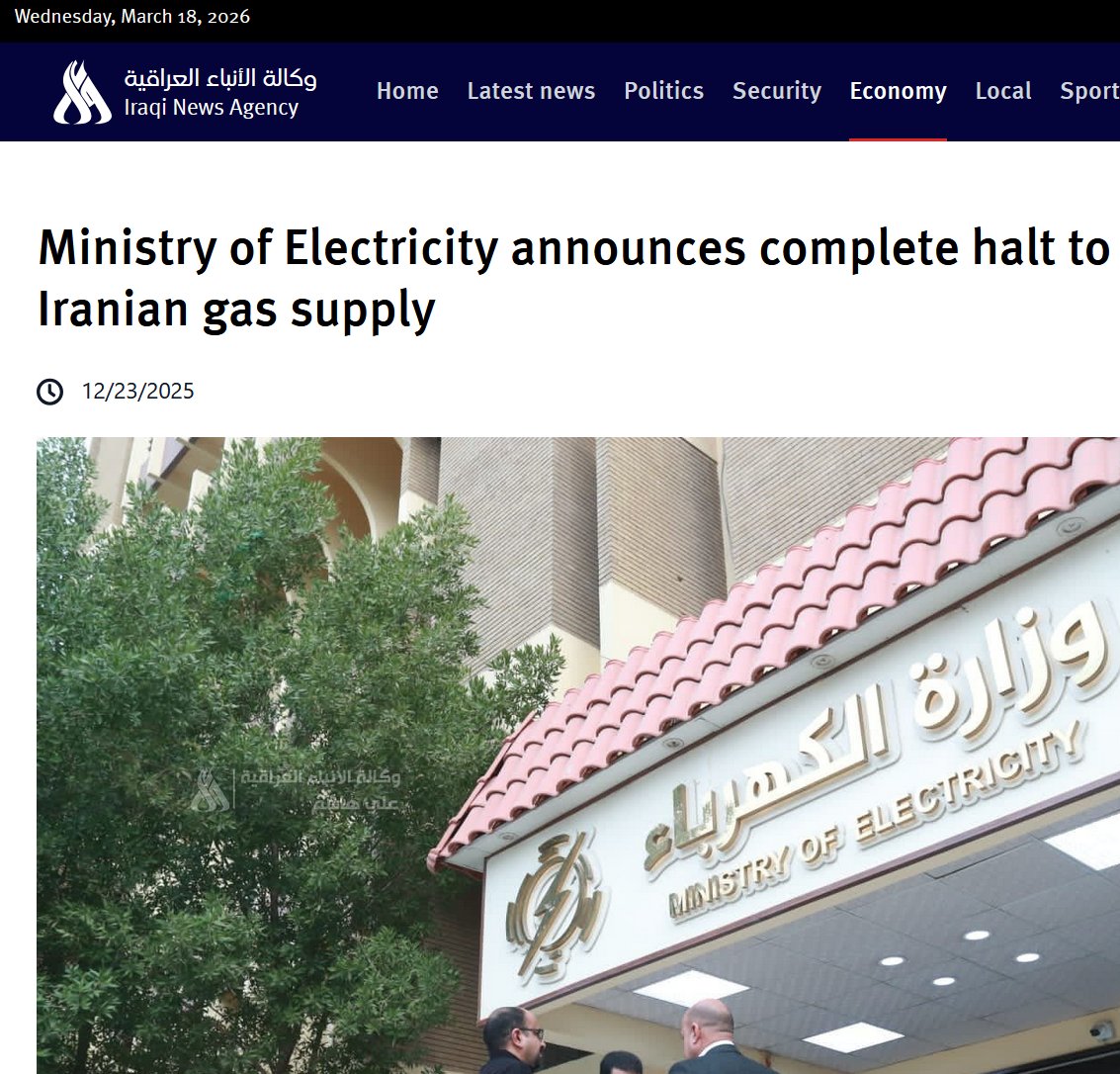
I don't think people appreciate what this means for heavy sours to Asia and diesel/fuel oil/bunker/jet balances in 2H26. ina.iq/en/economy/443…
English
9
10
125
47.1K
Nofreewords
Nofreewords@nofreewords·
@TheShortBear Extraordinary claims usually need extraordinary evidence. A few odd frames in a video isn’t enough to conclude something that big.
English
2
0
2
827
John Spencer
John Spencer@SpencerGuard·
@ChrisO_wiki That is a different point and not the point I am addressing, the “expert” said we did not plan contingencies. Laughable.
English
96
39
2.1K
118.1K
John Spencer
John Spencer@SpencerGuard·
Imagine a self proclaimed “military expert” telling his followers that in all of the U.S. National Security Council, Joint Staff, CENTCOM, U.S. Naval Forces Central Command (NAVCENT), and JTF staff, they did not plan for scenarios in the Strait of Hormuz. Then imagine people still following him for “analysis.” Crazy world of overnight “X-perts”
English
386
1.6K
13.1K
1.9M
E. Morales
E. Morales@ElianWorldView·
@PauloMacro Markets price fear. 90M passengers a year, largest port between Rotterdam and Shanghai. These structural facts haven't changed.
English
1
0
2
967
Paulo Macro
Paulo Macro@PauloMacro·
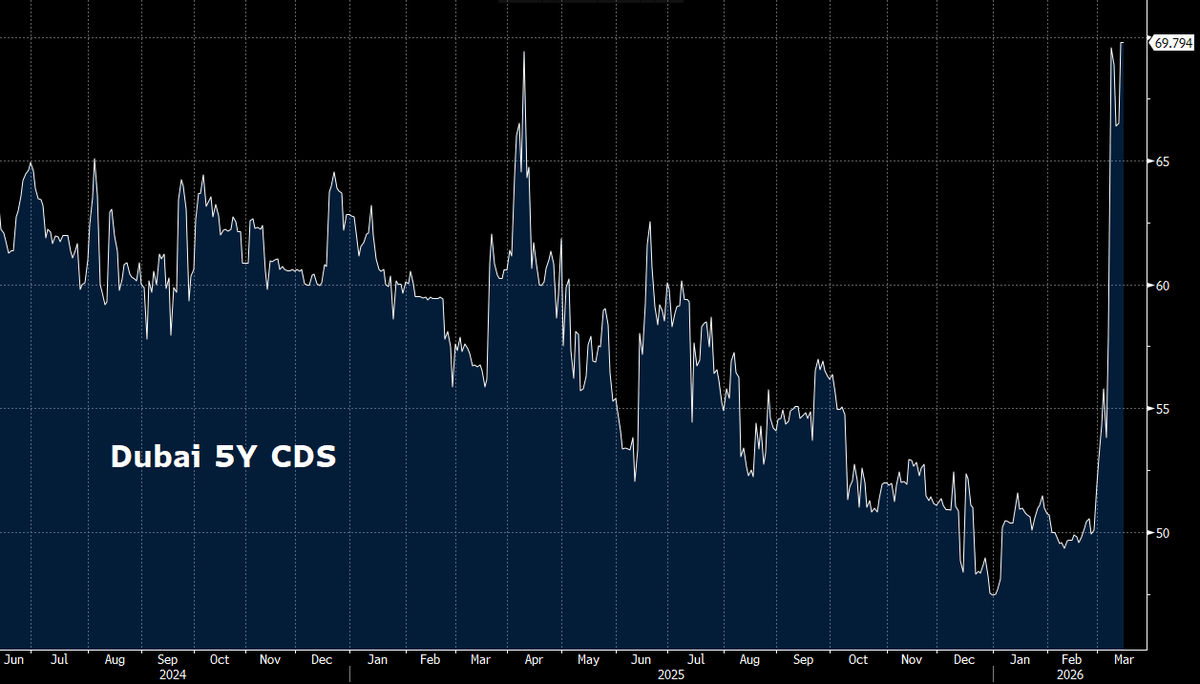
Well then I guess this is going higher
Paulo Macro tweet media
English
17
26
511
117.9K
gw
gw@bgwfoct·
@SeanParnellASW if this is the result of planning for everything, I d hate to see the result when you dont plan
English
0
0
0
43
Sean Parnell
Sean Parnell@SeanParnellASW·
Only partisan hacks like the activists at CNN would write that the United States military did not plan for Iran threatening shipping in the Strait of Hormuz. They know we plan for any and every scenario possible, yet they slander our military for sport. Here’s the truth: The Strait of Hormuz is something the Department has paid attention to from the beginning, and the American people can rest assured that we will ensure our interests are advanced.
Zachary Cohen@ZcohenCNN

New: The Pentagon & National Security Council significantly underestimated Iran’s willingness to close the Strait of Hormuz in response to US military strikes while planning the ongoing operation, sources to me, @Phil_Mattingly, @kylieatwood & @Kevinliptakcnn. Top Trump officials acknowledged to lawmakers during recent classified briefings that they did not plan for the possibility of Iran closing the strait in response to strikes, per 3 sources. cnn.com/2026/03/12/pol…

English
480
507
3.4K
396.1K
gw
gw@bgwfoct·
@robin_j_brooks when you follow Robin for bad fx takes and end up with bad strategic takes instead.
English
0
0
6
110
Robin Brooks
Robin Brooks@robin_j_brooks·
Brent is up 30%. The Strait of Hormuz remains de facto shut, even as Iran is exporting more oil than before the war. Iran's oil exports need to be shut down. That won't spike oil prices. They'll fall as Iran implodes and its blockade of Hormuz ends... robinjbrooks.substack.com/p/what-can-mak…
Robin Brooks tweet media
English
61
46
260
35.2K