Dr Andrew K Roy

762 posts

Dr Andrew K Roy banner
Dr Andrew K Roy

Dr Andrew K Roy

@cardiologist_

Interventional Cardiologist ~TAVI , structural heart disease, coronary interventions @svphs @notredameaus . Running. Surfing.

Sydney, Australia Katılım Mayıs 2011
1.2K Takip Edilen2.1K Takipçiler
Dr Andrew K Roy retweetledi
Dr. Martha Gulati ♥️🫀❤️‍🩹🇨🇦
What tremendous work led by @JGrapsa making this paper a reality. So proud of her and all our coauthors for leading the charge in. Making #womensheartcenters grow across the EU and beyond.
Julia Grapsa@JGrapsa

Our ESC Clinical Consensus Statement on Women’s Heart Centres is published in @EurHeartJ merging 4 associations @EACVIPresident @EAPCIPresident @HFA_President @ACVCPresident Link ➡️ academic.oup.com/eurheartj/adva… ESC press release ➡️ escardio.org/news/press/pre… This is the first statement to define what a Women’s Heart Centre actually is: its structure, its team, its referral pathways, and the training standards clinicians need to lead one. The problem: CVD is the #1 killer of women. Yet women face systematic delays in diagnosis and treatment and the conditions most likely to affect them (INOCA, MINOCA, pregnancy-related CVD) remain underdiagnosed everywhere. Our solution: hub-and-spoke Women’s Heart Centres, embedded in existing CV systems, not parallel structures. Advanced diagnostics, multidisciplinary care, research coordination. For the first time we define: ✅ The nucleus clinical team ✅ Adjunct specialties (cardio-obstetrics, oncology, rheumatology, psychology and more) ✅ Core vs advanced competencies ✅ A pathway toward subspecialty certification We also set milestones for national and institutional adoption. This has been a Herculean effort and an important task to lead this document with enormous gratitude to senior author @DrMarthaGulati for her mentorship and friendship - really grateful to @Drroxmehran @rafavidalperez @mmamas1973 @HeartDocSharon @Bharatishivalka @PrSusannaPrice1 @Cosyns @VictoriaDe32503 @d_trabattoni @Marta33717088 @ARakisheva @yappelman @mirvatalasnag @lesleejshaw @alessia_gimelli #WomensHealth #Cardiology #WomensHeartDisease #CardioTwitter #ESC #EACVI #HeartDisease #WomensHeartCentre #CVD #CardioEd

English
5
19
56
5.7K
Dr Andrew K Roy retweetledi
Gabe Wilson MD
Gabe Wilson MD@Gabe__MD·
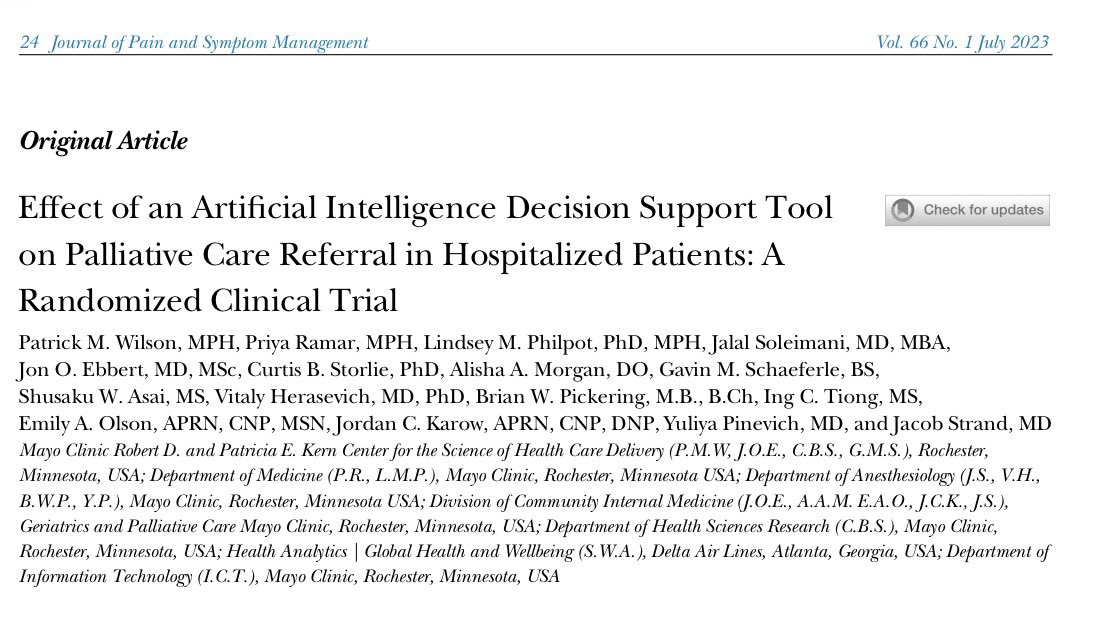
Mayo Clinic and Bayesian Health just announced a partnership to commercialize an AI palliative care screening tool. The underlying randomized trial is worth understanding on its own. The intervention was narrow. An AI/ML algorithm scored hospitalized patients for palliative care need. A control-tower operator screened the list daily. Palliative care specialists reviewed flagged patients and approached the primary team when a consult was warranted. Human in the loop at every step. The algorithm made no clinical decisions. The design was rigorous. A pragmatic, cluster-randomized, stepped-wedge trial across 12 nursing units at two Mayo hospitals. 3,183 hospitalizations. Published in the Journal of Pain and Symptom Management (Wilson et al., 2023). The primary outcome held. Patients in the intervention arm had a 44% higher rate of palliative care consultation (IRR 1.44, 95% CI 1.11 to 1.92). The exploratory signal is the interesting part. 60-day readmissions were lower in the intervention group (24.5% vs 34.3%; OR 0.75). 90-day readmissions were lower as well (28.5% vs 38.7%; OR 0.72). The authors are careful to label these as exploratory and nonprespecified. They are hypothesis-generating, not confirmatory. 30-day readmission did not reach significance. Here is why this matters beyond palliative care. This is the category of AI that critics single out as the weak link: a risk flag inside the EHR. The Nature Medicine editorial framed exactly this kind of tool as telling you who is at risk without telling you what to do. This trial shows what happens when you close the loop. The flag triggered a human review. The review triggered a workflow. The trial measured downstream consultation rates rather than model accuracy. The primary outcome moved. Now consider the surface. Sepsis recognition. Medication reconciliation. Discharge planning. Specialist routing. Goals-of-care timing. Each is a touchpoint where the same pattern can apply: identify the right patient, route to the right intervention, measure the outcome. AI will affect these unevenly. Some will move dramatically. Others will resist. But the mechanism is now demonstrated in a randomized trial with a closed-loop workflow and a primary endpoint that held. This is what moving from prediction to deployment looks like.
Gabe Wilson MD tweet media
English
5
5
35
5.1K
Dr Andrew K Roy retweetledi
Avi Roy
Avi Roy@agingroy·
Eli Lilly just released Phase 3 data for retatrutide, their next-generation obesity drug. 2,339 patients. 80 weeks. The biggest trial in the field. 8 things worth knowing: 1️⃣ It beats every obesity drug on the market. Wegovy (semaglutide): 15% Zepbound (tirzepatide): 22% Retatrutide: 25% 2️⃣ You don’t need the highest dose. The lowest (4mg) already outperforms Wegovy. 18% weight loss with one dose increase. Fewer people quit than on the sugar pill. 3️⃣ At two years, weight was still dropping. No plateau. Patients with BMI over 35 lost 84 pounds. 30% of their body weight. 4️⃣ Some patients stopped taking it because they lost too much weight. That’s never happened with an obesity drug. 5️⃣ It works differently. Ozempic and Zepbound suppress appetite. Retatrutide does that too, but its third receptor (glucagon) flips your metabolism toward burning stored fat. In Phase 2, ketone bodies rose 2-3x, confirming the body was switching fuel sources. 6️⃣ It causes a side effect no other obesity drug does: tingling and numbness (12.5%). New receptor, new trade-off. Worth watching. 7️⃣ In a separate study, it cleared 86% of liver fat. 93% of patients reached normal levels. 1 in 3 adults have fatty liver disease. No approved drug comes close. 8️⃣ Two-thirds of patients on the highest dose were reclassified out of obesity entirely. They started at BMI 40. They finished under 30. That’s not just weight loss. That’s a medical reclassification. @US_FDA filing expected late 2026.
Eric Topol@EricTopol

Retatrutide, a triple receptor drug for GLP-1, GIP, and glucagon, is the most powerful weight loss drug yet. A significant issue is too much weight loss among the trial participants. New randomized trial results announced today with 28% body weight loss. gift link nytimes.com/2026/05/21/sci…

English
92
384
4.5K
2.5M
Dr Andrew K Roy retweetledi
Ali Max Erturk
Ali Max Erturk@erturklab·
Today in @Nature, we report MouseMapper: foundation-model AI to map disease perturbations across the entire mouse body cell-by-cell. In obesity, it revealed body-wide inflammation & unexpected facial nerve damage. 🧵👇🔉 nature.com/articles/s4158… led by @Dorie00 & @yingchen733
English
28
309
1.1K
252.3K
Dr Andrew K Roy
Dr Andrew K Roy@cardiologist_·
At #EuroPCR2026 in Paris, what stands out isn’t just incremental iteration — it’s the convergence of structural heart, imaging, robotics, AI-guided navigation, and device engineering into truly integrated procedural ecosystems. From next-generation TAVR leaflet design and anchoring systems… to ultra-flexible peripheral scaffolds… to intravascular imaging that is becoming increasingly intelligent and actionable in real time… The pace of innovation in interventional medicine is accelerating dramatically. The future cath lab will be: • more image-guided • more data-driven • less invasive • more personalized • and increasingly physiology-led rather than anatomy-led. Exciting times to be in interventional cardiology. #CardioTwitter #InterventionalCardiology #TAVR #PCI #MedTech #HealthTech #EuroPCR #StructuralHeart #Innovation
Dr Andrew K Roy tweet media
English
0
1
1
396
Dr Andrew K Roy
Dr Andrew K Roy@cardiologist_·
Great to be back in Paris for an exciting EuroPCR program 2026! #europcr
Dr Andrew K Roy tweet media
English
0
1
3
251
Dr Andrew K Roy retweetledi
Davide Capodanno
Davide Capodanno@DFCapodanno·
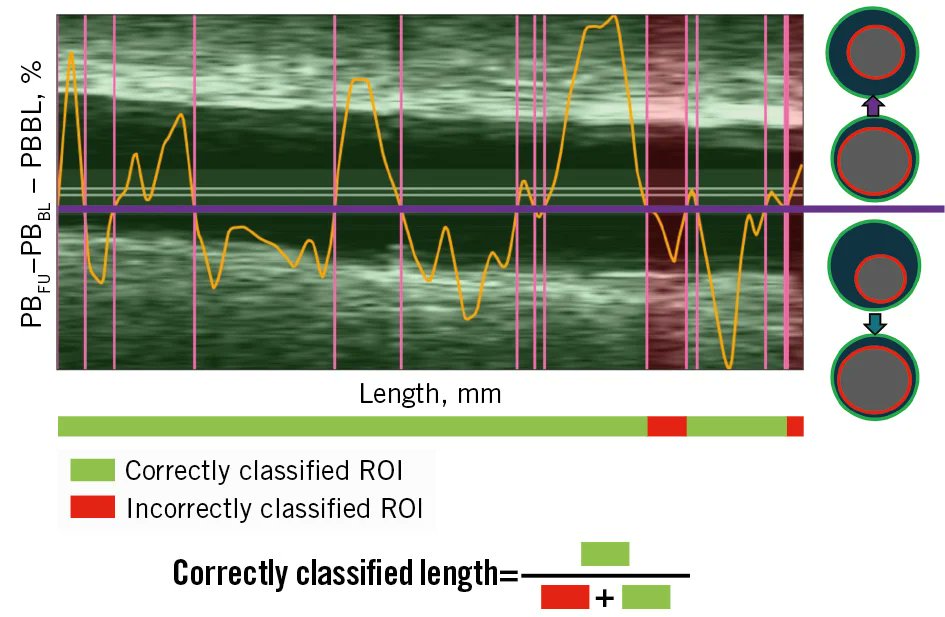
Can artificial intelligence detect coronary plaque progression before it becomes clinically evident? This is the first deep-learning model designed to detect changes in plaque progression by quantifying frame-to-frame changes in plaque burden across adjacent IVUS images. eurointervention.pcronline.com/article/deriva…
Davide Capodanno tweet media
English
3
16
37
3.8K
Dr Andrew K Roy retweetledi
Edward Hulten
Edward Hulten@cardiac_md·
"In 2014, he was a leader of a study that found an alternative cholesterol-lowering drug could protect people from heart attacks and strokes. The study validated previous findings that lowering cholesterol prevents heart disease — settling the issue, Dr. Braunwald insisted, once and for all." 'People,' he said, 'can stop yapping.'" nytimes.com/2026/04/25/hea…
English
0
7
21
2.5K
Dr Andrew K Roy retweetledi
Brett Sperry, MD
Brett Sperry, MD@BrettSperryMD·
Golf legend @jacknicklaus has bravely stepped forward to share his ATTR-CM diagnosis. As a cardiologist who specializes in ATTR-CM, I know how often this progressive disease flies under the radar. When icons like Jack speak out, it changes everything - raising awareness, encouraging earlier testing, and giving patients hope for timely treatment. Thank you, @jacknicklaus. Your voice matters. Let’s get the word out! vyndamax.com/jacks-journey
English
11
29
110
42.6K
Dr Andrew K Roy retweetledi
Pablo Corral MD
Pablo Corral MD@drpablocorral·
👉 Update on familial hypercholesterolemia: An expert clinical consensus from the National Lipid Association 👆 FH is common (≈1:311) and systematically underdiagnosed → the real problem is not rarity, it’s detection 👆 Driven by lifelong LDL-C exposure, not a single value → risk = LDL-C × time 👆 Genetics help, but phenotype rules → treat based on LDL-C burden, not just mutations 📍 Diagnosis LDL-C ≥190 mg/dL (adults) → think FH, but confirm clinically Genetic testing = useful for cascade screening, not mandatory Always exclude secondary causes before labeling 📍 Screening Universal pediatric screening (9–11 yrs) is not optional—it’s delayed prevention Cascade screening = highest yield strategy (and still underused) 📍 Risk Standard risk calculators? Useless in FH → they underestimate risk Risk depends on: Lifetime LDL exposure Lp(a) Family history Timing of treatment 📍 Treatment (no shortcuts) Lifelong, early, aggressive Targets: <55 mg/dL (secondary prevention) <70 mg/dL (primary prevention) Start with: High-intensity statin, ezetimibe, PCSK9i / others as needed ≥50% LDL reduction is the floor, not the goal 📍 Take-home FH is not a lipid disorder. It’s a time-dependent vascular disease. Diagnose early, treat hard, treat forever. 🔗 🔓 Open Access #fig0010" target="_blank" rel="nofollow noopener">lipidjournal.com/article/S1933-… @nationallipid @LipidJournal @society_eas
English
4
30
69
7.4K
Dr Andrew K Roy retweetledi
NEJM
NEJM@NEJM·
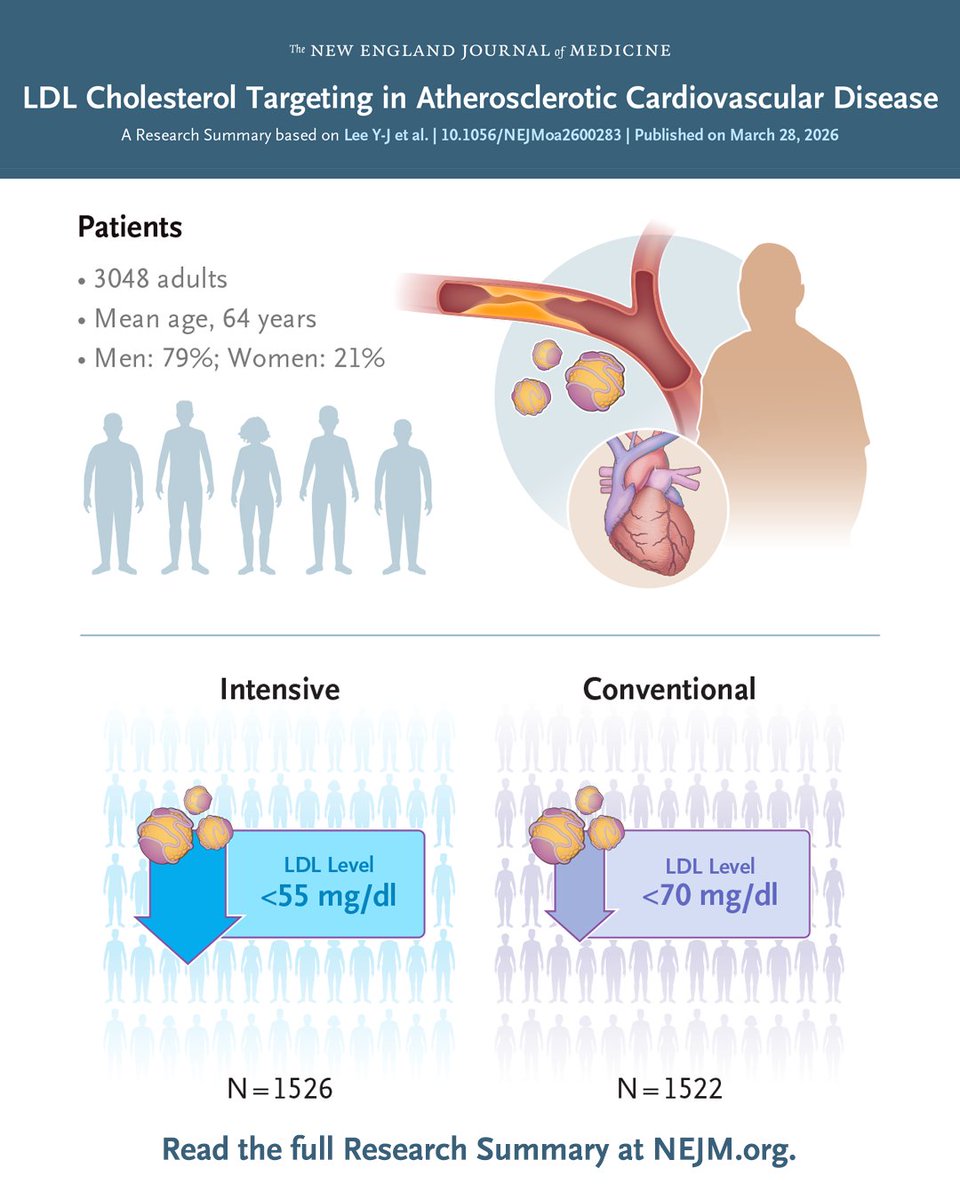
Among patients with atherosclerotic cardiovascular disease, targeting an LDL cholesterol level below 55 mg per deciliter led to a lower 3-year risk of cardiovascular events than targeting a level below 70 mg per deciliter. Full Ez-PAVE trial results and Research Summary: nejm.org/doi/full/10.10…
NEJM tweet media
English
23
242
695
211.1K
Dr Andrew K Roy
Dr Andrew K Roy@cardiologist_·
Glucagon-like peptide-1 receptor agonists reduce experimental atherosclerosis progression, inflammatory biomarkers and cardiovascular events, irrespective of hyperglycaemia and obesity academic.oup.com/eurheartj/arti…
English
1
1
2
127
Dr Andrew K Roy retweetledi
ASPC
ASPC@ASPCardio·
Trying to understand the new cholesterol guidelines? This @nytimes article breaks it down clearly. New guidelines are pushing for earlier action and lower targets—because heart disease risk builds quietly over decades. Instead of waiting until your 50s or 60s, experts now say prevention should start much sooner, with more personalized risk checks and, when needed, earlier treatment. A few key takeaways: • Lower LDL (“bad” cholesterol) is better—often well below 100 mg/dL, and even lower for higher-risk people • Risk isn’t just 10 years anymore—doctors are looking at your 30-year heart risk • Screening and prevention may start as early as your 30s (or younger) • Lifestyle still matters—but meds like statins are being used earlier when needed Bottom line: heart health isn’t something to think about “later.” The earlier you act, the better your long-term outcomes. Read more: nytimes.com/2026/04/09/wel… Featuring experts @ErinMichos @AnnMarieNavar @DrMarthaGulati #HeartHealth #Cholesterol #PreventiveCare #Wellness
English
2
5
10
1.1K
Dr Andrew K Roy retweetledi
Cleveland Clinic
Cleveland Clinic@ClevelandClinic·
Do you know what VO2 max tracks? Or what qualifies as a good VO2 max score? Our sports medicine physician walks us through it. cle.clinic/4tu6wAc
English
1
6
17
4.1K
Dr Andrew K Roy
Dr Andrew K Roy@cardiologist_·
Thanks for sharing Michael- and also the study tags for each therapy. As we understand more and more about atherosclerotic disease/vascular biology and the spectrum of inflammation, metabolic dysregulation, LDL (and Lp a + ApoB), its clear preventing early atherosclerosis is not a one size fits all recommendation, and we often have to cover many bases!
English
0
0
0
106
Michael Albert, MD
Michael Albert, MD@MichaelAlbertMD·
Every morning I take five things. A statin. Ezetimibe. Psyllium. Creatine. A multivitamin. Once a week, I add a sixth: tirzepatide. No rapamycin. No NMN. No Bryan Johnson protocol. Here's what the evidence actually says—and why I left everything else out. 🧵
English
127
60
717
181.5K