gary taubes

5K posts

gary taubes banner
gary taubes

gary taubes

@garytaubes

Author of Rethinking Diabetes, The Case for Keto, The Case Against Sugar, Why We Get Fat, Good Calories, Bad Calories, Bad Science, and Nobel Dreams

Oakland, California Katılım Haziran 2009
503 Takip Edilen120.5K Takipçiler
Sabitlenmiş Tweet
gary taubes
gary taubes@garytaubes·
gary taubes tweet media
English
28
94
359
54K
gary taubes retweetledi
Metabolic Mind
Metabolic Mind@Metabolic_Mind·
To learn more about the clinical evidence discussed in this article and additional published research, visit our Foundational Clinical Trials page: metabolicmind.org/resources/scie…
English
1
7
18
1.5K
gary taubes retweetledi
Metabolic Mind
Metabolic Mind@Metabolic_Mind·
Big moment for metabolic psychiatry and ketogenic therapy for serious mental illness. 🔗nyti.ms/4sj2WZD Today’s @nytimes piece highlights early research from Stanford University, The Ohio State University, and the University of Edinburgh — alongside the stories of individuals who have shared their lived experience here on Metabolic Mind. This kind of visibility matters. It reflects years of work by researchers and clinicians like @ChrisPalmerMD, @ShebaniMD, and @IainCampbellPhD, research funded by @BaszuckiGroup, advocates like @janellison, as well as the many people who have been willing to share their personal stories. Lived experience alone isn’t enough. Early data alone isn’t enough. But together, they point to something that must be tested, confirmed — or challenged — through high-quality science. That’s why we are excited about several RCTs currently completed or underway around the world. We need to continue efforts to advance education, public awareness and research on a scale that will require public funding. That’s how medicine moves forward. And that’s the exciting work ahead.
English
6
28
107
7.8K
gary taubes
gary taubes@garytaubes·
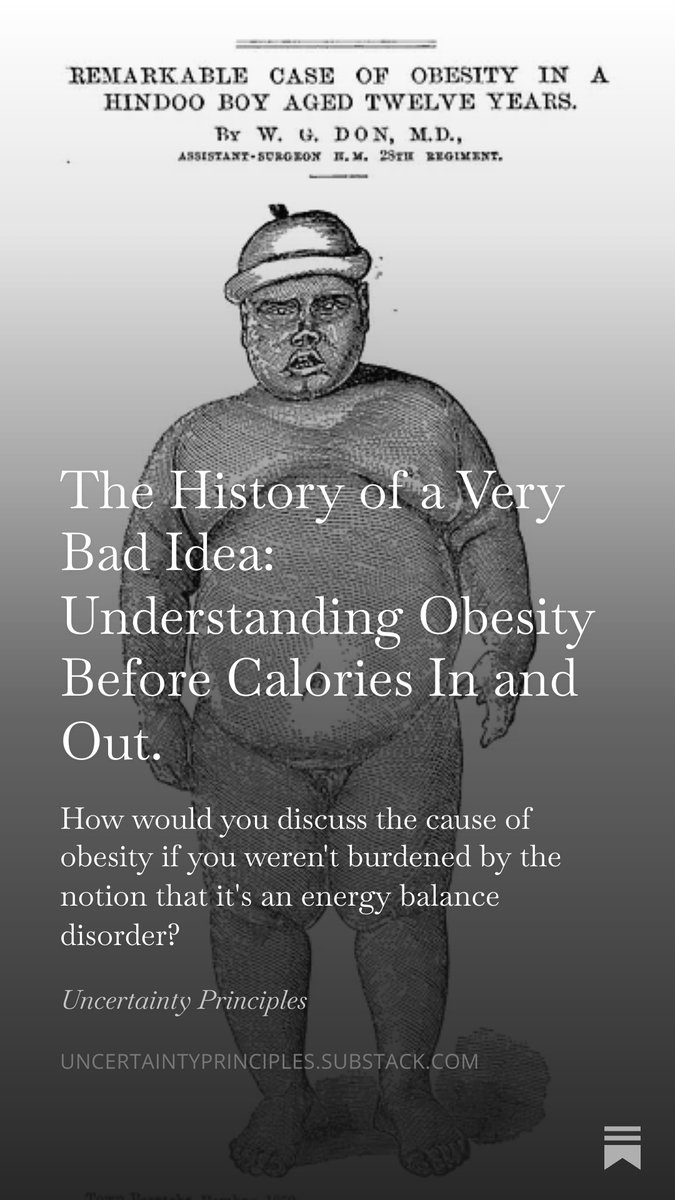
Prader-Willi syndrome is a rare chromosomal disorder characterized by pathological hunger and severe obesity. 150 years ago, John Langdon Down (the Down of Down's Syndrome) successfully treated the first recorded case of Prader-Willi Syndrome with an animal diet. After years of weight gain despite calorie restriction and enforced exercise, his patient, E.C., lost 77 pounds in a year, eating (mostly) carnivore. Can we learn anything from that about PWS? PWS researchers assume, per the CW on obesity, that hunger causes the children afflicted to eat too much and that, of course, causes the fat accumulation. But what if that's wrong, as the evidence has suggested since Down's experience? If so, then the calorie-restricted diets considered standard of care for kids and adults with this syndrome may be doing more harm than good, as is the all-too-common assumption that all diets work by getting us to eat less. Obesity researchers don't like to entertain the notion that they may be laboring under the wrong paradigm--energy balance--when they think about the cause of obesity. They find it boring, if not insulting, when we continue to suggest it. I can't entirely blame them. In medicine, though, working from the wrong paradigm can have profound effects on therapy. PWS is an extreme example. Read more in my latest post on Uncertainty Principles. Which comes first, Pathological Hunger or Obesity? open.substack.com/pub/uncertaint…
gary taubes tweet media
English
4
21
111
31.5K
gary taubes retweetledi
Jan Ellison Baszucki
Jan Ellison Baszucki@janellison·
Can a keto diet "cure" serious mental illness? Here's my piece published today in @sfchronicle. "OPINION: Diagnosed with bipolar disorder, my son began a medically supervised ketogenic regimen — and it sent his symptoms into lasting remission, Jan Ellison Baszucki writes." To read the full oped, just enter your email when prompted for the gift link: tinyurl.com/3kwrcxyu In response to comments from HHS Secretary, Robert F. Kennedy Jr., I share our family's story about how after half a decade of illness, ketogenic therapy has kept my son's bipolar I disorder symptoms in remission since 2021. I include the latest on the emerging science and practice of this therapeutic approach. "Has my son been 'cured'? It’s not a term we use in our work, and it’s also not the most important question. The more pressing concern is whether we are willing to rigorously test promising new treatment approaches when conventional care has failed far too many." @Metabolic_Mind @ChrisPalmerMD @BaszuckiGroup @matthewbaszucki @DavidBaszucki @metcoalition @LWSchizophrenia
English
16
105
397
40.1K
gary taubes
gary taubes@garytaubes·
@BradChilmeran @davidludwigmd Yes, always. Tempting as it may be, on occasions. It never works to our advantage (speaking, regrettably, from experience).
English
1
0
2
61
Bradley Chilmeran, PhD
Bradley Chilmeran, PhD@BradChilmeran·
@garytaubes @davidludwigmd One major implication from David's article is the need for us insurgents to be equanimous and magnanimous. We have to resist the temptation to be snarky, even if we didn't start it. We lack the home field advantage to get away with it
English
1
0
2
223
gary taubes
gary taubes@garytaubes·
The word paradigm has become devalued over the decades as every minor shift in thought is sold as a paradigm shift. In this case, it's precisely the correct word. @davidludwigmd discusses the implications for nutrition science in Cell Metabolism
Dr. David Ludwig@davidludwigmd

Why do debates on critical questions in nutrition – from the harms of sugar to the cause of obesity – drag on for decades, leaving science at a standstill? I explore this question through the lens of science philosopher Thomas Kuhn. @Cell_Metabolism Free article link below👇

English
2
2
13
3.8K
gary taubes retweetledi
Ty Beal
Ty Beal@TyBealPhD·
In this episode, Harvard professor and obesity researcher Dr. David Ludwig (@davidludwigmd) joins the show to discuss his new paper "Overcoming Impasse in Nutrition Science," published today in Cell Metabolism. Dr. Ludwig—author of the New York Times bestseller Always Hungry and one of the leading proponents of the carbohydrate-insulin model of obesity—uses the framework of science philosopher Thomas Kuhn to explain why paradigm clash in nutrition has stagnated into paralysis. We walk through the carbohydrate-insulin model versus the energy balance model, then dig into two highly cited clinical trials at the center of this debate: his group's 2018 BMJ feeding study and the 2021 Nature Medicine crossover trial—and why, despite publicly available data, the field has failed to resolve the competing claims from either study. We then turn to what a path forward looks like: why ad hominem attacks poison the trust needed for collaboration, how professional societies and funders could incentivize adversarial collaboration between opposing researchers, and what a definitive long-term feeding study would need to look like to settle these foundational questions. Whether you follow the carbohydrate-insulin debate closely or just want to understand why nutrition experts can't seem to agree, this conversation is a candid call for humility, rigor, and scientific renewal. Timestamps 00:00 Introduction to the Carbohydrate-Insulin Model 11:00 Debate and Polarization in Nutrition Science 17:28 Defining a Path Forward in Nutrition Research 25:40 Unraveling Scientific Discrepancies 33:50 Bridging Paradigms: The Need for Collaboration 39:39 The Role of Humility in Scientific Discourse 45:44 Towards Constructive Scientific Engagement
English
5
20
67
15.7K
gary taubes retweetledi
Coalition for Metabolic Health
Coalition for Metabolic Health@metcoalition·
At the Coalition for Metabolic Health, we're working to address America's chronic disease crisis. Learn more about our mission to make metabolic health mainstream—and hear directly from some of our experts—in our new video:
English
5
34
106
16.4K
gary taubes
gary taubes@garytaubes·
RFK Jr's new Food Guide Pyramid doesn't just flip the old one on its head--promoting red meat and dairy like they're, well, healthy 😬 -- but it embraces a different paradigm of nutrition. No longer are saturated fats and cholesterol the focus, but refined carbohydrates, sugars, and blood sugar. Larry Rifkin and I had fun discussing this.
Larry Rifkin's America Trends podcast 🎙@trendspodcast

EP 945 The New Food Pyramid Differs in Significant Ways from the Previous One americatrendspodcast.com/2026/02/23/ep-… via @trendspodcast

English
8
12
110
8.1K
gary taubes
gary taubes@garytaubes·
We've been hearing about the "replication crisis" in science for 20 years now, and NIH director Jay Bhattacharya describes it as a "disaster." He has a prescription for fixing it that involves incentivizing researchers to replicate the latest findings and making it easier to publish the results, positive or negative. I think the world of Bhattacharya, but I think he's misunderstanding the fundamental nature of science here. Not that his solution might not help, a little, but I think the problem starts far upstream of the publications. See my latest Substack for the details. And if you like what you read and you want to support my work, please consider becoming a paid subscriber. If Most Research Publications are Just Wrong, is that a Disaster? open.substack.com/pub/uncertaint…
gary taubes tweet media
English
2
4
30
4.2K
gary taubes
gary taubes@garytaubes·
I would say it's physiologically context-dependent. If you're lean and healthy now, then what you describe might be fine. If you're not, and you want to achieve sustainable weight loss and health, then a high-fat, very low-carb diet (i.e., keto or carnivore) might be necessary.
English
1
0
0
44
9legaci
9legaci@9legacii·
@garytaubes @ElieJarrougeMD Fruits and vegetables, nuts, and seeds whole grain 100% Whole Foods can keep you satiated and keep your insulin low as well. It does not have to be a high fat diet!
English
1
0
0
39
Elie Jarrouge, MD
Elie Jarrouge, MD@ElieJarrougeMD·
Most people overcomplicate nutrition. Two principles cut through all of it: ↓ Keep insulin low ↑ Keep satiety high Follow those honestly and something interesting happens: You don’t end up eating processed food or counting calories. You end up eating mostly animal-based food. Meat, eggs, fish, dairy, some veggies, occasional fruit. Foods that sustained humans for hundreds of thousands of years. Extraordinarily nutrient-dense. Deeply satiating. No insulin rollercoaster. No cravings to fight. The animal-based diet isn’t a trend. It’s what happens when you stop eating for dopamine and start eating for biology. Low insulin. High satiety. Human food. That simple.
English
26
83
490
14K
gary taubes
gary taubes@garytaubes·
@dramerling I have always wondered if those with salt-sensitive hypertension are the ones with metabolic syndrome. I haven't looked into it in a decade or so, but that was a viable hypothesis last I did.
English
0
0
1
41
Richard Amerling
Richard Amerling@dramerling·
@garytaubes Salt is literally the stuff of life. Salt restriction is indicated in some patients with heart, liver, or kidney failure and a small minority with “salt-sensitive” hypertension. All others should salt liberally to taste.
English
1
0
4
116
RF121. Your health and fitness journey is yours.
Luck not required. Losing body fat resolves many issues. I had high BP as a low carber but I was also fatter. Now I eat high carbs but I am at a more ideal weight. But my BP is in a healthy range. So it's not the carbs. Getting to a more normal weight allows the bodies energy systems to function as they should.
English
2
0
0
21
gary taubes
gary taubes@garytaubes·
We're not talking about serious scientists here, because serious scientists would know that what's considered the "totality of the evidence" is determined by the researchers' preconceptions. Regarding salt and hypertension, those preconceptions were locked in by the 1970s and remained an evidence-free zone. garytaubes.com/wp-content/upl…
English
2
3
78
2K
Dr Terry Simpson
Dr Terry Simpson@drterrysimpson·
No serious scientist says every debate is closed. What we say is that the totality of evidence is sufficient to guide clinical practice. On salt and blood pressure: • Mechanistic data • Metabolic ward studies • Population studies • Randomized trials • Mendelian randomization • Outcome reductions in stroke and heart failure All point in the same direction. Yes, individual response varies. Yes, sodium sensitivity exists. No, that does not make the evidence “messy” in the way Taubes implies. Calling an issue “still debated” does not negate decades of convergent evidence. It’s how controversy entrepreneurs keep oxygen in the room. A real scientist distinguishes between: • residual uncertainty and • policy-relevant conclusions. This is why we don’t let journalists prescribe medications or play with people’s health.
gary taubes@garytaubes

The evidence linking salt to hypertension gets messy fast. A real scientist doesn’t say “there’s no evidence” when the debate is still alive. #NutritionScience #HeartHealth #Hypertension #SaltIntake #ScienceCommunication #CriticalThinking #HealthDebate #EvidenceBased #MedicalResearch #PublicHealth

English
19
9
50
7.5K
CambridgePT
CambridgePT@cambridge_pt·
No such thing as bad publicity…
gary taubes@garytaubes

For the past decade, @nytimes has been resolutely resistant (knee-jerk?) to reporting on the emerging science of the ketogenic diet. But if RFK Jr gets behind it, then it becomes a story. Now the paper of record can use keto and its potentially remarkable efficacy for treating cognitive disorders as more ammo against RFK Jr. Vitally important research would have been damned by association, but luckily the story didn't stop there... RFK Jr Gives the NY Times Reason to Write About Keto and Schizophrenia. Good News? open.substack.com/pub/uncertaint…

English
2
0
14
2.6K