Hadrien Comte

749 posts

Hadrien Comte banner
Hadrien Comte

Hadrien Comte

@hadriencomte

Tech Growth Investor @Revaia_Cap

Paris, France Katılım Mart 2018
2.1K Takip Edilen711 Takipçiler
Hadrien Comte retweetledi
Gokul Rajaram
Gokul Rajaram@gokulr·
THE TOKEN HANGOVER @matanSF (Matan Grinberg), CEO and co-founder of @FactoryAI , interviewed by @HarryStebbings (@20vcFund ) This is a special for me since I've been an investor in @FactoryAI since their seed round, and think Matan is a very very special founder. Summary: Grinberg argues the next 24 months in enterprise AI are a resource-allocation problem: tokens, dollars, and people. Most CIOs are now waking up to bills they cannot justify. The fix is to spend frontier tokens only on the 10-20% of work that requires planning intelligence, run the other 80-90% on open models, and rebuild teams around load-bearing polymaths who own business outcomes. The single-frontier-monopoly fear is fading: four roughly-equivalent labs is the emerging reality, which puts pricing power back in the application layer. 1. The Token Hangover. Enterprise AI adoption ran through three phases this year: boards yelling at CEOs about AI strategy, "token maxing" with AI usage written into perf reviews, and now the morning-after bill. One CIO Grinberg spoke to was spending hundreds of thousands of dollars a month on engineers asking Opus 4.8 things like "how's it going" and "what are my macros from lunch." The frontier model became the default surface for every question, no matter how trivial. Phase 3 is the moment routing matters: every call to a frontier model needs to earn its price. 2. Resource Allocation Is the Job. For the next 24 months every C-suite is solving the same problem: how to allocate dollars, tokens, and headcount against business outcomes. Engineering teams used to be judged by features shipped per quarter, a metric with no link to revenue, market share, or retention. A logistics company adding more engineers to ship more features was always solving the wrong problem; AI made the misallocation visible. Tie every person's work to the metric that actually moves the business, then re-allocate. 3. Load-Bearing Individuals. The "10x engineer" frame measures lines of code, the wrong unit. Grinberg's unit is the load-bearing individual: the person whose absence breaks something. With AI the load-bearing few compound roughly 10,000%; the others get close to nothing, so any org enforcing one token-spend-per-engineer number is painting with too wide a brush. Average token spend per engineer will land on the same order of magnitude as their salary within three years, with a wildly bimodal distribution. 4. Frontier for Decisions Only. 80-90% of software development tasks can run on open models; the remaining 10-20% is planning, where the frontier still wins. This mirrors how human orgs work: leadership is a tiny share of total hours but decides the company's fate. The ego trap is engineers assuming their work is too important for an open model. The router decides better than the engineer, and the cost curve falls only if you wire the routing. 5. The Kirkland Mistake. Kirkland & Ellis announced a $500M, five-year internal AI build, which Grinberg reads as validation for Harvey rather than a threat. Building AI is not a law firm's core competency, and Kirkland's spend will teach them how hard it is. The general rule: just because you can build it does not mean you should, and the discipline is naming the few things you and your team own end-to-end. Outsource everything else, even when you technically know how to do it yourself. 6. Model-App Separation. When the model provider also sells the app, the incentives split: an API business wants you to spend more tokens. A healthy market keeps the application layer independent, so model providers compete on price, speed, and quality every week. Enterprises do not want to vendor-lock again; every CIO carries scars from the cloud era's three-year discount-then-jack-the-price trap. The application layer survives precisely because it forces that competition. 7. Sales as Product. Name a legendary company with a weak sales or marketing team. You can't. The Silicon Valley fallacy that research sits at the top and sales is "dirty work" produces companies that win the gold rush and then collapse when gravity returns. At Factory, engineers and salespeople sit intermixed; when sales closes, engineering says "we closed"; when engineering ships, sales says "we shipped." Atrophied sales muscles will not regrow once enterprise buyers stop saying yes to everything. 8. Polymath Era. Da Vinci, Newton, Euler could be polymaths because their fields were shallow. By the 2010s a theoretical physicist needed 50 years to reach the frontier before contributing anything new. AI collapses that catch-up time, so one person can push forward developer marketing, token-caching infrastructure, and solution engineering at once. The engineer of the future is a GM who owns marketing copy, product metrics, and sales enablement. 9. Build the Factory. Factory's name is literal: engineers in the next era design the assembly line that produces software. The DevX investments that used to scale linearly with headcount (good docs, CI/CD, linters, pre-commit hooks) now scale with the number of agents you run, which is 10x or 100x larger. Every dollar spent making agents production-ready compounds against thousands of PRs a week. Humans move up the stack, from writing code to designing the system that writes code. 10. Seal Team Six. Mandating beds in the office is a hiring failure dressed up as commitment. Grinberg's image: a basketball game judged by who sweat the most, when the scoreboard is what counts. Factory bought eight sleeps for all 30 team members at the time, because recovery is where the gains come from when work requires every ounce of brain power. If your load-bearing engineer can do their best work on two hours of sleep, they were not doing load-bearing work in the first place. 11. Four Frontier Labs. Grinberg's biggest mind-change this year: a single dominant model is unlikely, and four roughly-equivalent frontier providers is the more probable steady state. That outcome is the win for humanity. A one-lab monopoly was the dangerous scenario, and four equivalent labs is also the structural bull case for the application layer because it forces real ongoing price competition. Every CIO Grinberg meets has already decided not to throw their lot in with a single provider. 12. Dario's Self-Serving Doom. "AI will take your jobs" was the pitch that helped raise hundreds of billions, and Grinberg thinks it damaged public psychology and fed the slow-AI lobby. Watch the rhetoric flip at IPO: humans will suddenly become important again, because humans are the ones buying the stock. Founders who never needed to raise that money, like Zuckerberg and Hassabis, never made that argument. Incentives drive the labor-displacement rhetoric more than philosophy does.
English
28
67
570
269.5K
Hadrien Comte
Hadrien Comte@hadriencomte·
@altcap Fantastic pod guys! I would love to see @jaminball on the show. I grew up in SaaSland reading Clouded Judgment.
English
0
0
1
63
Hadrien Comte retweetledi
anhtho 🍊
anhtho 🍊@byAnhtho·
1/ Stripe bought Metronome. Adyen is buying Orb. Easy to read as payments consolidating. Then Salesforce bought m3ter.
anhtho 🍊 tweet media
English
3
10
36
6.9K
Nathan Benaich
Nathan Benaich@nathanbenaich·
Today, @airstreet led a $60M Series A in Alta Ares to accelerate next-generation air defense for the age of autonomous warfare. Every generation of defense risks building the shield it wishes it had for the last war. Born from the battlefield in Ukraine and now scaling across Europe, the Middle East, and Asia, Alta Ares is an extraordinarily talent-dense company on a singular mission: to build the Iron Dome for autonomous air defense. Europe has written enough policy documents about waking up. It needs companies that jolt us into action. We believe Alta Ares is that company. Partnering on this mission with @HarpoonVentures @CherryVentures @otb_ventures and more soon!
Nathan Benaich tweet media
English
9
9
182
19.6K
Hadrien Comte retweetledi
Harry Stebbings
Harry Stebbings@HarryStebbings·
I have interviewed 1,000 CEOs of the largest companies over the last 10 years. Adam Foroughi is top 5 I have ever met. Easily. AppLovin Market Cap: $160BN Revenue: $5.48BN EBITDA per Head: $10M There is no company on the planet with numbers like AppLovin. Episode coming 👇
Harry Stebbings tweet media
English
23
22
220
45.7K
Pavel Prata
Pavel Prata@pavelprata·
This week I spoke with a partner from a tier-1 VC platform that raised a few $B this year. A few things that stood out to me: 1/ Speed: their latest multi‑billion fundraise came together in several months (versus 17.8 months on average). 2/ IR team structure: - 10+ people investor relations and fundraising team with regional coverage (Asia, West Coast, East Coast, etc.). - Senior partners cover huge liquidity markets (like Middle East), and large advisory‑board relationships. - A dedicated LP experience team focused on LP engagement, events, and content – essentially “how it feels to be an LP with the fund.” 3/ Check sizes: LP tickets range from $1M up to $1B. They don’t have a “minimum check” bias – something that’s only viable because the IR function is scaled. I think part of it is also that fundraising is taught nowadays, and the implicit goal becomes to vacuum up as much capital as possible so you can play at scale. 4/ Their core thesis: technology will be much bigger than anyone assumed. Historically, 10-15 companies per year would reach a $1B valuation. Now that number is closer to 150+ companies per year. 5/ The distribution of outcomes has shifted upward. SpaceX is the first private company the world is casually discussing in the $1T+ range, with some analyses going as far as $5T in enterprise value. NVIDIA took 30+ years to reach a comparable scale, mostly as a public company. SpaceX is still private. 6/ From there comes the fund size logic: to deliver something like 3x net to LPs, given their typical ownership, they need to participate in $0.5-1T+ of enterprise value creation. A large share of that value now lives in private markets for much longer. So a $300M fund is no longer sufficient if you want to meaningfully back those late‑stage winners that historically would have been public already. 7/ The real goal: see every serious founder who comes to market, and be in a position to win the #1 company in a given category, not the “good alternative.” In a world of extreme outcomes, the gap between #1 and #2 can be enormous – sometimes literally winner‑takes‑most. If they consistently end up in the #2 or #3 company, the fund math breaks, especially at their scale. 8/ View on the EM market. Over the last few years, there has clearly been over‑exuberance: too many funds were raised that probably shouldn’t have existed. A healthy washout is inevitable and even beneficial – a meaningful number of EMs simply won’t survive. At the same time, angels and solo GPs in the right networks are a different category that, in her view, will make it through this cycle. 9/ From an LP’s perspective, a sensible approach is a barbell: put roughly 80% into AI “index” platforms / mega funds to target a 3x net+ with upside to 5–10x in the best vintages, and use the remaining ~20% for emerging managers - back them in Fund I–II, then graduate them and recycle that capital into the next cohort. What's your take on this?
English
3
4
62
24.4K
Hadrien Comte retweetledi
Patrick OShaughnessy
Patrick OShaughnessy@patrick_oshag·
Lead Edge has built one of the most unique LP bases in venture, with over 800 founders and executives who are actively engaged across the entire investment lifecycle. They represent 95% of the firm's total capital. "All of these people invest in funds and never get asked for help. The reason we did it is because the returns in tech flow to the top 10% of funds. When I was starting Lead Edge, I asked "why is anybody going to take my money?" Had I been the global head of HR at P&G and my partner had been the global head of HR at Microsoft, when I called Workday 80 times at Bessemer, Dave Duffield would've engaged with me because he would've known that I could've introduced him to those companies. In a world that's super crowded and undifferentiated, and I think it's exponentially the case more today even than what it was 15 years ago, it differentiates us and we do what we say we're going to do."
Patrick OShaughnessy@patrick_oshag

Mitchell Green is the co-founder and managing partner of Lead Edge Capital, a $9B growth equity firm he founded in 2011. For 15 years, he and his partners have built one of the most disciplined investment machines in the business, designed to deliver consistent returns by hitting doubles and triples rather than chasing power law outcomes. He obsesses over avoiding zeros and is constantly underwriting investments to know exactly when to sell. He has built a unique culture at Lead Edge, sending handwritten thank you notes to nearly everyone he meets and sitting down one on one with every person at the firm once a year. He is, by his own admission, one of the most persistent and competitive people you will meet. After the episode, he told me he believes the most important thing in life is to be memorable. You will find, listening to this conversation, that he very much is. We discuss: - Why it’s the best time to buy public software companies - Lessons from 10,000 cold calls - His unique LP base - Why consistency of returns matters more than home runs - The art of knowing when to sell - How culture is built from the top + the importance of follow-through - What skiing taught him about risk and competition Enjoy! Timestamps: 0:00 Intro 1:00 The Hierarchy of BS 2:20 Lessons From 10,000 Cold Calls 9:05 Base Hits vs. Grand Slams 15:24 The 8 Buying Criteria 17:24 Pricing and the AI Exit Multiple Trap 19:24 Software as a Game of Distribution 23:20 Creative Deal Structuring 26:27 The Framework for Focus 29:01 The Art of the Investigative Cold Call 34:24 Culture of Hustle 35:34 The Annual One-on-One Process 37:59 Playing to Strengths 39:43 The Mount Rushmore of Investment Machines 42:05 Fears and Excitement Around AI 48:54 Ski Racing 52:29 Advice for Starting a Firm 54:35 The Kindest Thing

English
9
12
128
47.1K
Hadrien Comte retweetledi
Deedy
Deedy@deedydas·
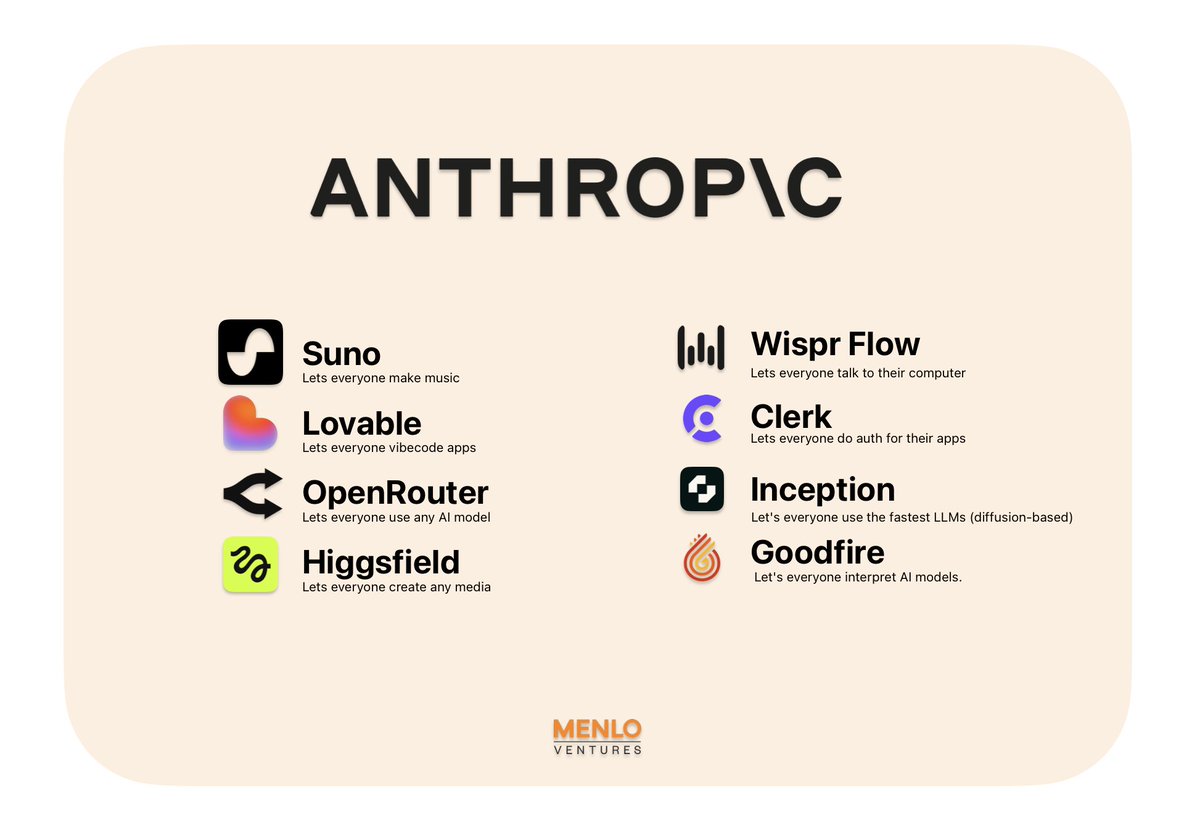
2026 has been a generational year for us at Menlo already. — Anthropic is the fastest growing company of all time adding $4.5B run rate in 42 days after the $380B round. We put ~$1B into it starting from the Series C — Suno reaches 100M users and $300M ARR — Lovable is the 5th most adopted and 2nd fastest growing AI vendor, going 0 to $200M in a yr — OpenRouter grew 2.5x in 1.5 months. On track to 1 quadrillion token annual run rate. — Higgsfield hits $200M run rate with creative tools and a $1B+ valuation. — Wispr Flow continues to grow 40% MoM with a 70% 1 year retention and wins some massive enterprise contracts — Clerk becomes #4 fastest growing vendor in the league of Google, Atlassian and Replit — Inception launches the first and best reasoning diffusion model that is the fastest for its intelligence at 1000tokens/s — Goodfire, Anthropic's first direct investment, hits $1B+ val and discovers novel biomarkers for Alzheimer's Most VCs don't believe in this model of being picky, low volume investors. We do very few investments (up to 2/partner/yr) and we go early. 5 of these were partnerships since the Seed. It's been working for us so far (even though we've missed a lot too!) It's an privilege to work with founders who run through walls and take on so much risk to bring new things into the world. And we're very lucky to play a small part in that! Still a lot of work to do.
Deedy tweet media
English
63
50
1.1K
167.4K
Bryan Johnson
Bryan Johnson@bryan_johnson·
I'm traveling to Paris...who should I meet?
English
474
14
968
216.8K
Hadrien Comte retweetledi
Shane Legg
Shane Legg@ShaneLegg·
AGI is now on the horizon and it will deeply transform many things, including the economy. I'm currently looking to hire a Senior Economist, reporting directly to me, to lead a small team investigating post-AGI economics. Job spec and application here: job-boards.greenhouse.io/deepmind/jobs/…
English
582
745
7.4K
2.4M
Hadrien Comte retweetledi
Turner Novak 🍌🧢
Turner Novak 🍌🧢@TurnerNovak·
POV you’re about to be pitched the world’s first quadruple-layered Anthropic SPV
Turner Novak 🍌🧢 tweet media
English
13
5
144
17.3K
Hadrien Comte retweetledi
BuccoCapital Bloke
BuccoCapital Bloke@buccocapital·
Man the sentiment on software as an investment here is pretty bombed out. Some various thoughts from having spent a couple decades working in software: - This was the easiest market for a long time. Greenfield opportunity everywhere - A few sub-problems flow from this. A) That didn’t exactly nurture what I would describe as “operational rigor.” B) I also wouldn’t describe many of these executive teams as killers C) People are used to operating in an inbound environment with weak competition. Very much not the case today - Similarly, gross margins hid a bunch of lazy, bad habits - And investors have never given a shit about real profit, so that is baked into how these companies operate. - You would think 2022 would have washed a lot of these bad habits away. For some companies, like I would say Shopify is a great example, it absolutely did. For other companies it did for a little, but muscle memory is strong, and times got good again. Some didn’t even really try. So you are going from an environment with a ton of tailwinds, minimal competition, low interest rates, investors who didn’t care about profit, and high gross margins to… Incredibly intense competition, needing to sacrifice margins to compete in AI, knife fights everywhere as tailwinds vanish and operating surfaces converge, higher rate environment, investor concerns on terminal value due to AI disruption risk, and a bunch of other real, structural issues that would make this post way too long to read And almost all these companies aren’t cheap even after this de-rating. And they’re not growing that fast anymore either. And AI native app layer companies are stealing their incremental customer LTV. And the management aren’t really killers because they haven’t had to be. So do I think a lot of the bear cases are extreme? Yes. But is there a lot, a lot of truth here? Also yes.
English
30
38
659
173.3K