
Free Speech Collective

625 posts

Free Speech Collective banner
Free Speech Collective

Free Speech Collective

@indiafreespeech

FREE SPEECH COLLECTIVE: Safeguarding the right to freedom of expression and the right to dissent.

Katılım Haziran 2013
164 Takip Edilen399 Takipçiler
Sabitlenmiş Tweet
Free Speech Collective
Free Speech Collective@indiafreespeech·
May 3, 2026: What does World Press Freedom Day mean to jailed journalists in India? We pose this question for two journalists behind bars in India – Jharkhand-based Rupesh Kumar Singh and Jammu and Kashmir journalist Irfan Mehraj freespeechcollective.in/commentaries/m…
Free Speech Collective tweet media
English
0
2
1
96
Free Speech Collective retweetledi
Darab Farooqui
Darab Farooqui@darab_farooqui·
The Shackles Indian Muslims can't Break. The Indian Constitution is secular. Indian politics never was. From the first decade of independence, political power in India operated on a majoritarian logic because partition played its part. Congress gave it ideology. The RSS challenged it. The Jan Sangh gave that challenge electoral form. The socialists gave it caste arithmetic. The communists gave it class language. But underneath all of it, the majoritarian logic was the same. Hindu political dominance was so normalized it became invisible, which is precisely what gave it flexibility. It could be progressive or conservative, reformist or reactionary, and still remain Hindu politics at its core. That invisibility was its greatest structural advantage. Muslim politics never had that luxury. And what began as a rational response to a real disadvantage has, over decades, become a prison of its own making. After Partition, the logic of Muslim political consolidation in a conservative bracket made sense, because the attack was partially on Islam. Afterall, Islam was held responsible for the partition of British India. The community was vulnerable, the state was unreliable, and communal violence was not a memory but a recurring present. After that, riots punctuated every decade. Jabalpur. Ahmedabad. Moradabad. A steady drumbeat of othering that no constitutional guarantee could silence. The 1965 and 1971 wars made it worse in a different way, not through violence but through suspicion. Indian Muslims found themselves having to prove a loyalty that no Hindu was ever asked to demonstrate. The secular consensus offered citizenship but not belonging. Then Shah Bano exposed how quickly even that citizenship could be traded for electoral arithmetic. Babri Masjid confirmed that the constitutional promise and the street-level reality were two different countries. Gujarat 2002 made defensiveness feel like the only sane position because Muslims knew by then, no help is in sight. So, Muslim politics contracted. It turned even more inward. It organized around the majlis, the muhalla, the personal law board, and at times the masjid, the one question that felt urgent enough to answer. Are we safe? That was not cowardice. That was a community reading its situation accurately. The only exception has been Anti CAA/NRC movement led by Muslim women, supported by Hindu progressives and moderates, fueled by Muslim masses. But the end result has been the same. The rise of an even stronger right wing in Muslims. The ossification deepened. The community turned further inward, not outward. Because the movement had no political home of its own. It was consumed from two directions simultaneously. Secular parties arrived to harvest its energy at the ballot box without building anything lasting from it. And AIMIM moved in from the other side, converting the anger and fear into deeper communal consolidation. It offered Muslims a louder voice inside the bracket instead of a way out of it. The movement that had briefly escaped the bracket was pulled back into it from both ends. For a long time, the reading was functional. Congress and the secular parties needed the Muslim vote. The bargain was unspoken but understood. Muslims stayed in their lane, kept their politics within the bracket of communal identity, and in return Congress provided a degree of protection. It was undignified. It was a tenancy arrangement dressed up as an alliance. But it worked well enough to survive on. The defensive crouch, organized around religious institutions, delivered just enough to justify itself. That bargain is now dead. The Congress system that made defensive Muslim politics viable has collapsed. What replaced it is not a neutral state open to negotiation. It is a government that uses the full apparatus of the state, courts, police, investigative agencies, legislation and bulldozers, as instruments of majoritarian pressure. Against that, defensive consolidation around religious identity does not produce protection. It produces a target. The old strategy assumed a protector was available. The protector is no longer there. And yet Muslim politics has not updated its logic. It remains where it was. Organized around the majlis, anchored to religious identity, speaking only the language of communal grievance, waiting for a protection that is not coming. The reason this has not changed is structural. Religious institutions in India have never restricted themselves to religious matters. They have functioned as the default political unit of Muslim public life, setting the boundaries of what can be said, what can be contested, and who can speak. The maulana and the madrasa answered the question of survival when survival was genuinely at stake. They are not equipped to answer the questions that governance asks. Today, governance in India is 95 percent secular in nature. It lives in budget allocations, urban planning commissions, public health policy, judicial appointments, financial regulation and labor law. It determines whether your child gets a good school, whether your neighborhood has a drain, whether a young man finds a job or loses one. It has nothing to do with religion. Muslim political voice is absent from almost all of it. You will not find Muslim political formations with serious positions on agrarian distress, on GST's impact on small traders, on the crisis in public education, on housing policy in expanding cities. The issues that determine the material conditions of Muslim life, and of everyone else's life, go unaddressed by Muslim politics, because Muslim politics has decided these are not Muslim issues. What Muslim political culture has instead is a concept. “Maslihat”. Prudence. The idea that a Muslim who comments on secular affairs, on farm policy, on the judiciary, on the economy, even on societal morality, is being reckless, inviting attention, disturbing a peace that is better left undisturbed. This Maslihat is passed down as wisdom. It is enforced inside the community against those who want to step outside the bracket. The religious institutions that enforce it are not acting out of malice. They are operating from the same siege logic that made sense in 1950 and in 1985 and in 2002. But siege logic applied to a changed situation does not produce protection. It produces paralysis. A Muslim middle class has quietly emerged through all of this, particularly through the economic expansion of the 2000s. Muslim professionals, economists, journalists, urban planners, civil servants and academics now participate in secular public life in ways that would have been difficult to imagine a generation ago. But they did not arrive there through Muslim political culture. They arrived despite it, through secular institutional pathways that Muslim political leadership neither built nor celebrated nor claimed. They did not build alternative political formations either, not because they lacked the will, but because they lacked the ground. Any Muslim professional who stepped into secular political space without the blessing of religious authority was immediately suspect, accused of abandoning the community, of playing into the hands of the other side. The cost of dissent was exclusion from the only political home available. So, they made a private peace. They participate in secular life as individuals, not as a constituency. Muslim political culture has no use for them and largely no pride in them. Thus, a moderate Muslim, a progressive Muslim, a Muslim who cares about public education or economic policy, has nowhere to go within Muslim political formations. They find their representation in Congress, in SP, in RJD, parties that accommodate them without being accountable to them. They will never lead these parties. They will never shape their ideology. They will never sit in the think tanks that determine policy positions. They are voters, occasionally candidates, never architects. That is not representation. That is tenancy. And the landlord is getting weaker by the election. The world will not wait. What Muslims regarded for decades as self-preservation politics, staying within the bracket, organizing around religious identity, keeping secular matters to others, was always costly. It is now dangerous. The state is no longer an unreliable protector. It is an active adversary. Defensive consolidation against an adversary that controls courts, police, legislation and public narrative is not a strategy. It is a slow surrender dressed up as patience. The only exit from this is also the exit that Muslim politics has resisted for seventy years. Diversification. Entry into secular discourse not as supplicants seeking protection but as citizens with positions, arguments and alliances. The kind of political presence that cannot be easily dismissed, isolated or targeted, because it is woven into the fabric of issues that affect everyone. Look at what Hindu politics did over a century. It diversified. It produced Congress nationalists and liberals, RSS ideologues, socialist redistributors and communist organizers, reformers and reactionaries, modernists and revivalists. It fought internally, bitterly, over the soul of the nation. That internal diversity, that argument within, is precisely what gave Hindu politics its reach, its resilience and ultimately its dominance. Muslim politics needs its own version of that diversification. Its own socialists. Its own secular progressives. Its own people who show up to argue about agrarian policy and urban housing and public health, not as Muslims seeking Muslim outcomes, but as citizens with a political position. Alliances built on ideology rather than vote bank arithmetic. Coalitions that cut across community lines because the issues cut across community lines. But none of this is possible until the prior question is settled. Politicians for politics. Religious institutions for religion. But what we have instead, Muslim activists for Muslim politicians. Muslim Religious leaders for Muslim political thinkers. That division of labor, which Hindu political culture achieved imperfectly but sufficiently over decades, has never happened in Muslim public life. Until it does, the space for a diverse, secular, ideologically grounded Muslim politics cannot open up. For those who argue that weakening religious institutional authority means weakening Muslim solidarity, the answer is already visible on the ground. That authority is being systematically managed, incentivized and intimidated by the same state it was supposed to resist. A handful of religious leaders, through a combination of inducement and pressure, have already been brought to heel. Centralized religious authority is not a shield. It is a handle, and the current government knows exactly how to grip it. Distributed civic presence across secular issues, across coalitions, across ideological lines, is structurally far harder to capture than a few institutions whose centrality makes them high value targets. This separation will not come from outside. No party, no government, no well-meaning outsider can negotiate it. It can only come from within Muslim society, from Muslims willing to have an argument their own political culture has long forbidden. The trap is visible. The old protector is gone. The adversary has learned that the fastest way to silence a community is to control its leaders rather than confront its people. The only defense against that is to stop having so few leaders to control. Recognition has to come first, of the problem. Everything else follows from that. And that, just that, is where it has to begin.
English
82
65
209
104.6K
Free Speech Collective
Free Speech Collective@indiafreespeech·
A must read. The silencing of an informed voice is deliberate… and, as @rejitweets points out in this poignant piece, debilitating for those who still try to break it. Are you tired of watching TV debates? I am tired of participating in them. thementality.org/are-you-tired-…
English
0
1
1
88
Free Speech Collective retweetledi
Darab Farooqui
Darab Farooqui@darab_farooqui·
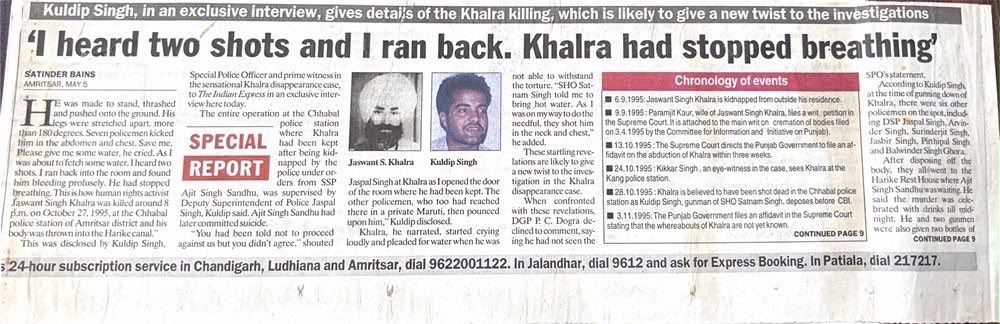
Bhai Hartosh, I share your politics, and I am the last person to pull down someone on my own side. You open your piece on KPS Gill by admitting you cannot be unbiased. I respect the honesty. But bhai, admitting you are the nephew is not the same as admitting where your evidence comes from. And your evidence has a problem you never mention. Your table comes from the Institute for Conflict Management. Your key text, quoted at length and recommended to readers in its entirety, is Gill's own essay, Endgame in Punjab, published on satp.org, the website of that same institute. The Institute for Conflict Management is your Mama's baby. He founded it. Who do you think we are? You accuse Human Rights Watch of quoting Gill out of context, and your correction is what? Quoting Gill more fully, from Gill's own website, backed by Gill's own institute's numbers. You told us you were the nephew. You did not tell us the data was the uncle's. Second, Ribeiro. You dismiss Julio Ribeiro as a liberal favourite because he speaks against Modi today. Fine. But you never mention that Gill was appointed Security Advisor to Chief Minister Narendra Modi in May 2002, right after Godhra, and later publicly defended Modi by putting the blame for the riots on the police and not on the political leadership. If speaking about Modi today counts against Ribeiro, then working for Modi counts against your Mama. You cannot run the test on one man and give the other a pass. Third, the cremations. You call the figure of 25,000 disappearances a fabrication, and on the data you may even be right. But look at what your own correction concedes: roughly 7,650 unidentified cremations over eleven years. Your calculation, not mine. Then you compare this to peacetime NCRB figures on unclaimed bodies. A beggar who dies on a railway platform and a man picked up from his home by the police; for you these are the same category of corpse? Your whole NCRB comparison rests on one assumption: that the label "unidentified" was honest. That is exactly the assumption this case destroyed. We saw it as recently as Covid. The Indian state does not hide bodies, it renames them on paper. That is why the world's excess-mortality estimates were many multiples of our official count. This is not hard to do in India today. In the 80s and 90s it was even easier. And in Punjab it was not a suspicion, it was the finding. Executions were logged as encounters. Custody deaths were logged as escapes. The murdered were registered as unclaimed. You are citing the register to defend the man, when the register itself was the weapon. And what sits under that register is not in dispute. The CBI confirmed 2,097 secret cremations at just three grounds in one district, and cremation workers testified that multiple bodies were often burned on firewood meant for one. The Supreme Court called it a flagrant violation of human rights on a mass scale. The NHRC identified 1,513 of those bodies and compensated their families, including 195 people who were in police custody immediately before they died. Jaswant Singh Khalra, who found these bodies in the firewood registers, was abducted by the Punjab police and killed for it. The Supreme Court upheld life sentences for the officers who did it. Not one of these facts appears in your article. Not one. Your table of monthly killings does not answer any of this, because the charge against Gill was never the maths of the body count. It was what the state did in the dark, under his command. It was what he did in the shadows of bureaucratic cover. And you know it. You write that accusations of custodial torture in Punjab are likely true, and that such excesses were just ordinary Indian policing. Read that sentence again, bhai. You have admitted the torture. And your defence is that it happens everywhere. That is not a defence. That is a confession. CONT+
Hartosh Singh Bal@HartoshSinghBal

why? i've written about it, and in detail examined how the 25,000 number of diappeared was concoted, hyped. from khalra on, everyone knew it was completely off the charts. rigour abandons the liberal mind when they see grounds for indignation. scroll.in/article/842699…

English
15
133
435
114.4K
Free Speech Collective
Free Speech Collective@indiafreespeech·
Predictably, this film was taken down from YouTube, No prizes for guessing which one
Free Speech Collective tweet media
English
0
0
0
29
Free Speech Collective
Free Speech Collective@indiafreespeech·
We all know how repressive that has been, with across the board censorship. The statement by @ZEE5India on pausing screenings is disquieting. Subscribers need more transparency about takedown orders. Who issued them and on what grounds.
English
0
0
0
14
Free Speech Collective
Free Speech Collective@indiafreespeech·
The film, under the title Punjab 95, was prevented from public exhibition by incredibly excessive CBFC demands for upto 120 cuts. Perhaps the film-makers decided to avoid public echo and go for an OTT screening, which is subscriber driven, but still governed by IT Act regulations
English
1
0
0
25
Free Speech Collective
Free Speech Collective@indiafreespeech·
@internetfreedom Interesting development. This is a good statement. However, between the over-eager policing by MeitY and the feature roll out by WhatsApp, where are the users? They continue to lose control of their identities.
English
0
0
1
240
Internet Freedom Foundation (IFF)
Internet Freedom Foundation (IFF)@internetfreedom·
Statement on MeitY's notice to WhatsApp over the "usernames" feature The Ministry of Electronics and Information Technology (MeitY) has sent WhatsApp a notice about the usernames feature it announced on 29 June 2026. The notice asks the company to explain, within three days, why regulatory action should not be taken against it "for launching a feature that may increase cybercrimes", and it directs the company "not to roll out this feature until the consultation on this point is achieved to the satisfaction of the Government". The Internet Freedom Foundation is concerned that the notice has no clear basis in law. It is an attempt by the executive to decide what a company may build and ship, which no statute permits. The notice treats the launch of a lawful feature as a wrong the company must justify. That reverses the ordinary position especially given the absence of any clear legal power that exists. MeitY does not name any provision that lets it approve a product feature before release or order one withdrawn, because there is none, and the provisions it does cite do not supply that power. Section 79 of the IT Act, 2000 is a safe harbour that protects an intermediary from liability for what its users post, so long as it observes due diligence. It decides when a platform can be held liable. It is not a power for MeitY to decide what features the platform may offer. Sections 66C and 66D punish identity theft and cheating by personation. They are criminal offences, tried by courts, aimed at the person who steals an identity, not at the maker of a tool that a third party misuses. Also, on MeitY's logic, a telecom operator could be told not to sell SIM cards because SIM cards are used in almost every online fraud. Rule 3(1)(b), Rule 3(2) and Rule 4 of the IT Rules, 2021 are due diligence and grievance obligations and cannot be converted into a licensing scheme. Section 69A, the one provision that lets MeitY control what appears online, permits the blocking of specific information through a set procedure. It says nothing about which features a company may build. Further the IT Rules, 2021 are subordinate legislation made under Sections 79 and 87 of the IT Act, and subordinate rules cannot travel beyond the parent statute (Ajoy Kumar Banerjee v. Union of India). If a rule cannot exceed the Act, a letter certainly cannot. The power to require prior permission for a feature is not in the Act, not in the Rules, and cannot be created by a notice. MeitY has tried this before. In March 2024 it told the same large intermediaries, among them AI Companies, to obtain its explicit permission before deploying under-tested AI models. That was criticised as an overreach that sought to build a licensing mechanism with no empowering provision in the IT Act, and within a fortnight MeitY withdrew it and dropped the permission requirement. This notice repeats the move for a single feature and goes further, because it names one company, sets a three-day clock, and bars the launch until MeitY is satisfied. This matters beyond WhatsApp. A power asserted against one company by letter can be turned on any company and any feature. On this reasoning MeitY could tell a browser not to switch on a privacy setting by default, or a payments app not to add a login method, each time until it was content. The notice also invokes traceability, through Rule 4(2) of the IT Rules, 2021 and the identification of the "first originator" of a message. Rule 4(2) has been challenged as exceeding its parent provision and resting on no law made by Parliament, and that challenge is pending before the Delhi High Court. Raising it against a feature meant to share fewer identifiers fits a pattern. We ask MeitY to state the exact provision of law under which this notice, and the direction to halt the roll-out, has been issued, and to withdraw that direction. It should stop using Section 79 and the contested traceability rule as leverage to control product design and to reverse features that improve privacy. Impersonation and fraud are real risks, but they are met by enforcing the criminal law against those who commit them, and by open processes that rest on identified legal powers. They are not met by MeitY deciding, in private and by letter, what features Indians may use. That is a licence raj for software features. New Delhi, 1 July 2026
Internet Freedom Foundation (IFF) tweet media
English
11
114
305
40K
Free Speech Collective retweetledi
Aslah Kayyalakkath
Aslah Kayyalakkath@aslahtweets·
I watched both of their interviews in Malayalam (they’ll soon be available with English subtitles) before editing this reportage. I have edited hundreds of stories over the years, but this was one of the most emotionally difficult. A man was imprisoned for nearly 18 years after his phone number was found in another person’s contact list. Branded a terrorist, he died before the court could deliver its verdict. His children grew up being called “terrorist’s children.” His wife faced attempts to remove her from work because she was “a terrorist’s wife.” His children lost their father when they needed him most, struggled through poverty, abandoned dreams of higher education, and spent their childhood waiting for him to come home. The family built a new house hoping to welcome him after his release. Instead, it received his body. Even if convicted of the original charges, the maximum punishment would have been three years. He spent nearly eighteen years in prison, waiting not only for freedom but also for the chance to be declared innocent. His family says he was denied the medical treatment that could have saved his life. If you read just one story today, let it be this: maktoobmedia.com/share/115834
Maktoob@MaktoobMedia

In conversations with Maktoob, Abdul Qadir's daughter and son recount growing up as the "terrorist's children" after his arrest in the 2008 Bengaluru serial blasts case, and how they waited nearly eighteen years for the Muslim undertrial to return home, only to lose him before the verdict. Liya Mariyam and Mohammed Rishad K report: maktoobmedia.com/share/115834

English
6
213
353
10.7K
Free Speech Collective
Free Speech Collective@indiafreespeech·
The query stems from a proposal by the Goa Union of Journalists to draw up a list of “duly registered media organisations” operating in Goa. It has sparked debate over the role of a trade union in determining which media outlets qualify for recognition.
English
0
0
0
9
Free Speech Collective retweetledi
Editors Guild of India
Editors Guild of India@IndEditorsGuild·
Statement on the Denial of Electoral and Passport Rights to R. Rajagopal
Editors Guild of India tweet media
English
107
506
930
265K
Free Speech Collective retweetledi
Nilanjana Roy 📚🦊
Nilanjana Roy 📚🦊@nilanjanaroy·
"The greatest challenge was not legal or technical. It was human. Behind every statistic was a child. Our investigators were not simply analysing documents or verifying satellite images. They were repeatedly watching videos of children being killed, mutilated, stripped, tortured, and permanently disabled. Every case represented a life interrupted." ~ Justice S. Muralidhar, Chair of the United Nations Independent International Commission of Inquiry on the Occupied Palestinian Territory, including East Jerusalem, and Israel frontline.thehindu.com/world-affairs/…
English
10
473
850
21.7K
Free Speech Collective retweetledi
SFLC.in
SFLC.in@SFLCin·
What happens to press freedom when journalists are constantly at risk of surveillance and data breaches? In this video from our series, Protecting Press Freedom in the Digital Age, in collaboration with @RSF_inter, @AbhinandanSekhr from @newslaundry, @geetaseshu from @indiafreespeech, and Degree Prasad Chouhan, a human rights defender, share their firsthand experiences of surveillance and data breaches. 🚫 Watch to understand why protecting privacy is essential for protecting press freedom. #privacy #surveillance #Spyware #dataprivacy #Pegasus #pressfreedom #freespeech #FoE @UNESCO @PENamerica @TheCAOV @IWMF @NidhiSuresh_ @RanaAyyub @rohini_mohan @aishwaria_s @rupa_jha @chitraSD @dhanyarajendran @IFEX @amnesty @IFJGlobal @IndexCensorship @theGNI @kalpana1947 @nit_set @Article14live @Info_Activism @CPJAsia @globalfreemedia @mediadefence @openmarkets @AsiaSociety @witnessorg @CFWIJ @APC_News @paranjoygt @svaradarajan @vijaita @RitikaChopra__ @bainjal @iftikhargilani @dgidwani123 @Smita_Sharma
English
0
5
7
1.4K
Free Speech Collective
Free Speech Collective@indiafreespeech·
As lakhs of students appear for the NEET exam today, the focus of the paper leak shifted to the Telegram messaging app and the government’s decision to block it, but is that the real problem? Tanya Arora examines the issue. freespeechcollective.in/uncategorized/…
English
0
1
0
95