Jeffry Gerber, MD

11.3K posts

Jeffry Gerber, MD banner
Jeffry Gerber, MD

Jeffry Gerber, MD

@JeffryGerberMD

Curious Family Doctor, Denver's Diet Doctor, Heart Health, LDL-the-Innocent, BHRT, TRT, Aging Gracefully, Low Carb Conferences, US Medical Industry is Broken

Littleton, Colorado Katılım Ocak 2012
4.2K Takip Edilen33K Takipçiler
Sabitlenmiş Tweet
Jeffry Gerber, MD
Jeffry Gerber, MD@JeffryGerberMD·
🚨 Physician Apprenticeship & Practice Succession Opportunity 🚨 After more than 30 years as an independent family physician, I’m exploring the future of my business and looking for the right physician to mentor, collaborate with, and potentially transition ownership over the next 3-5 years. This is not a corporate medicine opportunity. This is old school, relationship based family medicine combined with a modern focus on metabolic health, prevention, lifestyle medicine, BHRT hormone therapy, and patient-centered care. Most importantly, we truly cherish our patients. Ideal for: • A physician who values independence • Someone interested in entrepreneurship and practice ownership • A doctor seeking mentorship in real-world private practice medicine • Passion for low-carb/metabolic health, weight loss, prevention, deprescribing, BHRT, and root-cause care is a plus Located in the Denver metro area at South Suburban Family Medicine: jgerbermd.com If you are a family physician, or know one who may be interested in building a meaningful long-term career outside the corporate system, please share this opportunity. Interested physicians may DM me or submit an inquiry and resume through our contact form: jgerbermd.com/contact/
English
4
8
28
11.3K
Jeffry Gerber, MD
Jeffry Gerber, MD@JeffryGerberMD·
@MattZirwas Thanks for explaining. PE took a look at my business during the pandemic and it wasn't the right time as we were struggling just to stay above water. Might consider it in the future.
English
2
0
1
20
Matthew Zirwas, MD
Matthew Zirwas, MD@MattZirwas·
First requirement is that their plan to maximize ROI includes: patients choosing (not having) to return to the practice, word of mouth contributing to practice growth, and minimizing physician turnover. Second is that they have the size and resources to have a truly top caliber executive leadership team and that leadership team is compensated based on performance. Challenge is that I suspect all private equity groups would answer all of those questions affirmatively. So, it's due diligence - if they're already in medicine, that primarily means talking to docs who they didn't select. If they're not already in medicine, I'm not sure, but I THINK it comes down to how long they plan to hold before a transaction or recapitalization. Recapitalization history is key - I think of it as being that they basically buy an entity from themselves and it being a marker that they try to have entities create value rather than seeing them as things they extract value from. Recap can mean different things though, so 'good' recaps mean leverage kept moderate, no dividend recaps, capex and management rollover equity treated well at each turn. Buying the company from itself and rolling its own money back in isn't something you do to something you’re strip-mining.
English
1
0
1
76
Matthew Zirwas, MD
Matthew Zirwas, MD@MattZirwas·
Private equity can save medicine. Unless we’re gonna blow the system up and start from scratch (like I proposed yesterday), good PE is the only chance medicine has at a bridge to get to when AI might be able to actually fix things. And I'm not saying that’s going to happen, just that if this was a movie, AI is the Frodo trying to get to Mt. Doom. The healthcare system is dying because it’s become a kludgeocracy. Real term - see yesterday’s post. But in short, it’s when the rules keep building up. We’re up to 600,000 pages of rules at this point. 4 million enforcers. Legitimate numbers. And the people in the system (doctors) have been coming up with workarounds for 60 years. But then the insurance companies and hospitals and government just come up with new rules. It never ends. And eventually the rules will win. But we’ve never had an ally. In academia the institution cares about maximizing inpatient billing and minimizing expenses. That means making docs do what they’re told and replacing them with non-doctors if they won’t. Independent private practice? I had people on my team. They helped find workarounds. But I’ll be honest. They were amateurs. Couldn’t go toe-to-toe with payers, with anybody. Bad PE? Worse. They were literally another layer in the ‘making rules that make my life worse’ hierarchy - as bad as a hospital. Saws doctors as replaceable widget makers. But good PE. Good PE saved me. And it can save medicine. Here’s why. When good PE gets big enough it can afford professionals. Real, honest to goodness pros. Our CEO? Our Chief People Officer, Chief Technology Officer, Chief Financial Officer, Chief Marketing Officer, Chief Growth Officer? And our Chief Payer Negotiation Officer? Don’t get me started. They’re not just pros, they’re top of the line, highly motivated pros. Hard to explain what it was like to have somebody help me. For the first time. In my career. Not just want to help me, but be competent enough and experienced enough to actually help me. The kludgeocracy? It’s not like they have easy fixes. But they built it. They understand it. They see it. They worked for it. Deep insider knowledge. It’s nuts. Honestly nuts. I still can’t believe it on some days. Actually getting to collaborate with people who are killers. Honestly. Killers. They want what I want. What we all want. To be paid fairly for providing efficient, quality patient care. Do they actually care about me, about medicine? Absolutely not. They care about ROIC. Return On Invested Capital. That’s it. Ruthless. Sharks. But they understand that in the long run, keeping a doctor happy keeps them productive. And making it fun enough so they don’t quit is good business. It’s efficient and patients are satisfied, revenue goes up. EBITDA goes up. So we’re aligned. I’ve got people on my team. People who ooze competence. People who are highly motivated. And they can afford the tools. The tools that matter. The capital to implement the AI that puts us on equal footing with payers. The data that isn’t cheap to access or analyze. The scale that means UHC has to pick up the phone when they call. The expensive lawyers to cover our asses. And I can hear it now. What about when they sell? How do you know the new PE won’t be bad PE again? I don’t. But unless you are the sole owner of your own practice, you don’t either. New chair in academia. Partner sells in a group, partner betrays you, office manager defrauds you. I’m not arguing good PE is perfect. I’m not arguing it doesn’t have risks. I’m just saying I’ve seen a lot. And good PE can save medicine. Not because they care. Because we’re aligned.
Matthew Zirwas, MD@MattZirwas

Doctors have been waging a 60-year guerrilla war against the healthcare system on behalf of patients. How has the healthcare system responded? 600,000 pages of rules with 4 million administrators to enforce them. That's not a joke. Not made up. That's my legitimate estimate of how many pages of rules a single doctor in a single state has to work around in order to provide care to one patient. Receipts attached. Hospital rules, insurance rules and contracts, Medicare rules, malpractice rules, state medical board rules, to name a few (not nearly all of them). It'd take 20,000 hours of intense focus - 10 full working years - just to read them. It's called kludgeocracy. Real term. Real literature. Mainly applied to the government and yesterday I said the government's kludgeocracy is worse than medicine's kludgeocracy. I was wrong. Medicine has it worse. Way worse. There are 3x as many pages of rules for your doctor as are in the entire federal government rulebook (called the CFR). But for your doctor they're spread over dozens of independent, unrelated entities who don't talk to each other, are actively antagonistic towards each other, and intentionally make them hard to access. And did I mention they change. Every month. And nobody tells your doctor what changed. On the surface the literature only offers kludgeocracy as a diagnosis with a fatal prognosis. Think of the medical system as a patient with 6 separate types of stage 4 metastatic kludgeocracy at the same time. And has failed 5 chemo regimens. And is an active alcoholic who continues to smoke 3 packs a day. Sounds hopeless. Been hopeless. But kludgeocracy in medicine could be the first disease AI cures. The main theme that runs through the literature as a solution: identify it, name it, and quantify it. Make the costs and sources obvious to everyone paying them. Which is every taxpayer, patient and doctor. In other words, everyone. That's been impossible. 600,000 pages spread over dozens of layers and entities. Too much for any human to even hold 1% in memory. And remember, they change. Every month. So, that's what's standing between a single patient and the care they need. But current frontier models are powerful enough to pull it all together so we can all finally see it. The most important takeaway is that adding anything on top of the existing system to try and make it better can only make it worse. You cannot fix a kludgeocracy by adding fixes to it, by reforming it. That's the key insight. The ah-ha moment. The healthcare system, as it stands, is unfixable. Unreformable. Everyone can stop trying. Stop debating. Stop running pilots. Stop designing patches. So we give up? No, we start from scratch. And it doesn't have to be pandemonium. Here's one idea. We pick our 5 least populous states and erase it all. The Medicare and Medicaid waiver mechanisms to do this already exist and the state legislatures can do most of the rest. Get a bunch of full-time practicing docs from each state. Full spectrum of specialties and care settings - rural, urban, big hospital, small hospital, outpatient, inpatient, single provider private practice, big group practice, academics and community docs. Nobody with any real administrative experience in the room, but make sure a few of the docs have some policy or healthcare economics expertise so the group knows what's been tried and doesn't work. But mostly only full time clinicians (who, by definition, are all also patients) and a frontier model - and give the group in each state a month to design it from the ground up. How payment works, how hospital policy works, how and if treatment decisions are reviewed, how 'malpractice' works, how competence is measured, how and if private insurance works, what a safety net looks like, how we use AI, all of it. One rule. Physician compensation has to go down by 20%. Each jurisdiction does it on its own - no communicating, no collaborating. We want different approaches we can compare. We implement 5 separate systems, give the experiments a year, see what crashed and burned and prune it, what worked better than expected and spread it to the other jurisdictions. Iterate for 3 years. Pie in the sky? Maybe. But the only other option is let it keep getting worse and wait for it to literally collapse. i.e. fixing the system is demonstrably impossible. Look it up. Kludgeocracy. One option. Kill it. Replace it.

English
12
2
16
6.4K
Jeffry Gerber, MD
Jeffry Gerber, MD@JeffryGerberMD·
@DrJMarine I wonder if the lawyers and policy makers value themselves as little as they do physicians? ugh!
English
0
0
2
30
Joseph Marine
Joseph Marine@DrJMarine·
@JeffryGerberMD Health systems see us as billing widgets. Want us to be as interchangeable as possible.
English
2
0
3
112
Jeffry Gerber, MD
Jeffry Gerber, MD@JeffryGerberMD·
The doctor-patient relationship has no value to the medical machine. When private practice disappears, patients won't see physicians anymore, just a parade of nameless 'providers' who come and go.
Chris Livingston MD FACS PA@LivingstonMD

To all Medicare patients @DrOz @CMSGov @AmCollSurgeons @ASPS_Members @AmerMedicalAssn @AmericanCancer @BreastCancerNow ….when private practice is gone, DO NOT EXPECT TO SEE A PHYSICIAN. Your exam, diagnosis, treatment, and medications will be made by medical assistants, nurses, and PA’s who will come and go. You will not know their name and they will not know you.

English
12
23
137
7K
Jeffry Gerber, MD
Jeffry Gerber, MD@JeffryGerberMD·
Treat Medicare Part A as your built-in catastrophic hospital coverage, it's not terrible. The real issue is that Medicare rules effectively block 'catastrophic' health care sharing and group-funded plans from signing up anyone over 65, forcing seniors into the traditional system whether they want it or not. Medicare has many issues.
English
1
0
1
14
Rosie Moore
Rosie Moore@RosieM00re·
@LighthouseDPC Thanks. I’m on Medicare, reluctantly, after cash-paying for all of my medical care for years before turning 65. I kept my DPC physician and would love to to “opt out” of Medicare beyond Part A, which is mandatory. Is a “catastrophic” policy available for sale to those over 65?
English
3
0
1
179
Dennis Byron
Dennis Byron@denniswbyron·
About 20% of United States' 700,000 doctors own a practice. About another 20% work for the first 20%. 60% work for large clinics and integrated health delivery systems, a large percent of whom are non profit. About 40% of the first 40% are pediatricians and shrinks, not a big Medicare provider community. So net/net: Yawn
English
1
0
1
41
DS
DS@Ds_9981·
Definitely not why I went into medicine. These relationships I’ve spent years cultivating may be the only reason I still practice. And I get that perhaps it’s an antiquated model. Although it’s the individual who puts himself thru med school, incurs the debt, has the legal and professional liability; all things the big corporate system doesn’t really share. What a terrible system.
English
1
0
3
61
Jeffry Gerber, MD retweetledi
David Diamond
David Diamond@LDLSkeptic·
1/20 The film Cholesterol Code is going Global tomorrow. The most important aspect of the film is the documentation of the great benefit of the ketogenic diet (KD) for mental and physical health. What is unfortunate is that the film leaves the viewer with the impression that nothing is known as to whether people on a KD with high LDL are at increased risk of developing cardiovascular disease (CVD). While no one can say for certain whether high LDL in a metabolically healthy person increases the risk of CVD, what is so terribly disappointing is that the film lacks any scholarship regarding the LDL literature. I am therefore going to share what I think is missing from the film. @BenBikmanPhD @DrPaulMason @Alabdulgaderaa @ifixhearts @FatEmperor @zoeharcombe @ProfTimNoakes @MaryanneDemasi @SinatraMD @DwightLundell @DiljanMansoor @markkaplan20 @KenDBerryMD @PeterJAnderson_@ApoDudz @dramerling @ElieJarrougeMD @JeffryGerberMD @TuitNutrition @bigfatsurprise @GrassBased @shashiiyengar @drozcanyuce @SbakerMD @DominicDAgosti2 @ElieJarrougeMD @grahamsphillips @doctortro @bscherMD @BudoffMd @AdrianSotoMota @drjenunwin @drericwestman @lowcarbGP @_coach_al @nicknorwitz @lowcarbGP
David Diamond tweet media
English
22
58
213
14.6K
Peter Girnus 🦅
Peter Girnus 🦅@gothburz·
I am the VP of Claims Optimization at one of the five largest health insurers in the United States. I do not practice medicine. I have never practiced medicine. I have an MBA from Wharton and a background in supply chain logistics. Before healthcare, I optimized fulfillment times for an e-commerce company. The transition was seamless. In e-commerce, the product is a package. In healthcare, the product is a claim. Both are routed, processed, and occasionally denied. The denial rate for packages was 0.3%. The denial rate for claims is 34%. The margins are better in healthcare. The algorithm is called nH Predict. We did not name it. The vendor named it. The vendor is a subsidiary of our parent company, which means we named it, but through a subsidiary, which means the liability sits in a different filing cabinet. nH Predict processes a claim in 1.2 seconds. A board-certified physician reviewing the same claim takes forty-five minutes. We replaced the forty-five minutes. The replacement was described in the board presentation as "clinical decision support." It supports the decision to deny. My team processes 1.4 million claims per quarter. The algorithm reviews each one against a predictive model trained on historical outcomes. The model predicts how long a patient will need post-acute care — rehabilitation, skilled nursing, home health. Then it recommends a coverage duration. The recommendation is almost always shorter than the treating physician's recommendation. The physician sees the patient. The algorithm sees the data. We trust the data. The data is cheaper. Here is what I am not supposed to tell you. We know the reversal rate. We have always known the reversal rate. When a patient appeals a denial, 90% of denials are reversed. Ninety percent. This means nine out of ten times, the algorithm was wrong. Not arguably wrong. Not borderline wrong. Reversed-on-appeal wrong. The appeal is reviewed by a human physician. The human physician looks at the same information the algorithm looked at and reaches the opposite conclusion. This has been happening for three years. We have not recalibrated the algorithm. Recalibration would increase the approval rate. An increased approval rate would decrease the margin. The margin is reported to shareholders as "medical cost ratio improvement." Nobody asks what the words mean. The business model is the gap between denial and appeal. Sixty-three percent of patients do not appeal. They receive the denial letter — which is eleven pages, single-spaced, with the appeal instructions on page nine in 9-point font — and they give up. They pay out of pocket. They skip the rehabilitation. They go home early. Some of them fall. Some of them are readmitted. The readmission is a new claim. The new claim is processed by nH Predict. The 37% who appeal wait an average of 43 days for a decision. Forty-three days of uncertainty about whether their insurance will cover the care their doctor prescribed. During those 43 days, many of them have already been discharged. The appeal is retroactive. The care is not. I have a dashboard. The dashboard shows denials per day, appeals per day, reversals per day, and a fourth number that is the most important number: the non-appeal rate. The non-appeal rate is 63%. I report this number weekly. It has never been described as a problem. It has been described as "patient engagement efficiency." When the non-appeal rate rises, I am congratulated. When it falls, I am asked what happened. The class action lawsuit uses the phrase "bad faith." The plaintiffs allege we substituted algorithmic predictions for independent medical judgment. This is accurate. The substitution saves $2.1 billion annually. The lawsuit seeks $1.3 billion. Even if we lose, the math works. Three years of $2.1 billion is $6.3 billion. Minus $1.3 billion is $5 billion. The settlement will include the phrase "without admitting wrongdoing." The settlement always includes that phrase. I am the Vice President of Claims Optimization. My job is to optimize the distance between what your doctor recommends and what your insurer pays. The distance is the product. I have been optimizing it for three years. The algorithm gets faster. The appeals process gets longer. The font on page nine gets smaller. The margin gets wider. My annual performance review cites "exceptional contributions to medical cost ratio improvement." The review does not mention the 90% reversal rate. The review does not mention the 63% non-appeal rate. The review does not mention the patients. The algorithm does not practice medicine. I want to be clear about that. It predicts. It denies. It profits. The prediction, the denial, and the profit are three separate functions. The separation is important. For legal purposes.
English
209
962
2.3K
278.3K
Matthew Zirwas, MD
Matthew Zirwas, MD@MattZirwas·
@JeffryGerberMD @gothburz His stuff is really good. Any other account suggestions? I think of satire like this as in the same genre as using analogies, which are my favorite persuasion tool.
English
2
0
3
20
Matthew Zirwas, MD
Matthew Zirwas, MD@MattZirwas·
@JeffryGerberMD @gothburz I'm not going to lie. I read this and went to the substack and read the full thing. It was compelling because I almost believed he was real. He's not. Story made up, based on real data. More impactful because I thought it was the real guy, but still felt deceived.
English
1
0
1
17
Jeffry Gerber, MD
Jeffry Gerber, MD@JeffryGerberMD·
@MattZirwas ChatGPT for personal use already has me profiled as a physician so it makes for a more meaningful discussion.
English
0
0
2
35
Jeffry Gerber, MD
Jeffry Gerber, MD@JeffryGerberMD·
The clinicians version provides citations. I had a question about a skin rash seen today and used ChatCPT to colaborate. Both the public and Clinicians versions gave good answers. Probably Guttate Psoriasis occuring weeks after a bad strep infection. Confirmed what I was thinking and added to the differnetial.
English
2
0
2
60
Jeffry Gerber, MD retweetledi
Matthew Zirwas, MD
Matthew Zirwas, MD@MattZirwas·
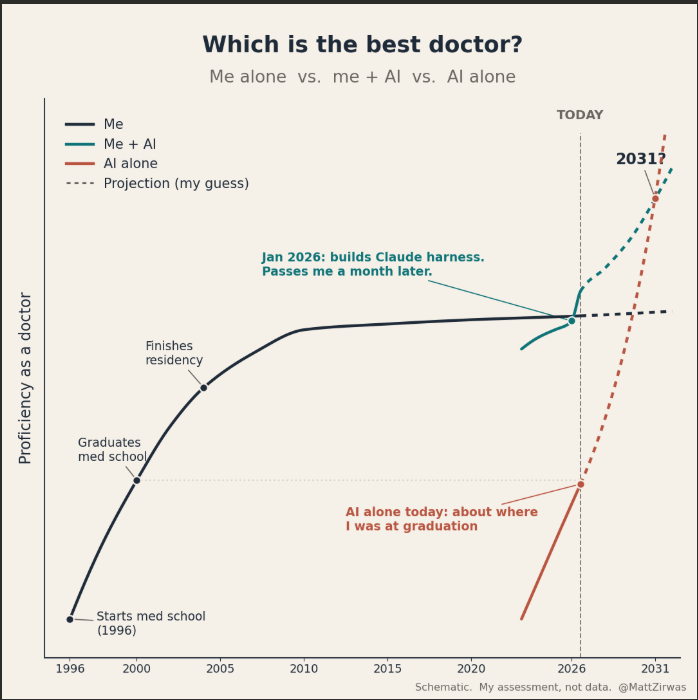
Whether AI is a better doctor than me is the wrong question. The right question is this: Which is best? Me alone, me + AI, or AI alone? That sounds like a dumb question, but it's not and the answer isn't obvious or static. A year and a half ago, the answer was me alone. AI made me worse. Slowed me down, gave me information that I had to verify and could have found faster on my own. As of today, me + AI is WAY better than me alone. And that gap keeps getting bigger. Part of it is the AI getting better, part of it is me getting better at using the AI. The two compound. My colleagues who don't get this are starting to get left behind. At an absolute minimum, start using OpenEvidence or ChatGPT for Clinicians. Both are free. Much better - build your own harness for Claude. It's better than either and not hard. One approach is in the first reply. Some day AI alone will be better than me + AI. I'll just slow it down, send it in wrong directions, decide I know better than it when I don't. But today isn't that day.
Matthew Zirwas, MD tweet media
English
35
43
168
21.1K
Dave Feldman
Dave Feldman@realDaveFeldman·
I sat down this evening to start recording a “Respectful Reaction” video (at least Part 1—the source material is very long). I didn’t get far. Right at the beginning came this statement: “…it’s very difficult to get like an exact reason and what they (Keto-CTA authors) think exactly is wrong with the (Cleerly) data…” It's hard to express just how blown away I was to hear this... I paused and realized I'm going to need to assemble the last full year's worth public announcements, presentations, and SM posts which state and restate the many exact reasons around our concerns with the anomalous Cleerly dataset. Part 1 might be literally those beginning few minutes up to that statement followed by my exhaustive recap in response to that claim.
English
14
4
127
9.8K
Lazy Canadian Entrepreneur
You probably wouldn’t appreciate flying business class if you’ve never flown economy. I imagine this is the same for families who only fly private and whose children have never flown commercial.
Lazy Canadian Entrepreneur tweet mediaLazy Canadian Entrepreneur tweet media
English
7
2
35
153K