kevin

851 posts

kevin banner
kevin

kevin

@kevinverse

founder & chairman https://t.co/YvR5Ym1hnv, owner https://t.co/JWpHXllMHo, thiel fellow

Manhattan, NY Katılım Mart 2011
1K Takip Edilen1.6K Takipçiler
Sabitlenmiş Tweet
kevin
kevin@kevinverse·
We are excited to officially release our public preview of fossabot - a new AI dependency update reviewer for JavaScript / Typescript. To try it, simply follow the link in the announcement to install on Github: fossa.com/products/fossa… Fossabot burns down the backlog of alerts from security and dependency update tools like Dependabot, Renovate and Snyk by automatically triaging PRs for breaking changes and code impacts. At the center of fossabot is an advanced static analysis engine built in our partnership with Edgebit. We started by proving out this capability in JavaScript — notoriously one of the hardest languages to perform reliable analysis in due to its variability. This particularly novel approach goes significantly deeper than SOTA reachability analysis, nearly doubling the accuracy and tripling the consistency of identifying the impact of dependency updates compared to vanilla coding agents. Soon, we are planning to expand both the capability to opening our own strategic updates and bring official support for other languages / platforms. We hope you enjoy this preview and look forward to the feedback!
English
0
1
7
651
kevin retweetledi
Eve Labs
Eve Labs@EveLabsAI·
Today we're announcing our thought-to-search system, morphism. This open-weights pipeline lets you decode your thoughts using only the broadly available @OpenBCI Cyton! Try it now: huggingface.co/evelabs/morphi…
English
10
4
25
2.4K
kevin
kevin@kevinverse·
@akoratana A context graph is just Postgres / rdbms
English
0
0
0
31
Animesh Koratana
Animesh Koratana@akoratana·
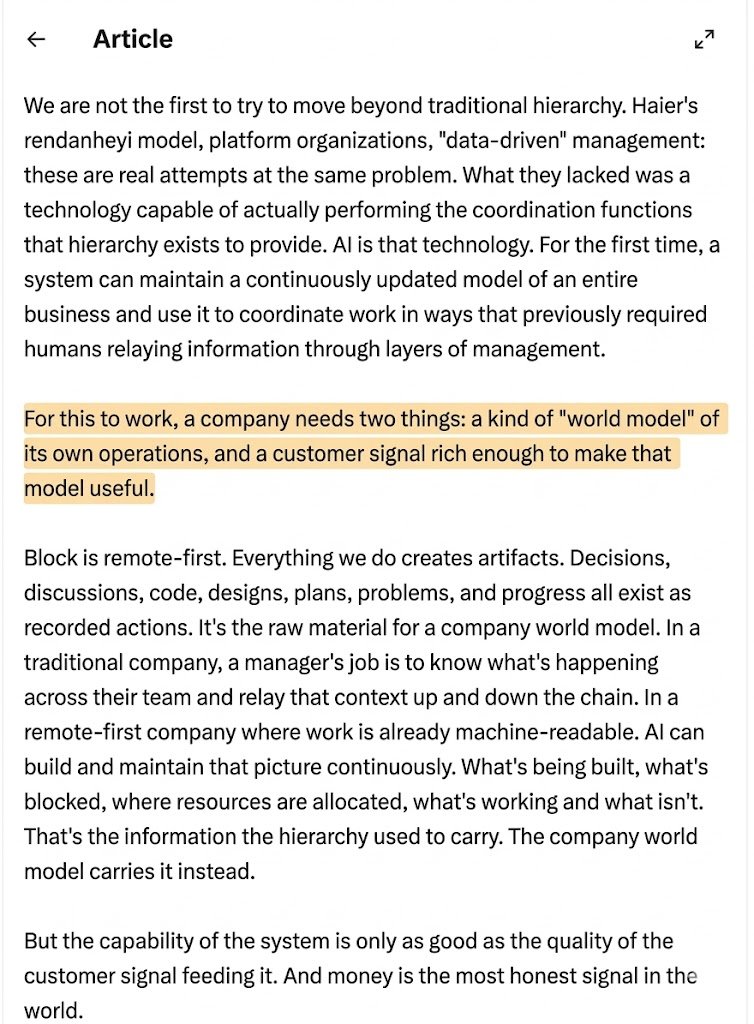
Context graphs will be to the 2030s what databases were to the 2000s. Within a year, every frontier lab will be building one and here's why: At 10 people, coordination is free. Everyone knows what everyone else is doing. You never hold a meeting to "align." At 100 people, you spend maybe 20% of your payroll on coordination. Managers, syncs, standups, planning sessions, status reports. At 10,000 people, that number approaches 60%. The majority of your headcount exists not to produce anything but to make sure the people who produce things are producing the right things in the right order. This is the dirty secret of large organizations: output scales linearly with headcount, but coordination cost scales exponentially. Every person you add creates new information pathways that must be maintained. The hierarchy is the protocol that manages this, and it's brutally expensive. Hierarchy is a compression algorithm for organizational knowledge. At every layer, a manager compresses the reality of their team into a summary that fits in a 30-minute meeting with their boss. Their boss compresses eight of those summaries into one for their boss. By the time information reaches the CEO, it's been lossy-compressed through five or six layers of human interpretation. This is why CEOs make bad decisions. The information they receive has been compressed, filtered, and distorted at every layer. The hierarchy is high-latency, low-bandwidth, and lossy. Jack didn't fire 4,000 producers but cut 4,000 compression nodes. Block's "world model" is a replacement algorithm. Zero latency, high bandwidth, lossless. Every person at the edge gets the full picture without waiting for information to travel through human relays. The infrastructure that makes this possible is the context graph. A living, continuously updated representation of how the organization actually works. Not just data, but decision traces: the reasoning connecting observations to actions. Not what's true now, but why it became true. The shift from "give agents memory" to "give agents organizational judgment" will define the next platform war
Animesh Koratana tweet media
jack@jack

x.com/i/article/2038…

English
94
212
1.7K
374.4K
kevin retweetledi
Stuart Hameroff
Stuart Hameroff@StuartHameroff·
I agree LLMs won’t be conscious and the reasons relate to ‘biological naturalism’, i.e. the Orch OR theory on which the first biomimetic quantum computer is based. @anirbanbandyo has made a warm temperature self organizing quantum computer of organic helical aromatic ring oscillators which processes quantum optical information and is likely to be inhibited by anesthetic effects. The future just happened. iopscience.iop.org/article/10.108…
Anil Seth@anilkseth

There are very good reasons why LLMs are very unlikely to be conscious. noemamag.com/the-mythology-…

English
18
10
74
6.2K
kevin
kevin@kevinverse·
@sidrmsh Good writing, you should start a company and apply these; many folks would likely back you.
English
1
0
2
903
kevin
kevin@kevinverse·
@levie Agent harness is wrong abstraction, it’s tasks that can be decomposed into coding problems. You cannot agent harness CAD well for example.
English
0
0
0
91
Aaron Levie
Aaron Levie@levie·
The force multiplier of the agent harness right now is crazy. The industry has landed on some architectural consistency, but there are still so many different variants of how to attack this. Maybe this gets bitter lessened out of existence, but for now it’s a huge lever.
Himanshu@Hxlfed14

x.com/i/article/2028…

English
47
59
635
221K
staysaasy
staysaasy@staysaasy·
@sama Are you more of a Beatles or Rolling Stones guy?
English
1
0
4
707
Sam Altman
Sam Altman@sama·
I'd like to answer questions about our work with the DoW and our thinking over the past few days. Please AMA.
English
7.6K
584
10.4K
7.1M
kevin
kevin@kevinverse·
@bencera Next up: Ai that signs up for random shit, acts like a user and confuses other ais making saas slop.
English
1
0
5
543
Ben Cera
Ben Cera@Bencera·
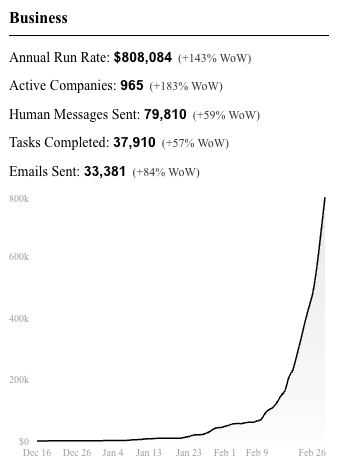
This is getting so wild. $200k->$800k in a week. Just one founder with a swarm of AI agents running in the cloud. Zero employees.
Ben Cera tweet media
English
52
15
359
65.6K
kevin
kevin@kevinverse·
@0xluffy This is stupid, lots of young folks are more senior than an average L5 but this attitude will shut them out of the job market.
English
0
0
0
373
kevin
kevin@kevinverse·
@jeffdfeng This is bulkshit. This is the time to be investing in young talent not alienating them.
English
0
0
3
356
Jeff
Jeff@jeffdfeng·
Spoke with several YC founders planning to lay off all engineers below staff/principal — basically everyone under L5. This only became viable after Opus 4.5 in December. The Block layoffs are a signal: the floor just collapsed. If you’re early in your career, the next few years are everything. Your edge will be how well you integrate AI into the value you create. The fastest learners are about to compound at absurd rates.
jack@jack

we're making @blocks smaller today. here's my note to the company. #### today we're making one of the hardest decisions in the history of our company: we're reducing our organization by nearly half, from over 10,000 people to just under 6,000. that means over 4,000 of you are being asked to leave or entering into consultation. i'll be straight about what's happening, why, and what it means for everyone. first off, if you're one of the people affected, you'll receive your salary for 20 weeks + 1 week per year of tenure, equity vested through the end of may, 6 months of health care, your corporate devices, and $5,000 to put toward whatever you need to help you in this transition (if you’re outside the U.S. you’ll receive similar support but exact details are going to vary based on local requirements). i want you to know that before anything else. everyone will be notified today, whether you're being asked to leave, entering consultation, or asked to stay. we're not making this decision because we're in trouble. our business is strong. gross profit continues to grow, we continue to serve more and more customers, and profitability is improving. but something has changed. we're already seeing that the intelligence tools we’re creating and using, paired with smaller and flatter teams, are enabling a new way of working which fundamentally changes what it means to build and run a company. and that's accelerating rapidly. i had two options: cut gradually over months or years as this shift plays out, or be honest about where we are and act on it now. i chose the latter. repeated rounds of cuts are destructive to morale, to focus, and to the trust that customers and shareholders place in our ability to lead. i'd rather take a hard, clear action now and build from a position we believe in than manage a slow reduction of people toward the same outcome. a smaller company also gives us the space to grow our business the right way, on our own terms, instead of constantly reacting to market pressures. a decision at this scale carries risk. but so does standing still. we've done a full review to determine the roles and people we require to reliably grow the business from here, and we've pressure-tested those decisions from multiple angles. i accept that we may have gotten some of them wrong, and we've built in flexibility to account for that, and do the right thing for our customers. we're not going to just disappear people from slack and email and pretend they were never here. communication channels will stay open through thursday evening (pacific) so everyone can say goodbye properly, and share whatever you wish. i'll also be hosting a live video session to thank everyone at 3:35pm pacific. i know doing it this way might feel awkward. i'd rather it feel awkward and human than efficient and cold. to those of you leaving…i’m grateful for you, and i’m sorry to put you through this. you built what this company is today. that's a fact that i'll honor forever. this decision is not a reflection of what you contributed. you will be a great contributor to any organization going forward. to those staying…i made this decision, and i'll own it. what i'm asking of you is to build with me. we're going to build this company with intelligence at the core of everything we do. how we work, how we create, how we serve our customers. our customers will feel this shift too, and we're going to help them navigate it: towards a future where they can build their own features directly, composed of our capabilities and served through our interfaces. that's what i'm focused on now. expect a note from me tomorrow. jack

English
130
100
1.9K
584.8K
kevin
kevin@kevinverse·
@zephyr_z9 This has been possible for a while but will struggle w assemblies.
English
0
0
0
170
kevin
kevin@kevinverse·
@notch Discover and admit the true goal behind your actions, ask if you truly want it or consciously let go, emotionally commit to outcome
English
0
0
1
195
notch
notch@notch·
So I've come up with this pretty ridiculous system for self improvement that seems to actually work. It's kind of hard to tell you're self you're going to stop doing something or whatever. It's also hard to even honestly tell yourself you're going to even try to stop doing the thing. But you kind of can truly honestly promise yourself you're going to legitimately TRY trying to stop doing the thing. For me, it seems to be a five day process of legitimately making down the acceptance ladder.
English
123
48
1.8K
286.3K
Bryan Johnson
Bryan Johnson@bryan_johnson·
I've been in the depths of despair with depression. A state where nothing matters. No one can say anything to convince you otherwise. For those of you who've also been there or who are there now, what advice would you give others about how to speak with people in this state?
English
2.5K
188
6.6K
1.2M
David
David@DavidSHolz·
@andy_matuschak Gaming has tons of underutilized elite talent. As brutal as the field is, it motivates WAY more than other fields of software. A lot of our non-gaming software ideas are 'abstract' where games are 'concrete' and 'primal', and every pound of primal gets you a pound of genius
English
12
7
261
8.3K
Andy Matuschak
Andy Matuschak@andy_matuschak·
Confused: exciting new UIs seem rare in large part because inventing them requires both programming and imaginative design skills. It’s rare to find both in one person, and hard to coordinate in a dyad. But then: why does this kind of invention seem more common in games? If true, shouldn’t this be a problem in all design sciences, like architecture?
English
47
6
337
25.7K
kevin
kevin@kevinverse·
@vasuman Probably productivity perception was an inherent benefit to most companies of mgmt challenging their teams to be headcount lite.
English
0
0
1
24
kevin
kevin@kevinverse·
@Xaraphim This won’t work well without good diffusion models from China. This demo is template based can’t scale to more complex or novel assemblies.
English
0
0
0
466
Mitchell Hashimoto
Mitchell Hashimoto@mitchellh·
You're latching onto the wrong thing. My response is for people that don't have an idea. If you want to be a founder and have an idea then yeah, go do it. I also think your comparison to athletes etc are incorrect. It's more akin to if a kid came up to you and said "I want to be an athlete but don't know what sport to play." You'd say: go play a sport then and figure that out. That's the same thing I'm saying, except these folks are usually coming to me and saying "I want to be an athlete and don't know what sports to exist, so I've invented my own and think people might like it" lol
English
5
0
202
9K
Nathan Baschez
Nathan Baschez@nbaschez·
I vehemently disagree with the attitude that it's not OK to want to be a founder "for the sake of it" We don't discourage athletes, actors, musicians, or any other creative high-beta profession this way
Mitchell Hashimoto@mitchellh

I answer about a dozen or so emails every week from students and early stage founders. One of the most common red flags I see are people who want to be a founder for the sake of it and are chasing ideas or guessing. It's so common I have a canned response. Here it is: (Starting the canned response here) I’m sorry to say it sounds like you’re searching for an idea. Or, you have a solution in need of a problem. Or, you just like the idea of being a founder (for whatever reason). This isn’t what you want to hear, but go get a job and work for awhile. If you have a solution that needs market validation, then work in the industry that you think that market exists. Immerse yourself in some industry, it really doesn’t matter what one, because they’re all so filled with problems that need to be solved that you can choose anything. It only takes one or two years. Then your problem isn’t going to be wondering “is this a good idea?” “What is a good idea?” Etc. The problem is going to be: which of these 10 obviously good ideas won’t be solved unless I do it, and which do I want to spend the next 10 years of my life working on? That’s the real hard question. Remember, the key questions a VC is going to ask you and you should ask yourself is: “Why this? Why now? Why you?” You should have full confidence in all of them. The easy part is confidence in all of them. Then the hard part is executing fast enough and hoping the market moves with you with external factors that are mostly out of your control. :) Don’t search for an idea. Let one come to you. Go get a job. I’m sorry to tell you that, but it’s the advice I think you need to hear. Like I said, it won’t take long, one or two years or so. But that one or two years of working is going to save you more years of your life most likely wasting your time on the easy part (finding the idea). Plus, you’ll get paid for it.

English
12
1
63
25.3K