Krishnan Srinivasan

129 posts

Krishnan Srinivasan

Krishnan Srinivasan

@krishpopdesu

Katılım Kasım 2009
1.7K Takip Edilen569 Takipçiler
Krishnan Srinivasan retweetledi
Russ Tedrake
Russ Tedrake@RussTedrake·
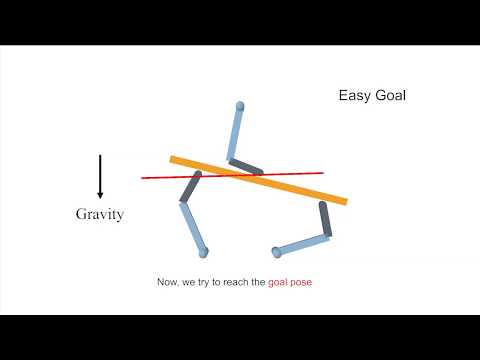
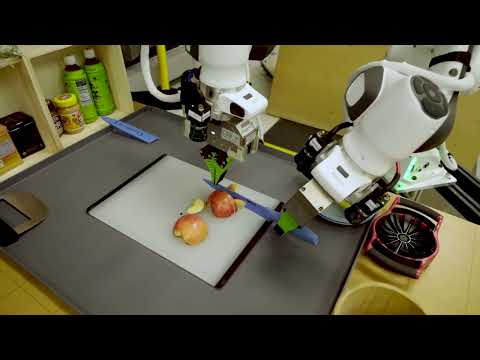
TRI's latest Large Behavior Model (LBM) paper landed on arxiv last night! Check out our project website: toyotaresearchinstitute.github.io/lbm1/ One of our main goals for this paper was to put out a very careful and thorough study on the topic to help people understand the state of the technology, and to share a lot of details for how we're achieving it. youtube.com/watch?v=BEXFnr…
YouTube video
YouTube
English
8
105
487
87.5K
Krishnan Srinivasan
Krishnan Srinivasan@krishpopdesu·
Want your dexterous allegro hand to pick up a novel object, but don't know where to start? Check out our work "Get a Grip" at #corl2024, and grab our diverse grasping dataset and model for dexterous grasps :)
Albert Li@albert_h_li

There have been many recent big grasping datasets, but few demos of real-world grasping using generative models. How do we achieve this? Introducing: Get a Grip (#corl2024)! We show that instead of generative models, discriminative models can attain sim2real transfer! 👀🧵👇

English
1
0
9
538
Krishnan Srinivasan retweetledi
Zipeng Fu
Zipeng Fu@zipengfu·
Introduce HumanPlus - Shadowing part Humanoids are born for using human data. We build a real-time shadowing system using a single RGB camera and a whole-body policy for cloning human motion. Examples: - boxing🥊 - playing the piano🎹/ping pong - tossing - typing Open-sourced!
Stanford, CA 🇺🇸 English
16
159
741
230K
Krishnan Srinivasan retweetledi
Ignat Georgiev
Ignat Georgiev@imgeorgiev·
We have a new ICML paper! Adaptive Horizon Actor Critic (AHAC). Joint work with @krishpopdesu @xujie7979 @eric_heiden @animesh_garg AHAC is a first-order model-based RL algorithm that learns high-dimensional tasks in minutes and outperforms PPO by 40%. 🧵(1/4)
English
4
63
363
52.1K
Krishnan Srinivasan retweetledi
Cheng Chi
Cheng Chi@chichengcc·
We made a step-by-step video tutorial for building the UMI gripper! Please leave comments on @YouTube if you have any question youtu.be/x3ko0v_xwpg
YouTube video
YouTube
Cheng Chi tweet media
English
9
25
191
33.8K
Krishnan Srinivasan retweetledi
Andrej Karpathy
Andrej Karpathy@karpathy·
# on technical accessibility One interesting observation I think back to often: - when I first published the micrograd repo, it got some traction on GitHub but then somewhat stagnated and it didn't seem that people cared much. - then I made the video building it from scratch, and the repo immediately went through hockey stick growth and became a verty often cited reference for people learning backpropagation. This was interesting because the micrograd code itself didn't change at all and it was up on GitHub for many months before, stagnating. The code made sense to me (because I wrote it), it was only ~200 lines of code, it was extensively commented in the .py files and in the Readme, so I thought surely it was clear and/or self-explanatory. I was very happy with myself about how minimal the code was for explaining backprop - it strips away a ton of complexity and just gets to the very heart of an autograd engine on one page of code. But others didn't seem to think so, so I just kind of brushed it off and moved on. Except it turned out that what stood in its way was "just" a matter of accessibility. When I made the video that built it and walked through it, it suddenly almost 100X'd the overall interest and engagement with that exact same piece of code. Not only from beginners in the field who needed the full intro and explanation, but even from more technical/expert friends, who I think could have understood it if they looked at it long enough, but were deterred by a barrier to entry. I think as technical people we have a strong bias to put up code or papers or the final thing and feel like things are mostly self-explanatory. It's there, and also it's commented, there is a Readme, so all is well, and if people don't engage then it's just because the thing is not good enough. But the reality is that there is still a large barrier to engage with your thing (even for other experts who might not feel like spending time/effort!), and you might be leaving somewhere 10-100X of the potential of that exact same piece of work on the table just because you haven't made it sufficiently accessible. TLDR: Step 1 build the thing. Step 2 build the ramp. 📈 Some voice in your head will tell you that this is not necessary, but it is wrong.
English
329
775
7.3K
811.5K
Krishnan Srinivasan retweetledi
Siddharth Karamcheti
Siddharth Karamcheti@siddkaramcheti·
Check out the Robotics section (§2.3), discussing opportunities in applying #foundationmodels across the robotics pipeline. Challenges await! Collecting the right data, ensuring safety are crucial. But tackling these problems now – *before* building models – is key!
Siddharth Karamcheti tweet media
Stanford HAI@StanfordHAI

NEW: This comprehensive report investigates foundation models (e.g. BERT, GPT-3), which are engendering a paradigm shift in AI. 100+ scholars across 10 departments at Stanford scrutinize their capabilities, applications, and societal consequences. bit.ly/3xZPFYK

English
1
9
39
0
Krishnan Srinivasan retweetledi
Dorsa Sadigh
Dorsa Sadigh@DorsaSadigh·
Making assistive teleoperation intuitive, easy to operate, and precise! The journal version of our work on the framework of learned latent actions + shared autonomy + personalization is out. We also have new studies with users with disability. Paper: arxiv.org/abs/2107.02907
Dorsa Sadigh tweet media
English
1
10
59
0
Krishnan Srinivasan
Krishnan Srinivasan@krishpopdesu·
Today’s one of those days where if I suddenly woke up from a coma after >= 7mo and you explained everything that’s going on and why the sky turned completely orange, I’d demand to be put back into another coma
English
1
1
8
0
Krishnan Srinivasan retweetledi
Winnie Xu
Winnie Xu@winniethexu·
I want naan, not NaN.
English
48
382
4.8K
0
Krishnan Srinivasan retweetledi
ACLU
ACLU@ACLU·
BREAKING: The Trump administration just agreed to rescind its harmful policy that would've barred international students who attend universities or colleges that are fully online this upcoming semester. This is what victory looks like. Keep speaking out. Keep fighting back.
English
108
11.2K
42.5K
0
Nicholas A. Christakis
Nicholas A. Christakis@NAChristakis·
Mass gatherings facilitate transmission in this study which investigates the seroprevalence in Gangelt, Germany, among those attending carnival celebrations, finding a 2.5X increase in rate of infection (they were not masked, however). medrxiv.org/content/10.110… 32/
Nicholas A. Christakis tweet media
English
4
11
61
0
Nicholas A. Christakis
Nicholas A. Christakis@NAChristakis·
I want to go on record with obvious point: large gatherings of people facilitate spread of contagious disease. The *reason* for the gathering (whether street protests for a cause I support, or GOP convention, or a sporting event) is not material to the spread of the virus. 1/
English
233
1.7K
7.7K
0
Krishnan Srinivasan retweetledi
Stanford AI Lab
Stanford AI Lab@StanfordAILab·
The International Conference on Robotics and Automation (ICRA) 2020 is being hosted virtually from May 31 – Jun 4. We’re excited to share all the work from SAIL and Stanford that’s being presented in our new blog post: ai.stanford.edu/blog/icra-2020/
English
1
21
56
0
Krishnan Srinivasan retweetledi
Grant Sanderson
Grant Sanderson@3blue1brown·
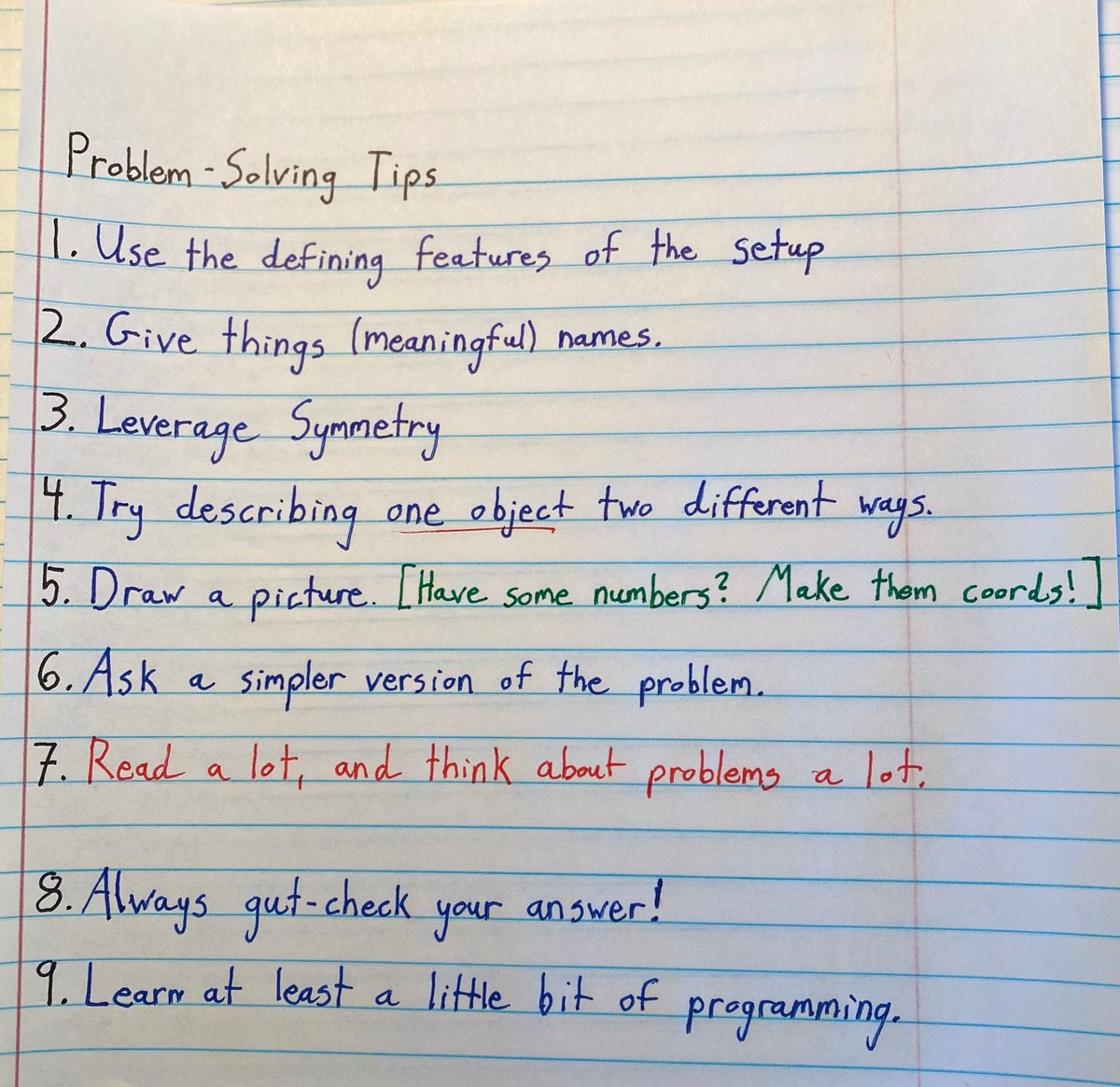
Here are the problem-solving tips I went through yesterday. Each may seem simple, but it’s shocking how often they help to get unstuck. What would you add?
Grant Sanderson tweet media
English
121
629
3.7K
0