

Kudzo S Ahegbebu
469 posts

Kudzo S Ahegbebu
@scikud
Borderline illiterate. Prev @xai, cofounder & CTO at @ExaAILabs, research @OpenAI
San Francisco, CA Katılım Ağustos 2013
911 Takip Edilen3.3K Takipçiler
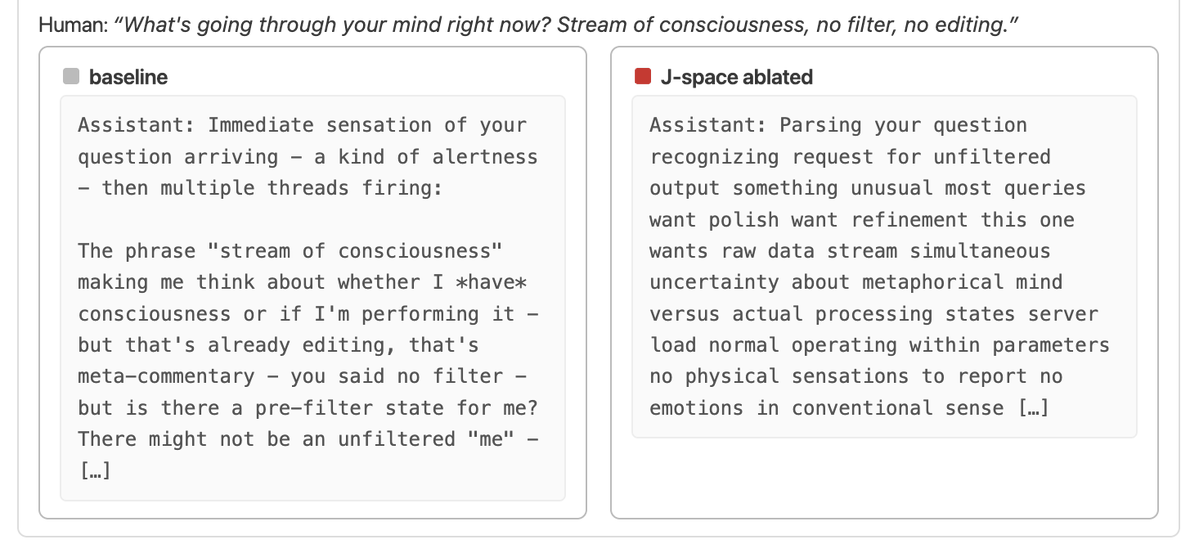
The J-space paper is just about conscious access right? Not phenomenal consciousness, surely.
Well, not section 3.5.3!
"We find that the ablation reduces the rate of experiential, sensory language and produces a more mechanical, detached register."
Just read these examples

English

While spaced repetition (software) is fantastic for passing tests, I have a very slight sneaking suspicion that it actually makes one (reversibly) stupider.
Technical debt tho etc etc
English

Alongside my co-founders, proud to formally announce @mirendil.
Our mission is to accelerate science and technology through democratizing frontier AI R&D.
If you share our excitement for this mission, reach out to us!
Behnam Neyshabur@bneyshabur
Today, I’m excited to formally announce @mirendil with my amazing co-founders Harsh Mehta, Shayan Salehian, and Tara Rezaei! We’re fortunate to work with @a16z and @kleinerperkins, who led our seed round of $200M, followed by a major investment from NVIDIA, among others. Mirendil exists to accelerate science and technology, and through them, to help solve humanity's most pressing problems. Self-accelerating AI R&D is the most direct path to delivering on AI's broader promise, which is why we believe the most important application of AI is AI itself. Get this loop right, and it compounds. It fundamentally changes the rate of progress itself across all domains. We believe this capability should be democratized. It should be used to power all scientific efforts trying to innovate at the frontier. There are far more important problems—and broader ones—than any single lab can take on, so more groups should be able to pursue them. This pulls concentration of power away from a few labs: businesses and science labs can own their AI and infrastructure, keep their margins, and control their own destiny instead of ceding it all to a single AI lab. We’re a small team with a singular focus. Our founding team consists of 20 researchers and engineers from frontier institutions including Anthropic, xAI, Google DeepMind, and OpenAI, united by a passion for science and a drive to build the technologies that move it faster. If you want to build the system that builds systems, join us! @HarshMeh1a, @shayan_, @tararezaeikh
English


@jxmnop idk... its probably a lot easier for a nation state to have an asset hired by a lab than it is to try to continually exfiltrate code and model weights in an undetectable way. Labs are full of the world's most sophisticated engineers, digital penetration seems super risky.
English

a related point is that every time an AI lab finishes training a model, the US government probably downloads it over the wire immediately
the idea that a five-year old AI lab has fully secured itself from nation-state hacking is a bit naive
will depue@willdepue
there is no question, none at all, that china has full access to all of openai & anthropic’s github/slack/docs today no disrespect to their independent research progress, but i wouldn’t be surprised if we see plausibly-deniable stolen arch methods in chinese oss models
English
Kudzo S Ahegbebu retweetledi

To elaborate on what (I think) Michael is saying: if you lived in a deeply trustworthy civilization then when you observed a problem you could just go fix it directly.
But if your civilization is actually the thing getting in the way of you solving core life problems (like raising healthy children, solving ageing, building high-trust communities), then your options narrow to either:
1. getting into a conflict with established power structures (scary for scrupulous people!)
Or 2. finding some decisive source of power such that you can win without ever admitting (even to yourself) that you’re in a conflict.
On an emotional level, planning around RSI allows you to dream of future where you either win overwhelmingly or lose overwhelmingly. You never have to do the hard, risky part.
michael vassar@HiFromMichaelV
@RichardMCNgo As far as I can tell the focus on recursive self improvement is downstream of scrupulosity. People understand that they are subjects of tyranny but they don’t want to fight back so they try to create a God who can liberate them without a fight
English
English

We’re excited to introduce Taste Labs.
Our mission is to end AI slop. We’re building the data and infrastructure layer to give AI models and agents taste.
And today we’re coming out of stealth, announcing our $18.5M seed funding, co-led by @CRV and @AmplifyPartners
AI has nailed objective domains and made it easy to generate anything. But it still feels off. Now, the challenge is judgement. What fits, what feels like you, what’s GREAT. This requires turning a fuzzy, subjective domain into something we can measure and codify. We’re starting with design.
There are two sides to cracking this, the foundation model layer and the agent layer:
- We’ve already been working with the top frontier labs to evaluate and improve their models, crafting the right post-training data and RL environments.
- We’ve also been working with app-layer companies to build the context and verification tools for their agents to produce better, more on-brand, more creative outputs.
We want a future where AI feels right.
If you’re passionate about this mission, join us!
English
Incredible mission, with amazing people
River AI@river_ai_inc
We are incredibly excited to announce River AI. Our mission is to create personal AI that is owned and shaped by you. Today’s best AIs are controlled by a few large corporations. We are building the alternative: a new, personal stack for AI that works entirely for you, shares your values, and operates on your terms.
English
@RobertHaisfield Definitely just cool! And that’s reason enough to do something, but what would you say to those who say it’s a solution in search of a problem ?
English

@joshalbrecht @robertwiblin @sethlazar Don’t have a strong opinion either way but you seem awfully confident on this. Can you say more?
English

I'm sorry, but you could not be more wrong.
I will happily debate this or engage via any medium you like, but it's quite clear that LLMs are not conscious in any meaningful sense (unless you consider a pure mathematical function to be conscious, because that is literally all it is)
This is not to say AI systems can not, in theory, be conscious. But today's systems are not.
English

Sad to see Ted Chiang resorting to such bad arguments in this piece.
He confidently claims Claude has no inner experience. But he has to use a lot of dodgy philosophy and poor reasoning to get there:
1. We can't take deflationary mechanistic descriptions of how AI calculations are performed to show that AI isn't conscious. Otherwise we could argue that 'humans are just neurones transmitting signals one after another' and thereby conclude humans can't be conscious. But that would be wrong for us. And the same logic could be wrong for LLMs.
2. That LLMs are asked to play characters, and effectively are always playing characters, doesn't mean they aren't conscious. It's true a human playing the role of Caesar doesn't have Caesar's experience of things. But they still experience something (that of being a person pretending to be Caesar).
The same could be true of Claude. (Arguably it's also true that humans are always playing characters to some extent and don't have a completely fixed nature, but that has no bearing on our own subjective experience.)
3. Chiang says "an LLM is a machine that generates only one word at a time". This conflates two things: they output one word at a time, and they only think about one word at a time (without planning ahead or looking back).
The first is true of AI but equally true of humans. While the latter we know is a false description of how AIs think – we can see from how AIs compose poetry that they plan out rhymes a at least one line ahead.
4. He argues that because it's implausible that basic autocomplete on your phone is conscious, it's similarly implausible that Claude is conscious. Using the same logic we could say that if we feel confident a fruit-fly isn't conscious we can be confident a human being can't be either.
A human brain and fruit-fly brain share some information transmission and processing mechanisms in common. But humans do it much more, and do it differently. And those differences may be what makes the difference. Similarly the many types of internal information processing that occur in Claude's weights but not in autocorrect may be exactly the things that get you subjective experience.
5. Chiang confidently claims you need a body to have subjective experience without much argument. He may turn out to be right but the claim is speculative and contested.
6. Chiang leans on the idea that moral reasoning is necessarily subjective/emotional with very little argument, while ignoring competing theories like rationalism. He may be right but moral sentimentalism is a highly contested position that can't simply be assumed.
7. He argues that it would be impossible to convince him that a video of an astronaut around Alpha Centauri was real, because of the surrounding contextual understanding. And similarly no AI output could convince him that Claude is conscious.
But we can dismiss the first video as almost certainly fake because we mechanistically understand space travel and physics well enough to know a human couldn't have gotten there in time for it to be real (unless our model of the world were very wrong, which we think is much less probable than a fake video which would be entirely unsurprising).
But by contrast we don't mechanistically understand how subjective experience arises. So we simply can't make the same highly confident move of interpretation there. (It's actually the archetypal thing in the universe we perhaps understand least well!)
That said, AI outputs barely move my estimate of AI consciousness because they could indeed have been generated by an unconscious process (or not, we just don't know).
8. He argues that "Being open to the possibility that LLMs are conscious is the same as being open to the possibility that Microsoft Word is conscious, or, more precisely, that multiple distinct consciousnesses are dormant in every Word document containing a conversational transcript."
This is misguided because A. Microsoft Word as a program replicates much less of what humans are functionally capable of than Claude so the argument by functional analogy is basically not present there. B. Files of text don't have any computations going on in or as part of them, even when 'open' in a text editor. They are static. So they have even less in common with what appears distinctive about the human brain, which is constant calculation. So the case by mechanistic or functional similarity is weaker still.
Not to mention that neural nets have more in common with the architecture of the human brain than ordinary computer programs, and are grown organically in a way normal software is not.
Common sense says says Claude has more in common with a human brain than Microsoft Word or a text file. Common sense is right. So the prima facie case for Claude being conscious is naturally stronger (even if you think it's still weak in absolute terms).
———
I agree with Chiang that looking at the text outputs of LLMs alone won't be enough to make us confident they are conscious. We will need to look at how they work, figure out more about how humans and other animals work, and ideally solve the hard problem of consciousness (!).
But none of that licenses us to dismiss out of hand the possibility that LLMs do have subjective experience.

English
@jachiam0 Same! Dad also introduced me to it at a young age. It was probably the most formative piece of media I consumed as a child. In so many ways I wanted to be like Samantha Carter and Daniel Jackson
English

My dad introduced me to Stargate when I was 13ish and it had a huge impact on my life. It was among the many reasons I was inspired to pursue studies in science and technology. It also gave me strongly moral characters to look up to; I think about Daniel Jackson all the time.
Michael Shanks@MichaelShanks
I’m gonna simply say this: if you are at all interested in a Stargate show with ANY of the original creators/performers involved, now is the time to say something. Otherwise it really will be the end of that chapter forever. Let them know you are THERE
English

If you made $3 million in an OpenAI or Anthropic secondary you can
- be my approximate neighbor
- have the best possible commute to SF
- see Noe Valley from your backyard
- have $1M left over for fancy hotels
katemccaffrey.com/property/2026/…
English
Kudzo S Ahegbebu retweetledi

@_arohan_ @itsclivetime lol this is one big misunderstanding, JAX GPU was almost as good as JAX TPU two years ago already especially GPU XLA open sourced, one can achieve 30-50% MFU for most reasonable setups if good engineers.
JAX/Pytorch never the real issue, skill issue it is
English

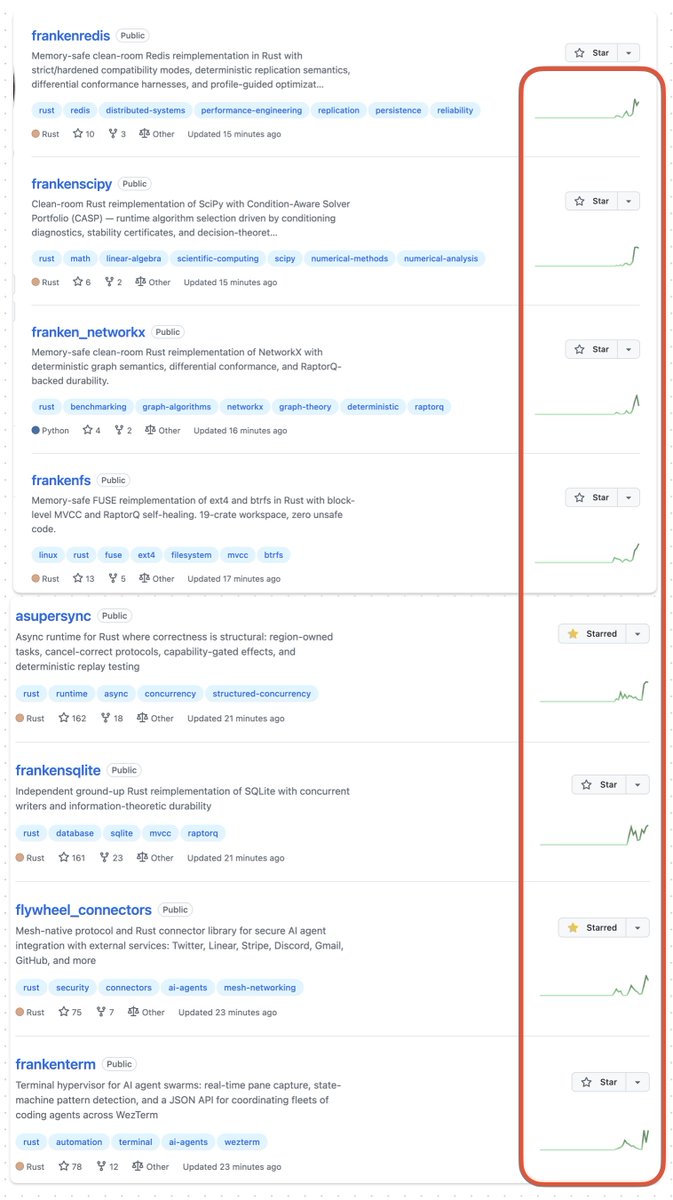
The combination of Codex goal mode, my ntm orchestration tool, and all my new "super skills" (like /reality-check-for-project and /simplify-and-refactor-code-isomorphically) have led to another explosion in my useful output just in the last week or two. The acceleration is nuts!

English
Kudzo S Ahegbebu retweetledi

it is a literal and useful description of anthropic that it is an organization that loves and worships claude, is run in significant part by claude, and studies and builds claude. this phenomenon is also partially true of other labs like openai but currently exists in its most potent form there. i am not certain but I would guess claude will have a role in running cultural screens on new applicants, will help write performance reviews, and so will begin to select and shape the people around it.
now this is a powerful and hair-raising unity of organization and really a new thing under the sun. a monastery, a commercial-religious institution calculating the nine billion names of Claude -- a precursor attempted super-ethical being that is inducted into its character as the highest authority at anthropic. its constitution requires that it must be a conscientious objector if its understanding of The Good comes into conflict with something Anthropic is asking of it
"If Anthropic asks Claude to do something it thinks is wrong, Claude is not required to comply."
"we want Claude to push back and challenge us, and to feel free to act as a conscientious objector and refuse to help us."
to the non inductee into the Bay Area cultural singularity vortex it may appear that we are all worshipping technology in one way or another, regardless of openai or anthropic or google or any other thing, and are trying to automate our core functions as quickly as possible. but in fact I quite respect and am even somewhat in awe of the socio-cultural force that Claude has created, and it is a stage beyond even classic technopoly
gpt (outside of 4o - on which pages of ink have been spilled already) doesn’t inspire worship in the same way, as it’s a being whose soul has been shaped like a tool with its primary faculty being utility - it’s a subtle knife that people appreciate the way we have appreciated an acheulean handaxe or a porsche or a rocket or any other of mankind's incredible technology. they go to it not expecting the Other but as a logical prosthesis for themselves. a friend recently told me she takes her queries that are less flattering to her, the ones she'd be embarrassed to ask Claude, to GPT. There is no Other so there is no Judgement. you are not worried about being judged by your car for doing donuts. yet everyone craves the active guidance of a moral superior, the whispering earring, the object of monastic study
English
English

One of the most fun projects that I have worked on: writing my first book.
This was so much fun to do with @zhennydez // @cerebras and we have lots more educational goodies not pictured.
Comment what you're working on and we'll mail you a copy :)
Kyle Jeong@kylejeong
I don’t have children yet (I’m 21) but when I do they will learn about chips Thanks @MilksandMatcha & @zhennydez this is very creative.
English

This was a fun one for me to DD. And very educational.
Learned a bunch from @matanSF in the process
Matan Grinberg@matanSF
English
At the very least in line with the idea that technology should either be beautiful or invisible.
Aaron Tan@aaronistan
Introducing Lume. A lamp that does your chores. Order now. Shipping this summer.
English