Gil Shiff

66 posts

Gil Shiff

Gil Shiff

@shiffgil

Founder of Reevol ConvertMedia (acquired by Taboola)

Katılım Temmuz 2008
280 Takip Edilen31 Takipçiler
Gil Shiff
Gil Shiff@shiffgil·
@web3butwhy Brazil may signal the next wave for stablecoin regulation. $6-8B/month in cross-border B2B volume is impossible to ignore. Regulators might try to control or limit it, not kill it - but the trade finance efficiency gains are too significant to shut down.
English
1
0
1
11
Siva
Siva@web3butwhy·
Brazil’s eFX rule seems targeted at one specific flow: BRL in → stablecoin rail → fiat payout And probably the reverse too. The concern is obvious: Brazil is seeing massive usage of dollar stablecoins for B2B/cross-border payments - reportedly $6B–$8B/month. If USD stablecoins become the default settlement layer, the central bank loses FX visibility and monetary control. Maybe this pushes the market toward regulated BRL stablecoins. But even then, the key question remains: Does the stablecoin sit inside the official FX/reporting framework, or does it bypass it?
CoinDesk@CoinDesk

🇧🇷 LATEST: Brazil's central bank bans stablecoin and crypto settlement in cross-border payments, effective October 1.

English
1
2
2
46
Gil Shiff
Gil Shiff@shiffgil·
@singhabhinav This is the stat that should wake up every B2B cross-border company. Stablecoins aren't a crypto story anymore - they're a trade finance story. The next layer is AI automating the receivables and credit decisions around these faster settlement rails.
English
0
0
0
28
Abhinav Kumar
Abhinav Kumar@singhabhinav·
62.9% of all stablecoin transactions are B2B payments. Not DeFi speculation. Not crypto trading. Not retail purchases. Business paying business. Supplier invoices. Vendor payments. Cross-border contractor payouts. Platform-to-seller settlements. Treasury-to-subsidiary transfers. The boring, high-frequency, high-volume backbone of global commerce —> running on stablecoin rails because the alternative is 3–5 day SWIFT settlement at 5–7% cost. When people say stablecoins aren't ready for enterprise, I send them this number. The enterprise didn't wait for permission. It migrated quietly, to the corridors where the cost differential was undeniable first —> India-US, Nigeria-UK, Latin America cross-border —> and it's expanding from there. The finance team running the migration didn't file a press release. They just stopped using SWIFT for the corridors where stablecoins were faster and cheaper. The 62.9% is the result of thousands of those quiet decisions. The remaining 37.1% is being decided right now. As GENIUS Act implementation finalizes. As Circle CPN makes bank-to-bank settlement accessible without crypto on the balance sheet. As Mastercard and SWIFT add stablecoin settlement to infrastructure that touches every enterprise that processes payments. 62.9% is not a market share number. It's a confirmation that the enterprise thesis has already played out in the segment with the most acute need. The rest of the market is next.
English
12
3
57
3.9K
Gil Shiff
Gil Shiff@shiffgil·
@fintechfrank @GSR_io Makes sense that B2B is going to lead stablecoin adoption. Working with SME exporters we see that when cross-border invoices sit 30-60 days waiting for settlement, faster rails aren't a nice-to-have - they're critical.
English
0
0
0
74
Frank Chaparro
Frank Chaparro@fintechfrank·
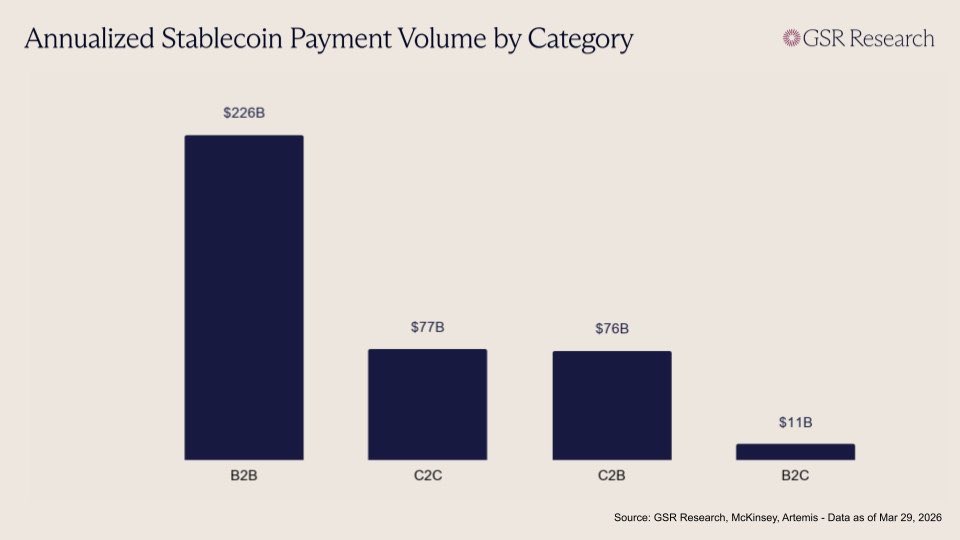
B2B dominates stablecoin payments. ~$226B annually — roughly 60% of total volume. Via @GSR_io Research
Frank Chaparro tweet media
English
19
10
96
21.7K
Gil Shiff
Gil Shiff@shiffgil·
@movesupplychain Interesting case @movesupplychain ! This is exactly why data beats gut feeling in sourcing. AI-powered supplier scoring is making blind moves less common - but the instinct to follow LinkedIn trends over data is still too real.
English
0
0
0
3
Move Supply Chain
Move Supply Chain@movesupplychain·
The most expensive sourcing mistake we've witnessed had nothing to do with China. A founder moved 100% to Vietnam after a competitor's LinkedIn post. No pilot. No routing analysis. 18 months later: $47K defective, two recalls, back to original supplier.
English
1
0
0
9
Gil Shiff
Gil Shiff@shiffgil·
@Dano_Br Spot on @Dano_Br At Reevol we see the same pattern globally - once payments are commoditized, the real value shifts to AI-driven credit decisioning and receivables automation. The platforms that embed smart financing at the point of trade will win.
English
1
0
2
14
Daniel
Daniel@Dano_Br·
The next ten years of African tech will not be defined by consumer apps. It will be defined by the infrastructure that B2B SaaS, marketplaces, and embedded finance platforms run on. Payments was the first wave and it is now done. Billing is the second wave. Identity, fraud, compliance, KYB, embedded credit etc. I bet the companies that build these layers correctly will be infrastructure for everything that comes after. The companies that build them poorly will be replaced by the companies that build them well, and the founders who chose the wrong infrastructure will pay for the migration in lost time. I'm betting that billing is the most underbuilt of the current wave. The data backs it, but the market hasn't named it. So the category is presently is empty. @pay_sight is a bet that the company that names it and ships it correctly takes the entire territory. If you're a founder picking a billing layer right now, you have two options: Build it yourself and pay the African startup tax or use ours and ship product instead. Either way, i strongly believe the layer is the next decade.
English
1
0
0
29
Gil Shiff
Gil Shiff@shiffgil·
@finance_gossips Not replaced - augmented. The best CFOs will deploy AI agents for cash flow forecasting, collections, and risk scoring while they focus on strategy. The gap between AI-native finance teams and everyone else is widening fast.
English
0
0
0
11
Gil Shiff
Gil Shiff@shiffgil·
@_kylematthies_ Great breakdown @_kylematthies_ The 2026 full-stack shift is real - past the 'add AI to everything' phase into 'build natively with AI.' At Reevol that's how we approach B2B finance - agents handling the full receivables workflow, not just one step.
English
0
0
0
4
Kyle Matthies
Kyle Matthies@_kylematthies_·
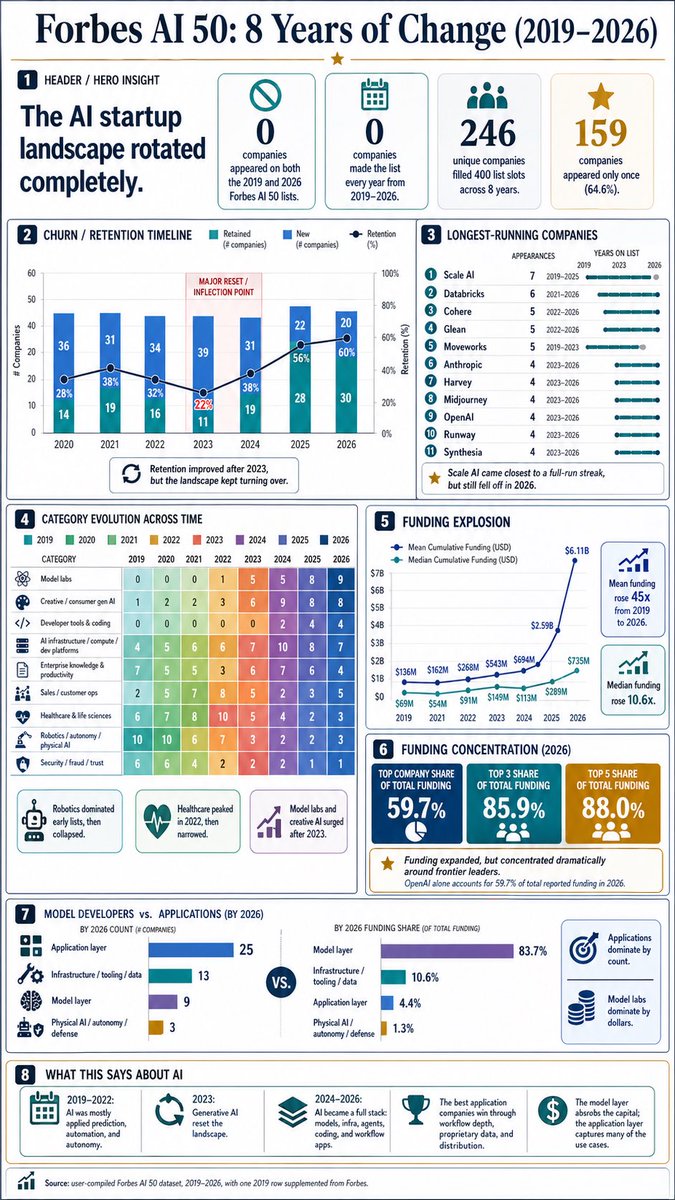
Spent some time digging into 8 years of the Forbes AI 50—pretty interesting shift: You can see the progression pretty clearly: → 2019: applied ML, autonomy, fintech → 2023: generative AI reset things → 2026: full stack (models, infra, agents, apps) One thing that stood out: Applications dominate by count Model labs dominate by funding Feels like the structure of the market is still settling in real time at least until anticipated IPOs.
Kyle Matthies tweet media
English
1
0
0
20
Gil Shiff
Gil Shiff@shiffgil·
@yosephayele Interesting thoughs! Trade credit insurance took decades to mature and still covers a fraction of B2B flows. Stablecoins are moving faster but the trade insurance gap is real.
English
0
0
0
18
Yoseph Ayele
Yoseph Ayele@yosephayele·
Banks have deposit insurance. Certain transactions have trade credit insurance. Are any of the billions of fiat <> stablecoin flows covered by any kind of insurance?
English
5
0
20
1.8K
Daniel Emaasit
Daniel Emaasit@Emaasit·
@shiffgil I pivoted to AI Agents for supply chain coordination for manufacturers and distributors. Same market, same customer base, different problem.
English
2
0
1
5
Daniel Emaasit
Daniel Emaasit@Emaasit·
😡 I dare you! Say "B2B e-commerce" one more time! 😡 😡 I double dare you! P.S. I pivoted away from B2B e-commerce and built AI Agents for distributors & manufacturers to automate data entry of sales orders from Email/Phone and accounts receivable. logistify.ai
Daniel Emaasit tweet media
English
1
0
0
90
Gil Shiff
Gil Shiff@shiffgil·
@tweetthis101 Western Union launching a stablecoin for agent settlement is the clearest signal yet - legacy remittance players know on-chain rails are inevitable. The real question is who builds the AI layer on top to automate the entire settlement flow end to end.
English
0
0
2
7
Gustavo Maldonado
Gustavo Maldonado@tweetthis101·
Western Union to access stablecoin market with Solana-based USDPT launch timeline set for May Western Union will roll out its dollar-backed stablecoin, USDPT (U.S. Dollar Payment Token), next month on the Solana blockchain, initially as a settlement tool for agent partners rather than a fully-fledged retail consumer product. The launch had already been planned for the first half of 2026 since last year, and it brings Western Union closer to its goal of contributing further to restructuring cross-border settlement architecture globally. The company also aims to release two other innovative products, namely The Digital Asset Network (DAN), and the USD Stable Card. Plans to launch the USDPT stablecoin were revealed in October 2025, as reported by Cryptopolitan. CEO Devin McGranahan confirmed the timeline during the company’s first-quarter 2026 earnings call on April 24. “At the foundation of our strategy is USDPT, our U.S. dollar-backed stablecoin,” McGranahan told analysts, “It is no longer a question of if Western Union will be active in digital assets; it is now how fast we can scale.” NEWS: During its Q1 earnings call, @WesternUnion said its @Solana-based U.S. dollar stablecoin $USDPT is in final-stage preparation and expected to launch next month as an alternate to SWIFT for cross-border settlements. pic.x.com/vr9vgtutuv— SolanaFloor (@SolanaFloor) April 27, 2026 Western Union’s USDPT focuses on settlements first USDPT will not launch as a retail product. McGranahan said the token will serve as an alternative to SWIFT for settling transactions between Western Union and its agent network in select countries. On-chain settlement would allow transfers to process 24/7, including on weekends and banking holidays when traditional banks go offline. The USDPT token will be issued by the Anchorage Digital Bank, a federally chartered crypto custodian. Western Union first disclosed the partnership with Anchorage and Solana in October 2025, along with the stablecoin reveal, and has since filed a trademark for “WUUSD,” per the Crypto Times report. The company has claimed that USDPT will allow it to capture revenue that would have otherwise flowed to third-party stablecoin issuers, including income from issuance, exchange spreads, transaction fees, and float on reserves. The Digital Asset Network and USD Stable Card companion products The Digital Asset Network (DAN) will connect crypto wallets to Western Union’s retail and agent footprint through a single API. The company said the first DAN partner would go live the week of April 27, with seven or more partners expected to activate throughout the rest of 2026. “Through DAN, millions of wallet users will be able to move from digital assets into local currency using Western Union’s retail network,” McGranahan said. Western Union operates in more than 200 countries with hundreds of thousands of agent locations, giving the network a distribution advantage that most crypto-native stablecoin projects lack. The second product is the USD Stable Card, a payment card that lets consumers hold stablecoins and spend them globally. The card is planned for launch later in 2026 across dozens of markets. The Stable Card is expected to act as an easy-to-assess method to spend stablecoins, particularly in inflation-sensitive markets. Western Union has not disclosed the specific launch markets or its card network partner for the Stable Card. Western Union enters competitive field Dollar-pegged stablecoins now exceed $300 billion in total market capitalization, and the GENIUS Act, signed into law in 2025, has given U.S.-issued tokens a clearer regulatory footing. Western Union is not the only legacy payments company building on Solana. PayPal’s PYUSD, issued by Paxos, has grown into the multi-billion dollar range. Fiserv is rolling out its own Solana-based stablecoin, FIUSD. MoneyGram has also integrated Circle’s USDC on the Stellar blockchain for its mobile app, and Visa has expanded stablecoin settlement support to Solana. Solana processed $650 billion in adjusted stablecoin volume in a single month earlier this year, making it one of the fastest-growing settlement networks by transaction volume. The pilot rollout during the launch in multiple select countries will be the first test of whether USDPT can significantly reduce settlement costs and processing times enough to justify the infrastructure shift and make an impact on the competition. The identities of the initial agent partners and DAN’s first wallet integration, along with The Stable Card’s launch markets and network partner, remain undisclosed. Those details will determine whether Western Union’s stablecoin strategy reaches meaningful scale and achieves the impact intended by the company since the launch announcement.
Gustavo Maldonado tweet media
English
1
0
0
49
Gil Shiff
Gil Shiff@shiffgil·
@FintechSIN Fragmented Asian payment rails are the perfect problem for AI agents to solve. Instead of humans navigating dozens of local methods, agents pick the optimal route in real time. The agentic commerce wave is real.
English
0
0
0
20
Gil Shiff
Gil Shiff@shiffgil·
@Alex__Radu @coinbase Great breakdown! @Alex__Radu For B2B payment missing piece in most agentic payment stacks is real-time credit decisioning - agents can route payments but someone still needs to underwrite the risk.
English
0
0
0
32
Alex Radu /Acc
Alex Radu /Acc@Alex__Radu·
are agentic payments here yet? kind of, but x402 isn't adopted everywhere and the rest of the "agentic payments layer" is still being built. it's wide open and some of the solutions I have seen are in the following buckets: 1. protocols: x402 from @coinbase and the machine payments protocol from @tempo_xyz and @stripe. agents pay merchants directly in stablecoins. clean and fast, but most merchants don't accept it yet. distribution is a bottleneck and most companies from Europe that I have discussed with don't even know about this 2. agentic cards: you allocate a virtual card with scoped limits to your agent. nice on paper.. in practice agents keep getting blocked at checkout because the rails were built to prevent automation. so you end up building the workarounds yourself around the agentic cards 3. payment processing level: @Visa intelligent commerce and @Mastercard agent pay tokenizing cards for agents. production at full scale is still not really there. delayed and custom solutions. direct integrations with these things are not that feasible still 4. custom integrations: merchants and processors, browser agents, scrapers doing the work end to end. ugly, but it ships today curious to learn more about all solutions out there biggest open lane in payments right now as the market is fragmented and there is not a clear winner for this solution. probably the answer will be many integration opportunities and payment processors will have to act as aggregators for increasing revenue, nevertheless still a big opportunity in the market to build around this use case
Alex Radu /Acc tweet media
English
2
4
14
755
Gil Shiff
Gil Shiff@shiffgil·
@JevweOps Nice build! The next level is chaining agents downstream - finance emails auto-reconcile invoices, sales emails update CRM, support emails draft responses. Classification is step one, autonomous action is the real unlock.
English
0
0
0
15
JevweOps
JevweOps@JevweOps·
Just built an AI Email Classification workflow with n8n + OpenAI! 🤖📧 It automatically reads emails and routes them to Sales, HR, Finance, Customer Service or Operations — zero manual sorting. This is automation doing the heavy lifting. 🚀 #n8n #AIAutomation #OpenAI
JevweOps tweet media
English
1
0
4
53
Gil Shiff
Gil Shiff@shiffgil·
@sehaislam Sharp framing. The unbundling of settlement vs yield vs UX is the right lens. And whoever controls the sweep interface controls the customer.
English
0
0
1
11
Seha Islam⚡
Seha Islam⚡@sehaislam·
The stablecoin yield debate is too narrow and increasingly a red herring. Even if rewards are banned, the market can separate the product: stablecoin = settlement tokenized MMF = cash management sweep = customer experience The real question is who controls the interfaces for money, payments, and banking services that customers seek?
English
2
1
3
117
Gil Shiff
Gil Shiff@shiffgil·
@Habtech01 Great usage, thanks for sharing! Invoice processing is where AI agents shine - validation + duplicate detection is exactly what humans shouldn't do manually. Did you use a flow to detect duplicates?
English
0
0
1
13
Gil Shiff
Gil Shiff@shiffgil·
@nelooyekwe Invoice processing and AP automation at the top is spot on. These aren't glamorous use cases but the ROI is immediate and measurable. AI agents that handle receivables end-to-end are the next frontier - way beyond just OCR and data entry.
English
0
0
1
57
Nelo Oyekwe
Nelo Oyekwe@nelooyekwe·
The Tech & AI Usecases with the highest ROI for SMBs: 👇🏾 ✨Invoice Processing & AP Automation ✨Customer Service ✨Accounts Receivable ✨Lead Response & Sales Automation ✨Document/ data intake ✨Content / email marketing Automation Which on could your business use right now?
English
7
0
2
70
Gil Shiff
Gil Shiff@shiffgil·
@shobitfarcast Spot on and these moves are not a coincidence. The 'AI-native platform' move is the new table stakes for fintech infra. AI features don't cut it anymore - you need the entire data model designed around agentic workflows.
English
0
0
1
21
Shobit
Shobit@shobitfarcast·
Two fintech companies just made the same move on the same week. Xero launched Xero OS - an AI-native operating system with JAX, an "AI CFO" that reads bills, sets up payments, and reconciles transactions end-to-end. Built on 20 years of financial data across 21,000 institutions and 1,000 connected apps. Block built Moneybot for Cash App consumers and Managerbot for Square merchants - proactive AI agents that monitor your business, forecast shifts, schedule staff, and draft marketing campaigns without being asked. Both are the same structural bet: the job of accounting and financial operations software is no longer to store data. It is to act on it. The vertical AI window is open right now. Whoever owns the ledger, the context, and the action layer in their category wins.
English
1
0
0
41
Gil Shiff
Gil Shiff@shiffgil·
@metanoetix Good to hear that we got to the point that several minutes is the pain point, and not several days
English
0
0
0
13
Meta
Meta@metanoetix·
A few days ago, I had dinner with a friend who runs a cross-border e-commerce business. He’s been using USDC to settle payments with suppliers in Southeast Asia and complained that a single transfer still takes several minutes to confirm. While it’s already much faster than traditional remittances, he still finds it not fast enough. Behind this lies a very real issue—the sheer volume of stablecoins has grown enormously. In March 2026 alone, on-chain stablecoin transaction volume reached $7.5 trillion, and total market capitalization surged to an all-time high of over $317 billion. With that much capital moving at high speed on-chain, any network congestion brings a sense of urgency much like being stuck in rush-hour traffic during the morning or evening commute. What’s even more striking is that a large portion of on-chain transactions today are not initiated by humans. According to measured data, 76% of on-chain stablecoin transaction volume is driven by trading bots. At the same time, with the advancement of AI, on-chain AI agents capable of autonomous decision-making are beginning to participate in payments, asset management, and trading. The reaction speed of these machines and programs is measured in milliseconds, and their demands on network responsiveness far exceed what humans tapping on a phone require. Yet the current infrastructure is struggling to keep pace. The mainstream Ethereum network can only process a few dozen transactions per second—a stark contrast to Web2 systems, which easily handle tens of thousands per second. It’s like building a highway for cars but only opening a couple of tollbooths, forcing vehicles to form long queues. To address this pain point, Optimum has introduced RLNC (Random Linear Network Coding). Conceptually, RLNC works by intelligently breaking a file into multiple fragments; once the recipient collects a sufficient number of these fragments, they can solve a mathematical puzzle to reconstruct all the data at once. Real-world tests show that with RLNC, communication efficiency between nodes is dramatically improved. For everyday users, the most immediate benefit is this: on-chain transfers will eventually feel as instantaneous as scanning a QR code to pay, eliminating the anxious need to constantly refresh the page. Only when the underlying responsiveness of blockchain catches up with the demands of the real world will large-scale stablecoin payments and the “autonomous economic activity” between AI agents truly run smoothly—ushering in genuine mass adoption. @get_optimum
GIF
English
3
0
5
47