द्विज

29.2K posts

द्विज

द्विज

@sritrader

Nationalist!! Indian First! RTs not endorsements self declared Modi fan! Tweets in personal capacity! #aalareaalamodiaala2024

Delhi bhiwani Goa Mumbai Katılım Ekim 2009
803 Takip Edilen803 Takipçiler
Anakin
Anakin@Twin_Sunsett·
But the devil is in the fiscal trade off...the argument for rewarding patient capital is correct as india does need more long term equity investment and less gold hoarding but abolishing LTCG outright is a blunt instrument. A more workable path is much lower LTCG rates, higher exemption thresholds and indexation for inflation. That still distinguishes investment from speculation and rewards long term ownership, without imposing a large unfunded fiscal cost or severe asset class distortion though the goal is right the design can be more nuanced.
Anakin tweet media
English
10
0
7
4.3K
द्विज retweetledi
Vijay Kedia
Vijay Kedia@VijayKedia1·
Respected @nsitharaman ji and @FinMinIndia , Suggestion 1 of 3 for strengthening India's capital markets: Long-term capital gains tax on listed equities should be abolished. A long-term shareholder is not a speculator but a provider of patient risk capital. By investing in and holding businesses, investors help companies expand, create jobs, innovate and contribute to India's economic growth. India requires enormous amounts of long-term capital to build world class enterprises, infrastructure and global champions. Tax policy should encourage households to move savings from passive assets, including imported stores of value such as gold, into productive businesses that create jobs, generate tax revenues and build national wealth. The appreciation in a company's value is not created in isolation. During its growth journey, the government already collects corporate tax, GST, income tax from employees, customs duties, stamp duties and numerous other levies. Long-term capital gains are often the final outcome of economic activity that has already generated substantial tax revenues. Most importantly, tax policy should clearly distinguish between investment and speculation. A long term shareholder is a partner in wealth creation, not merely a participant in market transactions. Tax policy should reward long-term ownership of productive businesses and distinguish it from short-term speculation. India needs more patient capital, more entrepreneurship and more long term investing. Abolishing long-term capital gains tax on listed equities would be a powerful step in that direction. Respectfully submitted.
English
271
1K
3.3K
174.3K
द्विज
द्विज@sritrader·
@Twin_Sunsett @VijayKedia1 @nsitharaman @FinMinIndia What is the per capita GDP of these countries with higher capital gains taxes? What was the stage of economic development when they increased CG tax ? India needs capital at low cost, it requires more spending on development projects and unfortunately runs twin deficits (1/n)
English
0
0
2
126
द्विज retweetledi
Sprouts News
Sprouts News@sproutsnews·
Kanakia Paris Water Contamination Case: FIR Sought Over Alleged Data Suppression & Health Risks sproutsnews.com/kanakia-paris-… Over 1,500 residents in Bandra Kurla Complex have approached Mumbai Police alleging contaminated water, hidden reports & negligence. Complaint names Godrej Living and Zipgrid Proptech Pvt Ltd, along with managing committee members. Key concerns raised: • E-Coliform contamination in samples • Alleged suppression of reports • Health impact on residents • STP system failures & poor maintenance • Selective disclosure of “clean” reports Authorities urged to act include: Brihanmumbai Municipal Corporation Maharashtra Pollution Control Board Central Pollution Control Board Matter may escalate under BNS & environmental laws if violations are established. Allegations remain under scrutiny. @mybmc @MumbaiPolice @CPMumbaiPolice @mpcb_official @CPCB_OFFICIAL @moefcc @CMOMaharashtra @mieknathshinde @Dev_Fadnavis @MoHUA_India @PMOIndia @PIB_India #KanakiaParis #Mumbai #WaterContamination #PublicHealth #BMC #MPCB #HousingSociety #Governance #Accountability #BreakingNews
Sprouts News tweet media
English
8
9
9
1.3K
द्विज retweetledi
bubble boi
bubble boi@bubbleboi·
I’ve been reading the Vedas a lot recently, and what’s stood out is how it doubles as an encyclopedia as well as a religious text. Astronomy, medicine, mathematics, metallurgy, linguistics, are all woven through hymns and rituals as one body of knowledge. Simply calling it “religious” forces it into a Western category that didn’t have the apparatus to recognize what it actually was. It’s closer to a tradition of formalized epistemology in which metaphysics, observation, and language form one continuous inquiry, which as a result led Indian civilization to develop along a fundamentally different path because of it. You can see the effect most clearly in the sciences. Around 600 BCE, the Vedic record describes a surgical procedure that matches modern rhinoplasty and is still foundational to reconstructive surgery today. Centuries before Western Europe stopped treating eclipses as supernatural, Indian scholars had calculated the circumference of the earth within 0.2% and explained eclipses as shadows. Centuries before Plato and Aristotle rejected atomism, the Vedic tradition already held that matter is composed of indivisible particles combining into binary and triatomic compounds, transformable by heat. The first formal rules for zero and negative arithmetic appear in the Vedas, along with infinite-series derivations of π, sine, and cosine centuries before Newton and Leibniz. The interesting question is how did they get so much right, so early? My best guess is language. The Vedic tradition is unique compared to other oral traditions as it demanded letter-perfect oral transmission across generations. Around 500 BCE, scholars composed a generative grammar of Sanskrit called Panini so rigorous it anticipates Backus-Naur form, the notation that defines programming languages today, by 2,500 years. Sanskrit is recursive, rule-based, and built to minimize ambiguity. It reads more like mathematics than English. When you think in a language built like that, the precision of the language becomes the precision of your reasoning. The West didn’t formalize this until much later. Kant argued our categories of understanding shape what we can know, Wittgenstein wrote that the limits of language are the limits of one’s world, and Kripke showed that naming doesn’t just describe things, it constitutes what they mean and how we can reason about them. All three touch the same insight which is that thought is downstream of language. The Vedic tradition operated on that insight thousands of years earlier. To the point that they built a whole language first and used it to think clearly about everything else after. I find that all really fascinating.
English
136
887
4.6K
270K
द्विज retweetledi
Aravind
Aravind@aravind·
IMO, the Vedas are everything in one. Chanting them after necessary refinements to the mind, and with intent, one can get revelations about science, as much as about spirituality or surgery. In the age of AI, I will request you to think of the Vedas as quantized, compressed version of a lot of revealed knowledge distilled into the most efficient, lossless sounds called mantras. Most people may, at most, appreciate their rhythms while they see religious intent mostly with bits of philosophy and spiritual instructions here and there. It's like someone appreciating an AI model's training weights and the output they see using a low level computer without having the powerful hardware or knowhow to extract the best knowledge. A truly determined seeker will improve this hardware (or his brain and mind) to be able to extract much knowledge out of the quantized and distilled model (or the Vedas). To the credit of the Vedas, they even provide the necessary steps to build and improve the hardware (body and mind) to extract the knowledge. Many seekers from Patanjali to Sankara have developed complete systems on how to do this. But even if all these systems are lost, and only the sounds of Vedas remain in human consciousness, it will still enable more Patanjalis and Sankaras to emerge and develop systems to realize the Universe complete with all its knowledge. This is the beauty of the Vedas. This is why the Vedas were never just "religion". They are a complete epistemic system engineered for precision, revelation, and infinite expansion of knowledge in our simulation. They enable us to see the entire source code of the simulation (past, present, and future) or access just parts of it to in-vivo improve our experience (by creating science & tech with the revealed knowledge). @bubbleboi is in the process of realizing this, do read👇
bubble boi@bubbleboi

I’ve been reading the Vedas a lot recently, and what’s stood out is how it doubles as an encyclopedia as well as a religious text. Astronomy, medicine, mathematics, metallurgy, linguistics, are all woven through hymns and rituals as one body of knowledge. Simply calling it “religious” forces it into a Western category that didn’t have the apparatus to recognize what it actually was. It’s closer to a tradition of formalized epistemology in which metaphysics, observation, and language form one continuous inquiry, which as a result led Indian civilization to develop along a fundamentally different path because of it. You can see the effect most clearly in the sciences. Around 600 BCE, the Vedic record describes a surgical procedure that matches modern rhinoplasty and is still foundational to reconstructive surgery today. Centuries before Western Europe stopped treating eclipses as supernatural, Indian scholars had calculated the circumference of the earth within 0.2% and explained eclipses as shadows. Centuries before Plato and Aristotle rejected atomism, the Vedic tradition already held that matter is composed of indivisible particles combining into binary and triatomic compounds, transformable by heat. The first formal rules for zero and negative arithmetic appear in the Vedas, along with infinite-series derivations of π, sine, and cosine centuries before Newton and Leibniz. The interesting question is how did they get so much right, so early? My best guess is language. The Vedic tradition is unique compared to other oral traditions as it demanded letter-perfect oral transmission across generations. Around 500 BCE, scholars composed a generative grammar of Sanskrit called Panini so rigorous it anticipates Backus-Naur form, the notation that defines programming languages today, by 2,500 years. Sanskrit is recursive, rule-based, and built to minimize ambiguity. It reads more like mathematics than English. When you think in a language built like that, the precision of the language becomes the precision of your reasoning. The West didn’t formalize this until much later. Kant argued our categories of understanding shape what we can know, Wittgenstein wrote that the limits of language are the limits of one’s world, and Kripke showed that naming doesn’t just describe things, it constitutes what they mean and how we can reason about them. All three touch the same insight which is that thought is downstream of language. The Vedic tradition operated on that insight thousands of years earlier. To the point that they built a whole language first and used it to think clearly about everything else after. I find that all really fascinating.

English
76
541
3.4K
116.2K
द्विज retweetledi
Team Hindu United
Team Hindu United@TeamHinduUnited·
This is how "converts" are treated in Arab countries! A Pakistani Muslim was begging for money in the name of a madrasa and orphans. Local Arab asked for documents or proof. He replied: “I have only Allah.” The Arab humiliated him and threw him out.
English
270
2.7K
9K
216.9K
द्विज retweetledi
Ricardo
Ricardo@Ric_RTP·
Microsoft just banned its own engineers from using AI. The tool was literally costing MORE than the humans it was supposed to replace. They lied to you about AI adoption and now the whole narrative is blowing up: Microsoft gave thousands of engineers access to Claude Code six months ago and encouraged them to use it. Engineers loved it and adoption exploded. But then the invoices arrived. Token-based pricing means every query, every code review, every debugging session costs money. At scale across 100,000 engineers, the numbers became so large that Microsoft issued an internal order to cancel nearly all Claude Code licenses by end of June and force everyone onto their own cheaper tool instead. The company that invested $5 billion in Anthropic just told its own people to stop using Anthropic's product because it costs too much. Uber's story is even worse... Their CTO Praveen Neppalli Naga told The Information that the budget he planned for the full year was "blown away already" by April. Uber had rolled out Claude Code in December 2025. By March, 84% of their 5,000 engineers were using it with 70% of all committed code coming from AI systems. Heavy users were burning $500 to $2,000 per month each. Naga himself spent $1,200 in a single two-hour demo session. The company had even built internal leaderboards ranking engineers by how much AI they used. They literally gamified the spending and then ran out of money. Now look at what Nvidia's own VP of applied deep learning Bryan Catanzaro said to Axios last month. Direct quote: "For my team, the cost of compute is far beyond the costs of the employees." This is a VP at the company that SELLS the chips saying that using AI is more expensive than paying humans. Think about what this means for the entire AI narrative. Every CEO on every earnings call for the past two years has said the same thing: AI will make us more efficient, reduce headcount, and cut costs. The stock market rewarded every company that said it. Fired workers, stock goes up. Announced AI adoption, stock goes up. But the actual companies deploying AI at scale are discovering the math doesn't work. The MORE employees use AI, the HIGHER the bill. Goldman Sachs forecasts a 24x increase in token consumption by 2030 as companies adopt AI agents. Gartner just published a report showing that even though individual token prices will drop 90% by 2030, total enterprise AI costs will go UP because agents consume exponentially more tokens per task than basic tools. Meta built an internal dashboard called "Claudeonomics" to track which employees use the most AI. Amazon started pushing engineers to "tokenmaxx," their internal term for consuming as many AI tokens as possible. Both companies are spending hundreds of billions on AI infrastructure this year alone. And Microsoft, the company that bet its entire future on AI, just told 100,000 engineers to stop using the tool they liked best because the per-token bills got out of control. The companies building AI are telling investors it saves money. The companies using AI are finding out it costs more than the humans it was supposed to replace. And even the company that makes the chips just admitted it through its own VP. This is the gap nobody on Wall Street is pricing in. $725 billion in AI infrastructure spending this year across Big Tech. And the first companies to actually deploy these tools at scale are already pulling back because the economics don't work. What do you think?
English
1.8K
9.1K
22.6K
2.8M
द्विज retweetledi
The Forgotten ‘Man’ 👨‍⚖️
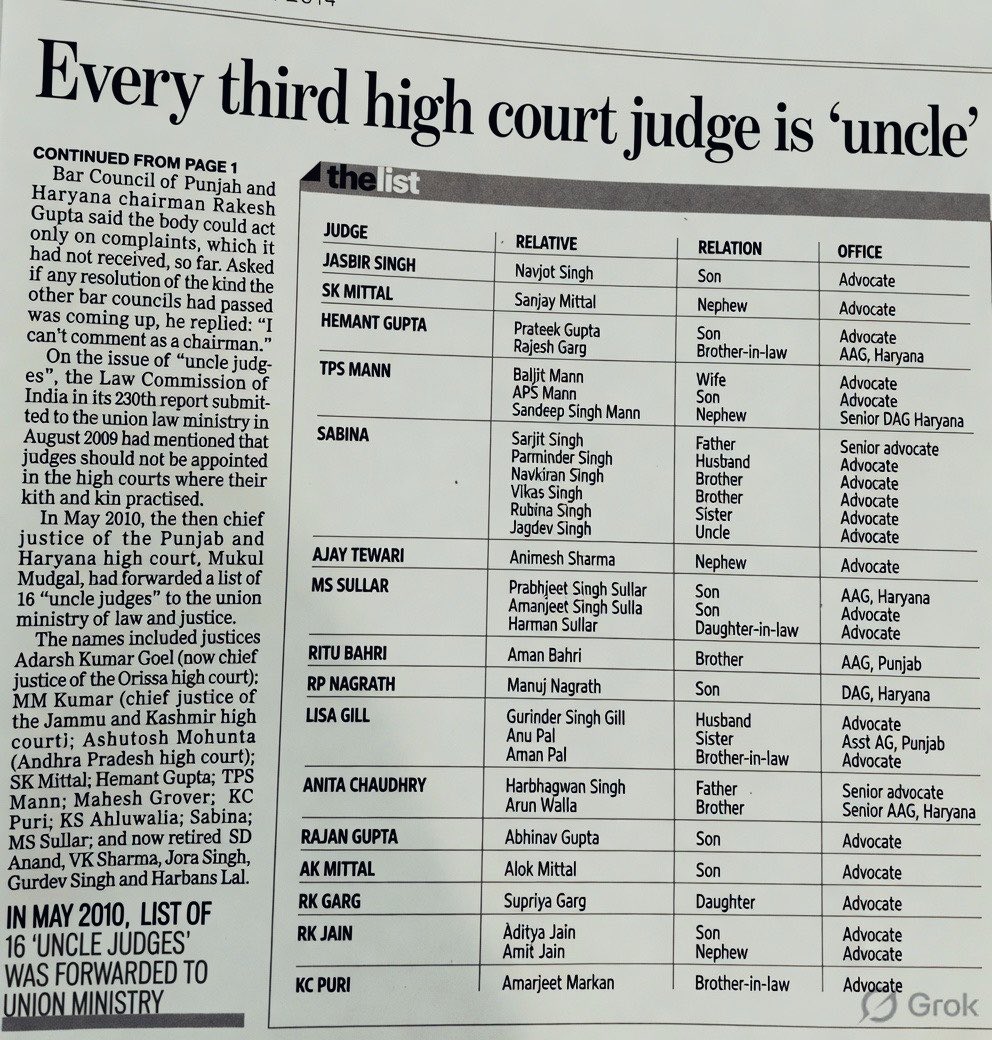
INDIA’S JUDICIARY: Every 3rd High Court Judge is an “Uncle” This 2010 exposé on Punjab & Haryana High Court is damning proof of deep-rooted nepotism and shameless family favoritism. Sons, nephews, wives, brothers, sisters & in-laws — all practicing as advocates in the SAME court where their relative sits as a Judge. A list of 16 such “Uncle Judges” was officially forwarded to the Union Law Ministry. Just look at this table. Clear, blatant conflict of interest. How the can justice be delivered fairly when family members argue cases before their own “Uncle”? The Law Commission and Bar Council flagged this years ago. Nothing changed. This uncle culture has destroyed public faith in the judiciary. Merit is dead. Nepotism rules. We need ruthless reforms NOW: - Ban close relatives from practicing in the same court - Mandatory public declaration of family links - Strict penalties for violations Enough is enough. The temple of justice has become a family business.
The Forgotten ‘Man’ 👨‍⚖️ tweet media
English
193
3K
5.7K
152.6K
द्विज retweetledi
H S Phoolka
H S Phoolka@hsphoolka·
2nd Flying Sikh is BORN! Gurindervir Singh has shattered the national record, 100M in 10.09 seconds.Very close to Usain Bolt’s 9.58s world record, Just half second away from history! Congratulations champion. Waheguru ji kripa rakhan sher putt te! #GurindervirSingh #FlyingSikh
English
2
519
4K
194.2K
द्विज retweetledi
THE SKIN DOCTOR
THE SKIN DOCTOR@theskindoctor13·
An old man in our neighborhood died today. He was hospitalized with chest pain three days ago, underwent angioplasty, but passed away in the ICU. His wife had died during the COVID wave, and he had been living alone since then. His only son lives in Australia and couldn’t come to see his father. Now, I’m not saying that the son is uncaring or abandoned his parents. I don’t know him. Maybe he is really a nice man. The elderly couple used to visit him every year and spend a few months with him. But maybe once you build a life outside, you can’t really come back. Life, distance, responsibilities, things become complicated. The son hadn’t come to India in nearly 10 years. He couldn’t come for his mother’s last rites due to COVID travel restrictions, and I don’t even know if he’ll be able to come now or will have to arrange his father’s last rites from there itself. This has stayed with me all day. To think of an old man spending his final years largely alone, losing his partner, and then leaving this world without his son by his side. Even as an unrelated observer, the whole thing feels unbearably sad.
English
785
2.1K
14.9K
465.2K
द्विज retweetledi
Tajinder Bagga
Tajinder Bagga@TajinderBagga·
Booked an @AkasaAir ticket via @agoda and accidentally selected Navi Mumbai instead of Mumbai. Tried cancelling via Agoda - they showed a cancellation fee of ₹4,764 and refund of just ₹1,571. Then I checked directly with Akasa Air. Akasa Air’s own cancellation page shows: • Total deduction: ₹299 • Refund amount: ₹6,076 Akasa customer care also confirmed the airline cancellation charge is only ₹299, and since the booking was made through Agoda, the refund would go back to Agoda. So the obvious question: If the airline is deducting only ₹299, why is Agoda charging me ₹4,764? That’s an extra ₹4,465 for what exactly? Charging 15x the airline’s actual cancellation fee for the same ticket feels completely unethical. @agodaindia please explain this loot. @AkasaAir passengers deserve transparency from booking partners. @jagograhakjago @MoCA_GoI
Tajinder Bagga tweet mediaTajinder Bagga tweet media
English
1.1K
3.8K
12.7K
1.5M
द्विज retweetledi
Prem Soni
Prem Soni@ValueWithPrem·
Ahmedabad is a hopelessly boring Tier 2 city. Please don’t move here. Living here is an absolute nightmare: • Zero Adrenaline: Women are just casually roaming around at 2 AM eating ice cream without fearing for their lives or dodging intense police naka bandis. Where is the survival thrill? • No Linguistic Pride: If you don't speak Gujarati, nobody even threatens to beat you up or smash your shop's signboards. They just awkwardly reply in broken Hindi. Absolutely no passion! • No Traffic Trauma: The roads are so wide and well planned that you actually reach your destination in 20 minutes. How am I supposed to finish my audiobooks or rethink my life choices during a 3 hour bumper to bumper commute? • Missing Action: Someone bumps into your vehicle, and they just say sorry and pay you instead of pulling out a hockey stick. No street fights, no "Tu jaanta nahi mera baap kaun hai." So dull. • Zero Aesthetic Culture: No underground drug or Udta Punjab vibes. Just boring, safe, sober families existing everywhere. Honestly, it’s unbearable. Please stay in your happening metro cities, enjoy spending half your life in traffic and keep breathing that sweet AQI 1000 air.
English
663
2.5K
14.9K
784.6K
द्विज
द्विज@sritrader·
@aravind but INR devaluation hurts us frm diff channels viz. possible higher int. rates, but as rightly put by you I agree with you without any proof with me that enemy countries are indulging in speculative attacks on INR, RBI should give them a shock treatment so they get the msg (2/2)
English
0
0
0
29
द्विज retweetledi
Aravind
Aravind@aravind·
This is not a "real story". This is just a story. Indians earn, save, and spend in INR. This sort of misrepresentation, coming from a professor, seems purposefully creating fear, uncertainty, and doubt. The USD itself has lost ~32% of its purchasing power in the last 15 years. This is because of inflation. Controlled inflation (under 5-6%) is considered normal and even healthy for a growing economy. A fast growing economy like India tends to have higher inflation naturally. In fact, central bankers and finance ministers get worried if inflation drops too low. Focusing only on the nominal USD rate without this context is purposefully misleading. So while INR has lost its purchasing power, it is natural just like the USD has lost its purchasing power. Someone's savings in India, to be used in India, suddenly doesn't become 50% less due to USD/INR rate increase. One day in the coming time, INR will suddenly start appreciating against the USD quickly. Then what will they say? They will change the attack to "inflation" then. These are the same people talking about de-dollarization and USD "crashing soon" as well. So assuming they are right, if suddenly we wake up to 1 USD = 50 INR, did every Indian become twice as rich in the night? Because its GDP and GDP per capita is suddenly 2x now in USD terms? No. The real story is, for those who can understand these things and see the pattern, there's an orchestrated attempt from a large network of anti-establishment types to fear monger and incite Indians to try cause political and economic instability in India.
Aravind tweet media
English
380
1.7K
6.7K
544.3K
द्विज
द्विज@sritrader·
@aravind INR on a trade weighted basis on 6 country basis is ~90 while 40 country basis ~ 92 . This has been significantly undervalued on historical basis, agreed Indians don’t feel the pinch from rupee devaluation if everything is domestically produced but we are net importers and (1/2)
English
0
0
0
39
द्विज retweetledi
Sachin Tendulkar
Sachin Tendulkar@sachin_rt·
Well done, Arjun. ❤️ Proud of the way you’ve carried yourself through this season, always believing in your ability, staying patient, working hard quietly, and remaining positive despite having to wait for your opportunity till the very last match. Cricket tests patience as much as skill, and you handled both beautifully today. Keep your feet on the ground, and continue being in love with the game like you always have. Love you always.👏
Sachin Tendulkar tweet media
English
3.3K
14.1K
208.5K
4.3M
द्विज retweetledi
Aravind
Aravind@aravind·
Is it time for PMAIY - PM AI Yojana? AI job losses are inevitable. IT&ES, BPO, Banking etc may be the first to lay off thousands in the coming months and years. Good thing is India will not be the first to face this. India will have a lag in layoffs due to the low cost advantage. Yet, the layoffs will hit India one day sooner than later. But what we need to understand is the job losses and economic issues will be temporary. Within some years, AI will be actually creating jobs. This is what many are missing while they raise the AI driven job loss concern. And anyone and everyone with a brain, able to learn and adapt, will soon be employed using AI. And they will be making much more than what they could have done before. IMO, India is well poised for this upheaval with a web and online literate young population. And a civilizational advantage when it comes to logic and questioning (prompting). I'm not at all worried. But the issue is, the temporary upheaval can cause a lot of social and political issues. Especially, when it is used by some adversaries to instigate the public. This must be managed by the state somehow strategically. I think it may be time GoI starts visibly doing some meetings to address the "AI future challenge" for reassurance, and thinks about creating some "Pradhan Mantri AI re-skilling and up-skilling yojana." A yojana where many Indians from certain jobs which can be replaced by AI are able to use some govt given credits to up-skill / re-skill in AI. It may even give a fillip to the economy during a globally gloomy period.
English
189
754
5K
203.4K
द्विज retweetledi
Gulshan Pahuja
Gulshan Pahuja@GulshanPahujaJR·
Hi , I am Gulshan Pahuja Fighting for Judicial Reforms for last 14 years Delhi High Court has convicted me for contempt of Court and sentenced me to 6 months in Prison My only mistake is to seek accountability, transparency, swift justice from Indian Judiciary
English
479
7.2K
21.3K
298.1K