tudor
8K posts

tudor
@tudoratu
Web3 Security Researcher (EVM, Solidity), investor and trader 📈 #crypto since 2018
Cryptoverse Katılım Mayıs 2013
3.2K Takip Edilen468 Takipçiler
tudor retweetledi

Our research showed that unicorn founders often spent their teenage years obsessed with a difficult craft like competitive gaming, a musical instrument or obscure solo sports.
Mastering a niche as a 15yo teaches someone just how much boring, repetitive work is required to stand out, and hitting the top 1% of a hard discipline is a massive advantage when building a company.
This early taste of being an outlier also creates a person who finds a normal, balanced life to be deeply uncomfortable.
Most people look at a failing company and see a rational reason to leave, but a former elite gamer or musician with early memories of being exceptional has near-delusional confidence that any setback can be solved with enough sweat+work.
That refusal to be average overrides most urges to quit, and can keep the company alive when things get really hard.
English

tudor retweetledi

Low-agency: “I don’t have what I need to start.”
High-agency: “I’ll start with what I have and acquire the rest along the way.”
One waits for sufficiency, the other creates it. This is why high-agency people often appear to have more luck: they’ve generated more opportunities for luck to strike.
Kpaxs@Kpaxs
Low-agency: “Can I do this?” High-agency: “I’m doing this unless someone stops me.” The high-agency person has realized that most permissions are granted retroactively. It’s easier to get forgiveness than permission because once something is already done, the default switches from “no” to “well, I guess it’s fine.”
English
tudor retweetledi

The personality type that showed up most frequently in our research on true outlier founders wasn’t “leader” or “visionary”. It was “difficult”.
As children, we found most never did the group work activity in school. They were often the students who didn’t raise their hand in class but always had something smarter to say. When employed, they asked “why” too many times and frequently pissed off their boss. In the wrong environment, these people were marginalized or ignored entirely instead of being celebrated.
When they started their company, suddenly questioning everything became a huge advantage, and refusal to settle pushed their product past "good enough". In a big company they were annoying, but in a zero-to-one environment they cut out months of wasted effort and got to something that actually worked.
We spend too much time looking for founders with charisma and "leadership presence", and not enough time looking for the ones who were kicked out of every system they were part of.
The next wave of iconic founders probably wouldn’t be the ones you’d pick in a boardroom; they are the ones who’d refuse to show up to the meeting at all.
English
tudor retweetledi
tudor retweetledi

At Stripe Sessions, we showed how we think agentic commerce will often happen behind the scenes in the course of producing other final products. Here, we show our Claude Code using MPP and @tempo to buy a dataset from @alpha_vantage in the process of generating a research report for me on AI energy usage.
English
tudor retweetledi

A 25 year old just turned $225 million into $5.5 billion in 12 months.
Here’s exactly what he bought.
Leopold Aschenbrenner got fired from OpenAI in April 2024.
He spent the next few months writing a 165-page thesis predicting AGI by 2027.
Then he launched a fund and put his money where his thesis was.
He bought zero Nvidia. Zero Microsoft. Zero Google. Zero Amazon.
He bought what AI actually runs on.
Bloom Energy (BE), power infrastructure for data centers. Up 1,422% in one year.
Lumentum (LITE), optical components that move data between chips. Up 1,331%.
Sandisk (SNDK), storage. Up 3,130%.
CoreWeave (CRWV), GPU cloud infrastructure. Up 166%.
Iris Energy (IREN), AI computing and data centers. Up 583%.
The thesis was simple: every AI company needs energy, bandwidth, storage, and compute.
Nobody was buying those. Everyone was buying the AI companies themselves.
He was right.
His fund now manages $6 billion. Backed by Patrick and John Collison of Stripe and former GitHub CEO Nat Friedman.
I’m adding this to my watchlist.
Every time he files a new 13F, we will break it down here.
Turn on notifications so you don’t miss the alert, this is VERY important.
Many people will wish they followed us sooner.

English
tudor retweetledi

These protocols are up a lot.
Here are the biggest 30D TVL gainers I found on @DefiLlama ↓
@Fira_Lend | +1384%
Fixed-rate lending with explicit maturities. Rates are fixed for set periods instead of floating with utilization.
@Featherlend | +751%
Risk-curated lending vaults with onchain risk parameters for collateral and liquidations.
@SuperEarnX | +590%
Kaia stablecoin yield layer routing USDT through curated strategies and Morpho vaults.
@kpk_io | +174%
Onchain asset manager for vaults, funds, and treasury mandates.
@0xprivacypools | +172%
Ethereum privacy pools by 0xbow, with transaction privacy and screening built in.
@protocol_fx | +135%
Dual-token stablecoin/leverage protocol. fxUSD is backed by wstETH/WBTC collateral.
@usddio | +118%
Crypto-reserve-backed stablecoin/CDP protocol.
@Paimon_Finance | +103%
RWA platform for private credit and pre-IPO exposure. Tokens give economic exposure, not direct ownership.
@EmberProtocol | +91.1%
Onchain capital allocator for accessing traditional and onchain financial products through crypto markets.
@gmtrade_xyz | +81.9%
Solana RWA perp DEX for wallet-native derivatives.
@origami_fi | +74.5%
Automated leverage layer for yield positions. One-click looping vaults.
@beets_fi | +72.7%
Sonic DEX and liquid staking hub built around stS and LST pools.
@Rockaway_X | +66.1%
Onchain liquidity provider and risk curator for vaults, markets, and DeFi liquidity programs.
@Vaulta_ | +61.3%
Vaulta/EOS resource lending market for CPU and NET resources.
Stakee | +59.4%
TON staking service for users looking to put idle TON to work.
IMO it looks like money is moving to places where it works harder.

English
tudor retweetledi

Jane Street is paying $650,000/Year for quants. They built this 13 page PDF themselves covering every math concept from scratch to crack their interview. And they put it out for free.
Bookmark & study this, then read the article below before someone takes it down.

Roan@RohOnChain
English
tudor retweetledi

Crypto protocols generating fixed income ($140T market in TradFi):
- @pendle_fi (PTs)
- @TreehouseFi (tAssets and DOR)
- @spectra_finance (direct Pendle competitor)
- @OndoFinance (tokenized U.S. treasuries like OUSG, USDY)
More to come... 💪
English
tudor retweetledi
tudor retweetledi
tudor retweetledi

tudor retweetledi

RWA is one of the hottest topics of the year
Here is some of the top RWA projects you can check 👇
S-TIER
@MidasRWA ($50M - yield rwa)
@plumenetwork ($30M+ - rwa l1)
@OndoFinance ($ONDO - yield rwa)
@centrifuge ($CFG - credit rwa)
@maplefinance ($MPL - institutional credit)
A-TIER
@goldfinch_fi ($GFI - private credit)
@realio_network Network ($RIO - tokenization)
@tokenfi ($TOKEN - asset issuance)
@PolymeshNetwork ($POLYX - compliant rwa)
@multiplifi ($21.5M - rwa yield)
@SimpleChain_RWA ($15M - asset infra)
B-TIER
@Etherealize_io (undisclosed - custody)
@fhenix ($4M - tokenization beta)
@Reental_co (tokenized real estate)
@blocksquare_io (property infra)

English
tudor retweetledi

aave ($AAVE) assembled a $230m private rescue fund in 48 hours to cover the rsETH exploit and still lost $9b in TVL. 34% drawdown. the rescue prevented insolvency but users voted with their capital anyway. 98% of rsETH collateral on aave was one recursive looping position. one entity. the code worked perfectly. the risk parameters that allowed 98% concentration in a single asset from a single strategy did not. this is the metric nobody tracks on lending protocols. not TVL, not audit count, not token price. collateral concentration ratio. when one position or one asset dominates a lending pool, you are not diversified. you are a counterparty to that position. check concentration before you deposit. the next crisis won't get a $230m rescue fund and the one that did still bled a third of its deposits
English
tudor retweetledi

Palantir CEO Alex Karp says two groups are structurally safer as automation accelerates
• Hands-on workers (electricians, plumbers, mechanics): Their work depends on physical presence, edge-case judgment, and complex real-world conditions that Al still struggles to handle.
• Non-linear thinkers (people with ADHD, autism, dyslexia): They don't follow standard playbooks. They reframe problems, spot patterns differently, and operate outside predictable logic.
As Al scales across coding, writing, and analysis, value shifts away from repeatable cognitive tasks toward physical execution and unconventional thinking.
English
tudor retweetledi

VCs that joined pre-seed rounds this year👇
@paradigm
@1752vc
@dragonfly_xyz
@Initialized
@1kxnetwork
@BanklessVC
@WhiteStarCap
@GSR_io
@cbventures
@FigmentCapital
@FulgurVentures
@flowdesk_co
@SeliniCapital
@DraperVC
@mf__xyz
@colosseum
@socialgraphvc
@frachtisvc
English
tudor retweetledi

Top DeFi tools I use regularly
@DefiLlama - DeFi Analytics
@DeBankDeFi - EVM portfolio tracker
@Infinit_Labs -AI-powered DeFi farming
@pendle_fi - Fixed stablecoin yields
@DeFiSaver - Auto loan management
@bendbasis - Funding rate arbitrage
@Tokenomist_ai - Tokenomics tracker
@_dexuai - CT Social Analytics
@getmoni_io - New projects finder
@tokenterminal - DeFi Analytics
@jumperapp - Cross-chain transactions
@RWA_xyz - RWA analytics
@growthepie_eth - Ethereum analytics
@JupiterExchange's Portfolio - Solana portfolio tracker
Anythings else I should check out?
English
tudor retweetledi

The highest-value human work in the AI era will be in domains with sparse reward signals. Internalize this, or watch your value erode over the next decade.
Math, programming, rote memorization, data science, all fucked. The classic “smart nerd” jobs are exactly where AI is strongest, because the feedback loops are dense. You can check the answer. You can run the test. That means AI can improve quickly, and humans will rapidly fall behind.
Your advantage as a human is in messy domains.
Taste. Judgment. Negotiation. Risk-taking. Politics. Sales. Science at the frontier. Anything you can only really learn by doing. Cross-disciplinary stuff.
The valuable domains will be the ones guarded by secrets, tacit knowledge, weak labels, long feedback cycles, and ambiguous outcomes. Places where the training data is scarce, the ground truth is disputed, and it's impossible to explain why something is good.
AI will still enter these domains. But we will be slower to trust it unsupervised there, because it will be harder to tell when it is right, harder to prove when it is wrong, and difficult to construct secure sandboxes. The stakes will be too high to YOLO it.
I find myself saying this over and over again to young people today: the future does not belong to people who are able to get good grades on tests. It belongs to people who can operate under uncertainty, in domains where correctness is hard to define.
Those domains will become the thin waist of the economy: as productivity everywhere else accelerates, the humans who excel there will become our economic Strait of Hormuz. The best humans in these domains will demand an enormous cut of the growing economic pie.
Your imperative going forward is to make sure you're one of these people.
(Or become an electrician. That probably works too.)
English
tudor retweetledi

10 GitHub repos that quietly run the entire internet.
You used 7 of these today and didn't know it.
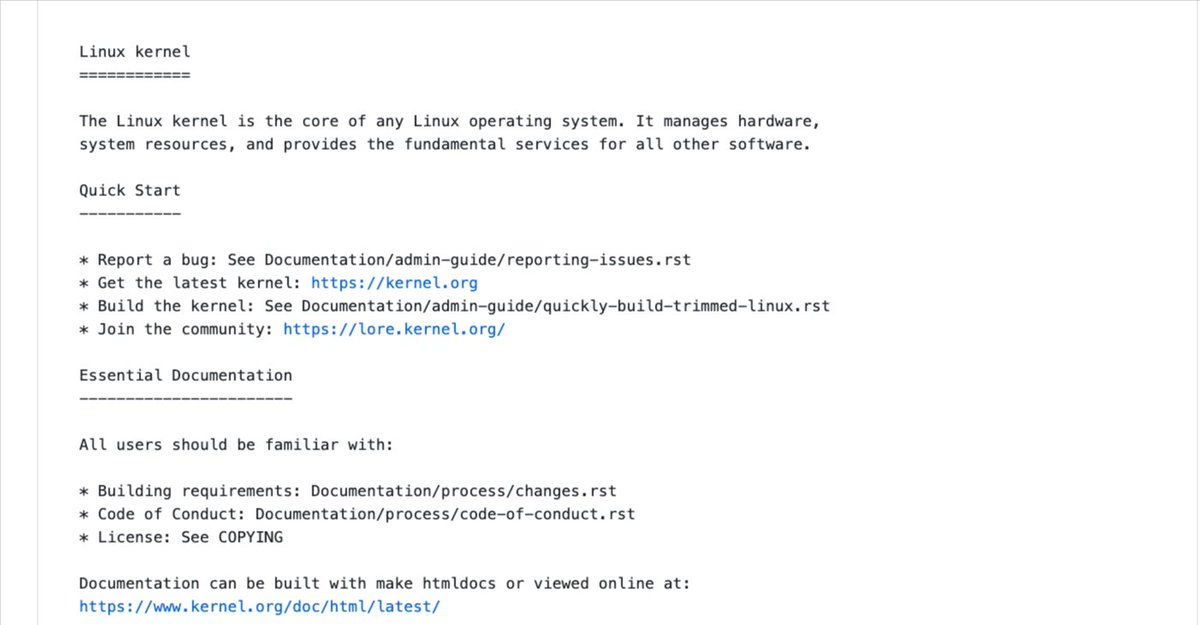
1. torvalds/linux
The Linux kernel. Powers 96% of the world's top web servers and every Android phone. 230K+ stars.
Repo → github.com/torvalds/linux
2. git/git
Every line of code on Earth lives inside Git. The version control system the entire industry runs on.
Repo → github.com/git/git
3. postgres/postgres
The database behind Apple, Instagram, Reddit, Spotify, and Stripe. In active development for over 35 years.
Repo → github.com/postgres/postg…
4. redis/redis
The in-memory database powering Twitter timelines and Instagram feeds. If the internet loads fast, Redis is why.
Repo → github.com/redis/redis
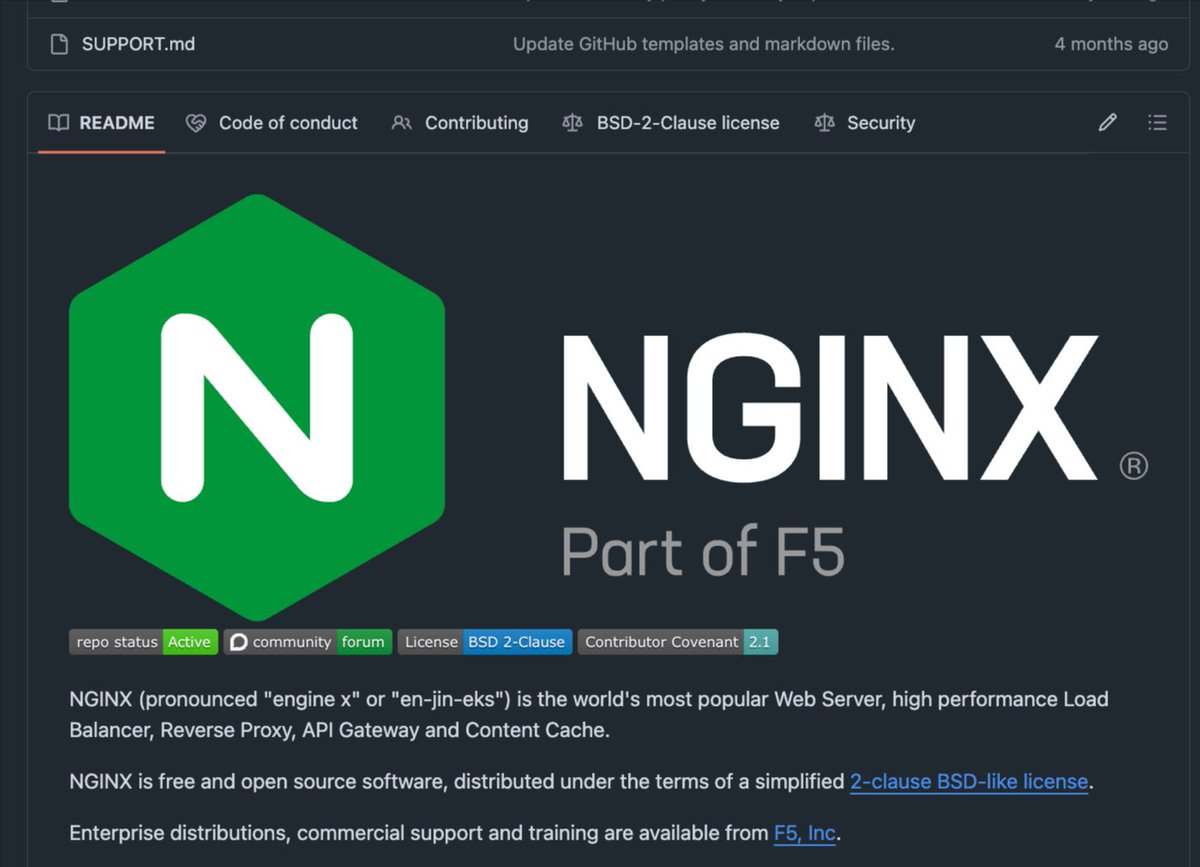
5. nginx/nginx
The web server running 33% of the entire internet. Netflix, Airbnb, and Adobe all depend on it.
Repo → github.com/nginx/nginx
6. nodejs/node
The runtime that turned JavaScript into a backend language. Powers Netflix, LinkedIn, and PayPal.
Repo → github.com/nodejs/node
7. facebook/react
The frontend library behind Facebook, Instagram, WhatsApp, Airbnb, and most of the apps you opened today.
Repo → github.com/facebook/react
8. python/cpython
The reference implementation of Python. The language quietly running the AI revolution in 2026.
Repo → github.com/python/cpython
9. moby/moby
The engine inside Docker. The reason every modern app deploys in seconds instead of weeks.
Repo → github.com/moby/moby
10. kubernetes/kubernetes
The orchestration layer running Google, OpenAI, and Spotify. The operating system of the modern cloud.
Repo → github.com/kubernetes/kub…
Here's the wildest part:
The internet is not held together by big tech.
It is held together by these 10 repositories. Maintained by people you have never heard of. Built for free. Used by every billion-dollar company on Earth.
You used at least 7 of them today and didn't know it.
The most important infrastructure on the planet is open source.
Save this before you forget.
100% free. 100% open source.


English
tudor retweetledi