Naveen Jain

700 posts

Naveen Jain

Naveen Jain

@uffdaALLberries

Future physician-scientist in internal medicine and incoming intern @UCSF | @Penn ‘25 | @WashU ‘16 | functional genomics, lineage tracing, rare cell biology

Phildelphia, PA เข้าร่วม Eylül 2019
511 กำลังติดตาม299 ผู้ติดตาม
Naveen Jain รีทวีตแล้ว
William J. Greenleaf
William J. Greenleaf@WJGreenleaf·
Our Human Multiomic Development Atlas paper is out in Nature today! A heart-felt "thank you" to all co-authors for their tireless work on this complex yet exciting project! Congrats all! nature.com/articles/s4158…
English
5
99
355
21.2K
Naveen Jain รีทวีตแล้ว
Katie Galloway
Katie Galloway@GallowayLabMIT·
🤔How do you design a promoter for stable titration of expression? 💡Try programmable promoter editing with DIAL! 📰Now published at @NatureBiotech 🧵 [1/n] 🔗 below
Katie Galloway tweet media
English
15
111
503
64.8K
Naveen Jain รีทวีตแล้ว
Fabian Theis
Fabian Theis@fabian_theis·
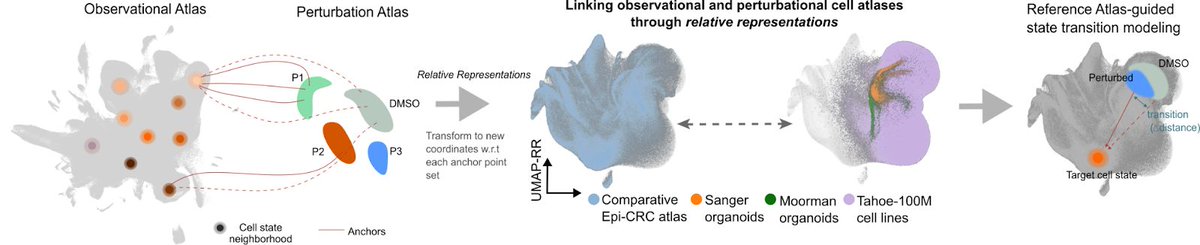
New preprint with Garnett lab 🚀: from descriptive → causal single-cell atlases in CRC.We build the largest CRC atlas (>300 pts, 1.5M cells) using continual learning, and link cell states to causal drivers via Tahoe-100M, validated in organoids! biorxiv.org/content/10.648…
Fabian Theis tweet mediaFabian Theis tweet media
English
4
44
188
17.1K
Naveen Jain รีทวีตแล้ว
Cell Genomics
Cell Genomics@CellGenomics·
Pre-existing cell states predict resistance to multiple treatments dlvr.it/TRn0Zw
English
1
25
94
16.7K
Naveen Jain รีทวีตแล้ว
Mo Lotfollahi
Mo Lotfollahi@mo_lotfollahi·
Single-cell technologies now let us profile entire transcriptomes in individual cells. But how do we make sense of this complexity in a biologically meaningful way? Many methods summarise cells into a single embedding, but this often comes at the cost of interpretability, especially when multiple gene programs are active at once. We developed Tripso, a self-supervised transformer model that represents cells through multiple gene program-specific embeddings, while also uncovering new programs directly from the data. Instead of collapsing biology into a single vector, Tripso decomposes cell state into multiple representations, each reflecting a different gene program. We explored this across multiple systems. In human hematopoiesis, spanning development to aging, Tripso identified distinct age-associated program activity, including stronger JAK-STAT signalling in early life and dynamic IKZF1-related changes during B cell maturation. By comparing in vitro culture conditions with in vivo hematopoietic stem cell states, Tripso suggested that targeting the SEC61 translocon could enhance stem cell maintenance ex vivo, a prediction that we subsequently validated experimentally. In parallel, we identified a previously uncharacterised tissue-resident memory T-cell program associated with atopic dermatitis and mapped it to distinct spatial immune niches Together, these results show how modelling cells through gene programs can lead to interpretable and experimentally testable insights. More broadly, this work points toward a more interpretable and biologically grounded models of cell state. As single-cell datasets continue to grow, we hope approaches like Tripso will help bridge the gap between data-driven representations and biological insight. This work wouldn’t have been possible without the contributions of an amazing team. Thank you to co-first authors @mariemoullet, @Tomo_Isobe, @AmirhVahidi, @CarloLeonardi7, and everyone from @roserventotormo's Lab, @HaniffaLab, Nicola Wilson and @BertieGottgens's Lab, bringing together expertise across @SCICambridge, @OpenTargets, @sangerinstitute and @Cambridge_Uni. @mariemoullet is one of the very best PhD students I have ever supervised. She is truly a force of nature, exceptionally resourceful, deeply innovative, and one of the most impressive scientists I have worked with. I am immensely proud of her and all that she has accomplished. As she begins her internship at @genentech , I have no doubt she will do amazing work there and continue to make her mark. paper:biorxiv.org/content/10.648… code: github.com/Lotfollahi-lab…
English
5
60
305
21.9K
Naveen Jain รีทวีตแล้ว
Vijay Sankaran
Vijay Sankaran@bloodgenes·
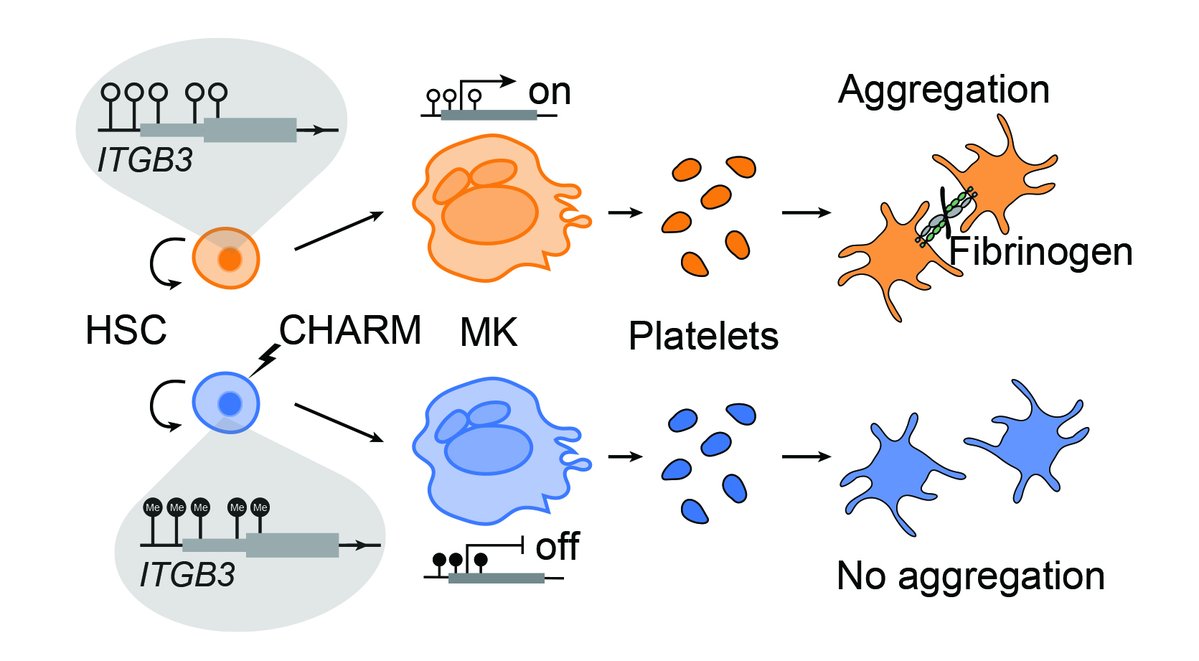
❓A one-time, durable, and even reversible way to prevent thrombosis? In this preprint, led by @lrbzldz, we show that epigenome editing of 🩸 #StemCells can durably reprogram platelet function: biorxiv.org/content/10.648…
Vijay Sankaran tweet media
English
6
42
144
18.2K
Naveen Jain รีทวีตแล้ว
William Gibson
William Gibson@wgibson·
What if a small molecule could activate a transcription factor program in one cell type and destroy the same pathway in another? In our new preprint, we describe one such story on bifunctional molecules that toggle between transactivation and repression.
William Gibson tweet media
English
7
86
460
58.5K
Naveen Jain รีทวีตแล้ว
Science girl
Science girl@sciencegirl·
Duck gliding through cherry blossom water
English
174
10.7K
56.2K
13.6M
Naveen Jain
Naveen Jain@uffdaALLberries·
The most jarring part of “Project Hail Mary” wasn’t the sentient rock organism, astrophage rocket propulsion, or xenon-eating alien bacteria, but was when Ryan Gosling ran a centrifuge with an unbalanced arrangement of microfuge tubes. Honestly a jump scare for me!
English
0
0
1
109
Naveen Jain รีทวีตแล้ว
Anirban Maitra
Anirban Maitra@Aiims1742·
MSK-IMPACT is truly the gift that keeps on giving! Cancer type-specific variation in patterns of driver alterations across 50,000 tumors (!!) cell.com/cancer-cell/fu… "One-third of all drivers arose in non-canonical contexts" Congratulations @MFBerger1 @DSolit & team.
Anirban Maitra tweet media
English
4
60
169
16.1K
Naveen Jain รีทวีตแล้ว
Surya Nagaraja
Surya Nagaraja@snaga13·
Excited to share my postdoc work with @JD_Buenrostro now out in @Nature! "Epigenetic memory of colitis promotes tumour growth" nature.com/articles/s4158… We wanted to understand how transient inflammation can create a long-lived increase in cancer risk, even after full recovery 🧵
English
11
77
358
38.5K
Naveen Jain รีทวีตแล้ว
Dr Steven Quay
Dr Steven Quay@quay_dr·
In 1923 Warburg published a paper showing that cancer cells generated energy by a metabolism that differed from normal cells. Fast forward to 2026. A group of @StanfordMed scientists genetically modify immune cells to 'sense' the changes in metabolism of cancer cells and home in on the tumor cells, killing them. Imagine programming 'blood hound' immune cells to kill cancers, not based on 20th century surface proteins, but on their broken way of making energy, ATP. This is the kind of exciting immunology research that belongs in a 21st century NIAID. The paper: doi.org/10.1038/s41590…
Dr Steven Quay tweet media
English
4
77
304
21.8K
Naveen Jain รีทวีตแล้ว
Livnat Jerby
Livnat Jerby@LivnatJerby·
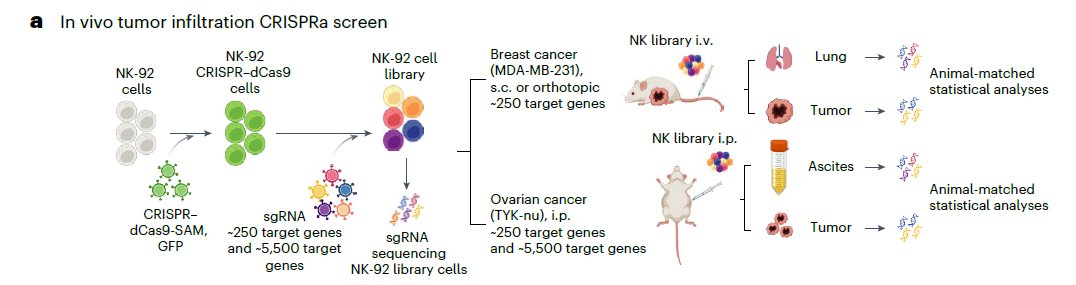
Excited to share our paper on engineering spatially targeted immune cells is now out in @NatImmunol. nature.com/articles/s4159… #CRISPR activation screens reveal that engineering metabolite-sensing NK and T cells provides programmable mechanisms to target solid tumors. Congrats to @komong0702, Mike Tsai, and the team! Thanks to @ocrahope, @StanfordCancer, @AllenInstitute, @BWFUND, @czbiohub, @genome_gov, Tull Family Foundation, @stanfordcbio, @Stanford Genetics and @StanfordMed for the support.
English
4
44
196
13.4K