#OppositionDividedWeakParalysed
While main opposition leader Nelson Chamisa has relatively been quiet - conspicuous by his absence from action and loud silence, except for his occasional political posturing and symbolic resistance with a religious-style approach under his Agenda 2026 in a bid to reboot his sluggish career, his former ally in the opposition trenches Tendai Biti has taken a more vocal, confrontational, high-profile legal and public-outreach role opposing the government on its constitutional amendments to facilitate President Emmerson Mnangagwa's term extension and a raft of reforms changing the political, electoral and governance systems.
Upon his return to active politics in January after a controversial two-year hiatus following the capture by Zanu PF of his CCC opposition party, Chamisa focused on "Agenda 2026" as a movement intended to rebuild Zimbabwe through a citizen-driven dialogue rather than traditional party politics.
While he has launched this initiative and occasionally commented on social media to oppose Zanu PF's "2050 agenda" - incomprehensibly referring to the 2030 agenda - his public engagement has been characterised more by statements of intent, use of symbols and preaching "change" rather than organising grassroots resistance given his huge popular support base.
He has defended his strange "No to 2050" social media post and castigated violence against citizens opposing constitutional changes, maintaining a symbolic rather than confrontational role.
In the process, Chamisa has now become the weak link within the opposition movement.
By constrast, Biti, who has no popular social base, has been highly vocal, acting as the convener of the Constitution Defenders Forum.
Others who have been vocal include Jameson Timba as Convenor of Constitutional Defence Forum, Job Sikhala who leads National Democratic Working Group, Lovemore Madhuku and his National Constitutional Assembly, and strong-willed opposition figure Jacob Ngarivhume, among others.
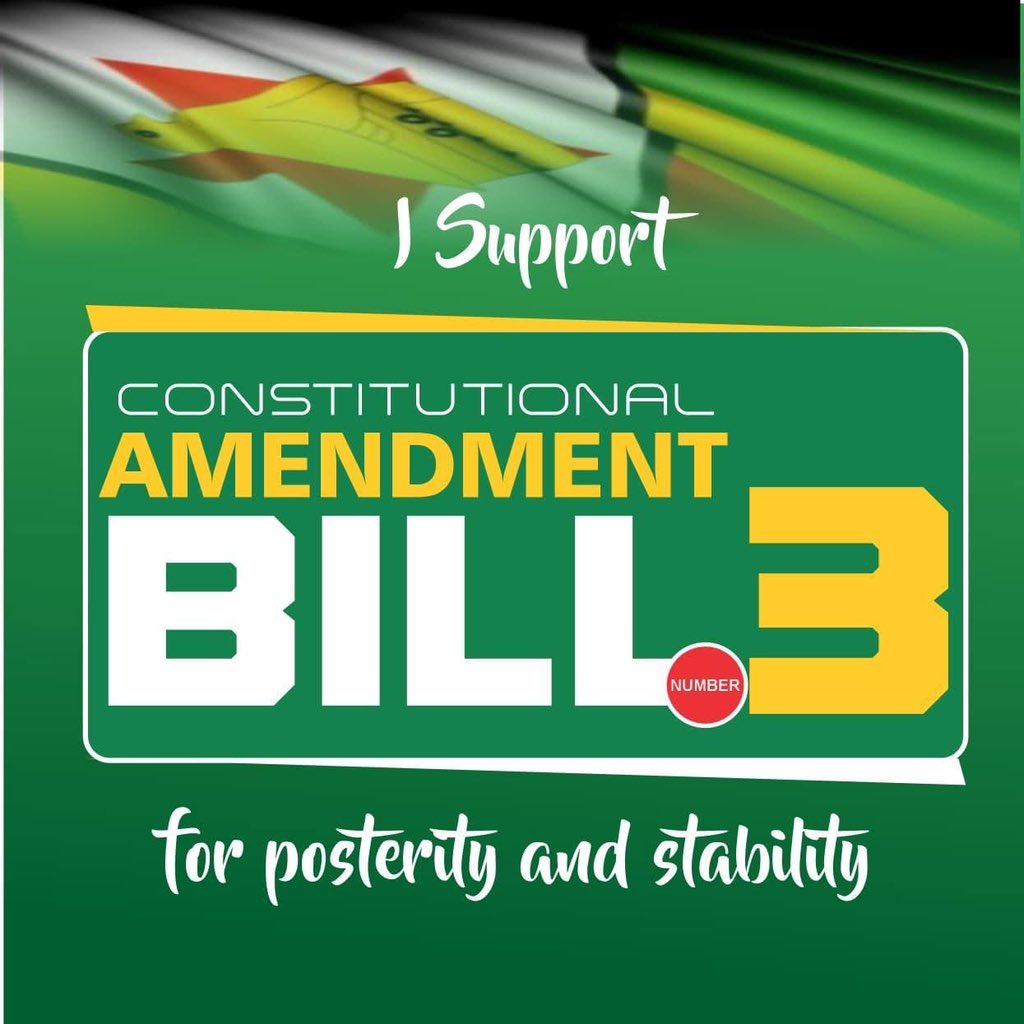
Biti has launched a vigorous campaign against Constitution Amendment No. 3, which aims to extend presidential terms beyond 2028 and change the political system.
He has referred to the proposed changes as "legal lunacy" and a "quiet constitutional coup".
Furthermore, Biti has taken the fight directly to the people, conducting door-to-door mobilisation drives and street campaigns in areas like Chitungwiza and Mutare to educate citizens on the implications of the reforms.
Alongside other activists, he has filed urgent court bids to stop police from disrupting their private meetings regarding the constitutional reforms.
As a result, Biti was yesterday arrested while organising a rally against the amendments in Mutare.
Biti has invited Chamisa to work with him and others in fighting the current constitutional changes.
However, Chamisa, despite his massive support, has distanced himself from Biti, Timba and others.
He has been pussyfooting and claiming there is no constitution to defend, alarming his opposition allies.
Despite pressure to take a form a party and adopt more aggressive approach, Chamisa maintains a propositional posture, making his politics and pronouncements merely symbolic opposition, not serious resistance anymore.
This comes as the opposition is divided, weak and paralysed.
The absence of a strong opposition and check on power has allowed for the proposal of constitutional amendments that extend the presidential terms from five to seven years and Mnangagwa's term extension, accompanied by raft of contentious changes in the political system.
As formal opposition parties have fragmented and weakened, civil society groups and grassroots movements have increasingly taken centre stage in protesting government policies, human rights issues and the current constitutional amendments.
@ShumbaTapiwa@molokele@nelsonchamisa In your OWN words, “A conversation about amendments that does not seek to address the real issues is not worth my sweat”. The constitution amendments are the real issues otherwise the movement you are building has a tough job ahead!
I am one of the seasoned academics fully behind the leadership of President @nelsonchamisa. I have clarity in understanding that in this first half of the year 2026, we are mobilizing and building institutions for our movement as outlined in Agenda 2026. This will give us capacity to achieve our objectives.
My view is that the struggle we have does not start and end with Constitutional amendments. i.e winning the battle against amendments alone will be a small temporary victory that will not help the people of Zimbabwe.
Constitutional amendments are a symptom of the deeper crisis we have always had. A conversation about amendments that does not seek to address the real issues is not worth my sweat.
In President Nelson Chamisa we have a leader with the capacity and following to take over government and govern the country for everyone. We qre guided by this serious and bold ambition. We cannot be reduced to the narrow ambitions of pressure groups. We were here before this Bill. We will be here after defeating it when others disappear.
The Bill is a footnote in our Agenda to defeat and replace oppression. We were not formed for the Bill. We have a history and a future. We should deal with the Bill in this context.
@Dr_JAMavedzenge@ZANUPF_Official@edmnangagwa In our current context I agree with you that a president appoint judges wont be ideal. But in USA, SA, Canada, China, UK, Russia etc its the similar system. The bill should be amended to remove the 7 year term limit clause and appointment of judges. The rest is fine with me.
Some in @ZANUPF_Official and those defending the status quo may not realise it today but the truth is that Constitutional Amendment Bill 3 represents something more than an attempt to illegally extend President @edmnangagwa’s term of office. This Bill hides something deeply sinister for Zimbabwe. It seeks to further consolidate power around one man-the President (including by giving him power to appoint judges and determine the composition of the commission that will draw electoral boundaries). In several ways, this Bill paves the way for the establishment of a dynasty. No-one will win any election in Zim, including ZANU PF primaries unless their candidature is approved by the dynasty. By its nature, a dynasty is exclusive. Very few will be part of it while the majority, including those in ZANU PF will be outsiders feeding on crumbs. By the time some realise this, it will be too late for they will either be in jail, dead or in exile. That’s how Dynasties work. If this Bill passes, whatever that was left of democratic centrism in ZANU PF will be gone. Yes, i am not a ZANU PF member but even outsiders like me can see what is at play here. No one will be safe after this amendment passes. @BitiTendai@freemanchari
Incarcerated for doing what @ZANUPF_Official is doing. They are congregating their dimwits to discuss Constitutional Amendment Bill No 3, but they don't want other to do the same. Till when are rogue police officers within @PoliceZimbabwe going to continue to be used.
@Shadda101@farai_makomo@TheMirrorMsv Yesss I was there. Making sure ZANU doesn't have a majority in parliament was the easiest way of defending the constitution kwete matuzvi avari kutiitira Aya ana Biti
@Zvoutete14 Bro zvinhu zvedu zvese zvaakungo decided by zvigananda sezvavakangoita kuti Benji ndiye watove Kochi tokupai Mari . Wicknail, Scot, Tagwirei are the people pulling strings in Zim football and magwizi is in their pockets
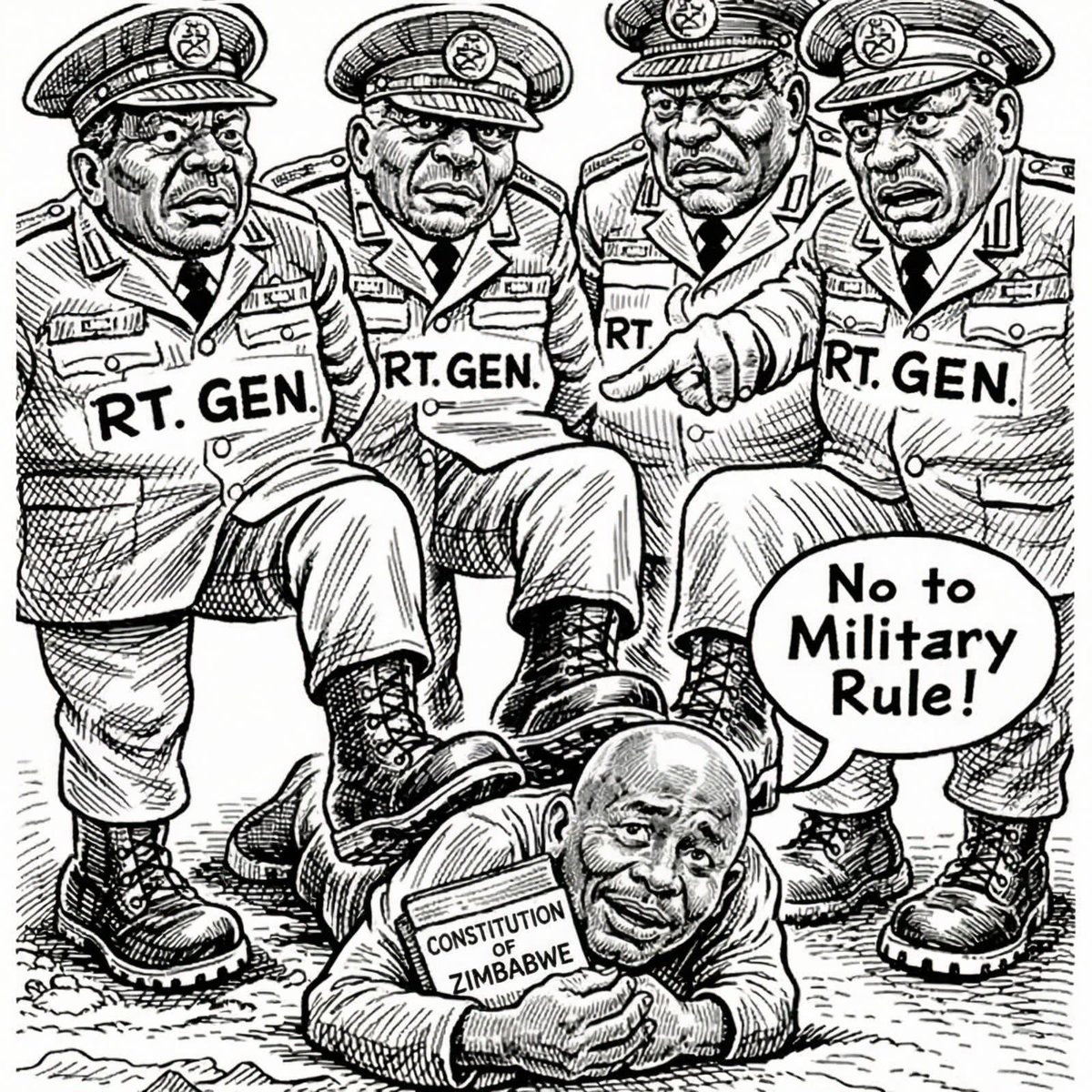
Retired Major General Gibson Mashingaidze has publicly distanced himself and other former senior officers from a statement attributed to retired Air Marshal Henry Muchena, emphasising that it does not reflect the collective position of retired generals.
Mashingaidze clarified that no formal consultation had taken place among the group prior to the release of the statement, and therefore it should be regarded as an individual view rather than a unified stance.
Mashingaidze also emphasised the importance of maintaining professional integrity and ensuring that any communication purported to represent a group of retired military leaders must be based on consensus.
He further noted that retired members of the defence forces remain committed to upholding national stability and constitutional order, and are cautious about being drawn into public or political narratives without proper engagement.
By distancing themselves from Muchena’s remarks, Mashingaidze sought to prevent misinterpretation by the public and to preserve the credibility of former military leadership.
The development indicates internal differences in perspective among retired security sector figures and raises broader questions about representation, authority and accountability when statements are issued in the name of a collective without clear mandate.
Ndakachibata kuti dzvii! At some point some of these Retired Generals have to come out in the open and state their actual position on CAB3 otherwise the current vague blanket of "Muchena and Retired Generals" covers a very wide area of suspects.
@SaMutasao Hakuna MEN vamunotiudza Baba pindai mu streets tione. Next time you won't help the oppresses to have a majority in parliament and come back pretending to oppose the same project you helped build
@SaMutasao Let me be clear to you Oliver, unless you have a PACT with the army faction of ZANU to help you there is NOTHING your can do to defend the constitution in the streets munopera kufa. But having a PACT with them is a more serious problem again coz achingoenda EDiot tomama futi
@StuartJohanne2@ChibayaaCitizen Yah iwewe irwa iyoyo nhamo yako isusu nhamo yedu is No to ZANU in it's totality not zvenyu zvekupindira ma ZANU factions
Let me illustrate by way of a simple example that is readily comprehensible. Should the Minister of Education decide to extend the duration of a school term by a few weeks, does it follow that when learners resume for the ensuing term, they will be in the third term? The answer is in the negative, they shall remain in the second term. The extension of a term does not constitute the creation of an additional term, and such an action does not necessitate a referendum.
Our Constitution expressly identifies three matters in respect of which any amendment requires a referendum:
1.Chapter 4, which pertains to the Bill of Rights
2.Chapter 16, which pertains to agricultural land
3. section 328, which pertains to the extension of a term of office.
It is an undisputed fact that the present amendment does not engage any of the said matters that would trigger a referendum requirement.