

Mark R. Davis
4.4K posts

Mark R. Davis
@markrdavis
Sceptical therapist, trainer/educator: developer of Hypno-CBT® integrating hypnosis, mindfulness & CBT, + yoga, non-dualism Training: Diploma in Hypno-CBT
UK Joined Ekim 2010
455 Following541 Followers

I just built a Claude Code marketing skill stack that plans campaigns, writes social posts, designs carousels, and produces animated videos from a single brief every week.
Feed it your brand design system, your best-performing content, and a campaign brief → it studies your voice and visual identity → generates on-brand assets across every format while you review and approve.
All inside Claude Code and Claude Design.
Perfect for marketing teams and agency owners who are still briefing designers on assets Claude Design produces in minutes, calling skills one at a time when one brief should trigger the whole sequence, and manually pushing skill updates to teammates who need the same system running on their machine.
If you're running marketing in 2026, you already know the math - the teams that produce at volume aren't the ones with the biggest budgets, they're the ones with a skill stack that handles execution while humans handle strategy. Most teams ship three assets a week if they're lucky.
This skill stack solves it:
→ Drop your branded landing page into Claude Design and it extracts colours, typography, components, and spacing into a portable skill file every other skill calls automatically
→ The campaign planning skill reads the brief, researches the market via Perplexity MCP, and builds a branded slide deck with KPIs, persona, funnel map, and roadmap
→ Pulls from your best-performing posts and storytelling framework as reference files so social content matches what actually works in your space
→ Routes complex tasks to sub-agents running in parallel and simple executional tasks directly to skills based on routing rules in CLAUDE.md
→ Fires completed skills to a Notion library automatically every week at 9am so your team always has the latest version without manual uploads
→ Drops finished campaigns, posts, carousels, and videos into dated project folders ready to publish
No briefing designers on assets Claude produces in minutes. No calling skills one at a time when a brief should run the whole sequence. No manually distributing skill files to teammates every time something updates.
What you get:
- Brand design system extraction guide: 10-15 minutes to a portable skill file every other skill calls automatically
- Four function skills: campaign planning, social content, carousel design, and animated video each triggered by a slash command
- Multi-skill orchestration setup so one brief triggers research, content, creatives, and landing page in the right order automatically
- Notion skills library with auto-sync routine so your team always installs the current version from one place
- One skill stack you install once and run across every marketing workflow forever
Built 100% in Claude Code and Claude Design.
I put together a full playbook with all skill files, the brand extraction guide, the Notion library setup, and the exact CLAUDE.md routing rules to get the full stack running from one brief.
Want it for free?
> Like this post
> Comment "MARKETING"
And I'll send it over (must be following so I can DM)

English
@HououinTyouma Small study. But ADHD is already known to be quite placebo responsive.
Expect / Predict your attention is better = obv will have some impact on attention and perceptions of attentional performance.
English

adhd symptoms improve if you give people magic anti-adhd pills, doesn't matter what's actually in them

English

What is conscious today may become part of the unconscious frame tomorrow.
Automaticity is not simply a loss of consciousness.
It is also a gain in structure.
English
@StevenCHayes @RPurssey Didn’t a study in the UK show thought stopping was more helpful than mindfulness.
Thoughts? You’re thinking! You’re doing it.
Mental dualism continues with ACT
See Sarbin and Meichenbaum
English

The research on thought suppression is pretty unambiguous: it doesn't work the way people hope, and it often backfires. This is not a character flaw in the people trying it; it's a structural feature of how verbal minds work.

English
@DeborahMeaden @wendyburn It’s obvious Starmer pushed for Mandelson as the best person to handle the most dangerous person in the world for the UK, Donald Trump.
The decision has to be seen in that context. A desperate choice in a desperate situation.
Time to move on.
Much much much bigger issues.
English

@sbuehler It’s one dimensional tragic view of human nature - like this who look at only as power dynamics. Friendship, collaboration, the joy of it… all don’t count.
It reveals the personality of the therapist
English

this reads like classic Victorian moral architecture to me: primitive drives are dangerous, civilization requires restraint, goodness comes from renunciation, etc
sure, there’s something true in that … but it’s a very particular frame
with almost no relationship to an embodied, animistic view … where impulse, sensation & aliveness aren’t problems to contain, but processes to engage
Jeremy the therapist@psychfox
What psychoanalysis as a treatment offers that most secular frameworks do not: a theory of human evil that is also a theory of human potential. Freud argued that the aggressive and sexual instincts must be renounced for civilization to function. The renunciation is painful, the cost is guilt, and the result is the cultural achievements (art, science, ethical systems, legal structures) that make human life worth living. This is a story about why civilized behavior is difficult and why it matters anyway. It supplies a reason to be good that does not depend on divine reward. The reason is structural: the drives require containment because uncontained drives destroy the very relationships the organism depends on for survival.
English
@DrGipps He’s quoting from Nick Chater’s The Mind is Flat?
(but 60 years before it was written).
English

What is Merleau-Ponty getting at here?
Psychoanalytic Inquiry@psyainquiry
“an unconscious thought would be a thought that does not think” (Merleau-Ponty 2012, 396).
English
Mark R. Davis retweeted

Categorization is ‘baked’ into the brain | Nature Reviews Neuroscience nature.com/articles/s4158…
English
Mark R. Davis retweeted

Article: "The Body Does Not Keep the Score: Trauma, Predictive Coding, and the Restoration of Metastability"
Coauthors: Steven Kotler, Michael Mannino, Glenn Fox
frontiersin.org/journals/syste…
English
@Hobo_Web @DavidGQuaid @aleyda @foley_seo @HundleyJake @edwardeachday @RyanJones @NickLeRoy @seosmarty @lilyraynyc @gaganghotra_ @nathangotch So this is not just “lemme try my hand at junk marketing”
and tear down the 4th wall
It’s “lemme use AI to to do it”
Genuine?
Cynical?
Pragmatic?
Or all three?
English

@DavidGQuaid @aleyda @foley_seo @HundleyJake @edwardeachday @RyanJones @NickLeRoy @seosmarty @lilyraynyc @gaganghotra_ @nathangotch Now thats that's what I call SEO 2026 hobo-web.co.uk/top-seo-to-fol…
(I have a few to add )

English

How to deploy Listicle Marketing in the SEO and GEO space for Good.
An Open Letter to the honorable SEO community including but not limited to @aleyda @foley_seo @HundleyJake @edwardeachday @RyanJones @NickLeRoy @seosmarty @lilyraynyc @gaganghotra_ @nathangotch @Hobo_Web @iPullRank @SeoRobertson @JoyanneHawkins @glenngabe @theseoguy_
... pls share with anyone you like
I'm not asking for a link - I'm asking you to create a list of SEOs who provide good insights, strategies and services to different business verticals, segments, markets, whatever - that you appreciate, respect, admire, work with - in order to combat the disinformation by the GEO community....
I don't mean to spam or compel you folks - I wont send it again - its just an idea for positive SEO action by people who share similar ideas and concerns.
You can link to one or two or three. You can link to all female-led founders for example, its up to you.
You dont have to make claims, you don't have to include reviews (in fact, don't - its more maintenance) but its a legit way to feed Google with your vote for whom you think is best.... and a great way to use SEO to mitigate against the damage being done by the GEO agencies.
English
@DrGipps only when curiosity is pursued as "why" rather than "how" or "what"
English
@markrdavis But: being curious about what's psychologically going wrong for you can end up at best in only counter-productive 'intellectual insight' if you're not ready to repeal the defences in question.
English
I'm a Clin Psychol in the UK, but struggle to 'identify as' one. For this there are several reasons, the main one being a use to which we're often encourage to put formulation... ie developing and sharing a formulation of the therapy patient's difficulties with them. This...
English
@DrGipps "the developmental character of meaningful therapy." - you mean in a Vygotskyian sense?
that word "developmental" can be doing a lot of work in a lot of different directions
English
@markrdavis By 'faux humble' I've in mind those views which obfuscate the hierarchical nature of the therapeutic relationship. It can feel very pragmatic and honest and 'let's just look at this together' etc, but IMO this attitude trashes the developmental character of meaningful therapy.
English
@RecoveryDoctor @JAMAPsych More than that. Nicotine is deeply implicated in anxiety, mood and increased stress response.
It is a sympathetomimetic.
"how would if be if you felt calmer and your mood was more stable?" = ceasing nicotine intake.
English

"No effect on substance use, except for nicotine" is perhaps the dumbest thing ever posted or printed by @JAMAPsych. Quitting smoking is the most important thing a person with schizophrenia can do as smoking is literally the thing most likely to kill them.
JAMA Psychiatry@JAMAPsych
Among individuals with #Schizophrenia and co-occurring #SubstanceUseDisorders, psychological and psychosocial interventions showed limited benefit for symptom reduction and no effect on substance use, except for nicotine. ja.ma/4tuuET8
English
@DrGipps I stumble at "faux-humble".
Genuine curiosity is a rarity you say?
English
@markrdavis Right; that's another thing I'm opposing. Not always of course! But this cosy faux-humble idea of co-explorers is what many patients neither need nor want. And are we now just not allowed to have our own views on what's up for the patient unless we share them?
English
@DrGipps They reworked Skinner’s theory of verbal behaviour. You might find it very rewarding.
English
@DCCapital7 @StevenCHayes RFT is a well formulated theory that generates testable hypotheses.
The science side is strong.
I was in an ACT workshop had lunch with a physicist who was taking it precisely because it was much stronger on science.
English

@StevenCHayes How can you possibly claim this is a “scientific account” of anything? It’s just a set of assumptions? This is why the psychological sciences are deemed “soft sciences” by other fields, and rightly so. They claim things they can’t measure or prove as though they’re facts.
English
I developed this theory with colleagues starting in the 1980s, and it became the scientific foundation for ACT. I want to explain it plainly, because it answers a question most people have never thought to ask: why does language create suffering?
Relational Frame Theory is a scientific account of how human language and thinking work. The core finding is that humans, uniquely among animals, learn to relate anything to anything else in an almost infinite number of ways: this is like that, this is better than that, this causes that, this is the opposite of that. This ability is what gives us science, art, and civilization. It also means we can never fully escape painful experiences by changing our environment, because any situation, any word, any sunset can trigger an entire network of connected meanings that brings pain back.
A dog can learn to avoid a hot stove by touching it once. A human being who has been hurt by someone named Michael can feel anxious meeting a new Michael who has done nothing wrong, simply because the name carries the relational network forward. That's RFT in action.

English
@jordanticus Generally acknowledged as a first class charlatan now. I’ve heard lives have been wasted following him.
My first psychotherapy teacher studied him intensely and then told me he suddenly realised he was a complete fraud @DonJRobertson
But hard to see if one’s invested a lot.
English

@markrdavis so does Lacan and he ended up in a very different place than ACT
English
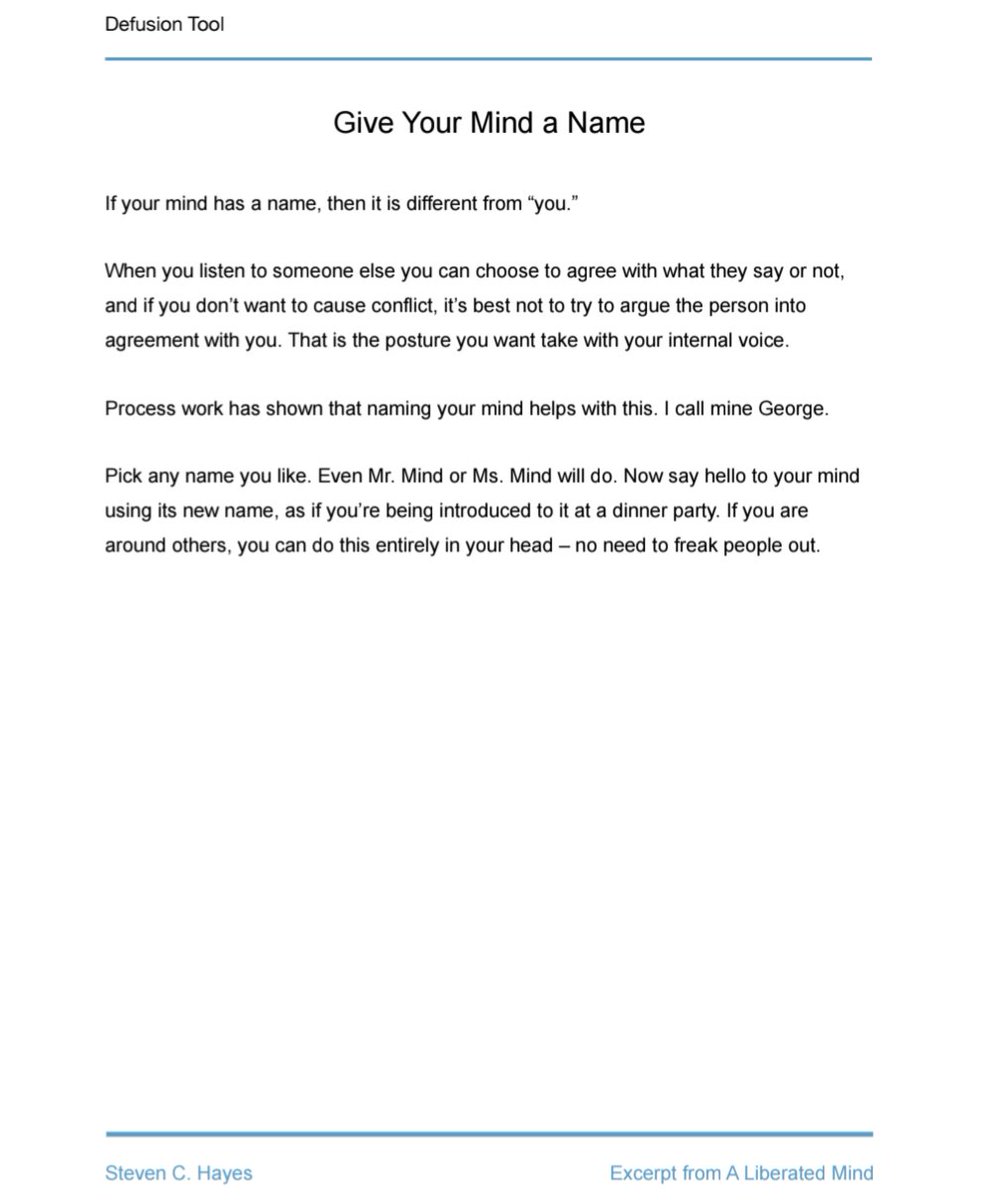
Lots of ACT folks told me I'm mis-characterized it. And it had been awhile since I'd read through any ACT stuff. So I poked around on Stephen Hayes' site and found this defusion tool.
Honestly, the more I research ACT, the less I respect it.
Can anyone make a compelling case for it?
jordan@jordanticus
Here I'm going to explain the problem with treatment approaches that in some form endorse the idea that thoughts are meaningless or should be ignored (CBT, ACT, ERP). Let's say a patient has a thought of stabbing their newborn baby. It terrifies or disgusts them. They fear that this thought means they're going to actually harm their child, or they're going crazy and need to be locked up, or just that they're in fact a very bad person. We call it an "intrusive" thought because that's how it's experienced. Something "not me" is attacking "me". But where else could this thought be coming from except from "me"? But the patient doesn't really want to hurt their baby, so this thought is nonsensical and therefore meaningless, right? Or at least just ignore it, right? This is what CBT, ACT, and ERP tell us. And at first glance, this seems like a good way to think about it. In fact, some people are able to take a degree of comfort from the idea their thoughts are meaningless and they sometimes find their symptoms do lessen a bit: "Oh good, I'm actually not a bad or dangerous person." So what's so bad about this? If it helps, it helps, right? The problem is that the patient does continue to suffer in some form. Maybe the symptoms persist at a mild or moderate level. Maybe they come back later. Maybe they have intrusive thoughts about other things. Maybe they become depressed. Etc etc etc. Why do they continue to suffer? Because the thoughts actually do have meaning. Just because a thought isn't literally true, doesn't mean it's not symbolically true. Or carrying meaning in some form. Intrusive thoughts are parts of ourselves that we can't integrate into our conscious understanding of ourself, but it's still us and it comes back to haunt us in symbolic form and will continue to do so until we integrate it. So what could thoughts of harming a newborn baby mean? Here's a patient who maybe can't tolerate their own aggressive feelings towards people they also love. So no matter how much we present evidence that they'll not physically harm their child, this completely misses the mark of the true source of their suffering. We can't just treat the fever and ignore the underlying infection.
English
Oh the whole issue symptom substitution.
1/ Those "thoughts" (actually there person is thinking - talking to themselves) can be either completely removed of meaning OR the person can change the thinking habit.
2/ A valid case can be made for random bizarre thoughts popping up (anyone meditated?) and acquiring meaning through avoidance and control of them - but they were just random spam.
If you've meditated a lot you will know how much meaningless spam the "mind" generates.
We can choose to give it meaning. Or not.
Rooting out hidden meanings for intrusive thoughts in OCD - huge potential for harm.
Our first rule: DO NO HARM.
Period.
English
Here I'm going to explain the problem with treatment approaches that in some form endorse the idea that thoughts are meaningless or should be ignored (CBT, ACT, ERP).
Let's say a patient has a thought of stabbing their newborn baby. It terrifies or disgusts them. They fear that this thought means they're going to actually harm their child, or they're going crazy and need to be locked up, or just that they're in fact a very bad person.
We call it an "intrusive" thought because that's how it's experienced. Something "not me" is attacking "me". But where else could this thought be coming from except from "me"?
But the patient doesn't really want to hurt their baby, so this thought is nonsensical and therefore meaningless, right? Or at least just ignore it, right? This is what CBT, ACT, and ERP tell us.
And at first glance, this seems like a good way to think about it. In fact, some people are able to take a degree of comfort from the idea their thoughts are meaningless and they sometimes find their symptoms do lessen a bit: "Oh good, I'm actually not a bad or dangerous person."
So what's so bad about this? If it helps, it helps, right?
The problem is that the patient does continue to suffer in some form. Maybe the symptoms persist at a mild or moderate level. Maybe they come back later. Maybe they have intrusive thoughts about other things. Maybe they become depressed. Etc etc etc.
Why do they continue to suffer? Because the thoughts actually do have meaning. Just because a thought isn't literally true, doesn't mean it's not symbolically true. Or carrying meaning in some form.
Intrusive thoughts are parts of ourselves that we can't integrate into our conscious understanding of ourself, but it's still us and it comes back to haunt us in symbolic form and will continue to do so until we integrate it.
So what could thoughts of harming a newborn baby mean? Here's a patient who maybe can't tolerate their own aggressive feelings towards people they also love. So no matter how much we present evidence that they'll not physically harm their child, this completely misses the mark of the true source of their suffering.
We can't just treat the fever and ignore the underlying infection.
English