Li Erran Li @ ICML 🇰🇷

87 posts

Li Erran Li @ ICML 🇰🇷

Li Erran Li @ ICML 🇰🇷

@erranlli

Dr. Li Erran Li is the head of Science for human-in-the-loop services at AWS AI, Amazon and an adjunct professor at Columbia University.

Santa Clara, CA Bergabung Nisan 2009
975 Mengikuti70 Pengikut
Henry Yin✈️ICML
Henry Yin✈️ICML@HenryYin_·
Possibly the first investor talk at a top AI conference. If you want to work with an investor who actually understands what you’re building, better call Brian
Brian Zhan@brianzhan1

It was an honor to give one of the invited workshop talks at ICML. The thesis: whoever turns messy real-world outcomes into reliable, scalable reward signals trains models where foundation models alone are stuck. It's also how we pick startups. Talk built with @HenryYin_ Coding agents suddenly started working because code shipped with free verifiers, like compilers and type checkers. We did reinforcement learning on those verifiers, and as we scaled compute, capability compounded. The next unicorn startup are ones that build verifiers for more challenging domains. Periodic Labs grades models with a physics fit against real measurements from its autonomous lab, and the capability ceiling moves. Applied Compute audits LLM judges across tens of thousands of rubric criteria before any RL runs, then trains open models to state of the art on Harvey's legal benchmark. Elorian is building verifiers that give models native visual reasoning capabilities, teaching models to actually see structure, where today's frontier models fail at counting more than ten objects.

English
2
2
14
1.7K
Zachary Lipton
Zachary Lipton@zacharylipton·
Dropping off the grid for a fabulously overdue honeymoon. Shitposts received in my absence will be triaged appropriately & reviewed on my return
Zachary Lipton tweet media
English
13
1
201
15.6K
Xindi Wu
Xindi Wu@cindy_x_wu·
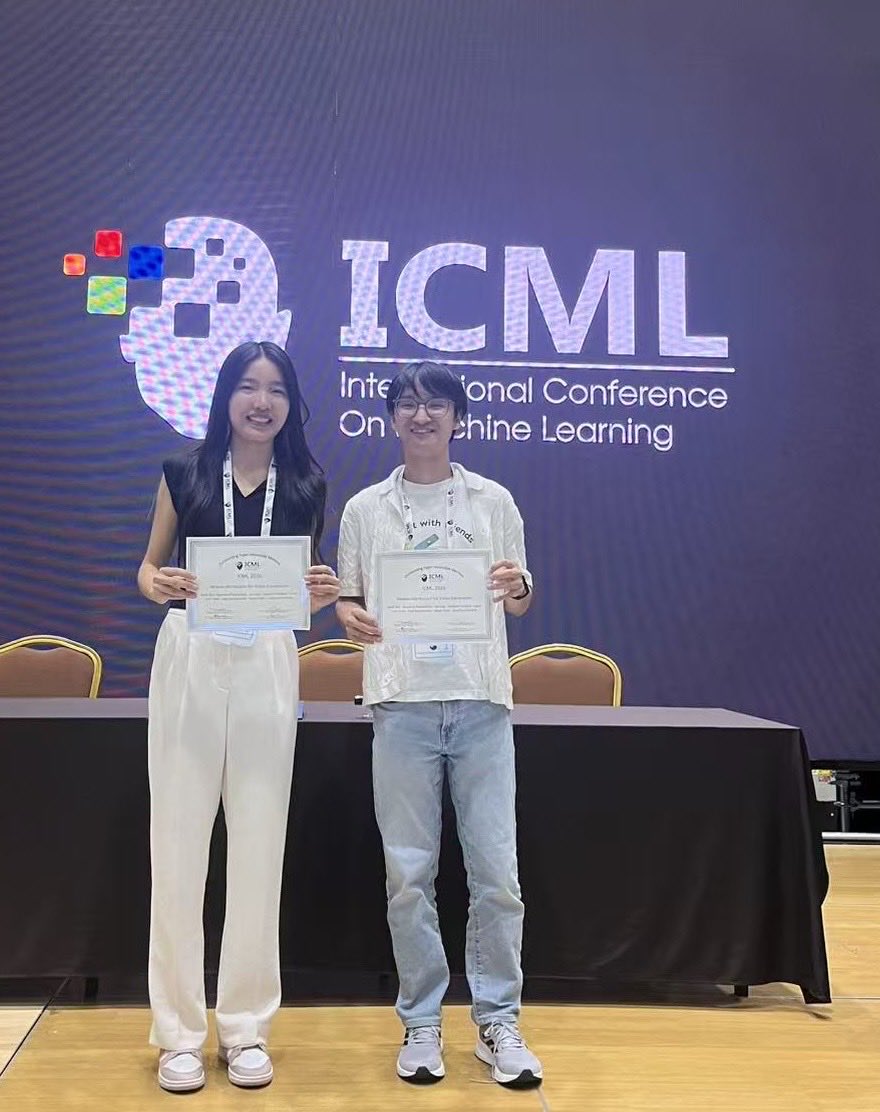
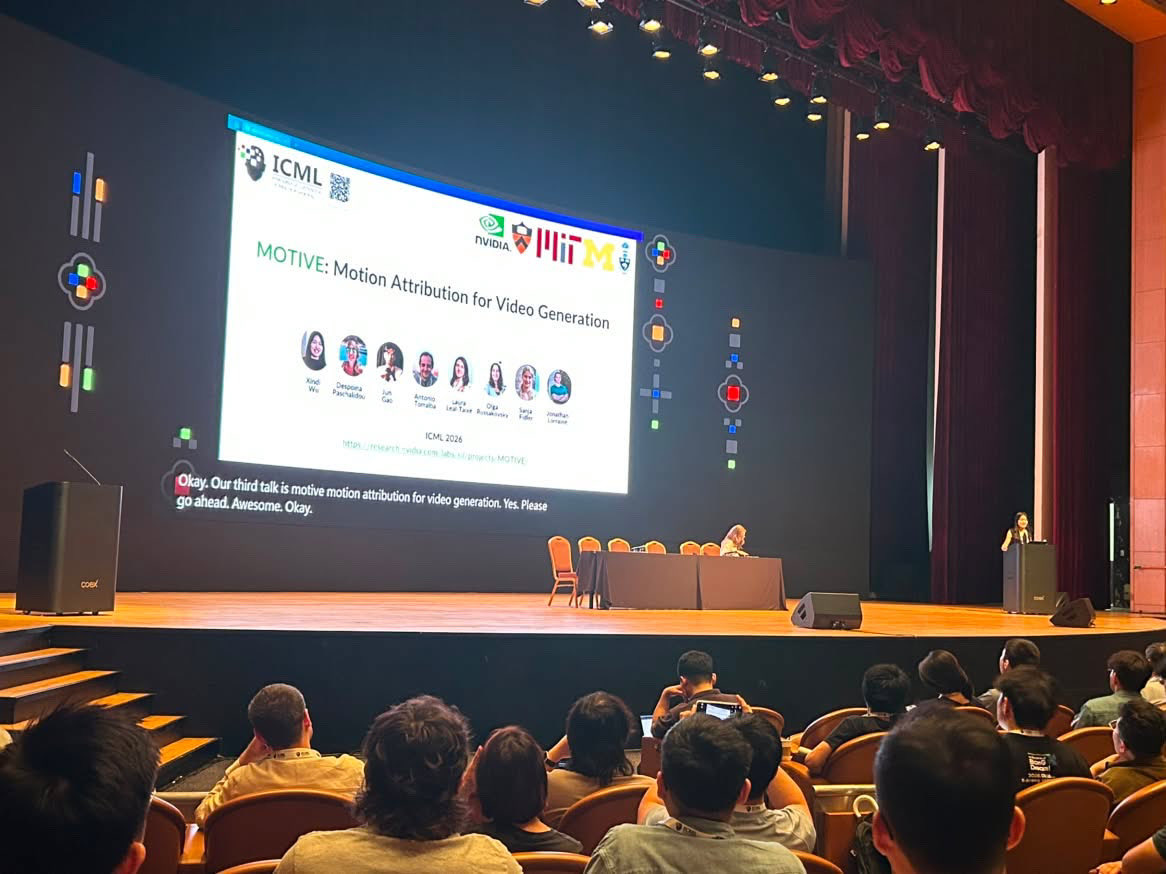
So grateful for the outstanding honorable mention at the main conference for motion attribution as well as a best paper award at f2s workshop for our most recent work on memory for world models❤️ Both works ask a similar question: how can we better compress and control the temporal information that shapes a video model’s behavior. What a week! I learned a lot from the community. Excited for what’s next in world models 🥰 #ICML2026
Xindi Wu tweet mediaXindi Wu tweet mediaXindi Wu tweet media
English
14
6
277
17.1K
Li Erran Li @ ICML 🇰🇷
Presenting Proteo-R1: Thinking Foundation Models for De Novo Protein Binder Design at ICML 2026. 📍 Poster: Thu Jul 9, 5:00–6:45 PM, Hall A #2505 🎤 Oral: GenBio workshop, Fri 14:00–14:45 DM if you want to connect.
English
0
0
1
137
Yining Hong
Yining Hong@yining_hong·
Look at these cute trophies @2077AI made for me and my advisors
Yining Hong tweet media
2077AI@2077AI

The Rising Star Award has been announced! Congratulations to Yining Hong @yining_hong , Rising Star Awardee for Spatial Intelligence, and to finalists Zhiyang Dou, Jiafei Duan @DJiafei , Hezhen Hu, Tiange Xiang @xxtiange , and Junyi Zhang @junyi42 . The awards are supported by 2077AI, with up to USD 30,000 in research gift funding to the awardee's institution and USD 2,000 in API credits for each finalist, helping early-career researchers further develop promising ideas in spatial intelligence. Full Rising Star list: e2e3d.github.io/rising_star.ht… Join the E2E3D Workshop today: 13:00–18:00 · Room 501 E2E3D Workshop: e2e3d.github.io/index.html

English
8
3
121
28.3K
Sam Rodriques
Sam Rodriques@SGRodriques·
If you want to work on using AI to accelerate the discovery of new medicines and scale up the creation of new biotech companies, get in touch.
English
48
26
403
26.3K
Dawn Song
Dawn Song@dawnsongtweets·
🚀I'm excited to share that I will be joining Meta Superintelligence Labs (MSL) as Vice President of AI Research, together with many members of the Virtue AI team. I will help shape Meta's AI safety and AI security efforts, advancing the safety and security of frontier AI models and agentic AI systems that will serve billions of people and organizations around the world. Throughout my career, I have been driven by a simple belief: for AI to realize its full potential, it must be secure, trustworthy, and beneficial. That belief has guided my research for many years and ultimately led us to co-found Virtue AI in 2024. Our goal was to translate advances in trustworthy AI research into practical solutions and build the trust layer for AI systems and agents, enabling organizations to deploy AI with confidence. I am incredibly proud of what the Virtue AI team has accomplished. Together, we built technologies for AI security and agent security, partnered with leading enterprises and frontier AI labs, and contributed research, benchmarks, and open platforms that have helped advance the science and practice of trustworthy AI. Most importantly, we assembled an exceptional team united by a shared mission: making AI more secure, trustworthy, and beneficial. I am deeply grateful to our team, customers, collaborators, advisors, and investors for their trust and support throughout this journey. In particular, I would like to thank Lightspeed Venture Partners, Walden Catalyst Ventures, Prosperity7 Ventures, Factory, Osage University Partners, Lip-Bu Tan, and all of our supporters who helped us turn an ambitious vision into reality. Your trust, guidance, and partnership have been instrumental in shaping Virtue AI's journey. As AI systems become increasingly capable and autonomous, ensuring their security, trustworthiness, and alignment will be one of the defining challenges of our time. I am inspired by Alex, Nat, Prashant, and the broader MSL team’s vision of building AI and AI agents that benefit billions of people, and I look forward to helping make that vision a reality through advances in AI safety and security. The future of AI will not be defined solely by how intelligent our systems become, but by how secure, trustworthy, and beneficial we make them. I believe we have an extraordinary opportunity and responsibility to shape that future together and bring the benefits of AI to billions of people around the world. We're just getting started. If you're passionate about advancing frontier AI while building the foundations of AI safety, security, and trust, I'd love to hear from you. Come join us on this extraordinary journey to help shape the future of AI.
English
134
59
1.2K
252.4K
Joy Jiao
Joy Jiao@joyjiao12·
excited to measure and improve the helpfulness of our models on high coverage, realistic, and sophisticated biology tasks we'll be hosting LifeSciBench and other benchmarks on a third party site in the coming months so users can transparently compare model performance
OpenAI@OpenAI

Introducing LifeSciBench, a benchmark for measuring and improving how well AI supports real-world life science research. Developed with 173 scientists from biotechnology and pharmaceutical research, LifeSciBench includes 750 expert-authored tasks across seven biological research workflows. openai.com/index/introduc…

English
7
14
69
13K
Yu Su
Yu Su@ysu_nlp·
We trained a ~frontier Deep Research Agent on academic budget > 32 H100s > 8K synthetic samples > fully open training infra + recipe (SFT, mid-training, RL) > models of diff sizes (2B -> 35B) ready to use out of the box This is yet another demonstration of how the frontier of AI is changing. We have reached a point where open models + a small capable team + a few hundred Ks can produce specialized models with ~frontier capabilities. The future of AI doesn’t have to be held in a chokehold by a handful of closed models. We've open-sourced everything we've built and learned from this project. Hope it helps the community build more! 📌 Project: osu-nlp-group.github.io/QUEST 📌 Paper: arxiv.org/abs/2605.24218 📌 Code: github.com/OSU-NLP-Group/… 📌 Model Weights and Data: huggingface.co/collections/os… 📌 Demo: huggingface.co/spaces/osunlp/… Amazing effort led by @jianxie_ (our 1st year student!!), Tianhe Lin, Zilu Wang. joint with @hhsun1 and the @osunlp team. thanks @amazon Xiangjun Wang for a gift that covers the compute and fruitful discussion.
Yu Su tweet media
English
36
182
1.3K
2.7M
Patrick Hsu
Patrick Hsu@pdhsu·
Today in @ScienceMagazine, we report a new DNA editing technology to seamlessly write massive changes into the right place in the human genome. The reason gene editing hasn't transformed human health is that current gene editing technologies like CRISPR are very limited. The problem with CRISPR is that it cuts up your DNA, and then hopes that unreliable cellular DNA repair will make the wanted edit. @geochurch famously called it genome vandalism. More precise versions of CRISPR only edit less than 100 bases - often only a single base. Therefore, it's not suited to make large changes safely. However, most diseases are not the result of mutations in one location. Instead, their causes are spread all across the 3 billion base pairs in the genome. We found bridge RNAs in bacterial “jumping genes” that allow us to make safe and arbitrary changes (insert, cut out, or flip) to every nucleotide within (up to) a 1 million bp sequence in your DNA. In the paper, we show that we can correct the disease-causing DNA repeats that cause Friedreich's ataxia (which is a rare neurological disease). The same approach could be applied to Huntington’s and other repeat expansion disorders. At @arcinstitute, we're working towards a full Turing machine for biology. Evo, our DNA foundation model, helps us design the optimal healthy DNA sequences. And Bridge recombination gives us the ability to seamlessly write these changes into the right place in the genome. This work was a wonderful collaboration with my @arcinstitute cofounder @SKonermann and led by the indefatigable @ntperry13, alongside our amazing bridge editing team: @BartieLiam @dhruvakatrekar @Gabogonzalez515 @mgdurrant @james_jw_pai @AlisonFanton Juliana Martins Masa Hiraizumi @chiaroscurale @hnisimasu
Patrick Hsu tweet mediaPatrick Hsu tweet media
Patrick Hsu@pdhsu

What if we could universally recombine, insert, delete, or invert any two pieces of DNA? In back-to-back @Nature papers, we report the discovery of bridge RNAs and 3 atomic structures of the first natural RNA-guided recombinase - a new mechanism for programmable genome design

English
79
663
3K
702K
Brian Zhan
Brian Zhan@brianzhan1·
Excited to be on the Business Insider list of top robotics investors. The data wall is falling. For years, the bottleneck was teleoperation: slow, expensive, narrow. Now robots can learn from human video, practice in simulation before touching reality, and there is enough funding to scale data deployments. Robotics is finally running the playbook that took LLMs from autocomplete to reasoning. There are still many open frontiers. General manipulation. The right API layer for the robotics models. Application robotics. That's exactly why I'm bullish. We've just found a recipe that works. Thanks to @ryajetha for compiling the list.
Brian Zhan tweet media
English
27
9
173
27.3K
Eric Nguyen
Eric Nguyen@exnx·
Together with my co-founders Michael @MichaelPoli6, Stefano @Massastrello and Armin @athmsx, I am excited to announce @RadicalNumerics is emerging from stealth with a $50M seed round to build general biological intelligence. We’re also sharing an early preview of our new model Omnii, the most powerful genome language model to date. Omnii preview link: radicalnumerics.ai/blog/radical-n… At Radical Numerics, our mission is to master the code of life, and to drive the frontier of biological AI for both design and defense. This is our dual mandate, which comes from something our own team helped make possible. Our founding team trained Evo and Evo 2, the largest biological AI models (40B params) trained on DNA sequences. Trillions of tokens across all of life, from microbes to mammals. It’s fully open source, and created the field now known as generative genomics. Last year, scientists used Evo to generate the world’s first complete genome from scratch using AI. Turns out it was a bacteriophage—a type of virus. It functioned in the real world, and in this case it was harmless. But for us, it was a clear turning point. It showed that AI is no longer just analyzing biology. It is on the cusp of generating functional lifeforms. Eventually, AI will have the power to design and control life itself. That should make all of us incredibly excited, and incredibly uneasy. (Anyone can design DNA with a new function, and have it synthesized and delivered, like something from Amazon Prime). The same technology that will help us cure cancer is the very technology that might create the next global pandemic, or worse, allow the creation of bioweapons that can wipe out populations. We believe these forces are inseparable. If you work on the frontier of biology, you have to build technology to safeguard it from its misuse. Existing biosecurity tools are sorely losing the arms race, relying on outdated “have I seen this exact thing before?” style algorithms. We founded Radical Numerics to turn the tide. And we can’t do that by training on textbooks and natural language. We must understand the language of biology from the raw physical data itself, to reason across every molecule and modality, from DNA to proteins. The next frontier for AI goes far beyond chatbots or video generators to models that can understand and engineer life. Today, we’re previewing Omnii, which is already far surpassing Evo 2, and will continue improving as we scale and add new modalities (training now). 1. For human health, Omnii can read and write whole genomes (more on writing later). It’s state of the art (SOTA) on detecting causal variants for disease, and can rank Alzheimer's mutations zero-shot. We’re partnering with a diagnostics company to use Omnii for early cancer detection (pancreatic and multi-cancer). 2. For defense, Omnii is SOTA at detecting AI-generated pathogens. We benchmarked existing detection tools, and they simply can’t detect the AI-generated ones (“deepfake viruses”). We’re partnering with a US national lab to pilot Omnii for detecting the next pandemic, both natural and AI-generated. We have a data center full of Blackwells in construction now to build the most powerful biological AI models ever. This mission takes a new kind of AI lab that can actually scale on physical, biological data: new alignment research (mid/post training), scaling long context, building out mech interp teams to dissect what these models learn, new architectures and systems designs, all from the ground up. Our team is made up of AI researchers and scientists from top labs and institutions (e.g. Stanford, MIT, Google DeepMind), but more importantly, we all share the belief that this is the most important challenge of our lifetime. If you feel similarly, we are hiring. We aim to bring the brightest minds in AI and science together to save lives. Thanks to our partners on this journey, led by Emergence Capital @emergencecap, with Obvious Ventures @obviousvc, Triatomic @TriatomicCap , and Patrick Collison @patrickc. Our advisors include Eric Horvitz @erichorvitz, CSO of Microsoft, Chris Re @HazyResearch of Stanford, George Church @geochurch of Harvard, and Andrew Weber @AndyWeberNCB, former Assistant Secretary of Defense for Nuclear, Chemical and Biological Defense Programs. Fortune article: fortune.com/2026/06/15/exc… Jobs: radicalnumerics.ai/join-us
Eric Nguyen tweet media
English
157
305
1.4K
2.6M
Li Erran Li @ ICML 🇰🇷
@AdamDraper @AdamDraper incredible vision! I share that too. Bio is the ultimate economic force that needs to be unleashed by AI. We are getting close to the o1 moment for digital biology.
English
0
0
0
1K
Adam Draper ⏻
Adam Draper ⏻@AdamDraper·
I believe this next wave of Bio is going to be bigger than anyone can imagine. Multiple $10T companies. Maybe even a 100 Trillion dollar company.
English
108
86
1.3K
316.2K
Max Jaderberg
Max Jaderberg@maxjaderberg·
Huge news today at Isomorphic Labs! We have secured $2.1 Billion investment to advance the most important mission that AI can unlock: to change the way we can improve human health and create new medicines for patients around the world. This funding milestone was built on the strength of our AI drug design engine (IsoDDE), which has already proven its worth (aside from smashing benchmarks) by designing breakthrough new molecules and creating new scientific breakthroughs across our drug discovery programs. Our IsoDDE is giving us a repeatable way to design new medicines for a wide range of diseases, building a future of medicine that we couldn’t unlock until now. A massive thank you to our incredible team across London, Boston and Lausanne, whose relentless work made this possible, and to our partners who share our ultimate vision. Now we have so much more to build together!
English
69
108
1.3K
82.5K