Biel Stephen retweetledi
Biel Stephen
10.9K posts

Biel Stephen retweetledi


Nobody has ever died because you did not help them. THEY JUST WANTED TO USE YOU
There is NO exception to this rule
Arnie_@Dannie_Ambush
@iQwatson @Dr_Kingori Wish I knew this in my earlier years , broke savings to help people , decisions I regretted later on

English
Biel Stephen retweetledi

While others make noise, Eritrea works in deep silence — humble in effort, mighty in outcome and lets its success tell the story of a resilient, self-reliant nation.
Happy Independence Month !
#Eritrea #EritreaShinesAt35


English
Biel Stephen retweetledi

THE CONFLICT INDUSTRY PANICS WHEN DIPLOMACY BREAKS OUT
The possibility of improved relations between the United States and Eritrea has sent certain conflict entrepreneurs into a tailspin. For them, conflict is not a tragedy to be resolved; it is a profession, a funding stream, a career ladder.
… Geoffrey York’s recent article in The Globe and Mail belongs squarely in that tired tradition.
… York’s article…gathers the usual hostile labels, quotes the usual Eritrea-haters and fellow conflict entrepreneurs, regurgitates the usual false claims, and presents the result as analysis. That is not reporting. It is narrative maintenance.
Read more: redseabeacon.com/the-conflict-i… by Red Sea Beacon
#AfricanUnion #HornofAfrica #Eritrea #Ethiopia #Sudan #Somalia #Egypt @hawelti @shabait @EmbassyEritrea @hadnetkeleta @SirakBahlbi @Ghidewon @PMEthiopia @MFAEthiopia @MofaSudan @MOFASomalia @MfaEGYPT @_AfricanUnion @StateDept @AJEnglish @BBCWorld @AFP @TheEconomist @thenation @PressTV @Telegraph @nytimes @UN @dwnews @tesfanews @TheReporterET @gulf_news

English
Biel Stephen retweetledi

British Ambassador Describes Somali Capital as One of the World’s Most Dangerous Diplomatic Postings
garoweonline.com/en/news/somali…
English
Biel Stephen retweetledi

Fyi, I'm a CPA-K. Inakuwaga an added advantage kama unatafta kazi ya udereva.
St Laurent@Murithire
Nataka kufanya CPA ama MBA and i am not sure nifanye nini. Mnipe maoni my learned mooties.
Indonesia
Biel Stephen retweetledi

Anyone you cannot put in jail, don’t put them in charge of your money/business.
Terry@terry_qcbf
A hill you’re willing to d!e on:
English

@IanECox Any relations to the famous Peri Peri restaurant in Maputo?
English

In the fiery crossroads of empires, exiles, and flame-grilled ambition, a simple Mozambican chicken dish became one of Africa’s greatest culinary exports. 🇵🇹🍗🇿🇦🌶️🇲🇿
It begins in the 16th century, when Portuguese explorers carried the bird’s-eye chilli, later christened piri-piri or peri-peri, from the Americas to their African colonies. In Mozambique’s rich volcanic soil, the tiny red peppers thrived wildly. Local African cooks taught the settlers to crush them with garlic, lemon, oil, vinegar, and herbs, creating a marinade that transformed humble chicken into something smoky, citrus-bright, and eye-watering. Grilled over open flames, frango piri-piri became a Mozambican staple.. Portuguese technique meeting African heat.
Fast-forward to 1975. Mozambique won independence from Portugal. FRELIMO’s socialist government and the brutal civil war that followed triggered a mass exodus of Portuguese settlers.. tens of thousands of retornados. Some sailed back to Lisbon. Many others simply crossed the border into South Africa, settling in Johannesburg suburbs like Rosettenville and in the Mpumalanga towns of the lowveld. They brought their families, their memories, and their recipes. In the dying days of apartheid, these white Mozambican-Portuguese communities turned peri-peri chicken into a takeaway lifeline. Humble spots called Chickenland or similar dotted the streets, serving flame-grilled birds to homesick exiles, mine workers, and curious South Africans who had holidayed in pre-independence Mozambique.
As South Africa itself lurched toward majority rule in the early 1990s, these immigrant kitchens exploded into something bigger. The transition to democracy opened markets, loosened regulations, and created a hungry new middle class eager for bold, affordable flavors. Peri-peri chicken, already beloved in Portuguese enclaves, went mainstream. What started as nostalgic takeaway evolved into franchised empires that would one day circle the globe. Here’s how three of the biggest (and a few others) rose from that exact moment of exodus and reinvention.
Nando’s: The Global Rooster That Started It All
In 1987, in Rosettenville, two friends walked into a modest Portuguese-Mozambican takeaway called Chickenland. Fernando Duarte (born in Mozambique to Portuguese parents, later tied to South Africa) and Robert Brozin (a South African entrepreneur) tasted the peri-peri chicken and had the same lightning-bolt moment: this had to be shared with the world. They bought the place for roughly 80,000 rand, renamed it after Fernando’s son Nando, and @NandosSA was born.
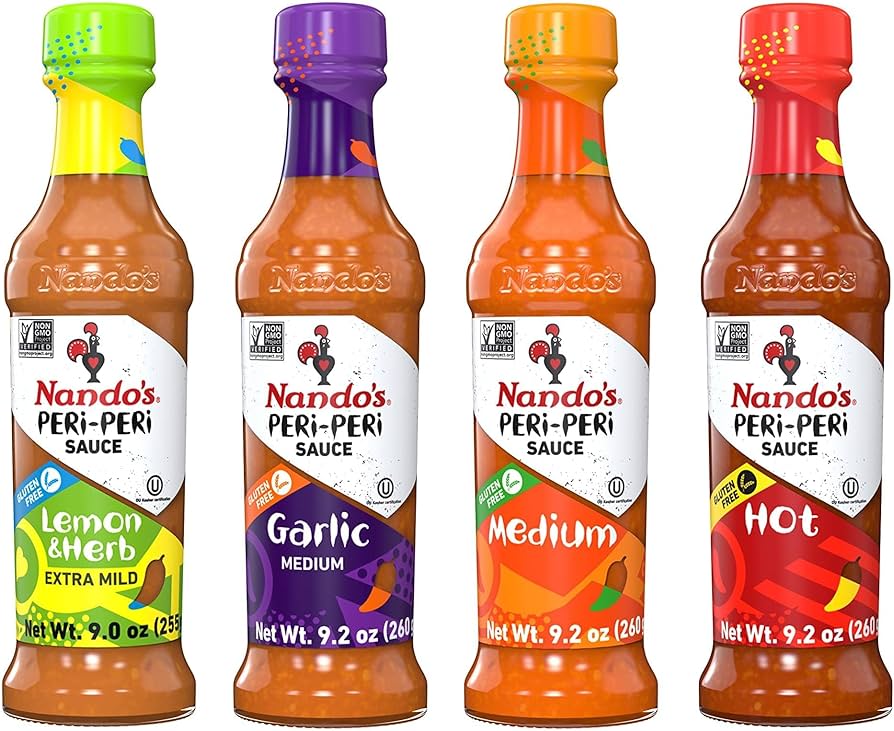
What makes Nando’s unique is its perfect marriage of Mozambican soul and South African swagger. The chicken is never frozen, fresh, butterflied, marinated for 24 hours in a secret PERi-PERi blend grown from Mozambican bird’s-eye chillies, then flame-grilled to order. Heat levels run from Plain to Extra Hot (with the legendary “XX Hot” that clears sinuses). Sides are pure fusion: Portuguese-style chips, spicy rice, coleslaw, or the cult-favorite “mushy peas.” The brand leans hard into cheeky South African marketing (“It’s a cheeky Nando’s!”), the Barcelos rooster logo (a classic Portuguese symbol), and an ethos that feels proudly post-apartheid.. diverse, irreverent, and proudly African-Portuguese.
By the late 1990s, Nando’s had already jumped to Australia with white South African emigrants and then conquered the UK, US, Canada, and beyond. Today it’s in over 30 countries, its sauce sold in supermarkets, and it remains the gold standard: the one that turned a refugee dish into a lifestyle brand.
Pedros: The People’s Flame-Grilled Champion
While Nando’s went global and upscale, @PedrosChicken stayed closer to its South African working-class roots, and that’s exactly why it exploded. Launched in the post-apartheid boom as an Afro-Portuguese flame-grilled chicken specialist, Pedros positioned itself as the fastest-growing, most accessible alternative. Its slogan is simple: “great Peri-Peri chicken at great prices.”
What sets Pedros apart is value and versatility. Full chickens, quarters, burgers, wraps, and meals come piled with chakalaka (a spicy bean relish) or Portuguese rolls. The peri-peri is bold but balanced, smoky from the grill, with that signature citrus-garlic kick, yet the menu stretches into family-friendly territory with combos that feed crowds without breaking the bank. It’s the chain you see in malls, townships, and highway stops across South Africa and Botswana, where it has become the go-to for quick, juicy, flame-kissed chicken that tastes like Sunday lunch at a Mozambican-Portuguese uncle’s house but costs less than a sit-down meal. Pedros proves the immigrant recipe didn’t need to go fancy; it just needed to stay honest and hungry for growth.
Galito’s (often spelled Garlito’s in casual talk): The 48-Hour Marination Marvel
Founded in 1996 in Nelspruit (now Mbombela), Mpumalanga.. right in the heart of the old Portuguese settler corridor.. @GalitosOfficial took the same Mozambican-Portuguese DNA and added serious technique. The chicken is marinated for a full 48 hours (some recipes cite at least 24) in house-blended piri-piri sauces that go far beyond plain heat. Flavors include classic Hot and Extra Hot, but also Lemon & Herb, BBQ, Garlic, and even milder options that let the smoke and citrus shine.
Galito’s uniqueness lies in that long, flavor-soaking process and its “fiery, fresh, flame-grilled” promise. The result is chicken that stays ridiculously juicy even at the highest heat levels. Ambience matters too—clean, welcoming restaurants with Afro-Portuguese murals and baskets of sauces on every table. From its South African base it has franchised aggressively into 17 countries (Kenya, Zambia, Canada, Malaysia, UAE, even Kazakhstan and Bangladesh). It’s the chain that proves peri-peri can travel anywhere once the marinade is perfected.
A Few More Worth Naming
- O’ Peri Peri - Smaller but fiercely proud, with the tagline “Sempre Portugues” (Always Portuguese). It keeps the no-frills, 24-hour-marinated, charcoal-grilled tradition alive in South African neighborhoods.
- Barcelo’s - Another fast-rising SA competitor mentioned alongside Pedros and Nando’s; it leans into the same rooster-and-flame aesthetic with strong local pricing.
- Independent “Mozambik”-style spots (like Rogerio’s in Johannesburg townships) still dot the landscape, run by descendants of the original 1970s immigrants, offering the purest, most backyard-Mozambique version, often with prawns on the side.
These chains didn’t just sell chicken. They bottled the story of displacement and resilience: Portuguese settlers fleeing majority rule in Mozambique, landing in a South Africa on the cusp of its own democratic rebirth, and turning a colonial-era fusion dish into a pan-African (and then planetary) obsession. The peri-peri sauce that once seasoned exiles’ nostalgia now flavors late-night orders in London, Dubai, and Sydney. Every time someone bites into a flame-grilled quarter with extra hot and a side of spicy rice, they’re tasting history, chilli peppers that sailed the Atlantic, met African soil, survived civil war and apartheid, and emerged triumphant on grills from Cape Town to the world.
That’s the real magic: one small red pepper, one wave of immigrants, and a continent’s worth of fire.


English