Justin Becker retweetledi

AI is cool and all... but a new paper in @ScienceMagazine kind of figured out the origin of life?
The paper reports the discovery of a simple 45-nucleotide RNA molecule that can perfectly copy itself.

English
Justin Becker
226 posts


@JustinSBecker
Thoracic oncologist and physician-scientist. Working to harness genomic dark matter to improve cancer immunotherapy. Views here are my own.



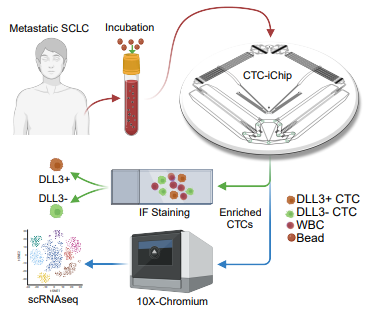
Now online: Circulating Tumor Cells Predict Response to the DLL3-targeting Bispecific Antibody Tarlatamab doi.org/10.1158/2159-8…

I share this enthusiasm for both model organisms and Drosophila, but the bigger tragedy of modern biology is our abandonment of the study of obscure biology just at the time when our ability to do so has become so powerful. Indeed many of the discoveries cited here came originally from experiments and observations in what we would call non-model organisms. Chromosome theory came from sea urchins and grasshoppers (and was validated in Drosophila), RNAi was first described in petunias and Neurospora before the mechanism began to be illuminated in nematodes, circadian clock genetics was worked out in flies, but a lot of important work was done in dinoflagellates.

Now online in @CD_AACR: Priming with DNMT Inhibitors Potentiates PD-1 Immunotherapy by Triggering Viral Mimicry in Relapsed/Refractory NK/T-cell Lymphoma - by Cheng Huang, Yan Gao, Jianfeng Chen, Choon Kiat Ong, Huiqiang Huang, and Jing Tan doi.org/10.1158/2159-8…
Happy to share our manuscript published today on regulation of cardiac adaptation to exercise training by PGC-1α and GDF15 in @NatureCVR! nature.com/articles/s4416…

Trump: “Hepatitis B is sexually transmitted. There's no reason to give a baby that's almost just born hepatitis B.”




After being stuck in Hong Kong after ISSCR meeting unable to fly back home, I managed to get on a plane to London to stay with family.. only to learn now in the air that our institute was hit. My team is all safe which is what matters. My lab sustained serious blast damage but we shall overcome! #PeaceNow Thanks for all the emails and messages.



Why don't Harvard/Stanford just raid their endowments to cover Trump’s research funding cuts? Take Harvard as a case study. They have a $53B endowment. That's massive! Harvard’s endowment pays out ~5% a year. That’s ~$2.6B in 2025. Covering the $3B shortfall from Trump's cuts is only ~1 additional year of spend. So why can't they simply tap into the endowment to make up for the loss of federal funds? Reason 1: 80% of the endowment is legally earmarked for a specific purpose. Every dollar in Harvard’s $53B pool is tagged with a donor’s intent. ~80% sits in ~14,600 micro-trusts dedicated to very specific purposes -- think “endow an AI research and teaching professorship” or “scholarships for students studying bioengineering”. Massachusetts trust law makes those gift agreements legally enforceable. To repurpose even a fraction, Harvard would need every donor’s consent or a court’s sign-off under the doctrine of cy pres -- an arduous, case-by-case slog. Violate the terms and you've violated the law. And trustees face personal liability for doing so. Bottom line: most of the endowment is not just restricted, it’s legally handcuffed. Reason 2: UPMIFA (Prudent Spending Law) The Uniform Prudent Management of Institutional Funds Act governs how nonprofits tap endowments. It ditched the old “never invade corpus” rule but replaced it with a fiduciary mandate: boards must preserve purchasing power for future generations and consider 8 statutory factors (inflation, expected returns, institutional needs, etc.) before spending the endowment. A one-off 10 % raid to plug lost grants might flunk that prudence test -- eroding inter-generational equity and exposing trustees to breach-of-duty claims. UPMIFA isn’t a guideline, it’s enforceable law. Boards can and have been hauled into court for less aggressive draws than a $3 B back-fill. Bottom line: massively tapping into the endowment in a way that puts it a long-term risk is often illegal. Reason 3: Debt Covenants & Financial Regs Harvard carries >$6B in tax-exempt bonds. Those require it to maintain healthy liquidity and a debt-service coverage ratio anchored by endowment support. A sudden multi-billion dollar withdrawal would crater those metrics, tripping technical defaults. That triggers cross-default across every outstanding series, giving bondholders the right to demand immediate repayment or higher interest. Add in SEC disclosure rules -- material adverse changes must be reported -- and a quick raid morphs into a compliance nightmare, potentially spooking investors and locking Harvard out of cheap capital markets for years. Bottom line: tapping into the endowment might trigger bond covenants and create a nightmare spiral for the endowment. Reason 4: Liquidity & Asset Allocation The $53B isn’t cash in a bank account. Nearly 60% of Harvard’s endowment sits in illiquid assets -- venture, private equity, real estate, natural resources, etc -- locked up for 7–15+ year horizons. Liquidating those assets to raise billions on short notice means fire-selling stakes in the secondary market at deep discounts (20-60 % haircuts are common). Worse, dumping public equities to get cash skews the portfolio toward illiquids, hurting risk balance and future returns. Doing so would also require a structural re-design of the portfolio, which is slow, costly, and value-destructive. Bottom line: Harvard doesn't actually have $53B to spend -- the total value of it's portfolio is $53B but turning that into cash quickly would dramatically lower the actual value. Reason 5: Impact on Credit & Operations S&P and Moody’s give Harvard their coveted AAA in large part because of its massive, intact endowment. Lop off $3B and ratings models light up: weaker coverage ratios, thinner liquidity, higher market risk. A ratings downgrade leads to higher rates, adding potentially hundreds of millions in additional costs each year. Or worse, limiting the endowments ability to borrow. Pulling cash today hollows out the payout stream tomorrow, forcing austerity: hiring freezes, deferred maintenance, cuts to financial aid, etc. Filling the shortfall would fundamentally change Harvard’s operating budget for a decade. Bottom line: Suddenly spending billions would spook the ratings agencies, significantly raising borrowing costs or limiting borrowing potential. Could any one of these impediments be overcome? Likely. But put together they make it damn near impossible for universities to simply tap into their endowments to cover federal funding cuts.



A remarkable escalation by Trump blocking international students from Harvard For many labs (including the one I led) many of the most advanced research is by international students and trainees International trainees are core to Harvard’s research nytimes.com/2025/05/22/us/…

Harvard notified me today that this K99 grant is terminated.