Once Again Sheikh Hasina

3.5K posts

Once Again Sheikh Hasina banner
Once Again Sheikh Hasina

Once Again Sheikh Hasina

@OnceAgainHasina

Activists For Peace and Bangladesh | @albd1971 | Once Again Sheikh Hasina | @OnceAgainHasina |

Bangladesh Katılım Ekim 2023
27 Takip Edilen9.5K Takipçiler
Sabitlenmiş Tweet
Once Again Sheikh Hasina
Once Again Sheikh Hasina@OnceAgainHasina·
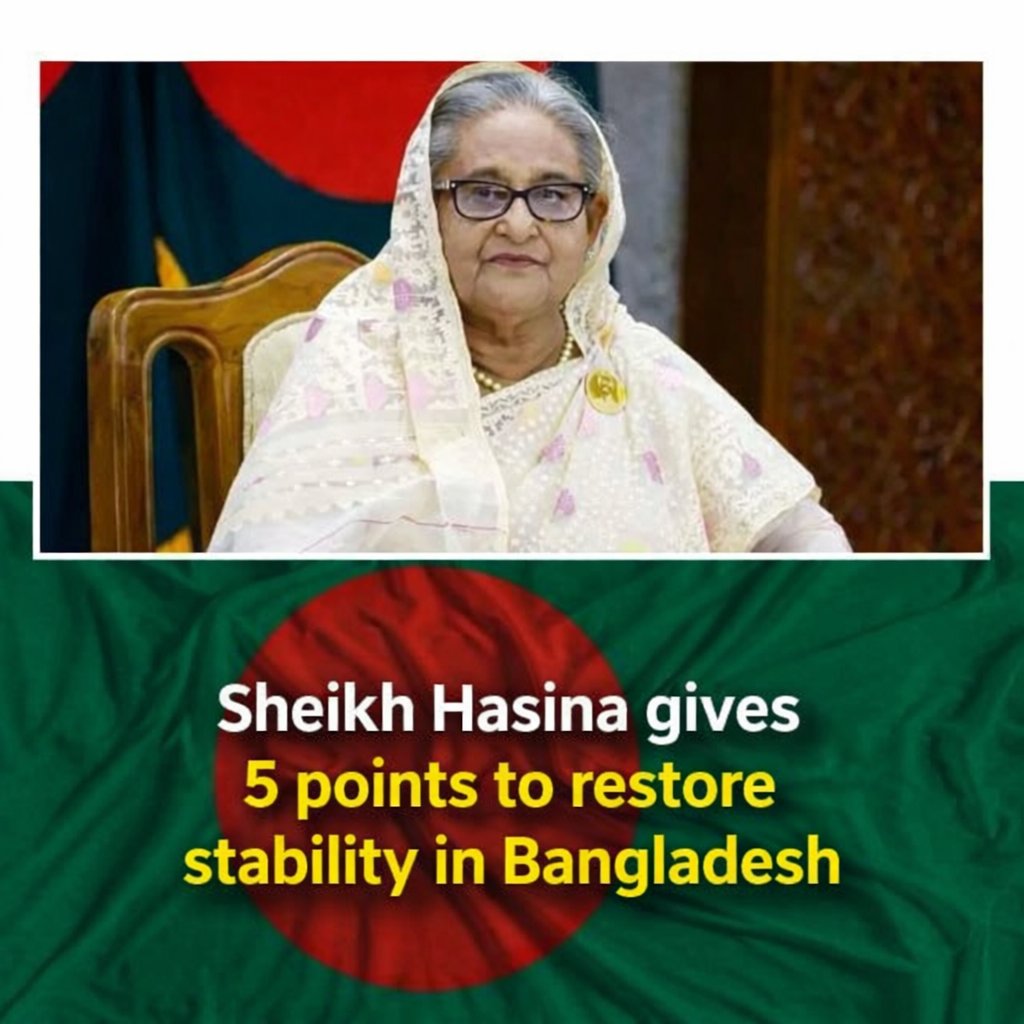
Sheikh Hasina gives 5 points to restore stability in #Bangladesh ———— People's leader #SheikhHasina has addressed the nation for the first time since the political upheaval. She delivered the speech through an audio message at an event titled 'Save #Democracy in Bangladesh' organized at the Foreign Correspondents' Club (FCC) in New Delhi, India. Sheikh Hasina accused the Interim Government's Chief Advisor @Yunus_Centre of leading an 'illegal, violent' administration. In her speech, she repeatedly referred to @ChiefAdviserGoB as a 'squatter', 'money launderer' and 'power-hungry traitor'. Sheikh Hasina said, "Bangladesh is standing on the brink of destruction today." She alleged that the country has now become "a huge prison, a slaughterhouse and a valley of death." She claimed that #humanrights are being trampled, press freedom has been abolished and #violence against women and minorities is spreading. Describing the August 5 uprising as a “carefully orchestrated conspiracy,” Sheikh Hasina said that democracy in Bangladesh has been in exile since that day. According to her, law and order in the country currently does not exist and #mobviolence, looting and extortion have taken hold from the capital to the villages. She blamed extremist groups and foreign interests for this. Sheikh Hasina claimed that Dr. Yunus is pushing Bangladesh towards a larger regional conflict by handing over national resources and strategic interests to foreign powers. She said, “By deceiving the nation, the murderous fascist Yunus is leading our beloved motherland towards disaster.” Sheikh Hasina raised five main demands in her speech to restore stability in Bangladesh: 1. Remove the ‘illegal Yunus administration’ to ensure an environment for free and fair elections. 2. Restore public security by stopping daily violence. 3. Provide strong assurances for the protection of religious minorities, women and vulnerable populations. 4. Close politically motivated cases against #Journalists and @albd1971 leaders and activists and restore the impartiality of the judiciary. 5. The @UN must conduct a "new and impartial investigation" into the events of the past year. Finally, he claimed the #AwamiLeague as the "only legitimate guardian" of democracy in Bangladesh and called on the pro-liberation forces of the liberation war to unite to restore the constitution. At one point in his speech, #Bangabandhu's daughter Sheikh Hasina also challenged Yunus to fight against her in any seat. @sajeebwazed @nytimes @amnesty @UN_HRC @UN_News_Centre @WSJ @UNHumanRights @ALBDMedia @UN @BBC @Reuters @UN_SDG @AP @hrw @HRUpdatesbd @bdwatch2024 @ANI @MHCN983 @MAarafat71 @ctgchatter @saddamhussainbd @ArifaRahmanRuma
Once Again Sheikh Hasina tweet media
English
4
28
111
3.4K
Once Again Sheikh Hasina
Once Again Sheikh Hasina@OnceAgainHasina·
#EidMubarak 🇧🇩 May this holy Eid bring peace, blessings and joy to you and your family. Wishing you a happy Eid-Al-Fitr!
Once Again Sheikh Hasina tweet media
English
1
1
11
121
Once Again Sheikh Hasina retweetledi
Bangladesh Awami League
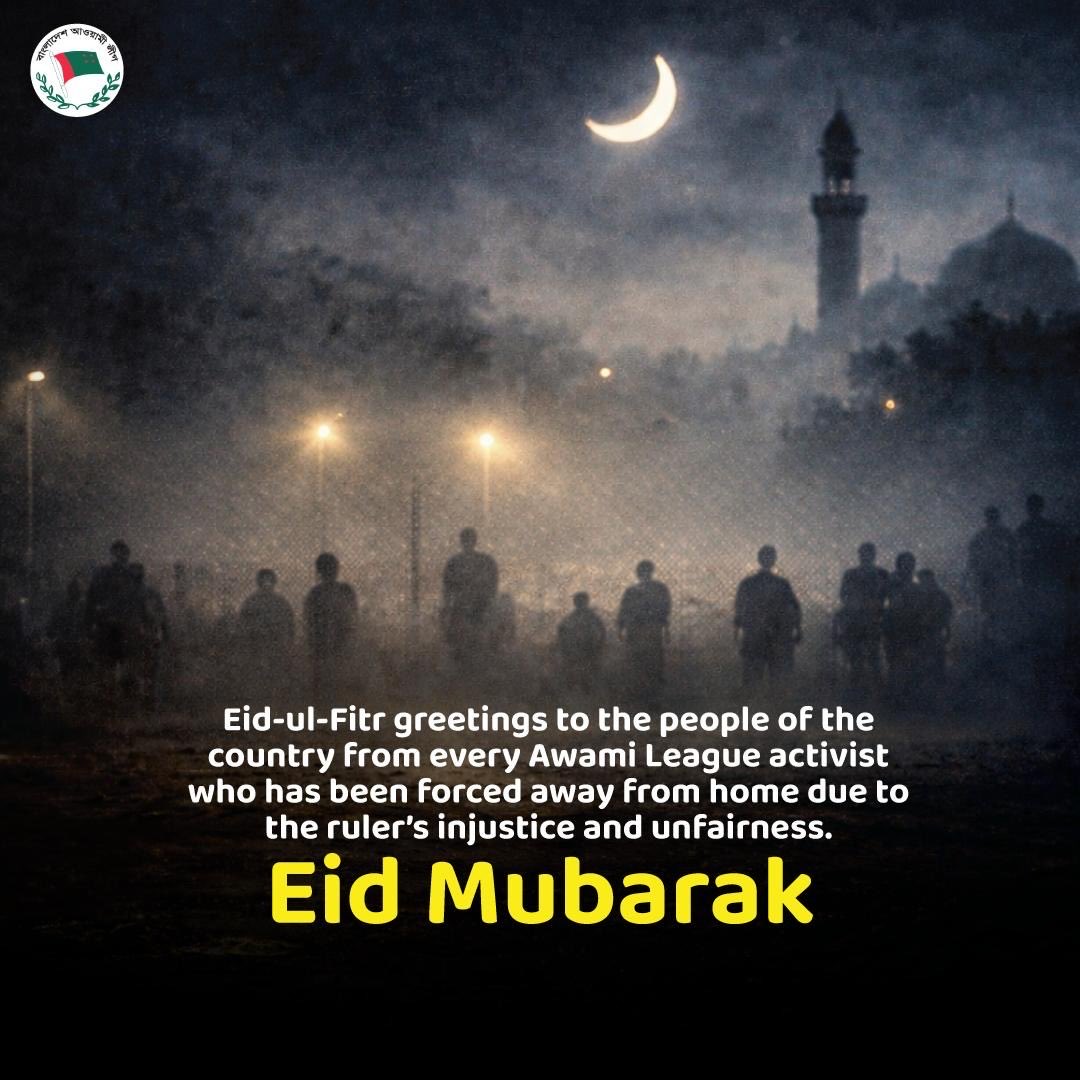
Like last year, this year too, millions of leaders and activists of the Bangladesh Awami League are unable to share the joy of Eid with their families. Many of them have no proven charges against them. Yet case after case hangs over their heads. Out of fear of mob violence, having lost their jobs and businesses, these displaced individuals are living in inhumane conditions. Many of them were the sole earners of their families. Have you ever wondered how they and their families are spending their Eid? Eid means food cooked by a mother’s hands, embracing one’s father after prayers, and the laughter of younger siblings. Thinking of these memories, a young man longs to return home, but his parents cannot give their consent. When his friends post photos on social media in new clothes, smiling and writing “Eid Mubarak,” the heart of that young man - once involved in student or youth politics - grows heavier as he sits far away. For us, Eid is not just a festival; it is a longing to return home, an irresistible pull to be with loved ones. When will these innocent people associated with Bangladesh Awami League politics return to their homes? When will they regain their normal lives, their families, their Eid? Eid-ul-Fitr greetings to the people of the country from every Awami League activist forced away from home due to the ruler’s injustice and unfairness. Eid Mubarak. #EidMubarak #Bangladesh #AwamiLeague
Bangladesh Awami League tweet media
English
4
24
65
971
Once Again Sheikh Hasina retweetledi
Bangladesh Watch
Bangladesh Watch@bdwatch2024·
What Mirza Fakhrul Islam Alamgir’s Comments on the AL Ban Say About BNP’s Commitment to Democracy Yesterday, Secretary General of the Bangladesh Nationalist Party (#BNP) made the following remark on the ongoing ban on #AwamiLeague (AL’s)’s activities: “Since the AL's activities are now banned, they are closed and will remain closed. The others who are left will work and are working. The AL will try to carry out some activities, they are doing so. There is no gain…People have completely rejected them?” Three key points emerge from this statement. First, the BNP appears willing to continue the repressive policy of the #Yunus-led Interim Govt, which indefinitely suspended the activities of AL under a controversial amendment to the Anti-Terrorism Act, 2009. This is despite BNP’s own stated position as previously articulated by the top policymakers.  Second, the remark that “others who are left will work and are working” likely refers to smaller AL-allied political parties, such as the #JatiyaParty and other left-leaning groups within the 14-party alliance. This gave the impression that it is up to the BNP as to which party can operate or not in the Bangladeshi political landscape.  Third, the assertion that the AL has been “completely” rejected by the people is presented as a settled political fact, despite the absence of any competitive electoral process involving all major parties.  Elaborating on the first point, this appears inconsistent with BNP’s previously stated stance on political party bans. In Nov 2024, Alamgir himself stated that the BNP does not support banning any political party. See:  tbsnews.net/bangladesh/pol…    Moreover, BNP chairman and current PM #TariqueRahman, in a @bbcbangla interview, emphasized that any alleged wrongdoing by the AL should be addressed through the law. He noted that accountability must be established through legal mechanisms, whether for individuals or orgs. See:  daily-sun.com/post/831190 Taken together, these positions suggest that a ban on the AL would only be justified if an independent court or tribunal had found the party guilty of serious offenses. However, no such judicial process has taken place. This raises a critical question: Were the earlier statements merely pre-election rhetoric, with current comments revealing their true position? That is a reasonable conclusion. The continuation of the ban appears politically expedient. By excluding its primary rival from the recent parliamentary elections, the BNP effectively got a one-sided election in their favour. Looking ahead, with local govt elections expected within the next year, the persistence of the ban could once again advantage the BNP, allowing it to consolidate power in a largely uncontested political landscape. The BNP has long projected itself as a champion of democratic values, crediting its founder Ziaur Rahman with restoring parliamentary democracy, and portraying the late #KhaledaZia as an uncompromising democratic icon. Yet, when it comes to translating rhetoric into practice, the party’s record raises serious questions. Time and again, BNP has been associated with actions that undermined democratic norms. From unilaterally holding parliamentary elections in 1996 without the participation of all major parties, to manipulating the caretaker govt system in 2006 to install a preferred person, the pattern is difficult to ignore. This is further compounded by its reliance on political violence and its role in politicising history for partisan ends. In the present context, the continuation of the ban on the AL’s activities, participation in successive one-sided elections at both national and local levels, the arbitrary detention of thousands of political activists without trial, and the use of anti-terrorism laws to suppress dissent all point to a troubling continuity rather than a break from the past. … #BangladeshCrisis #Democracy @Ginitastar @StateDRL @ESandersFCDO @PearsonElaine @Chellaney @MujMash
Bangladesh Watch tweet media
English
6
17
33
2.3K
Once Again Sheikh Hasina retweetledi
Mohammad Ali Arafat
Mohammad Ali Arafat@MAarafat71·
The individuals shown in the image have all passed away. They were affiliated with the Awami League as leaders and activists at different levels. During the tenure of the @Yunus_Centre administration, they were arrested and detained. In many cases, their families have alleged, and available evidence indicates that they were subjected to physical abuse and denied proper medical care, leading to their deaths, which are being described as instances of extrajudicial killing. Among them, several had participated in the Liberation War and contributed to the birth of Bangladesh. Yet, in that very Bangladesh, they were deprived of legal rights and denied the right to bail. At least 526 people have reportedly been killed under the government led by Yunus. According to human rights organizations, 128 people were killed through mob violence in 2024, and 166 in 2025. Law enforcement agencies under Yunus carried out extrajudicial killings of 45 individuals. During Yunus’s rule, 187 people died in prison, most of whom were Awami League leaders and activists. After the interim government led by Yunus took power, there was a surge in widespread killings and the filing of fabricated cases to suppress dissenting voices in Bangladesh. Not only Awami League leaders and activists, but also innocent people with even distant connections to the party were arrested and imprisoned. With direct intervention from the Yunus government, these individuals were deprived of their right to bail. The record of those killed during their tenure is enough to understand what the rule of NGO figures and so-called civil society representatives—who often speak about human rights—actually looked like. Many people question the number of deaths during Yunus’s tenure. Therefore, this effort has been made to publish a list with photos. Today’s first installment includes the names and images of 42 individuals, along with the prisons where they were held. The list was compiled by journalist @TaimurTusher who himself became a target of the Yunus administration and was forced to leave the country. It is important for the world to recognize the true nature of Yunus and his associates, who have long relied on rhetoric about human rights and the rule of law as a foundation for their NGO activities. #HumanRightsCrisis @AgnesCallamard @IHRF_English @IHumanRightsC @IhrcE @FCDOHumanRights @RapporteurUn @FranceskAlbs @Kennedy_HRC @SouthAsiaHudson @EUAmbBangladesh @CWhiteleyEU @USAmbBangladesh @StateDRL @DRL_AS @LisaCurtisDC @State_SCA @SergioGor @BobBlackman @usembassydhaka @AyorkorBotchwey @husainhaqqani @DerekJGrossman @MichaelKugelman @dhume @CJBdingo25 @Chellaney @mrubin1971 @ChathamHouse @kajakallas @bronwenmaddox @lelispatricia @patlakath
Mohammad Ali Arafat tweet media
English
0
41
99
2.2K
Once Again Sheikh Hasina retweetledi
Mohammad Ali Arafat
Mohammad Ali Arafat@MAarafat71·
This is only the beginning. The roots of @albd1971 run deep across Bangladesh, grounded in the spirit of Liberation, democracy, justice, rule of law, and freedom of expression. The people’s voice cannot be silenced for long. It won’t be long before the Awami League rises again with the people’s mandate—to strengthen democracy and continue Bangladesh’s journey of progress and development. 🇧🇩 facebook.com/share/1DdJ69my…
Mohammad Ali Arafat tweet media
English
0
19
75
1.1K
Once Again Sheikh Hasina retweetledi
Bangladesh Awami League
Bangladesh Awami League@albd1971·
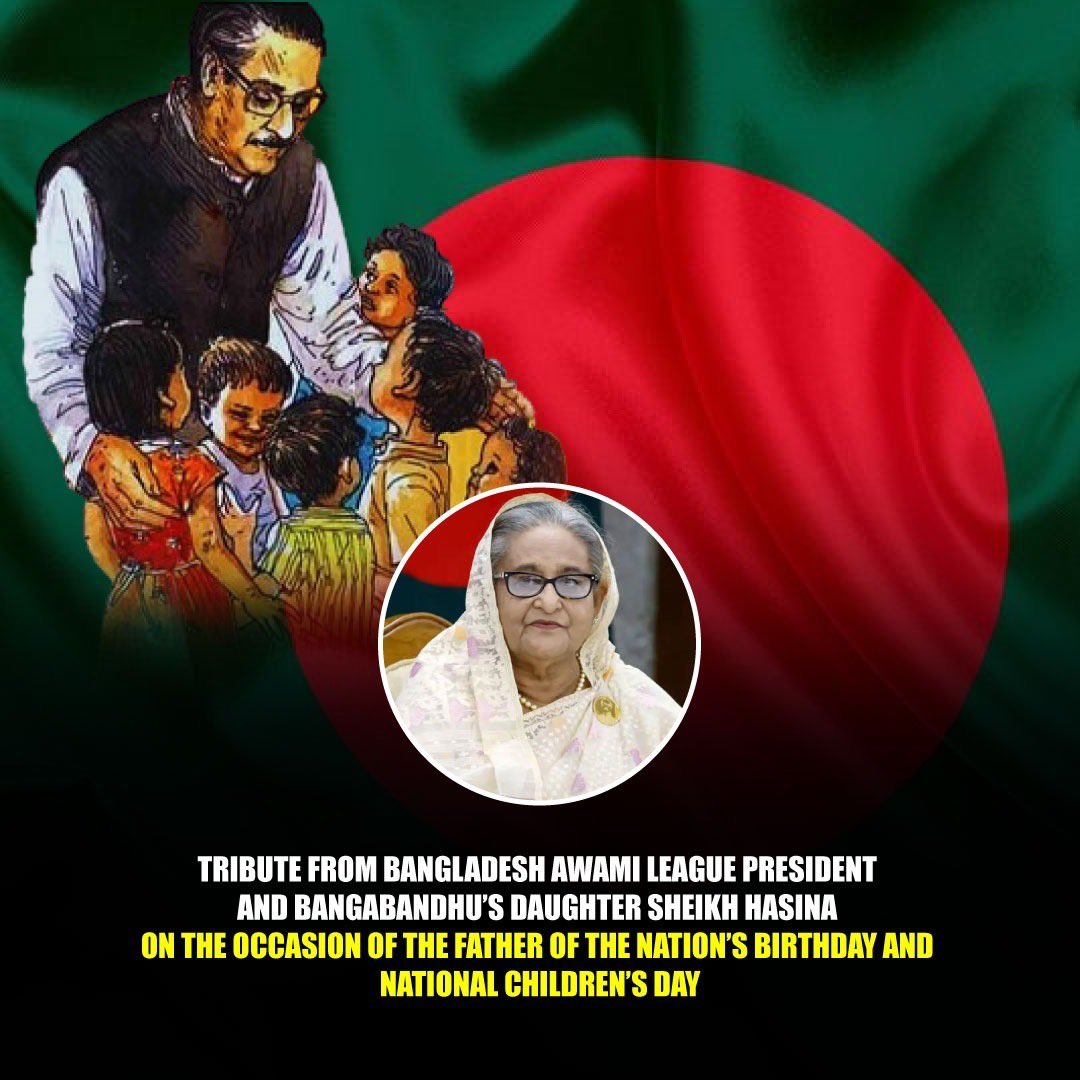
Tribute from Bangladesh Awami League President and Bangabandhu’s Daughter Sheikh Hasina on the Occasion of the Father of the Nation’s Birthday and National Children’s Day March 17, 1920…On this day in 1920, the greatest Bengali of all time and the Father of the Nation, Sheikh Mujibur Rahman, was born in Tungipara, Gopalganj, then part of Faridpur District. During his lifetime, the birthday of the Father of the Nation was observed without grandeur. On this day, he preferred to spend time with children. In recognition of this tradition, the government led by the Bangladesh Awami League introduced the practice of celebrating the day as National Children’s Day. However, taking advantage of political changes, an illegal occupying regime later cancelled all official programs associated with the historic March 17, including National Children’s Day. On the 105th birth anniversary of the Father of the Nation and on National Children’s Day, today I remember him with deep respect and extend my love and greetings to our beloved children. The child who grew up on the banks of the Madhumati River, later known to the world as Bangabandhu - Sheikh Mujibur Rahman - did not only give us an independent territory; he gave us the identity of a proud and dignified nation. As we observe his birth anniversary today, Bangladesh and the entire world are passing through a turbulent time. People who seek peace around the globe are suffering from violent aggression and instability. In such a crisis, Bangabandhu’s historic principle —“Friendship to all, malice toward none”— is more relevant to the world today than ever before. He always wanted Bangladesh to walk its own path with dignity, without becoming a pawn in any military alliance or the sphere of influence of any superpower. The current political situation in the country, marked by various conspiracies and the arrogance of undemocratic forces, has created a prolonged period of uncertainty. Bangabandhu taught us: “No one can suppress us.” These times of uncertainty, oppression, and persecution will pass if we remain steadfast in Bangabandhu’s ideals of building a secular, exploitation-free, and democratic ‘Sonar Bangla.’ To the children and young generation, I say: pursue higher education, but also learn from the courageous life and struggles of Bangabandhu. Build your lives inspired by his ideals. With honesty, patriotism, and courage, you must stand firm against any aggression. Let the realization of the Father of the Nation’s dream be the guiding mission of our lives. Joy Bangla. Joy Bangabandhu. May darkness fade and dawn arrive. May Bangladesh live forever. #Bangladesh #SheikhMujiburRahman
Bangladesh Awami League tweet media
English
23
42
195
2.5K
Once Again Sheikh Hasina retweetledi
Bangladesh Watch
Bangladesh Watch@bdwatch2024·
It is surprising that @TheEconomist described the Islamist revival as the “biggest surprise” in post–August 2024 #Bangladesh in their recent article. See: economist.com/asia/2026/03/1… For anyone even marginally familiar with the country’s political history, however, this outcome was largely predictable. Following the fall of the #AwamiLeague Govt, #Islamist orgs rapidly moved to consolidate influence across several key sectors of the state and society. Individuals linked to Islamist networks began occupying key positions within administrative and constitutional bodies, while Islamist #student groups expanded their presence across public university campuses. At the same time, their influence was increasingly visible within law enforcement and security agencies. The growing influence of parties such as #JamaatEIslami during the Interim Govt led by Muhammad #Yunus became so pronounced that some observers began referring to the administration as an unofficial Jamaat govt. This shift was accompanied by the systematic removal or marginalisation of individuals perceived to be secular or liberal from institutions including the civil administration, police, media orgs, and universities. The political landscape shifted further with the exclusion of secular alternatives, most notably through the ban on the activities of the #AwamiLeague and its exclusion from the electoral processes. It is worth recalling that the push for this ban was strongly advocated by Jamaat, its Islamist allies, and the National Citizen Party (#NCP), which organised sustained political pressure and mobilisation before the prohibition was imposed. The result was a dramatically narrowed electoral field. With the Awami League excluded from political participation, voters were effectively left choosing between two broadly similar ideological camps: the centre-right #BNP on one hand and the far-right Islamist alliance led by Jamaat on the other. In practical terms, this meant an electoral contest between political forces that had historically been allied against the Awami League for decades. In a country like Bangladesh, citizens depend heavily on political actors for everyday stability and access to resources. Faced with limited options, many voters would rather participate in a flawed election, one that excludes their preferred party or candidate, than abstain from the political process entirely. Thus, when Bangladeshis went to the polls in February 2026, their effective choice was between the Islamist-leaning BNP and a coalition of explicitly Islamist parties. Given these conditions, the outcome should hardly have been unexpected. So the question remains: What exactly was so surprising about it? … #BangladeshCrisis #TheEconomist @tom_sasse
Bangladesh Watch tweet media
English
1
10
13
659
Once Again Sheikh Hasina retweetledi
Bangladesh Watch
Bangladesh Watch@bdwatch2024·
A month after the departure of the Interim Government, #journalists are finally beginning to speak openly about the climate of fear and intimidation that characterised their work under the #Yunus Regime. In a revealing op-ed, senior journalist and Executive Editor of #Bangladesh Pratidin, one of the highest-circulated Bengali daily newspapers, AKM Manjurul Islam described what he says was a deeply restrictive environment for #media orgs during the tenure of the Nobel Peace Laureate Muhammad Yunus’s administration. In the piece, Manjurul makes a series of serious allegations, claiming that his media group, comprising among others, Bangladesh Pratidin, Daily Sun, and Kaler Kontho, was specifically targeted by the administration. According to him, the pressure came through multiple institutional and financial channels designed to marginalise their publications, including:  - Exclusion from official events: Journalists from the group were reportedly uninvited from covering key state functions, including the swearing-in ceremony of the newly elected government. - Denial of government supplements: The publications were deprived of government supplements traditionally published on nationally significant days throughout the entire duration of the regime. - Withdrawal of government advertising: The newspapers allegedly received no government advertisements during the period, a move that significantly affected revenue streams. (It should be noted that government ads and supplements are not charity but rights of newspapers which is supposed to be awarded based on circulation figures) - Non-payment of outstanding advertising bills: Pending payments for advertisements were not cleared, including payments from private sector entities that Manjurul claims were withheld under political pressure. - Late-night raids on printing presses: He alleges that sudden midnight raids were carried out at the group’s printing facilities in Dhaka and Bogura by officials from the Department of Film and Publications (DFP) under the Ministry of Information. - Restrictions on newsprint supply: The media group was also deprived of its designated quota of newsprint paper, which is essential for the publication of printed newspapers. - Lack of access to government officials: Manjurul Islam claims that their media org could not secure meetings with, let alone receive cooperation from, from successive Information Advisers of the Interim Govt, namely Nahid Islam, Mahfuj Alam, and Rizwana Hasan. Beyond institutional pressure, Manjurul also alleges that non-state actors were mobilised as part of a broader campaign of fear and intimidation against media outlets. According to him, journalists from the group faced mob threats and pressure from the regime-backed Students Against Discrimination (SAD) movement.  He further claims that SAD activists and certain political actors submitted lists of individuals who were to be removed from or appointed to positions within media organisations. Some of these lists reportedly contained as many as 50 to 72 names, effectively dictating who should be fired or hired within newsrooms. Taken together, these allegations paint a picture of systematic campaign of pressure on certain parts of the media landscape under the Yunus Regime, combining economic restrictions, administrative hurdles, and intimidation tactics to influence editorial independence. OpEd (Bangla):  bd-pratidin.com/Special-arrang…        … #BangladeshCrisis #PressFreedom #MediaFreedom @hrw @pressfreedom @MediaFreedomC @amnestysasia @CPJAsia @RSF_inter @ifjasiapacific @StateDRL @ESandersFCDO @volker_turk @Irenekhan @UNHumanRights @PearsonElaine @AgnesCallamard @UNinBangladesh @usembassydhaka
Bangladesh Watch tweet media
English
2
23
35
1.9K
Once Again Sheikh Hasina retweetledi
Bangladesh Watch
Bangladesh Watch@bdwatch2024·
“Many innocent people have been arrested and detained in jails. If you go to any jail in Bangladesh, you will see they are filled with the activists of one particular political party. Even supporters of the party are being detained, people who have held no formal political positions. I shared the cell with one young man who has been slapped with five cases. After getting bail in those cases, he was then “shown arrested” in two fresh cases to prevent his release”. - Anis Alamgir (15 March, 2026) Senior journalist Anis Alamgir was arrested by the #Yunus-led Interim Govt on 14 December 2025 under the controversial amendment to the Anti-Terrorism Act 2009. He was subsequently “shown arrested” in another case filed by the Anti-Corruption Commission (ACC) on 28 January 2026, deliberately prolonging his detention. Alamgir was finally released from Kashimpur Central Jail in Keraniganj, #Dhaka, on 14 March 2026 after securing bail in both cases. Following his release, he shared the above remarks with the media over the phone, describing his experience in prison and the widespread use of the practice of “shown arrested” to keep detainees incarcerated even after courts grant bail. The political party he refers to in his comments, if it was not already obvious, is the #AwamiLeague. Interview: 
facebook.com/share/v/1CCr71…#BangladeshCrisis #PressFreedom @CPJAsia @RSF_inter @ifjasiapacific @MediaFreedomC @StateDRL @amnesty @hrw @Irenekhan @volker_turk @UNHumanRights @UN_HRC @ESandersFCDO @TheDavidBergman @PearsonElaine @hrw @EURightsAgency @Ginitastar @MujMash @guardian
Bangladesh Watch tweet media
English
0
13
22
425
Once Again Sheikh Hasina retweetledi
Bangladesh Watch
Bangladesh Watch@bdwatch2024·
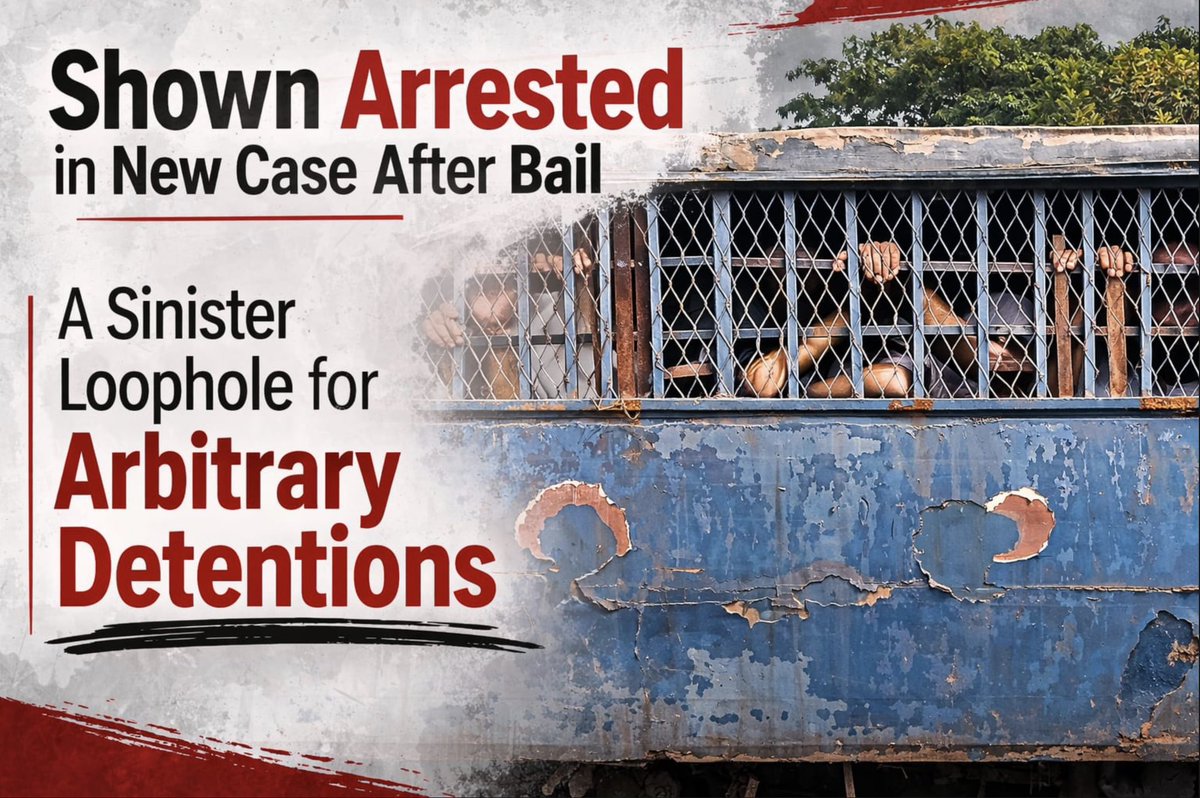
“Shown Arrested” in New Cases After Bail is Granted — A Sinister Loophole for Arbitrary Detentions in #Bangladesh Journalist @TheDavidBergman notes that a month into the premiership of #TariqueRahman, the #BNP Govt’s continued reliance on “shown arrested” cases against individuals associated with the #AwamiLeague raises serious questions about its commitment to the rule of law. Rahman spoke of “ensuring the rule of law,” in his first press conference, yet the ongoing use of this practice suggests those words may remain just that—words. As Bergman observes, the BNP government appears to show little concern for the rule of law when it comes to detaining political opponents. What does “shown arrested” mean? “Shown arrested” refers to an abuse of the criminal justice process by the executive and/or law enforcement agencies. Under this practice, a person who is already detained is re-arrested in a new case (often with questionable or fabricated allegations) immediately after being granted bail in an existing one, allowing authorities to keep them incarcerated indefinitely. This mechanism was widely abused under the #Yunus-led Interim Govt to keep AL-affiliated individuals detained for prolonged periods. Following the formation of the new BNP Govt, rather than the practice ending, it appears to have intensified. What does the law say? The governing provision is Section 167A of the Code of Criminal Procedure, which states that if a person already in custody is to be shown arrested in another case, a magistrate should allow this only if the application appears to be “well-founded.” In principle, this means a person should not be shown arrested in a new case unless there is genuine and substantial evidentiary basis linking them to that case. In practice, however, this safeguard appears largely ignored. Magistrates regularly approve such applications with little scrutiny, raising concerns that courts are acting in line with executive diktats rather than independently assessing the merits of the police application. Notable Examples A striking example of the abuse can be witnessed in the case of former Chief Justice ABM Khairul Haque. On 11 March, the High Court granted Justice Haque final bail in the various cases pending against him. However, the process of releasing him was immediately stalled after police filed an application to show him arrested in yet another case, a murder case from July 2024. Notably, Haque was not even named in the original FIR. As Bergman wrote, the allegation “seems wholly fabricated”, i.e. an attempt to prevent his release. A similar pattern emerged in the case of Selina Hayat Ivy, the former Mayor of Narayanganj. Ivy was recently granted bail in five separate cases. Yet shortly afterward, police filed another application seeking to show her arrested in a different case that again appeared plainly fabricated. When the matter came before the magistrate, the crucial legal question should have been whether the police application was “well-founded.” But once again, the court did not appear to independently examine the evidential basis of the claim before approving the application. Report: thedailystar.net/opinion/news/c… Human Cost of Abuse Beyond legal principles, the human consequences of this abuse are severe. Yesterday, Bangladesh Watch highlighted the devastating impact of the “shown arrested” practice on detainees and their families through the tragic example of former Chhatra League leader Shafiqul Islam. Shafiq died after being subjected to this malpractice for eight and a half months. His prolonged incarceration, sustained through repeated “shown arrested” applications, illustrates the human toll of a system where legal safeguards are ignored. Reference: thedailystar.net/news/banglades…#BangladeshCrisis @amnestysasia @hrw @Ginitastar @StateDRL @volker_turk @UNHumanRights @ESandersFCDO @EURightsAgency @meeganguly @PearsonElaine @IBAHRI @justiceinfonet @UN_SPExperts @AgnesCallamard @UN_HRC
Bangladesh Watch tweet media
English
3
23
34
863
Once Again Sheikh Hasina retweetledi
Bangladesh Awami League
Bangladesh Awami League@albd1971·
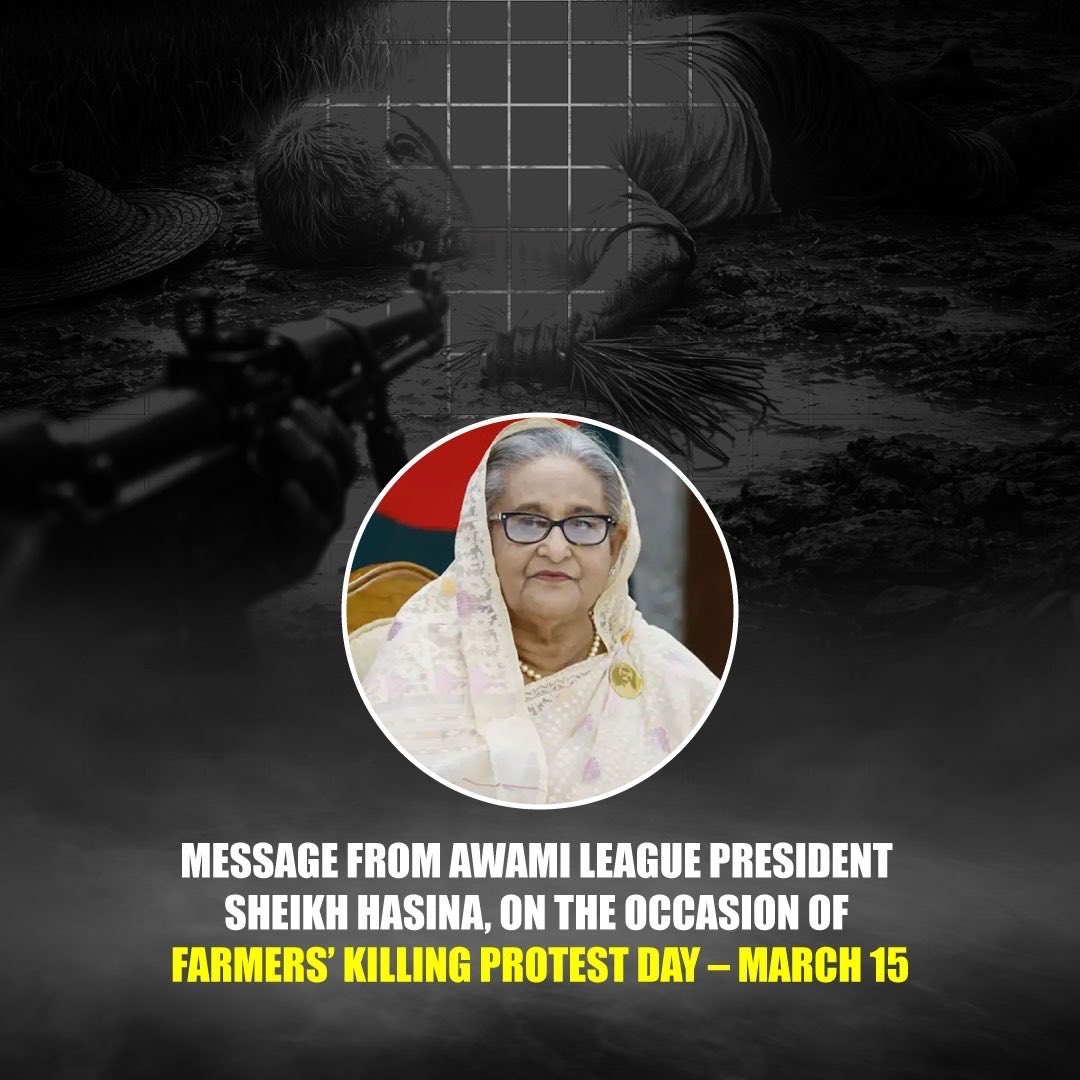
On March 15, 1995, 18 farmers were killed when indiscriminate gunfire was opened on protesting farmers who had taken to the streets demanding fertilizer. Since then, the Bangladesh Krishak League has commemorated the day each year as “Farmers’ Killing Protest Day.” Bangladesh is an agriculture-based country. Agriculture and farmers are the backbone of the nation’s economy. The lives and livelihoods of the people of Bangladesh are deeply intertwined with agriculture. Quietly but significantly, the farming community continues to play a vital role in the advancement of our civilization and culture. Farmers are tireless warriors and a blessing to humanity from the Almighty Creator. Despite enduring humiliation and hardship, they continue to supply food for all. Those farmers whose sweat and labor ensure our food security had their blood shed and their lives taken in 1995. This remains a dark chapter in the history of independent Bangladesh. As part of a conspiracy to undermine the benefits of independence and disrupt food production in the country, the then BNP–Jamaat alliance government killed 18 innocent farmers throughout March 1995. A severe fertilizer shortage emerged due to the sale of fertilizer on the black market instead of ensuring supply to farmers. When farmers could not obtain fertilizer at affordable prices, protests erupted across different districts against the black marketeers. During that time, there was an attempt to suppress the farmers’ legitimate movement with ruthless bullets. Guns were turned against the chests of farmers. The soil of Bengal, already soaked with the sweat and labor of farmers, was once again stained with their fresh blood. Among those brutally killed that day were: Shaheed Atik from Ghatail Upazila of Tangail District; Shaheed Khalek from Sadar Upazila of Jamalpur District; Shaheed Kabir from Melandah Upazila; Shaheed Nityananda from Netrokona District; Shaheed Rafiq from Phulpur Upazila of Mymensingh District; Shaheed Maksud Mia from Kishoreganj District; and Shaheed Tuku Mia and Shaheed Momin from Gobindaganj Upazila of Gaibandha District. The Bangladesh Awami League government has always been a farmer-friendly government. The Awami League believes that the development of agriculture and farmers means the development of Bangladesh. For that reason, soon after independence, the Father of the Nation, Bangabandhu Sheikh Mujibur Rahman, incorporated into the Constitution of Bangladesh the responsibility of the state to take effective measures for an agricultural revolution, to improve the nutritional standards of the people, and to enhance public health. Whenever we have been entrusted with the responsibility of governing the country, we have ensured that farmers receive the necessary agricultural inputs at affordable prices. Despite facing multiple economic pressures, we provided large subsidies on fertilizer and ensured its availability to farmers at low cost. As a result, there was never a fertilizer crisis during the tenure of the Awami League government. Consequently, during the Awami League’s term from 1996 to 2001, Bangladesh achieved food self-sufficiency for the first time. Later, when the BNP–Jamaat-led four-party alliance came to power, the country was pushed back into a food deficit. After forming the government again in 2008, the Awami League transformed Bangladesh from a food-deficit country into a food-surplus nation. Today, however, the country appears to be slipping back into the same old cycle. Shortages of fertilizer, fuel, and agricultural inputs are becoming visible. The question now is: will farmers focus on cultivation, or will they be forced to spend their time protesting for these basic necessities? We believe that if farmers survive, the nation survives; if farmers thrive, the people thrive. That is why the Awami League government has always remained committed to ensuring the supply of fertilizer and other essential inputs for agriculture. Joy Bangla!
Bangladesh Awami League tweet media
English
4
28
87
1.1K
Once Again Sheikh Hasina retweetledi
Bangladesh Watch
Bangladesh Watch@bdwatch2024·
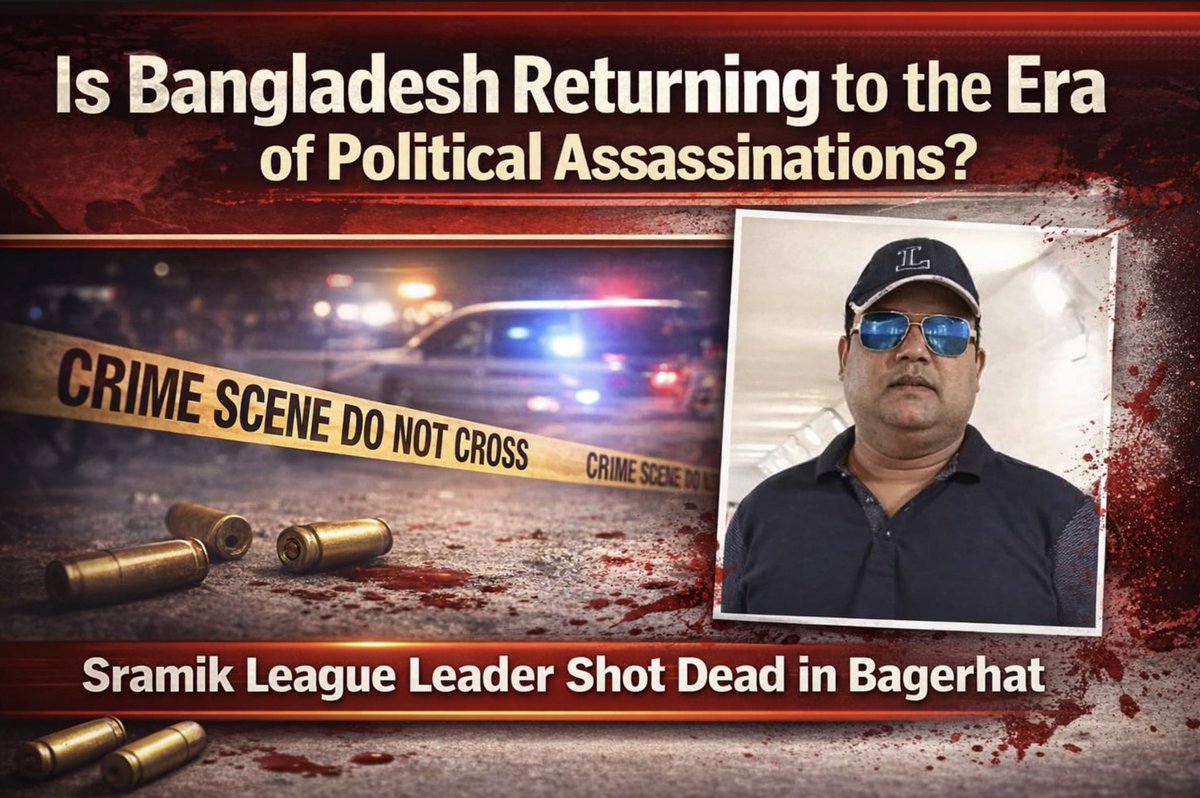
Is #Bangladesh returning to the era of political assassinations that characterised the last #BNP-led Govt (2001–06)? On Saturday night in #Bagerhat, a local leader of Sramik League, the labour wing of #AwamiLeague, was shot dead by unidentified assailants in Mollahat Upazila. The victim, 40 y/o Sohag Sheikh, served as the General Secretary of the Upazila Sramik League and was the son of Daud Ali Sheikh from Udaypur village in Mollahat Sadar. According to eyewitnesses, Sohag was returning home on his motorcycle after closing his shop when attackers, who had reportedly been lying in wait, opened fire. He was killed on the spot. Notably, the incident follows another attack linked to the same location. On 7 March, unidentified assailants shot one of Sohag’s shop employees. The victim is currently receiving treatment in Dhaka in critical condition. News source:
#google_vignette" target="_blank" rel="nofollow noopener">newagebd.net/post/country/2… This killing revives troubling memories of a period when targeted assassinations of political figures were alarmingly frequent; during the BNP-led Govt between 2001 and 2006. During that time, hundreds of individuals affiliated with the Awami League and its associated organisations, including youth, student, labour, and women’s wings, were killed with impunity. The most prominent victims included, among others, MP Ahsanullah Master of Gazipur, Former Finance Minister Shah A. M. S. Kibria of Habiganj, Ivy Rahman, president of the Awami League’s women’s wing, et al. Under the #Yunus-led Interim Govt, targeted violence against individuals associated with the Awami League also raised serious concern. Between August 2024 and February 2026, more than 100 individuals associated with the Awami League were killed in incidents including targeted attacks, mob violence, and political assassinations. In several cases, reports indicate that family members were killed when the intended political target could not be located. Reference: 
files.albd.org/Bangladesh-Cri… The recurrence of such incidents raises serious questions about political safety, accountability, and whether Bangladesh is once again entering a period where widespread political violence becomes normalised. …. #BangladeshCrisis @TheDavidBergman @HannahEP @CharlieCamp6ell @JonathanEmont @CordeliaSkyNews @DavidPBMaddox @Kai_Schultz @suhasinih @Chellaney @TheEconomist @MujMash @SSabihaAlam @Sabir59 @AP @AFP @tanvirbengal @NikkeiAsia @ReutersAsia @dwnews
Bangladesh Watch tweet media
English
2
25
50
1.5K
Once Again Sheikh Hasina retweetledi
Bangladesh Watch
Bangladesh Watch@bdwatch2024·
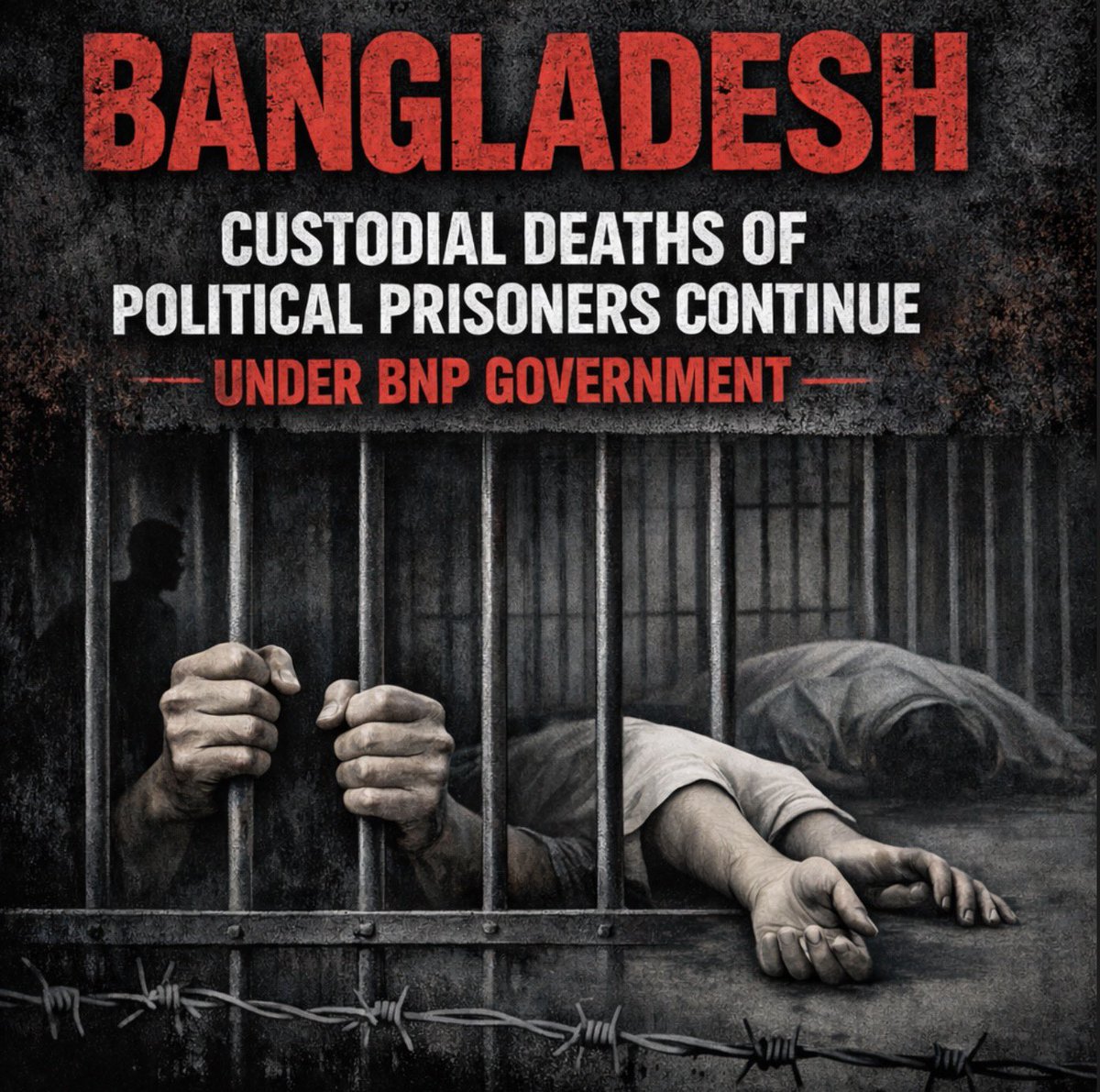
Custodial deaths of political prisoners continue unabated in #Bangladesh, raising serious concerns about the protection of #humanrights and the treatment of detainees under the new government led by the Bangladesh Nationalist Party (#BNP). In the last 30 days alone, three detainees with affiliations to the #AwamiLeague (AL) have died while in prison custody. Over the past 19 months, the total number of reported custodial deaths of political detainees has reached 45. The most recent case is that of 55-year-old Shahnur Alam Shanto, Vice-President of the AL’s Hatsherpur Union unit in #Bogura’s Shariakandi Upazila. Shahnur was arrested on 4 January and later transferred to Dhaka Central Jail on 17 January. On 13 March, he died while receiving treatment at the National Institute of Cardiovascular Diseases (NICVD) after reportedly suffering a cardiac arrest. According to Shahnur’s neighbour, Razab Ali of Hatsherpur, Shahnur was physically disabled and had long struggled with health complications. He alleged that Shahnur’s death was the result of negligence by prison authorities and the failure to provide timely and adequate medical care. Shahnur had first been assaulted by a #mob before being handed over to the police, who subsequently showed him arrested in what his friends and family describe as a “fabricated case”. Bogura, the ancestral home of PM #TariqueRahman and widely considered to be a political stronghold of BNP, has emerged as a particularly sensitive and potentially dangerous region for detainees linked to the AL. With Shahnur’s death, the number of political prisoners associated with the party who have died in custody in Bogura alone has risen to six. Shahriar Opel, Organising Secretary of the Bogura District Awami League, has called for an immediate judicial inquiry into these deaths. News: bangla.bdnews24.com/samagrabanglad… Shahnur’s case is the third reported death of an AL–affiliated detainee since the BNP Govt assumed office on 17 February. On 27 February, 38-year-old Shafiqul Islam Khan, former president of the Dumki upazila unit of the Bangladesh Chhatra League, died in custody at Patuakhali District Jail. Prison authorities stated that Shafiqul had long suffered from heart-related health problems. However, members of his family contend that prolonged legal harassment was responsible for his deteriorating condition and eventual death. Over an 8.5 month-period, Shafiq was repeatedly “shown arrested” in new cases even after securing bail from both subordinate and higher courts. According to his relatives, this cycle occurred at least three times, placing severe emotional and physical strain on him and ultimately breaking down his health. News: thedailystar.net/news/banglades… Another custodial death occurred on 20 February, when 60-year-old Monir Hossain Sikder, Vice-President of the AL’s Araihazar Upazila unit in Narayanganj, died while undergoing treatment at Dhaka Medical College Hospital after falling ill in jail. News: en.bd-pratidin.com/printnews/57444 Taken together, these three cases mean that at least three AL–associated detainees have died in prison custody since the BNP Govt was sworn in. When custodial deaths recorded during the tenure of the #Yunus-led Interim Govt are included, the total number rises to at least 45 in 19 months. In a majority of these cases, family members have alleged torture, custodial harassment, medical negligence, or a failure by authorities to provide timely and adequate healthcare. By failing to conduct transparent and credible investigations into the large number of custodial deaths, the Interim Govt violated Bangladesh’s obligations under int’l law. Whether the new BNP Govtt will break from this pattern remains an open question. However, if the developments of its first month in office are any indication, meaningful accountability may once again prove elusive. … #BangladeshCrisis @amnestysasia @StateDRL @hrw @HRF @EURightsAgency @UNHumanRights @omctorg @Ginitastar
Bangladesh Watch tweet media
English
8
37
85
2.2K
Once Again Sheikh Hasina retweetledi
Bangladesh Awami League
Bangladesh Awami League@albd1971·
A disgraceful example of the rule of law. Bangladesh is now witnessing what “judicial independence” looks like in practice. An application has been filed to show former Chief Justice A B M Khairul Haque as arrested in a new case. The request was submitted by the investigating officer in the case over the killing of madrasa student মো. Arif in Jatrabari during the July movement, Sub-Inspector Mahmudul Hasan of Jatrabari Police Station. Dhaka Metropolitan Magistrate Sarah Farzana Haque has set March 30 for the hearing, to be held in the presence of the accused. As a result, the process of his release from prison has, for now, been put on hold.
English
4
12
38
760
Once Again Sheikh Hasina retweetledi
Bangladesh Awami League
Bangladesh Awami League@albd1971·
Reports are emerging about the deteriorating health of student leader Anwar Hossain Naim, who is currently in jail. A video circulating on social media shows him appearing seriously unwell, raising growing concern among supporters. Naim, known by colleagues as a humble and compassionate leader, serves as the Organising Secretary of the Central Executive Committee of Bangladesh Chhatra League and hails from Gazipur. Supporters claim he has been kept in detention for months. They allege that whenever he receives bail in one case, another case is filed, keeping him behind bars continuously. There are also concerns about the lack of adequate medical treatment inside the prison. Supporters say his health is worsening and warn that many other student leaders and activists are facing similar conditions in custody. The question many are now asking is simple: how long can this continue, and where is the humanity?⁩ #BangladeshCrisis #AwamiLeague #HumanRights
English
1
16
58
886