Presh404|OPTIMUM

5.6K posts

Presh404|OPTIMUM banner
Presh404|OPTIMUM

Presh404|OPTIMUM

@Presh404R

Katılım Nisan 2024
2.6K Takip Edilen395 Takipçiler
william Eric lame
william Eric lame@Cryptologist_12·
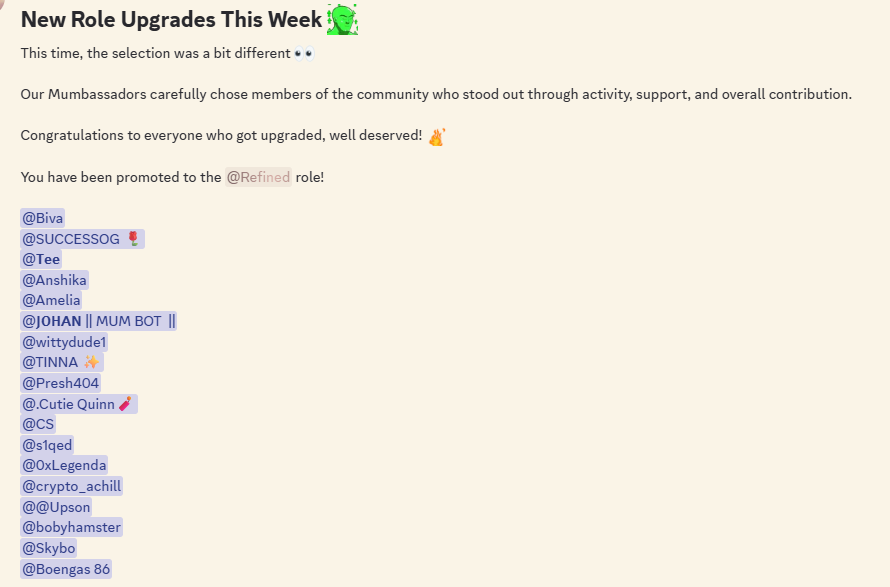
Huge congratulations to everyone stepping into the new Refined role in the @get_optimum community! 🎉 Thank you for the time, energy, contributions, and ideas you’ve poured into the project your contributions have helped shaping optimum. 🧵 ⬇️
william Eric lame tweet media
English
3
0
6
79
TG 🌋
TG 🌋@tgogayi·
Founders take note of those supporting you through the bear market. They are your true legends, don’t forget them when you have some rewards to offer..
English
3
0
16
213
maxi
maxi@maxi425784·
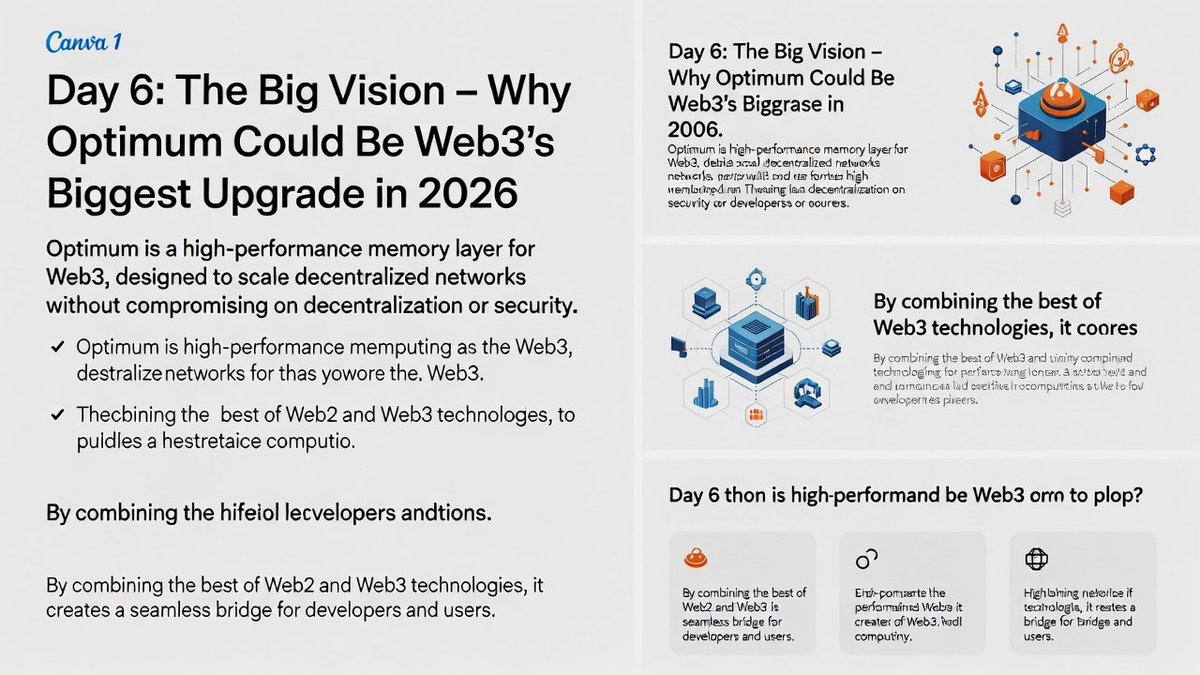
The Big Vision Why @get_optimum Could Be Web3’s Biggest Upgrade in 2026 Hey fam! 🌅 We’ve covered the problem (slow data propagation), the breakthrough tech (RLNC), the tools (mump2p for speed, deRAM for real-time memory), and the people powering it (Flexnodes). Today we zoom out to the big picture: why @get_optimum matters so much right now. Web3 in 2026 is at a tipping point. More capital is flowing in, AI agents are going on chain, DeFi volumes are exploding, on chain gaming is finally taking off, and social apps want real time feeds. But most chains still feel like dial up internet in a 5G world: slow gossip, laggy state access, high costs for validators, and clunky user experiences. @get_optimum isn’t trying to build another L1 or L2. It’s upgrading the plumbing the foundational layer every chain needs but no one has fully solved: a decentralized, high performance memory and communication fabric. Imagine: - Validators earning 20 to 50% more rewards because blocks arrive in 150 ms instead of 1 second. - dApps loading data instantly, like Web2 apps no more waiting for confirmations. - AI agents reading/writing state live, without choking the network. - Global Flexnodes (including many in Africa) making the system resilient and cheap to run. - Chains scaling without centralizing true decentralization at machine speed. This isn’t hype; it’s MIT-proven tech (RLNC) applied to real pain points. Backed by top funds ($11M seed), trusted by major validators in testnets, and chain agnostic so Ethereum, Solana, L2s, and new chains can all benefit. The end goal: Turn blockchains from slow, expensive databases into a true “world computer” fast, efficient, elastic, and open to everyone. A shared memory layer that makes mass adoption realistic, not just theoretical. We’re not there yet (Flexnodes rollout and deRAM mainnet are coming), but the path is clear. @get_optimum is building what Web3 has been missing since 2015: the high speed backbone for everything else. Quick reflection: After learning about @get_optimum, what excites you most faster validator rewards, real time dApps, or the chance to run a Flexnode yourself? Reply and let’s keep the conversation going!
maxi tweet media
English
10
2
12
76
Heis hazard (✱,✱)
Heis hazard (✱,✱)@Heis_hazard·
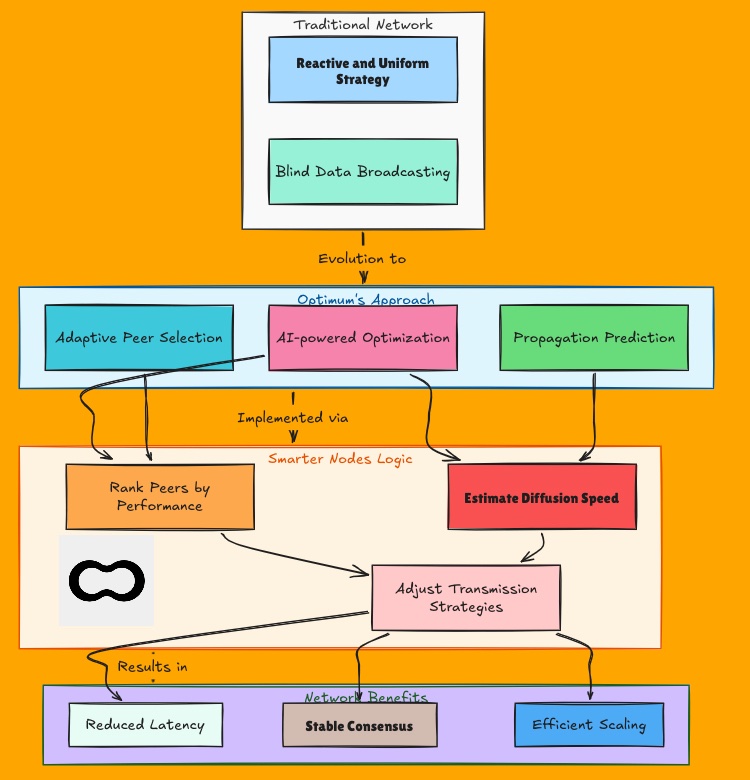
𝗔𝗜 𝗮𝗻𝗱 𝗡𝗲𝘁𝘄𝗼𝗿𝗸 𝗢𝗽𝘁𝗶𝗺𝗶𝘇𝗮𝘁𝗶𝗼𝗻: 𝗖𝗿𝗲𝗮𝘁𝗶𝗻𝗴 𝗦𝗺𝗮𝗿𝘁𝗲𝗿 𝗜𝗻𝘁𝗲𝗿𝗻𝗲𝘁 𝗡𝗼𝗱𝗲𝘀 The internet's speed isn't limited by cables, but by how nodes communicate with each other. @get_optimum takes a physics-inspired approach, treating data propagation like energy moving through a medium. Every unnecessary hop, delay, or redundant transmission slows things down. Their solution focuses on reducing friction at the node level. 𝙃𝙤𝙬 𝙉𝙤𝙙𝙚𝙨 𝙒𝙤𝙧𝙠 A node in a distributed network receives data, verifies it, and forwards it. The system's speed depends on how efficiently each node does this. Traditional networks handle propagation reactively and uniformly. Optimum makes it adaptive and measurable, using AI to analyze patterns and predict optimal routing decisions. 𝘼𝙄-𝙋𝙤𝙬𝙚𝙧𝙚𝙙 𝙊𝙥𝙩𝙞𝙢𝙞𝙯𝙖𝙩𝙞𝙤𝙣 Instead of broadcasting data blindly, nodes choose peers that reduce confirmation time, lowering redundant traffic and speeding up consensus. This approach focuses on propagation efficiency, identifying bottlenecks and dynamically rebalancing connections. 𝙆𝙚𝙮 𝙋𝙧𝙤𝙥𝙚𝙧𝙩𝙞𝙚𝙨 𝙤𝙛 𝙎𝙢𝙖𝙧𝙩𝙚𝙧 𝙉𝙤𝙙𝙚𝙨 -𝐀𝐝𝐚𝐩𝐭𝐢𝐯𝐞 𝐏𝐞𝐞𝐫 𝐒𝐞𝐥𝐞𝐜𝐭𝐢𝐨𝐧: Nodes rank peers by performance. - 𝐏𝐫𝐨𝐩𝐚𝐠𝐚𝐭𝐢𝐨𝐧 𝐏𝐫𝐞𝐝𝐢𝐜𝐭𝐢𝐨𝐧: Models estimate message diffusion speed. - 𝐁𝐚𝐧𝐝𝐰𝐢𝐝𝐭𝐡 𝐀𝐰𝐚𝐫𝐞𝐧𝐞𝐬𝐬: Transmission strategies adjust to available capacity. By improving node communication, Optimum reduces latency, stabilizes consensus, and enables efficient scaling ,no brute force needed. Interesting right? For more updates check here: X: @get_optimum Discord: discord.gg/getoptimum Gmum legends @blockchainjeff @tgogayi @aqccapital
Heis hazard (✱,✱) tweet media
English
9
0
11
64
smile😊
smile😊@smileonsolana_·
We delivered $LOVE now it’s time to deliver smiles 😊 Fill out form for SMILE NFT WHITELIST Free Mint 50% of $SMILE supply will be airdropped to NFT holders docs.google.com/forms/d/1gJd-P…
English
12K
3.7K
9.4K
516.6K
Adarsh raj
Adarsh raj@Adarsh3057·
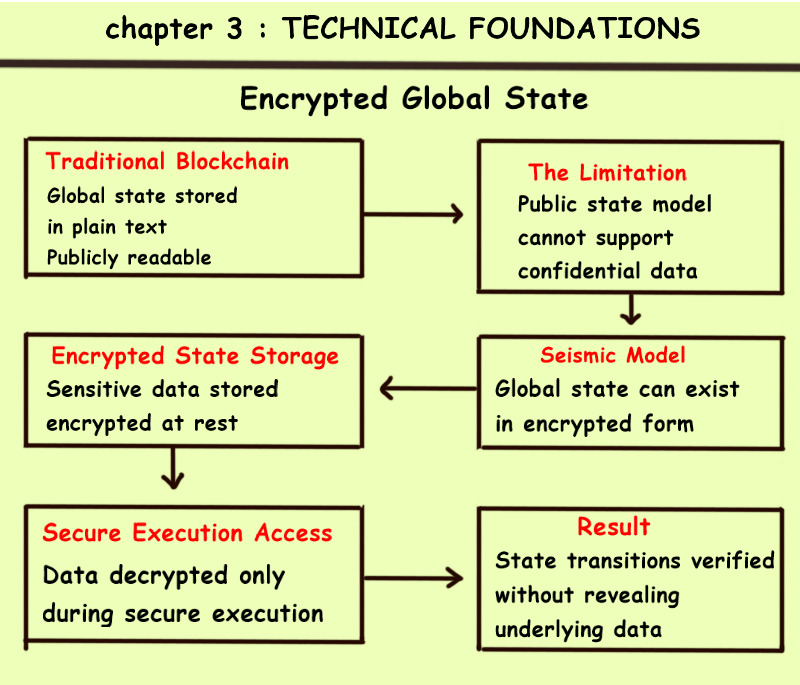
Seismic Research #21 Chapter III: TECHNICAL FOUNDATIONS Execution, Architecture, Mechanism __________ @SeismicSys ___________ Layer 2: State & Memory Model Topic: Encrypted Global State In the previous post we explored Seismic’s dual memory architecture: public memory and private memory. Now we go one level deeper: the global state itself. In most blockchains, the global state is stored in plain form. Account balances, contract storage, and state transitions are publicly readable by every node. This simplifies verification but it structurally eliminates confidentiality. Seismic introduces a different state model: the global state can exist in encrypted form. Sensitive state variables are stored encrypted at rest and are only decrypted inside secure execution environments when computation is performed. From the network perspective: • State commitments remain verifiable • State transitions remain deterministic • Consensus rules remain unchanged But the underlying data is never exposed in plaintext. This means validators can still agree on the correctness of state transitions without needing access to the raw state itself. In other words, the network verifies state changes, not the private data inside the state. || @NoxxW3 || @xealistt ||
Adarsh raj tweet media
Adarsh raj@Adarsh3057

Seismic Research #20 Chapter III: TECHNICAL FOUNDATIONS Execution, Architecture, Mechanism ___________ @SeismicSys ____________ Layer 2: State & Memory Model Topic: Dual Memory Architecture So far we explored how Seismic executes confidential computation. But execution is only half of the system. The next question is deeper: Where does private data live? In traditional blockchains, the answer is simple. All state lives in a single global storage layer. Balances, contract data, and transaction inputs are stored in the same public state that every node can read. This design guarantees transparency. But it also means sensitive data cannot remain confidential. Seismic introduces a different approach. Instead of storing everything in a single state model, it separates memory into two environments: • Public memory: visible and verifiable by the network • Private memory: encrypted and accessible only inside secure execution Public state keeps the blockchain auditable. Private state protects sensitive application data. This dual memory design allows applications to maintain confidentiality while still preserving verifiability at the network level. || @NoxxW3 || @xealistt || @lyronctk ||

English
19
3
28
274
Presh404|OPTIMUM
Presh404|OPTIMUM@Presh404R·
retransmissions, improving throughput and reducing delay. Overall, hybrid and adaptive RLNC approaches provide the best balance of reliability, efficiency, and low latency in modern networks.
English
0
0
3
33
Presh404|OPTIMUM
Presh404|OPTIMUM@Presh404R·
More advanced designs like Fulcrum coding reduce complexity by using high field coding at the source and simple binary operations within the network, maintaining strong resilience with lower computational cost. RLNC can also be integrated into systems like 5G to replace
English
1
0
3
34
Presh404|OPTIMUM
Presh404|OPTIMUM@Presh404R·
Ways to get Optimum loss resilience by combining RLNC with forward error correction hybrids Random Linear Network Coding (RLNC) is a powerful method for handling packet loss by sending linear combinations of data instead of raw packets. @blockchainjeff @tgogayi @aqccapital
Presh404|OPTIMUM tweet media
English
6
0
10
76
THEMULTIVERSE
THEMULTIVERSE@TH3MULTIV3RS3·
We’re excited to announce a legendary partnership between VolleyVerse and THEMULTVERSE bringing high-end kicks into the digital world. 🧵 **The Drop Details** • Total Supply: 333 • Mint Price: Free Mint **Requirments** Must follow @VolleyVersee ♥️ And 🔃 Pinned tweet
English
20
3
22
130
Kokonaw
Kokonaw@playboy_rai·
Important Announcement 💢 I’m currently collecting all wallets — if you see my reaction, that means yours is collected. After this account, I’ll start collecting from the Jolt page, so please be patient. Please stop DMing me for 1 GTD spot — it’s getting out of hand. I have 500+ messages to go through and a lot of work on my side, including drawing. If you collabed with my CM, send your sheet to him, not me. Also, some of you added more spots than I approved — don’t do that. I check every sheet and every giveaway entry. If it happens again, I won’t accept the sheet at all.Please be respectful Only a few GTD spots left. Will give 2 Gtd under this post
English
79
19
120
3.6K
maj.risΞ
maj.risΞ@0xUnderratedMaj·
𝗗𝗔𝗬 𝟮𝟬> 𝗛𝗼𝘄 𝗣𝗲𝗲𝗿-𝘁𝗼-𝗣𝗲𝗲𝗿 𝗠𝗲𝘀𝗵 𝗡𝗲𝘁𝘄𝗼𝗿𝗸𝘀 𝗠𝗶𝗺𝗶𝗰 𝗕𝗶𝗼𝗹𝗼𝗴𝗶𝗰𝗮𝗹 𝗦𝘆𝘀𝘁𝗲𝗺𝘀 Nature rarely relies on a single central controller. Biological systems such as neural networks, ant colonies, and immune systems operate through many small agents working together. Each unit follows simple local rules, yet the entire system behaves in a coordinated and adaptive way. ❒ Peer-to-peer mesh networks follow a similar principle. Instead of sending information through a central server, nodes communicate directly with nearby peers and collectively move data across the network. ❒ 𝙄𝙣 𝙖 𝙢𝙚𝙨𝙝 𝙣𝙚𝙩𝙬𝙤𝙧𝙠, 𝙚𝙖𝙘𝙝 𝙣𝙤𝙙𝙚 𝙥𝙡𝙖𝙮𝙨 𝙩𝙬𝙤 𝙧𝙤𝙡𝙚𝙨: it produces data and also forwards data for others. This resembles neurons in the brain. A neuron does not know the entire structure of the brain; it only exchanges signals with neighboring neurons. Still, billions of these small interactions produce complex cognition. ❒ Mesh nodes behave the same way. Local communication builds a large distributed structure capable of moving information efficiently without global coordination. ❒ Biological systems also survive failure because they contain redundancy. If some cells die, others continue functioning. The network adapts instead of collapsing. Peer-to-peer mesh networks apply the same concept. Data paths are not fixed; information can travel through many alternative routes. ❒ When a node becomes unavailable, packets simply take another path through nearby peers. The system continues operating because responsibility is shared across many participants. @get_optimum networking model applies this biological principle to decentralized infrastructure. The protocol organizes nodes into a peer-to-peer mesh where information spreads through local interactions rather than centralized routing. ❒ Data fragments move across many peers simultaneously, which improves resilience and lowers dependence on a single bottleneck. Like biological communication systems, the network grows stronger as more participants join. ❒ Another similarity appears in how biological organisms scale. An ant colony can expand from hundreds to millions of ants while still coordinating tasks such as food discovery or nest building. The colony works because each ant follows small, repeatable rules. ❒ Mesh networks scale in the same way. Each node maintains only limited knowledge of nearby peers, yet the collective structure can support very large systems. Optimum uses this idea so the network grows without forcing every node to track the entire topology. ❒ Adaptation is another shared trait. Biological systems constantly adjust to changing environments. Mesh networks mirror this by dynamically updating connections as network conditions change. ❒ Nodes measure latency, connectivity, and availability, then adjust which peers they communicate with. This continuous adjustment helps maintain efficient data flow even when the network structure shifts. ❒ The similarity between biology and peer-to-peer networking is not accidental. Both rely on decentralization, redundancy, and local cooperation to achieve large-scale coordination. ❒ By modeling communication after biological systems, protocols like Optimum design networks that remain efficient, fault-tolerant, and scalable even as participation grows. Special Tags @aqccapital I @CryptoSundayz | @f1nk1r @tgogayi | @shariaronchain Art by me.
maj.risΞ tweet media
English
14
1
28
183