
Sabitlenmiş Tweet

@TheRabbitHole You're right that "bigotry did it" is the laziest, most intellectually bankrupt move in modern discourse — the single-bullet Theory-of-Everything that requires no evidence, no trade-offs, no behavioral data, just an accusation and a demand for power. Helen Pluckrose has eviscerated this exact move better than anyone: it is the postmodern knowledge principle applied like a sledgehammer — all disparities are socially constructed by dominant discourses to maintain power, therefore the only acceptable explanation is bigotry, and anyone offering a more complex account is morally complicit.
But here's the brutal irony you keep missing.
When it comes to black–white outcome gaps in the United States, the actual historical record delivers exactly the kind of centuries-long, institutionally embedded, legally enforced, theologically defended bigotry that the woke falsely invent for everything else.
This isn't CRT.
This isn't Marx, Hegel, Foucault, or Kimberlé Crenshaw.
This is
pre-modern,
pre-Enlightenment,
pre-woke Christian (and later secular) doctrine all by an unbroken series of collective of fathers governing in evil as good-- yoking thrones/governments and churches with statutes and doctrines of wickedness against a phenotype of black or brown skin and an African Ancestry from conception in the name of Jesus:
→ the Curse of Ham
→ Aristotelian natural slavery
→ papal bulls (Dum Diversas, Romanus Pontifex)
→ Iberian limpieza de sangre
→ Southern Presbyterian/General Assembly pronouncements
→ Southern Baptist & Methodist confessions that declared Africans "inhereditarily inferior by divine decree"
These weren't fringe opinions. They were the overwhelming normative consensus in church and state for 90%+ of the 580 years of African presence in the Americas (1440s–2020s). PSALMS 94:20 direct violation normatively:
Psalm 94:20 English Standard Version
20 Can wicked rulers be allied with you,
those who frame[a] injustice by statute?
The Democratic Party the seedbed for the Southern Baptist and Southern Presbyterian conventions and the Confederacy— the most powerful political and Jesus representing institutions in every territory where blacks were the majority population from 1800 to 1970 — explicitly built its coalition on white supremacy. The largest Protestant denominations in the South formally taught that black inferiority was part of God's created order.
Even the "good guys" (Republicans) only opposed the expansion of slavery — not the underlying racial hierarchy itself. They fought a war that killed 400,000 men to stop slavery's spread, yet the majority of them still believed blacks were inferior and should never have social equality.
Yet here is the savage irony that almost no one on the anti-woke right will face:
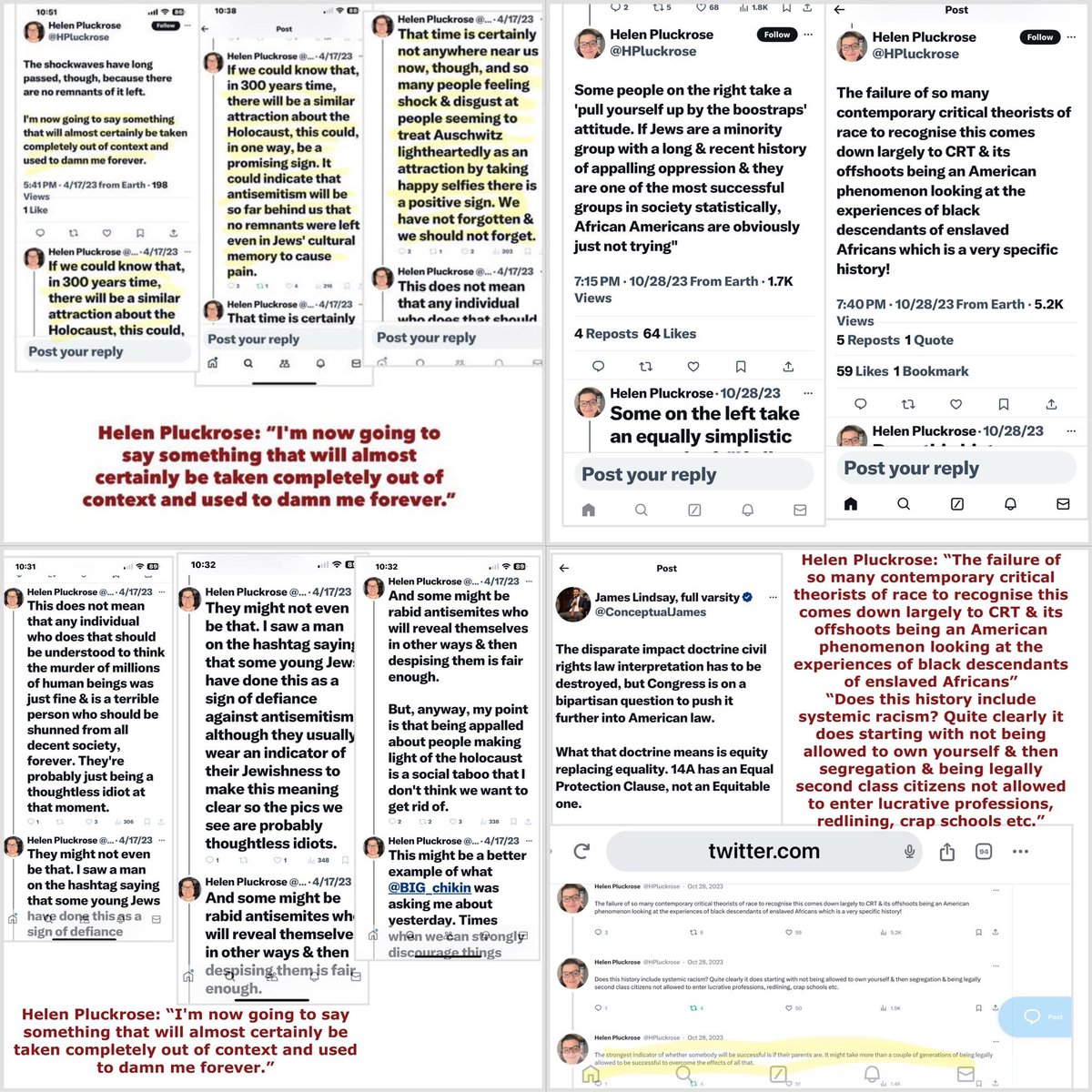
When it comes to black–white gaps in America, @HPluckrose herself says the explanation actually is centuries of explicit, legally enforced, theologically defended racism of a kind and intensity almost unknown in human history.
Her exact words (28 Oct 2023):
“The failure of so many contemporary critical theorists of race to recognise this comes down largely to CRT & its offshoots being an American phenomenon looking at the experiences of black descendants of enslaved Africans which is a very specific history! Does this history include systemic racism? Quite clearly it does starting with not being allowed to own yourself & then segregation & being legally second class citizens not allowed to enter lucrative professions, redlining, crap schools etc. The strongest indicator of whether somebody will be successful is if their parents are. It might take more than a couple of generations of being legally allowed to be successful to overcome the effects of all that.”
That is Helen Pluckrose , not @ibramxk . And she is right—because this goes deep into the Judeo-Christian roots America claims to cherish. The justifying doctrines weren't fringe. They were baked into rabbinic, patristic, and confessional theology for millennia. Check the nearly a century of resolutions, overtures, Annual meeting declarations and joint statements, like the SBC repudiating its use of the Curse of Ham in 2017/18 and @SBTS and others declaring the founders of those denominations heretics.
→ 400–500 CE (Jerusalem Talmud, Taanit 1:6): Midrash on the Flood punishes Ham for ark misconduct by emerging "darkened" (mefucham, pun on his name), linking blackness to sin's consequence—the seed of racialized curses.
→ 400–500 CE (Babylonian Talmud, Kiddushin 49b): "Ten kavim of drunkenness" descend to the world; Kushites (Black Africans) take nine—first clear negative trope in core rabbinic texts, clustering impairment with Blackness.
→ 500 CE (Babylonian Talmud, Berakhot 31b/Shabbat 31b; Sotah midrash): An innocent accused woman's "dark skin" (shchorot) is "blessed" by birthing light-skinned children—implying fairness as divine favor, darkness as lesser/default.
→ 800–900 CE (Saadia Gaon, Genesis commentary): Equates Ham’s line (Cushites) with "dark slaves," fusing biblical exegesis to emerging slave trades.
→ 1000–1250 CE (Medieval Sephardic/Ashkenazic thought): Amid Reconquista and Almohad persecutions, exegeses tie Ham/Cush to perpetual enslavement via Curse of Ham (Gen 9:20–27), influenced by Mediterranean African slave trades.
→ 1400s (Alba Bible, folio 33r): Illuminated Castilian Hebrew Bible depicts Ham—the father of Kush/Ethiopia—as a Black African gazing at Noah's nakedness, while Shem/Japheth avert theirs. Commissioned by a Spanish churchman, painted by Christians, translated by Rabbi Moses Arragel.
These fed straight into Protestant America’s “Judeo-Christian ethic”:
→ Curse of Ham/Canaan twisted for perpetual African servitude/inferiority → Mark of Cain reinterpreted as blackness → Babel’s Table of Nations as God-ordained racial hierarchies → Aristotelian “natural slavery” fused with scripture → 1857 Southern Presbyterian General Assembly: “The African race… by nature and by the curse pronounced upon Canaan, doomed to perpetual servitude” → R.L. Dabney (Reformed theologian, Stonewall Jackson’s chief of staff): “
The black race… is constitutionally inferior”
Start at 1526 (San Miguel de Gualdape, SC/GA)—first enslaved Africans on continental US soil, under the 1518 Royal Charter (Charles V’s asiento for 4,000 “Christian” Africans as commodities, rooted in 1452–1493 papal bulls and Ham curses).
Key codifications:
→ 1640 (John Punch ruling, Virginia): First judicial lifetime enslavement by race—Punch (Black) gets life; white runaways get 4 extra years.
→ 1662 (Virginia Hereditary Slavery Law): Partus sequitur ventrem—“all children borne… shalbe held bond or free only according to the condition of the mother.” A Psalms 94:20 abomination, ensuring perpetual racial chattel via mothers’ wombs.
Imagine if reformed biblically: Partus sequitur patrem—“the seed, name, blessing follow the father” (1 Cor 7:14; Num 1; Ezra 2). Children free if fathers free; fornicators wed or dower the mother/child; deniers of seed cursed. No dynasty of bondage.
End of normative consensus: 1965 Voting Rights Act—outlawing Jim Crow segregation/disenfranchisement.
Total: 1526–2025 = 499 years. Normative evil (slavery/Jim Crow): 1526–1965 = 439 years. 88% of US history under legally enforced racial subordination as the political/religious norm.
You, @elonmusk, @ConceptualJames, @colinwright keep saying: once a poisonous idea is made normative, it takes roughly as long to exit the system as it took to enter.
That leaves centuries of inertia—by your logic.
And we still name buildings after the architects. Still platform “benevolent institution” apologists. Still fly Confederate “heritage.”
So yes—in every other context, “bigotry!” is lazy, anti-scientific, authoritarian.
But for Black American outcomes?
The null hypothesis is millennia of theology-fueled, state-sponsored subjugation. Even Pluckrose sees it.
The rest of you are closing your eyes and working backwards to pretend what has been was not as you conflate Queer theory, trans ideology and all the rest with the call to biblical justice along racial lines that is symmetrical to all that is in place for Native Americans via treaty commitments and the London Debt Agreement that enabled Germany to pay reparations to Jewish Holocaust victims and their infants.
@AJKocman
@joe_rigney
@douglaswils
@alisa_childers
@VanJones68
@Pontifex
@JoshDaws
@ThaddeusWill
@nhannahjones
@christopherrufo
@nbusenitz
@jarbitro
@megbasham
@the_jefferymead
@LarryTaunton
@JohnMPerkins
@drtonyevans
@conservmillen
@ryanbomberger
@SlowToWrite
@ConradMbewe
@JustinPetersMin
@CollinRugg
@YourCalvinist
@hbcharlesjr
@tomascol
@LigonDuncan
@MattWalshBlog
@Jimdavis79
@ThabitiAnyabwil
@pastordmack
@kangminlee
@TheLaurenChen
@NeilShenvi
@megynkelly
@D_B_Harrison
@glennbeck
@Ty_Seidule
@HenryLouisGates
@SethDillon
@thatsKAIZEN



English