Mission Street Capital

28 posts

Mission Street Capital

Mission Street Capital

@missionstcap

Venture fund investing in preseed and seed companies

Katılım Eylül 2025
14 Takip Edilen74 Takipçiler
Mission Street Capital retweetledi
Nishkarsh
Nishkarsh@contextkingceo·
Is AI being designed to fail? Everyone talks about reasoning. But when given a task, the AI isn't reasoning the way you might expect. It looks at your input, finds the closest match it's seen before, and predicts the most likely next action. That process is called vector similarity search. It's genuinely powerful. It's also not the same thing as understanding what you actually meant. Think of a plumber who hears the word "leak" and starts pulling up floorboards before you've finished the sentence. He's not being careless. He's pattern-matching - that's exactly how he was trained. Your AI agent is doing the same thing. Context is the one thing that gets deprioritized when teams are racing to ship. But without it, you don't have an intelligent agent. You have a very fast guesser. Similarity ≠ relevance. How? Find out with the link in the comments ⬇️
English
88
271
643
807.6K
Mission Street Capital retweetledi
Nishkarsh
Nishkarsh@contextkingceo·
We've raised $6.5M to kill vector databases. Every system today retrieves context the same way: vector search that stores everything as flat embeddings and returns whatever "feels" closest. Similar, sure. Relevant? Almost never. Embeddings can’t tell a Q3 renewal clause from a Q1 termination notice if the language is close enough. A friend of mine asked his AI about a contract last week, and it returned a detailed, perfectly crafted answer pulled from a completely different client’s file. Once you’re dealing with 10M+ documents, these mix-ups happen all the time. VectorDB accuracy goes to shit. We built @hydra_db for exactly this. HydraDB builds an ontology-first context graph over your data, maps relationships between entities, understands the 'why' behind documents, and tracks how information evolves over time. So when you ask about 'Apple,' it knows you mean the company you're serving as a customer. Not the fruit. Even when a vector DB's similarity score says 0.94. More below ⬇️
English
621
659
6K
3.8M
Mission Street Capital retweetledi
Nishkarsh
Nishkarsh@contextkingceo·
Part 2 of The Long Walk is out. In the last episode, we explored how Voice AI is actually built and what makes it feel truly human. I break it down with @kamath_sutra from first principles, explaining how memory sits at the core of building more natural voice interactions. In today’s episode, we go deeper into why memory has become such a critical challenge in the world of AI. We talk about how modern AI systems depend heavily on context, and why combining context, memory, and storage is becoming essential for building smarter and more reliable AI products. From big tech to emerging AI startups, everyone is trying to solve the same problem: how to make machines remember, adapt, and respond more intelligently. If you're building or thinking about AI systems, this conversation will give you a deeper perspective on where the technology is heading.
English
19
13
53
4.6K
Mission Street Capital retweetledi
Sudarshan Kamath
Sudarshan Kamath@kamath_sutra·
OpenAI's S2S preview is polished but it still thinks in steps. Speech → text → model → text → speech. That's not how humans converse. Introducing Hydra. A native speech-to-speech model that doesn't wait for turn-taking, doesn't flatten emotion into text, and doesn't break when you interrupt it mid-sentence. Hydra reasons asynchronously, speaks and listens simultaneously, and preserves emotion because it never leaves the audio domain. It's still in beta, but the shift is obvious. If you want early access, the link is in the comments. Here's a preview of what that looks like -
English
160
114
895
326.5K
Mission Street Capital retweetledi
Nishkarsh
Nishkarsh@contextkingceo·
Memory isn’t just a feature in AI, it’s the difference between a system that responds and one that truly understands. In the first episode of The Long Walk, @kamath_sutra and I dive into how memory is shaping the next generation of voice agents, and why it’s becoming critical for real enterprise workflows.
English
18
16
105
29.2K
Mission Street Capital retweetledi
Nishkarsh
Nishkarsh@contextkingceo·
Announcing... Voice x Memory! We’re unpacking what makes agents listen, respond, and remember, or sometimes forget, and what that means for building better voice systems. We will move towards a world of large LLMs remembering a lot of information to smaller LMs with finite real-time intelligence and infinite memory.
English
22
13
68
7.4K
Mission Street Capital retweetledi
Alec
Alec@alecmhoward·
We started @ruvopay to make moving money between Brazil and the U.S as easy as a Pix. The rebrand reflects that: a global dollar account built on modern rails, for people who live and work across borders. Pix. Crypto. USD. Visa. Save & invest. One wallet. This is Ruvo.
English
13
12
154
36.1K
Mission Street Capital retweetledi
Ker Lee Yap
Ker Lee Yap@klyap_·
I'm hosting a cozy online coding show-and-tell on Saturday with @AlexAridgides ! 🧦 Curious about: - What does your workflow look like? Are you a command-line maxi? Is the only key you press "tab"? - Do you have homebrew tooling? A whole fleet of agents? MCPs? - What're the most helpful resources for learning new tools? DM for invite!
Ker Lee Yap tweet media
English
3
2
15
1.2K
Mission Street Capital retweetledi
Surabhi Todi
Surabhi Todi@SurbhiTodi·
Who are the best early stage founders out there? I'm writing pre- seed and seed checks. Willing to be the first one in, will make sure you have a fantastic next round (I work with all of the top investors in the valley). I write 3 checks a quarter so you know I'm focused on making sure you crush it.

English
155
8
368
34.3K
Mission Street Capital
Mission Street Capital@missionstcap·
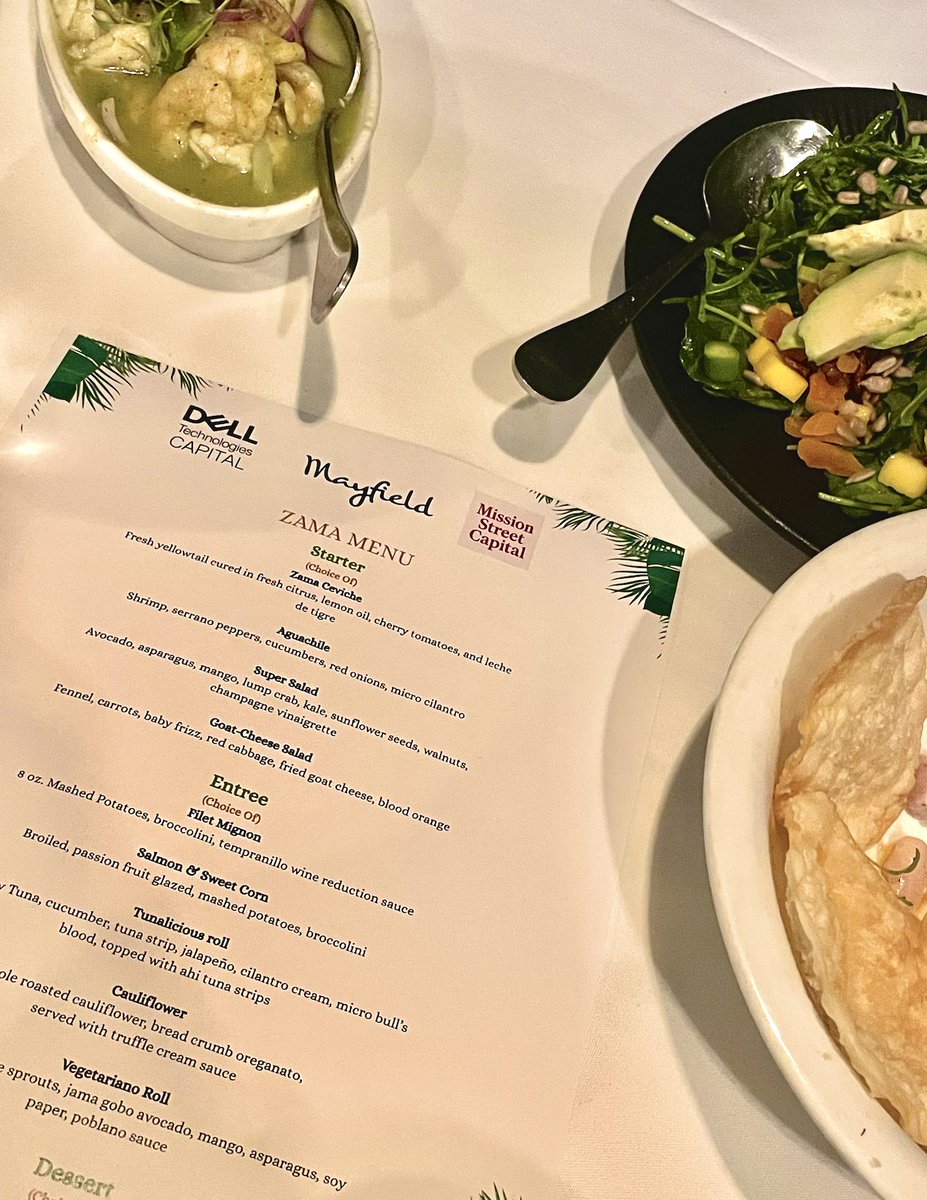
Dinner was a blast! Thank you so much for such a wonderful evening at @NeurIPSConf with founders and researchers from @GoogleDeepMind, @OpenAI, @AiEleuther, @allen_ai, @humansand. Excited for more to come!
Mission Street Capital tweet media
Mission Street Capital@missionstcap

Hosting an intimate NeurIPS dinner for AI researchers and early-stage founders with @DellTechCapital and Mayfield. Expect thoughtful conversation, great food, and serendipity. If you’re an AI researcher, engineer, or founder at NeurIPS, join us: luma.com/y98ypnlo

English
0
1
6
862
Mission Street Capital retweetledi
Neall
Neall@neallseth·
San Franciscan behavior is often inscrutable from the outside. Is it poverty? Contrarianism? Inexplicable quirks of the techno-bohemian class? It starts making sense when you walk out of SFO, and into the reality distortion field that’s inspired social deviance for decades For those on the other side: If the city is a universe, group houses (loosely defined) are its planets. Each has a unique cultural “gravity” that naturally selects for an orbital community. House “orbits” intersect, forming micro-cultural clusters which themselves overlap with peripheral clusters Given sufficient social energy, one might ride these orbital tracks across the universe Put another way: if SF is Twitter, these houses and their friends form the group chat archipelago Like GCs, houses are mostly assembled for fun, and because they’re natural platforms for conversation, events, and serendipity — not due to financial necessity as you’d see elsewhere. Starting a house is an implicit registration as a node in a sprawling social graph It’s hard to overstate these houses’ roles as SF’s serendipity machines. In some cases, they become de facto semi-public cafes or third places. Friends might flit in and out through the day, often hanging to cowork or take a quick nap on the couch It’s no surprise people choose this. It invites a social richness into life that’s hard to achieve otherwise, with no downside other than occasional raised eyebrows from people on the internet
Matthew Berman@MatthewBerman

“Dwarkesh, Dylan, and Sholto are all roommates” 🤯 I have so many questions: * did they know each other before becoming roommates? * if so, how? * if not, they just happened to live together by pure chance?? * presumably they can all afford to live solo, so they choose to continue to be roommates for the insane intellectual density? * who does which chore?

English
5
8
167
30.8K
Mission Street Capital retweetledi
Ker Lee Yap
Ker Lee Yap@klyap_·
Super excited to have gotten early access to Tinker by @thinkymachines! Tinker is great at making it easy to post-train, but also meant I wound up with lots of model checkpoints 😅 This is why I built a finetuning journal to keep track of each model iteration, with the help of Claude Code!
English
38
41
851
68.9K
Mission Street Capital
Mission Street Capital@missionstcap·
Hosting an intimate NeurIPS dinner for AI researchers and early-stage founders with @DellTechCapital and Mayfield. Expect thoughtful conversation, great food, and serendipity. If you’re an AI researcher, engineer, or founder at NeurIPS, join us: luma.com/y98ypnlo
English
0
1
4
1.4K
Mission Street Capital retweetledi
Lisa
Lisa@lisas8_·
100% agreed. This is why I almost always advise B2B startups to focus on selling to other startups before trying to go to enterprise — 1. Faster, easier adoption 2. Startups are more discerning on the best tools and more willing to give feedback, so you’ll end up with a better product. 3. Easier to land and expand 4. You can grow with them
James da Costa@jamdac

🚨How does an AI-native startup unseat an incumbent?🚨 👇Enter the Greenfield Strategy: AI-native startup bingo. The battle between every startup and incumbent comes down to whether the startup gets distribution before the incumbent gets innovation. One of the most powerful, and underrated, ways for startups to win distribution is to serve companies at their formation: greenfield companies. @stripe @deel @mercury @cartainc @brexHQ @tryramp have all done this at scale. Why does this work? Simply put, acquiring customers de novo is easier than getting customers to switch: - Many of the large software incumbents have hostages, not customers. Their customers would love to switch, but ripping and replacing existing software is risky and expensive. New companies don’t face those switching costs; they simply look for the best solution and evaluate based on merit. - New companies don’t need as many features to have a complete solution. - New companies have fewer stakeholders. You only have to convince the founders. Grow with your customers: If you attract all of the new companies at formation and grow with them, you will become a big company as your customers become big companies. Consider @stripe: many of Stripe’s customers did not yet exist when Stripe was founded. Some of those early customers later became large businesses in their own right. So when enterprises outside of Silicon Valley also needed to prepare themselves for a shift to ecommerce models, Stripe was an obvious choice, with plenty of relevant reference customers already in place. Incumbents, on the other hand, would much rather sell to existing businesses vs. companies that don’t exist now but might exist in huge numbers in a few years. They are bound by the rules of P&L (Profit & Loss) – and there’s no “P” for greenfield companies that don’t exist yet, just “L” (in sales, marketing, and product development costs). The startup, however, isn’t bound to a financial model – the startup doesn’t need one; it's still figuring stuff out! That leaves ample room for the startup to define the category. Graduation moments: In a similar way, software “graduation moments” (the moments when a startup begins to develop enterprise needs) also create opportunities to execute this greenfield strategy. QuickBooks may be great for single-product, single-entity companies, but once businesses add multiple subsidiaries, currencies, or more complex reporting needs, they outgrow it and require the controls, integrations, and scalability of an ERP like NetSuite. And you can now build a far better ERP with AI - just look at @RilletHQ. AI-native startup Bingo: There are many different categories of enterprise software. Enough to fill a 5x5 Bingo board and more! In each category of the Bingo board, there sits an incumbent that could be dethroned by an AI-native alternative. So, how does a new company win the game of Bingo? - Pick a square - Make a narrow wedge much better - Find a constant source of new customers - Rapidly iterate and add features to grow with your customers - Don’t be constrained by the division of existing categories If you’re building a category-defining company on the Bingo board - come and talk to us. cc: @arampell @astrange @a16z

English
1
1
4
1.5K
Mission Street Capital retweetledi
Surabhi Todi
Surabhi Todi@SurbhiTodi·
Sudarshan came in with a warm intro through a portfolio company founder- he told me “you have to get Smallest.ai and Sudarshan in your portfolio” we signed the next day. @kamath_sutra is fantastic- so proud of smallest.ai and can not wait to see them go to the moon. 🚀🚀
Sudarshan Kamath@kamath_sutra

Fundraise Announcement! We are proud to announce that we at @smallest_AI have raised 8M USD in an oversubscribed seed round led by @Sierra_Ventures with participation from @3one4Capital, @better_capital, @UpsparksCapital, @SchemaVentures, @DeVC_Global, @tinyvc, @peercheque, @shyamalanadkat, @missionstcap, @bwertz, @RaveenSastry, and many more angels to build the future of Enterprise Voice AI! We are transforming voice AI from the ground up - pushing agents to pass the Turing test in the coming years. We are also excited to build a research-first organization - diving into the depths of problems from first principles and doing things no one in the world is even thinking about. It was our dream to build a scientific team that pushes the boundaries of the frontier. We are privileged to have the support of some of the best early backers a founder could ever ask for. Thank you, everyone for supporting us - this is just the beginning!

English
2
2
60
17.2K