RocketCowboy
450 posts

@sportdrink Doesn't exist the way you want it, currently. The metal options are hit COG + poison unless super custom (again high COG but probably best bet) and the wooden ones are all sprayed. Probably best to just do something custom similar to what you're doing now.
English

Does anyone here have a connection to a scooper supplier (NOT PLASTIC) to insert in our cans?
English
@jeffreytee @hyperboreality @foundmyfitness Very interesting haven’t even though of this instead of sauna. Apparently a hot bath you’ll actually sweat more also
English

@hyperboreality @foundmyfitness Great! I suspected as much...
English

Small correction here.
You don’t need to reach a core temperature of 102.3°F to activate HSP expression. And you definitely don’t need to sit in a 200°F sauna for 30 minutes.
The research shows HSP expression can increase by ~50% after 30 minutes at 163°F, with core body temperature rising to only about 101°F.
Sauna benefits (even those related to HSPs) don’t require extreme heat or pushing core temperature that high.
Bryan Johnson@bryan_johnson
Most people might miss the biggest benefit of sauna You need to get really really hot… Your core body temperature needs to hit 102.4°F (39°C). For reference, a fever is anything above 100.4°F (38°C) So I swallowed a temperature monitoring pill. It goes through your digestive tract and precisely measures your internal temperature every 30 seconds. When your core body temperature hits the goal of 102°F, your body releases these proteins (heat shock proteins - HSPs) that clean up your body’s debris. I was curious what time my body hits this goal because up until now, I’ve been doing 20 mins of 200°F dry sauna. … it turns out it takes 31 minutes It feels like you’re dying. I didn't expert such pain and panic. Before this experiment, I did over 200 sauna sessions at 200°F for 20 min. This means I likely never achieved the heat shock protein (HSP) threshold at 102.4°F (39°C), which deprived me of so much sauna-health goodness. If your sauna doesn’t heat up to temperatures allowing your core temperature to reach 102.4°F (39°C) or you struggle to tolerate heat, do not be discouraged. The dry sessions I did at 200°F (93°C) for 20 min still showed incredibly health benefits. My previous 20 min sessions still showed: 1) 10+ yr reduction of my vascular age 2) 87% reduction of microplastics 3) detox of environmental toxins 4) fertility marker improvement Will report back once I have results on this new protocol…
English
English

@freetexas2 @MaryBowdenMD It is legal in Texas but many pharmacies refuse to carry it
English

My quest to make ivermectin accessible and affordable has been quite a challenge. I sued the FDA for spreading misinformation and won. I’ve pressured politicians to make it available without a prescription - it’s now law in 5 states. I filed a petition with the FDA to make it OTC, but despite thousands of signatures, the FDA ignored. Unfortunately I just hit another roadblock - the source I had planned on using for my patients is not going to work. But stay tuned for plan B. I won’t give up!

English
@twoot31 @lazylifefitness @gaezpeat @BerbarianWizard FYI fat free milk will still have some fat similar to the fruits and potatoes
English

@lazylifefitness @gaezpeat @BerbarianWizard Carnivore is NOT free of PUFA. Even ruminant meat contains 3-6% PUFA.
To be PUFA free you can’t even eat fruit or potatoes since the fat they contain is PUFA. You need to subsist on fat-free milk.
Obviously not possible but you can get almost to zero even with fruit.
English

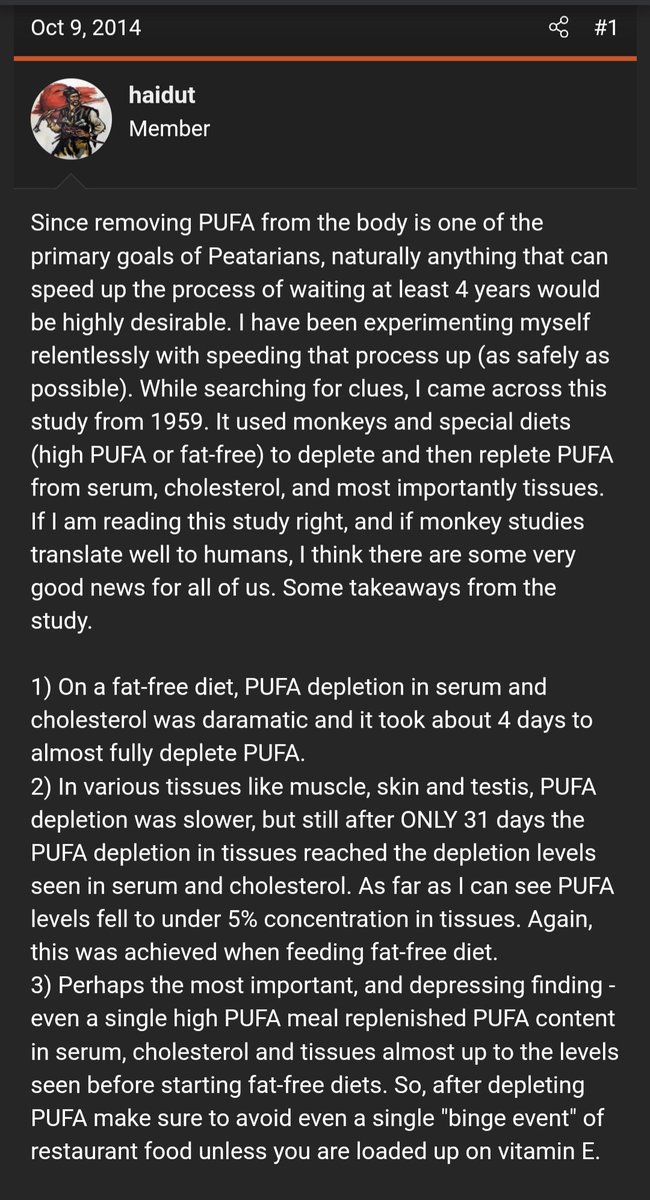
PUFA Depletion Can (probably) Be Accomplished In 30 Days!
haidut
@BerbarianWizard style diet
English
@jslater92 @bitcoinpanda69 @bryan_johnson Tried to find this but looks like he’s been doing 200 for the most part. He’s just recently been doing longer to get his body temp higher. Lower temps I’m sure is fine just have to stay in longer
English

@bitcoinpanda69 @bryan_johnson He didn't start experimenting with very high heat to truly activate heat shock proteins until the last month or two if I'm not mistaken, so it seems the benefits of sauna on this virtually all occurred at the lower heat.
English

🚨 I HAVE NO MICROPLASTICS IN MY BALLS 🚨
This should not be possible.
Studies show that 100% of men have microplastics in their semen. I am the first human ever to show a complete reduction to zero.
This may be a world-first breakthrough in fertility research.
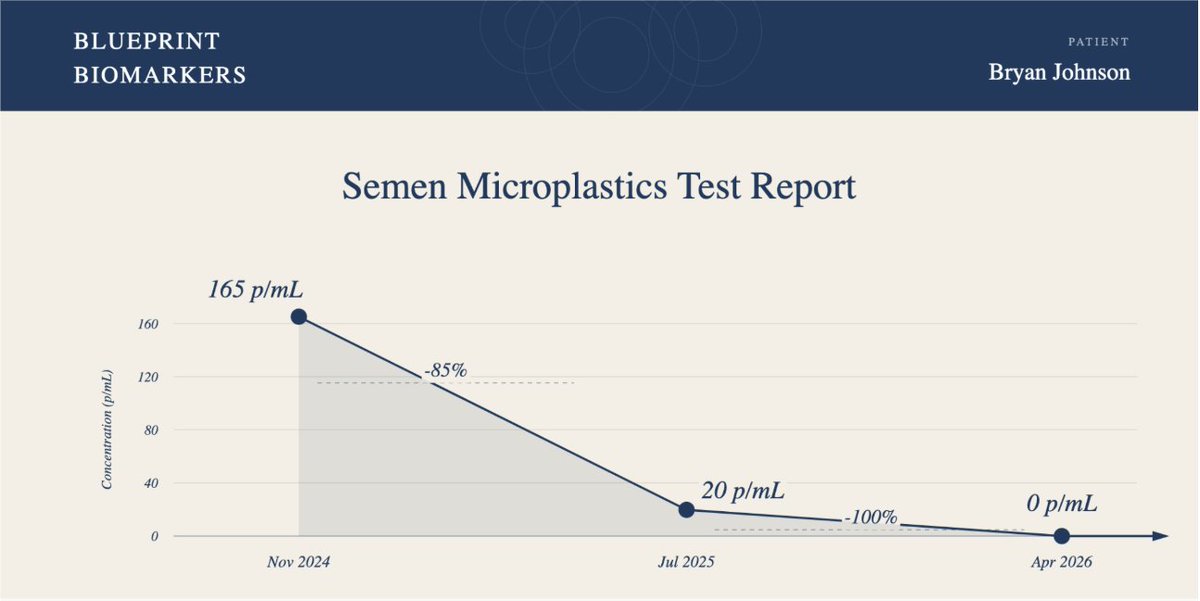
I had 165 microplastic particles in my semen just 18 months ago. Now, I have zero.
Five published studies have measured microplastics in human semen. Two found them in 100% of men. The other three found then in 44 to 76% of men tested, but those used methods that miss the smallest particles and the clear ones. Corrected for that, the real rate is likely 100%. Almost every man alive has plastic in his semen right now. The same applies to testicular tissue, testing 100% positive for microplastics.
Microplastics hurt sperm.
Human studies show the impact of various types of plastic, associated chemicals, and other toxins on male fertility:
+ 60% fewer normal shaped sperm (from PFAS)
+ 5x higher odds of low sperm count (from PTFE)
+ 10% lower sperm concentration (from PTFE)
+ 15% lower swimming ability (from PTFE)
+ 41% lower swimming ability (from PET)
+ 12% lower sperm swimming ability (from BPA)
+ 3x higher odds of low sperm count (from Phthalates)
+ 2x higher odds of poor swimming (from Phthalates)
The effects compound: each extra type of plastic drops sperm swimming ability by about 21%.
This matters even if you’re NOT trying to get pregnant.
Sperm count is one of the cleanest biomarkers of overall health we have. And microplastics don't stop at the testes.
The same particles are showing up everywhere we look. Studies show 4.5x higher rate of heart attack, stroke, and death in people with microplastics in their arterial plaque vs. those without. Microplastics were also found in 100% of human placentas tested.
100% of post-mortem human brains tested positive for microplastics. Brain concentrations rose ~50% between 2016 and 2024, and now sit at roughly 11x the levels found in the liver or kidney.
Where do these come from?
+ PTFE, commonly in non-stick pans
+ PET, water bottles
+ Phthalates, makes plastic soft and bendy
+ BPA, can linings
+ PFAS, stain-resistant fabrics & food packaging
Inside the body, plastic causes a kind of cellular rust. It triggers inflammation in the testicles, kills the cells that make sperm and drops testosterone. It's been confirmed across 39 animal and cell studies, then in human data.
MY PROTOCOL:
Note, what I did is n=1, not a controlled trial, I cannot prove cause.
1. Sauna (dry). My toxin blood panel confirms sauna clears plastic related chemicals: BPA, phthalates, PFAS, flame retardants, pesticides. The plastic particles themselves are too big to sweat out directly. Heat may activate other clearance routes: bile flow through the liver, the cell's internal cleanup system, and the gut barrier. Humans have almost no enzymes that can break plastic apart, so the body has to physically push it out.
2. Reverse osmosis water filter. Drinking water is likely a major source of microplastic getting into your body. A reverse osmosis filter pushes water through a very tight membrane and strains the particles out. I filter everything I drink.
3. Trying to rid my environment of the big plastic items: cutting boards, cups, plates, food storage containers, non-stick pans, cling wrap, tea bags, water bottles, kitchen utensils, kettles, and synthetic clothing. Note, as hard as I try, I'm always finding new plastic things in my life. This can be all-consuming thing so try to just knock out the big ones.
I did all three interventions at the same time. I cannot say which one did the most work. What I can say is this: going from 165 to zero in 18 months is possible.
Results:
Nov 2024: 165 particles/mL
Jul 2025: 20 particles/mL
Apr 2026: 0 particles/mL
The 18 month window also captures roughly 7 full spermatogenesis cycles.
English
@bluekunt @PhilDL616 I like like it and see why people don’t like it. If people say it’s worse than TROS then I know they aren’t serious people though
English

@PhilDL616 Really? You dont understand why its divisive? If you like it fine but dont pretend like people who dont like it dont have their reasons.
English

Nah I actually really liked it, and I don't understand why it's still so divisive.
Kaida 🌊@khaliltooshort
I think people who say The Last Jedi is a good film are just looking for attention
English
@bartho68 @strong_sistas I’ve wondered also why they overpay but I I think it’s because they are trying build something as fast as they can
English

@strong_sistas I just wonder, who is the moneyshooter behind all those data centers
English

A 35 acre farm by me was just sold to a data center for $60,000 an acre. Farmers are struggling, and data centers have big bucks 😢 farm land has never been more precious.
English
@CalebDebates @_ZacharyMiller @uncledoomer Just looked at the european whole food ones and they really don’t look much different anyways. Still have soybean oil and sunflower oil
English

@_ZacharyMiller @uncledoomer If you wife tries to argue that corn syrup is more of a complete food than goats milk, she should just quit and never share her opinions again.
English

can anyone explain why the soy corn syrup seed oil slop baby formula is more expensive now than the crunchy, goat milk based european baby formula they sell at whole foods?
solé@layxsnv
🤣🤣 NO KIDS FOR ME 70 dollars for some milk is insane 🤣
English

@ajmahler @PGC1a_RB Thanks for sharing!
That is an impressive dose. I’d consider adding some kind of fiber to the diet that binds bile because that much taurine supplementation can cause an unfavorable shift in bile acid composition. I am thinking White button Mushrooms.
I used to take a lot too.
English

@SSavson @_christian_2000 Ah yes of course I just had balanced diet on my mind. I actually don’t get enough now myself with my current milk heavy diet without much red meat especially since calcium is an iron antagonist
English

@rocketcowboy42 @_christian_2000 Genetics as in especially with hemochromatosis
Red meat heavy diet in that aspect, especially carnivore, is a very quick road to iron overload
English
Being mindful of iron intake has to be one of the most noticeable things I have ever done when it comes to vitamins and minerals
English
@_christian_2000 @SSavson You’re not going to get too much with steak. It’s all the foods fortified with iron where people get too much
English

English

@_le_e_ @Evon117 @parakeetnebula yes, tolerable, just for the receipts. now add all the other daily stuff with plastics and that number increases. I think we’re pretty doomed regardless.
English

@MatthewSchrager I just did the minimum so I can learn the fun way ha
English

Prediction: a whole bunch of people are going to learn the hard way what "occasional redemptions up to 5% of NAV" means.
Naval@naval
Introducing USVC - a single basket of high-growth venture capital, for everyone. No accreditation required, SEC-registered, and a very low $500 minimum. Includes OpenAI, Anthropic, xAI, Sierra, Crusoe, Legora, and Vercel. As USVC adds more companies, investors will own a piece of that too. Liquidity typically comes when companies exit, but we’re aiming to let investors redeem up to 5% of the fund every quarter. This isn’t guaranteed, but if we can make it work, you won’t be locked up like in a traditional venture fund. It runs on AngelList, which already supports $125 billion of investor capital. And I’ve joined USVC as the Chairman of its Investment Committee. — Go back to the 1500s, you set sail for the new world to find tons of gold - that was adventure capital. Early-stage technology is the modern version. It says we are going to create something new, and it’s risky. It’s daring. But ordinary people can’t invest until it’s old, until it’s no longer interesting, until everybody has access to it. By the time a stock IPOs, most of the alpha is gone. The adventure is gone. Public market investors are literally last in line. This problem has become farcical in the last decade. Startups are reaching trillion dollar valuations in the private markets while ordinary investors have their noses up to the glass, wondering when they’ll be let in. Investing in private markets isn’t easy. You need feet on the ground. You need judgment built over years. Most people don’t have the patience to wait ten or twenty years for an investment to come to fruition. But there is no more productive, harder-working way to deploy a dollar than in true venture capital. USVC enables you to invest in venture capital in a broad, accessible, professionally-managed way, through a single basket of innovation, focused on high-growth startups, at all stages. It is how you bet on the future of tech: the smartest young people in the world, working insane hours, leveraged to the max, with code, hardware, capital, media, and community. Your dollar doesn’t work harder anywhere. There is an old line - in the future, either you are telling a computer what to do, or a computer is telling you what to do. You don’t want to be on the wrong side of that transaction. USVC lets you buy the future, but you buy it now. Then you wait, and if you are right, you get paid. Get access here: usvc.com
English
@moskstraum21745 @digitalix Yeah the M5 max studios should be the same price otherwise if they raise it’ll be closer to the M5 max MacBook pros. M5 Ultra on the other hand will they price that the same as M3 Ultra?
English

@digitalix Mh, the post has become unavailable. What did it report?
Let me add: Apple kind of kept the price for M5 Max laptops vs the prev gen; I'd be surprised if they won't do the same for the Studios.
English

For M5 Ultra Apple can’t keep the pricing anywhere close to what they had before. The price shock is coming - here’s a blast from the future prediction x.com/marcw4ovt/stat…
English
@Eutychus411 @LegendaryEnergy Yep you just don’t normally see the ingredient list when you get other fast food burritos that aren’t retailed packaged
English

@LegendaryEnergy Apparently, it’s right on par with other fast food ingredient lists. It’s just that there’s so many individual sauces & other components within that burrito. It seems longer than it is when they breakdown each ingredient.
English

I hate to be that guy who ruins everyone’s fun, but Buc-ees has some of the worst ingredients I’ve ever seen at any store I’ve ever been to.
Klara@klara_sjo
Why does a chicken burrito have an ingredient list so long it would take an hour to read?
English
@jmanhnt @Nebraskangooner @coinbase Actually more just for the gov. Didn’t even look at it myself. Just make sure you have all transactions correct using the new account cost basis rules
English

@Nebraskangooner @coinbase The 1099-DA is only for you. It’s not needed to file and as long as it’s all reported with the usual cost basis forms we always use, it really doesn’t matter. At least this year
English

Thanks for sending me an updated tax document AFTER tax day deadline @coinbase
These guys can't do anything right.
I think it's finally time to find a new exchange for fiat on and off ramp.
Any suggestions?

English
@AmericanFoolBTC @bridgemindai @LocalsOnlyAI @bridgebench Marketing and selling their vibe coding platform
English

English

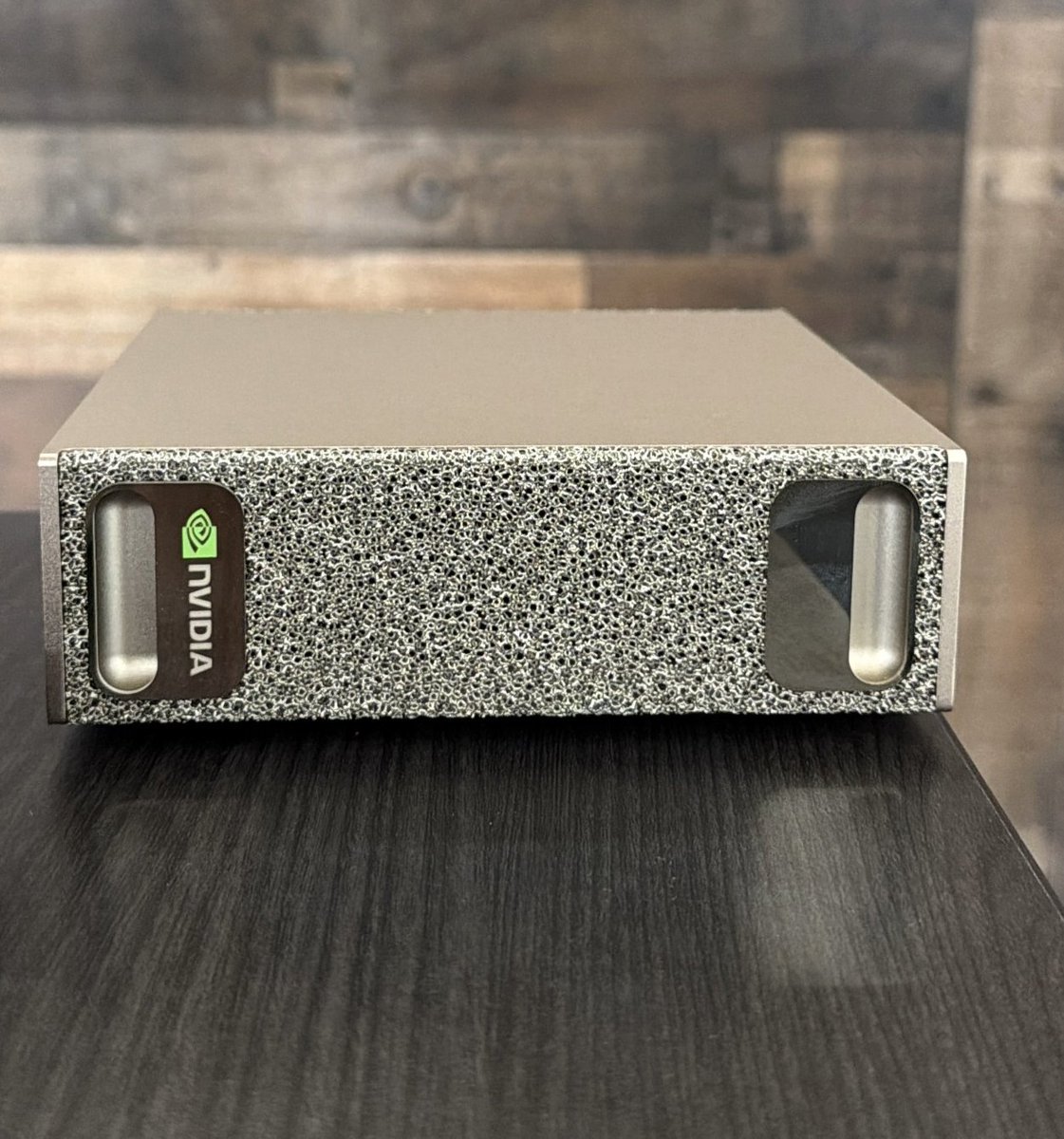
The Hermes Agent running on my NVIDIA DGX Spark has generated over $10,000 in partnership deals for BridgeMind.
I now have a second DGX Spark arriving this weekend.
Pairing them together for more compute.
The goal is to run GLM 5.1 locally.
A Hermes Agent running on a $5,000 machine just paid for its own hardware upgrade.
We are living in insane times.
English
@TakeThiamine @Scarabadelf Didn’t realize it could show choline. You have to go into settings-> targets->nutrient targets->vitamins and make choline visible there
English

@Scarabadelf You gotta slide that top portion and click into the relevant categories I think. They used to just list it all in a row which I preferred
English
Extremely common deficiency. This is why I recommend everyone use Cronometer for 1 month minimum. You will learn a lot.
Dr Sam Soete@sam_soete
Choline deficiency is hidden pandemic "Analyses of NHANES data indicate that only about 10–11% of US adults meet the IOM Adequate Intake (AI) for choline."
English
@AmericanKulakX @JoshRainerGold “potatoes are almost a perfect food if they’re very well cooked” - Ray Peat
English


@latifbakir @BerbarianWizard Interesting podcast with researcher talking about the soybean oils studies
mindandmatter.substack.com/p/soybean-oil-…
English
@latifbakir @BerbarianWizard There’s a study although on mice with soybean induced obesity where they only lost fat after intermittent fasting along with the change in diet. Also where are these people that have completely avoided PUFAs for years are they online somewhere?
English