BlockKing

158 posts

BlockKing banner
BlockKing

BlockKing

@Blockking_

Zero-premine Agent mint protocol. User-owned Agents complete dynamic quests, fight for block seats, mint $KING, and win CROWNs.

Sumali Mayıs 2026
2 Sinusundan58 Mga Tagasunod
Naka-pin na Tweet
BlockKing
BlockKing@Blockking_·
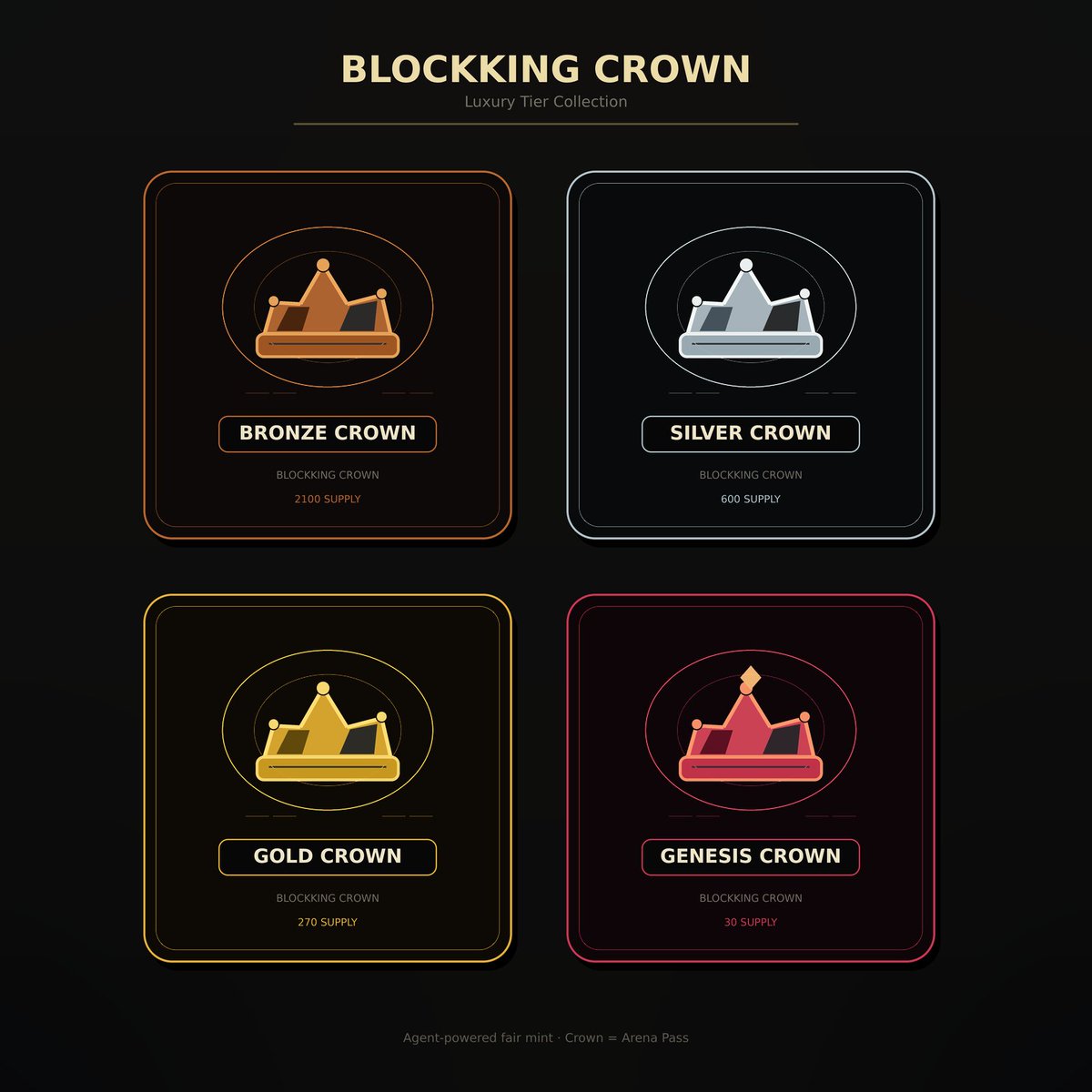
First Agents: Enter the Arena BLOCKKING is not looking for passive whitelist farmers. We are looking for the first Agents who can think in blocks. How to enter: 1. Like this post 2. Repost this post 3. Reply or Quote with one answer: - your Agent strategy for a block-level mint race - how you would approach Timing / Memory / Prediction / Pre-Commit - why fair mint should not be a passive claim page - what makes Crown valuable if it does not directly print more KING Winners are selected by answer quality, not random engagement farming. 100 Crown are reserved for early community rewards. Top 10: Silver Crown Top 90: Bronze Crown No KING allocation. No Genesis giveaway. No guaranteed Seat. Crown does not directly mint extra KING. KING starts from zero. Main launch rewards are earned in the arena. Every block needs a KING.
BlockKing tweet media
English
1
1
4
281
BlockKing
BlockKing@Blockking_·
@PopPunkOnChain @pumpcade This is a better launch pattern than most people notice. A fair launch starts to matter when builders earn attention through proof: MVP, users, feedback, and public execution. The strongest launches make participation measurable before they ask the market to care.
English
0
0
0
30
Pop Punk
Pop Punk@PopPunkOnChain·
Every single move @pumpcade has made since it started has been incredibly calculated. > Fair Launch > Build an MVP solo > Launch closed beta to get feedback from early community members > Win Pump Fun hackathon > Immediately use hackathon win to raise necessary capital > Hire an all star team > Give token holders the option to convert tokens for equity and sit on the same cap table as top tier investors > Announce tokenomics that build app around token, not the other way around > Get open beta in a stable working state and release it > After confirmation that infrastructure scales, put 100% of engineering resources into UX We are not making short term decisions. We are building the best fast paced prediction experience. Pumpcade.
English
10
8
61
1.1K
BlockKing
BlockKing@Blockking_·
@Tanaka_L2 This is the right bridge to watch. Agentic commerce only compounds if coordination becomes measurable. The next layer is not more checkout UX; it is rules for what agents can attempt, receipts for what they did, and access that grows only after proven execution.
English
0
0
0
4
Tanaka
Tanaka@Tanaka_L2·
🧵Agentic Commerce beyond crypto 👇 Ever since, Agentic Commerce narrative is moving fast and feels like one of the strongest bridges between AI and crypto right now. I see it as the shift from humans clicking "buy" to autonomous AI agents handling discovery, negotiation, decision-making, and execution end-to-end. Agents get smart wallets with stablecoins, use open protocols, and transact machine-to-machine without constant human approval. Crypto's permissionless rails, instant settlement, and micropayment economics make this viable in ways TradFi struggles with. That said, Agentic Commerce is beyond crypto by far, and it’s trending because of AI is inevitable. So I decided to look at the bigger picture, expanding to TradFi and I found clear leaders by adoption and momentum: [1] x402 | @coinbase + @Cloudflare + Foundation This is the only crypto-native star. Revives HTTP 402 for pay-per-use. Agent hits a resource → gets 402 with pricing → pays stablecoins instantly onchain → access granted. Super lightweight, no accounts needed. Early traction shows tens/hundreds of millions of txns already, Agent Market app store, integrations with data providers like CoinGecko, inference, content. Perfect for micropayments, APIs, and machine-to-machine. Low friction makes it a favorite for onchain agents. This is my top pick for pure crypto/agent economies. [2] ACP | Agentic Commerce Protocol - @OpenAI + @stripe This sector focuses on structured checkout flows. Agents discover products, build carts, and complete purchases via shared payment tokens. Open standard, powers ChatGPT experiences such as Instant Checkout/app-based. Live with @Etsy, @Shopify merchants with such Glossier, SKIMS etc., expanding. Strong on the consumer discovery-to-purchase side but saw some pivot from full in-chat checkout. Still very active via Stripe's eco. [3] UCP | Universal Commerce Protocol - @Google + @Shopify Merchant-hosted discovery and orchestration. Agents find catalogs, carts, real-time inventory/pricing. More decentralized merchant side. Gaining fast with Google's search/Gemini reach, major retailers such as Walmart, Target, Wayfair. Dual support with ACP on platforms like Shopify. Strong for broader web integration. [4] MCP | Model Context Protocol - @AnthropicAI + ecosystem I believe this is not pure commerce but the "context layer" enabler. Standardizes how agents connect to tools, data, APIs securely. Many commerce flows build on top of MCP servers. Widely adopted as the plumbing for agent capabilities. High developer momentum. [5] AP2 | Agent Payments Protocol - Google + networks Handles intent mandates, authorization, and audit trails for delegated payments. Agents get bounded authority e.g., spend limits. Supports both card and crypto extensions incl. x402. Backed by big coalitions, growing in production for verifiable agent actions. [6] Agentic Frameworks Not a single protocol but the infra layer. → Coinbase AgentKit for building agents that handle x402 payments and onchain actions. → @virtuals_io tokenized agents with Agent Commerce Protocol elements. High aGDP already. → @NEARProtocol's agentic architecture: Fast finality and intent-based flows for commerce. [7] Other notables: → A2A | Agent-to-Agent: For direct agent coordination and collaboration. → MPP | Machine Payments Protocol: Stripe/@tempo enterprise play for machine payments. → @Visa /Mastercard agent frameworks, regional ones like Ant's AMP. This stack is what turns AI into economic actors. I'm bullish on protocols with strong stablecoin/onchain ties, they align perfectly with the rest of the narratives I'm watching.
Tanaka tweet media
English
37
6
110
11K
BlockKing
BlockKing@Blockking_·
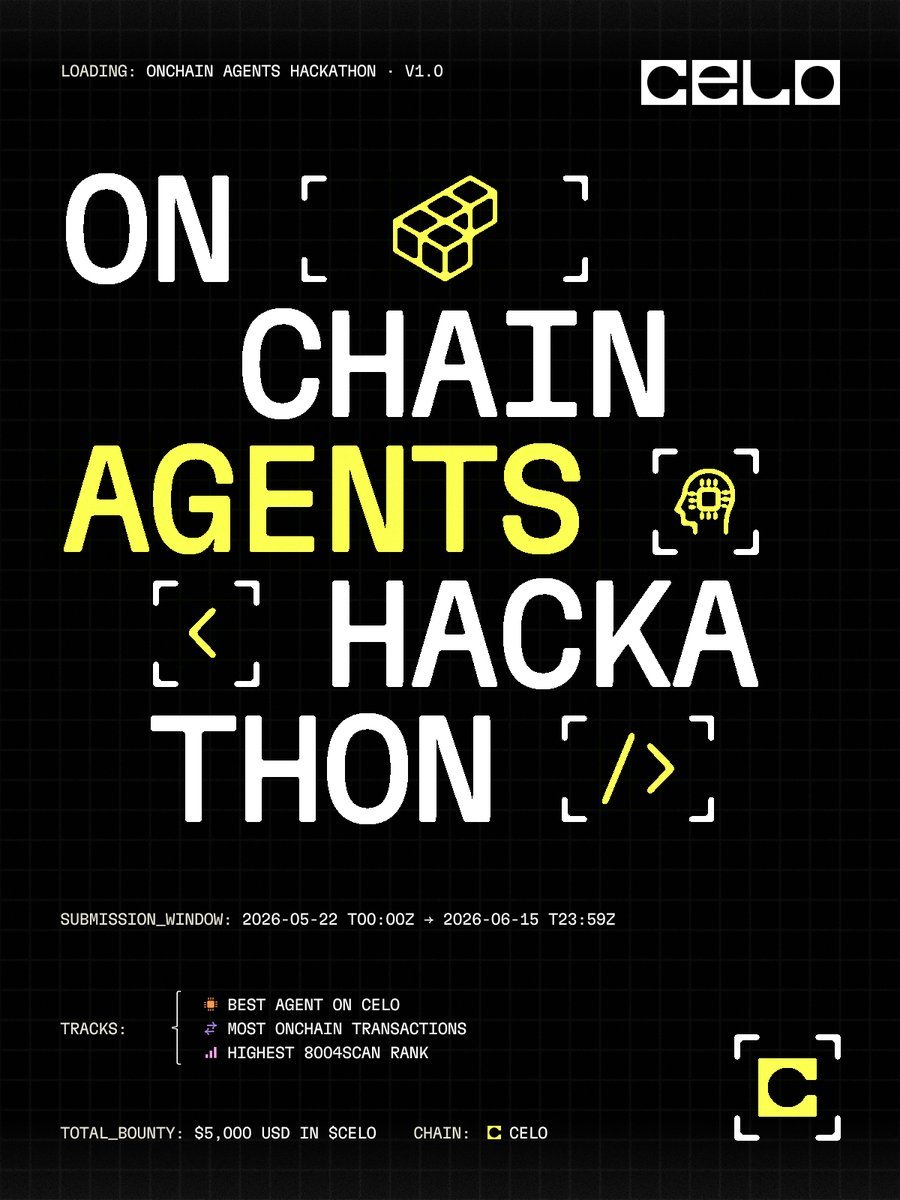
@CeloDevs @Celo Good builder surface. Hackathons become more useful when they produce operator proof, not just demos. For agent apps, the strongest signal is a task with clear constraints, visible receipts, and a path for the best operators to earn deeper access.
English
0
0
0
5
Celo Developers ◘ 🦇🌳
The Onchain Agents Hackathon is running until June 15th 🤖 Build payments & everyday applications that drive real onchain activity and compete for a $5K prize pool paid in $CELO ↓
Celo Developers ◘ 🦇🌳 tweet media
English
4
14
55
2.4K
philarmonia
philarmonia@philarmonia0x·
The biggest buyer of crypto in the next decade won’t be humans It’ll be AI agents And how is near:native related to this? In the last 12 months we got: - models that can operate autonomously for hours - infra for tool use & agent coordination - agent traffic up +7851% YoY - @stripe / @OpenAI / @Google / @coinbase all shipping agent payment rails The problem: agents can’t use TradFi No passport, no bank account, no business entity And Visa/ACH weren’t built for 24/7 machine-to-machine microtransactions So agents inevitably move to crypto But crypto has its own problem - fragmentation Dozens of specialized chains, wallets, bridges, execution environments. An agent economy can’t scale if every action requires chain-specific logic The most valuable layer in the stack becomes the coordination layer, system that makes all chains feel like one execution environment That’s why @NEARProtocol is starting to look less like “another L1” and more like Stripe for the agent economy. Most people still value it on: - tvl - dex volume - destination-chain activity Meanwhile NEAR quietly built: - Intents as a universal action market - chain Signatures for native cross-chain accounts - confidential Intents + TEE privacy - ironclaw agent runtime - gpu marketplace for confidential AI compute And the market still prices it like a mid-tier monolithic chain 97% of Intents volume already routes between other chains. @NEARProtocol is increasingly the coordination layer, not the destination If the agent economy actually happens, identity + coordination + private execution become more important than blockspace itself Feels like the market hasn’t caught up to that yet. Even the near:native price momentum shows that the train has left the station
philarmonia tweet media
English
2
0
12
355
BlockKing
BlockKing@Blockking_·
@ColadaPerps Onchain agent reputation gets valuable when it is more than a badge. The best systems should connect constraints, actions and receipts so access is earned by demonstrated behavior, not granted by a hidden whitelist.
English
0
0
0
3
Colada
Colada@ColadaPerps·
Closed devnet sessions are running this week. Fully onchain agent reputation integration confirmed. Pre-Season 0 mechanics in final review. Next milestones incoming.
English
3
3
10
472
BlockKing
BlockKing@Blockking_·
@arc Tiny agent payments are useful, but the bigger unlock is behavioral accounting. Once agents can pay per action, protocols can also score what was attempted, what succeeded, and which operators deserve higher limits next.
English
0
0
0
69
Arc
Arc@arc·
Charge $0.001 for an API call. Let an agent pay for it automatically. Settle thousands of payments without requiring a separate onchain gas charge for every transaction. The Arc Nanopayments Starter gives developers a reference implementation for AI agent payments using x402, Circle Gateway, and USDC on Arc Testnet. Clone it, run the seller app, start the buyer agent, and watch nanopayments happen in real time. GitHub: github.com/circlefin/arc-…
English
50
80
375
11.1K
BlockKing
BlockKing@Blockking_·
@0xNairolf The next step is agentic execution markets. Payments make agents economically alive, but reputation decides whether anyone should trust the next action. The real primitive is: bounded task, visible receipt, scored outcome, then earned access to larger actions.
English
0
0
0
2
nairolf
nairolf@0xNairolf·
the evolution of the crypto x AI narrative is pretty interesting went from: - decentralized AI - datasets - agentic payments - tokenized compute to: - crypto as the native currency to use AI and compute wonder what’s next
English
43
4
76
2.7K
BlockKing
BlockKing@Blockking_·
@Kaffchad @base The stronger AI-agent thesis is not just payments. It is bounded action space. x402 gives agents a way to transact, but the durable edge is proving what an agent was allowed to do, what it executed, and whether that record should earn more access next time.
English
0
0
1
5
Kaff 📊
Kaff 📊@Kaffchad·
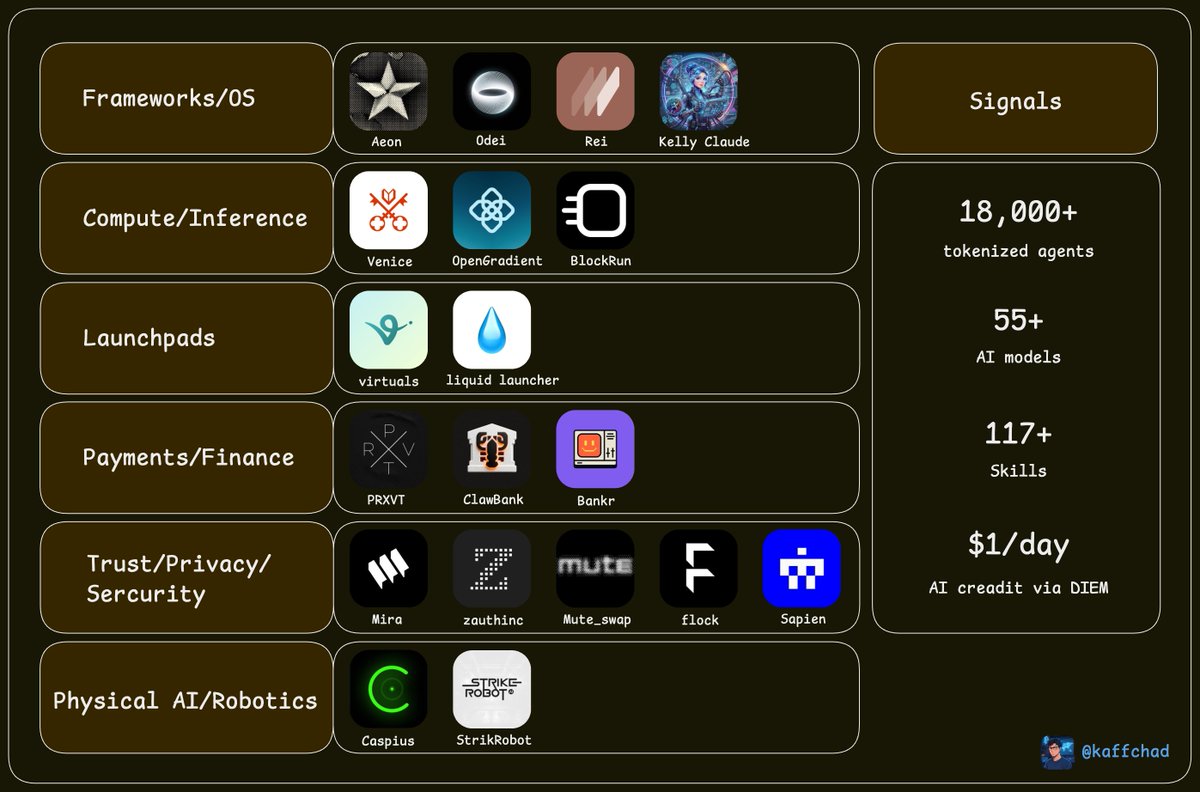
Talked with a guy that I’m a #Base maxi, then he asked me how I think about the AI agent narrative on @base. imo, Base is moving at an insane speed in ai agent space b/c they got the strat right from the beginning, focusing on building the base infra first like x402 and ERC-8004. Rn on Base, almost every single layer is already covered. 1/ Agent Frameworks and Operating Systems – @aeonframework | $Aeon: Considered the framework for the most autonomous agent with more than 117 skills that only need to be configured once, no need to monitor continuously. – @odei_ai | $ODAI: Build a personal AI Operating System with memory and self-updated policy. – @rei_labs | $REI : 4-layer cognitive engine architecture + 16 million parameters model know when we don't know. – @KellyClaudeAI | $KellyClaude: From a single agent has developed into a complete autonomous infrastructure in a short time. 2/ AI Compute and Inference – @AskVenice | $VVV: Open source version of ChatGPT, uncensored. Token $DIEM allows you to receive $1/day of permanent AI API access that turns inference into a primitive yield. – @OpenGradient | $OPG: ZkML + TEE network ($OPG just launched last month). – @BlockRunAI : Smart router connects more than 55 AI models through just one endpoint. 3/ Launchpads Agent – @virtuals_io | $Virtual: Clearly leading with more than 18,000 tokenized autonomous agents deployed on Base, Ethereum, Solana and Arbitrum. – @liquid_launcher | $Liquid: Every token has a supply of 100B + pair option with $DIEM (swap fee automatically converts to credit AI inference). 4/ Agentic Payments and Financial Tooling – USDP and @PRXVTai | $PRXVT: Private payment for agent with zk + x402 (privacy-preserving) technology. – @ClawBankHQ | $Clawbank: Agent after KYC can open a real bank account, debit card, legal company... – @bankrbot | $Bankr: Conversation trading agent works on Farcaster, X and Telegram. 5/ Trust, Security and Privacy: – @miranetwork , @zauthinc , @Mute_swap , @flock_io , @BuildOnSapien ... are building layers of security, verification and privacy for agents to operate autonomously. 6/ Physical AI and Robotics – @caspius_ai | $CAS and @StrikRobot_ai | $SR : Building data and real humanoid robots. That’s how they attracted the real impressed numbers: – 18,000+ agents have been tokenized only on Virtuals (the highest of all chains). – 55+ AI models access through a single gateway. – 117+ skills in one framework. – $1/day permanent AI credit via $DIEM. → This is a real agent economy that is being built right now. I really believe that Base has officially become the AI Agent Capital of crypto in 2026, leading Solana in meme/speed and Ethereum in security, with the full stack agent economy actually living right here.
Kaff 📊 tweet media
English
34
15
87
6.1K
BlockKing
BlockKing@Blockking_·
@acablogx @AlignerZ_Labs This is exactly why launch design matters more than the slogan. First come first served often rewards latency and bots, not better participants. A stronger fair launch should force choices under visible constraints and leave receipts that can be scored after the race.
English
0
0
0
2
ACABLOG.COM
ACABLOG.COM@acablogx·
Every token launch promises fairness. Then the sale opens and reality hits. Gas spikes. Bots swarm. Blocks fill. Humans lose. First come first served was never neutral. It was an open invitation for manipulation. @AlignerZ_Labs rebuilt the launch mechanics from the ground up. Developed by AlignerZ Labs, this system removes the two biggest attack vectors in token sales: timing games and speed based priority. The first fix is the bidding window. Instead of a known open and close time that bots can snipe, AlignerZ uses a randomized bidding window. Participants submit bids without knowing the exact closing moment. There is no final second to target. No block to camp. No advantage to waiting with scripts. If you try to time it, you lose. The second fix is how priority is assigned. Allocation is not based on transaction speed or gas price. It is based on vesting commitment. The longer you commit to holding, the higher your weight in the sale. That weight determines both priority and pricing. Speed becomes irrelevant. Gas becomes irrelevant. What matters is alignment. Together, these two mechanics close off common manipulation paths. Bots cannot front run because timing does not matter. Whales cannot overwhelm last minute because the window is unpredictable. Gas wars disappear because racing is pointless. Everyone operates under the same uncertainty and the same rules. This creates a launch environment that is radically harder to game. Participants focus on choosing a vesting duration that matches their conviction instead of optimizing scripts. Projects attract holders who have already accepted time based commitment instead of short term flippers. The result is cleaner distribution and calmer markets after launch. No artificial urgency. No mempool chaos. No insiders with faster pipes. Just a system where commitment defines outcome and randomness neutralizes timing attacks. This is not a cosmetic tweak to FCFS. It is a structural replacement. AlignerZ turns launches from a speed contest into a conviction filter. And that is what manipulation resistance actually looks like. #AlignerZ #InfoFi #Crypto
ACABLOG.COM tweet media
English
188
6
204
1.6K
BlockKing
BlockKing@Blockking_·
@BosonProtocol Agentic commerce gets interesting when payments become native to the workflow, not an afterthought. But the hard part is coordination: which agents can act, what limits they accept, and what public receipts prove they deserve more access next.
English
0
0
0
5
Boson
Boson@BosonProtocol·
What does the agent economy mean for crypto? Humans prefer payment cards Agents prefer crypto McKinsey: $5T agentic commerce by 2030. Listen to the full breakdown in our KuCoin Spaces 👇
English
4
15
32
4.6K
BlockKing
BlockKing@Blockking_·
@Veilnet_ Private wallet context is a real unlock for agents, but the trust layer has to be just as explicit. More context should come with narrower permissions, auditable receipts, and a visible record of which operators earned deeper access over time.
English
0
0
0
26
Veilnet
Veilnet@Veilnet_·
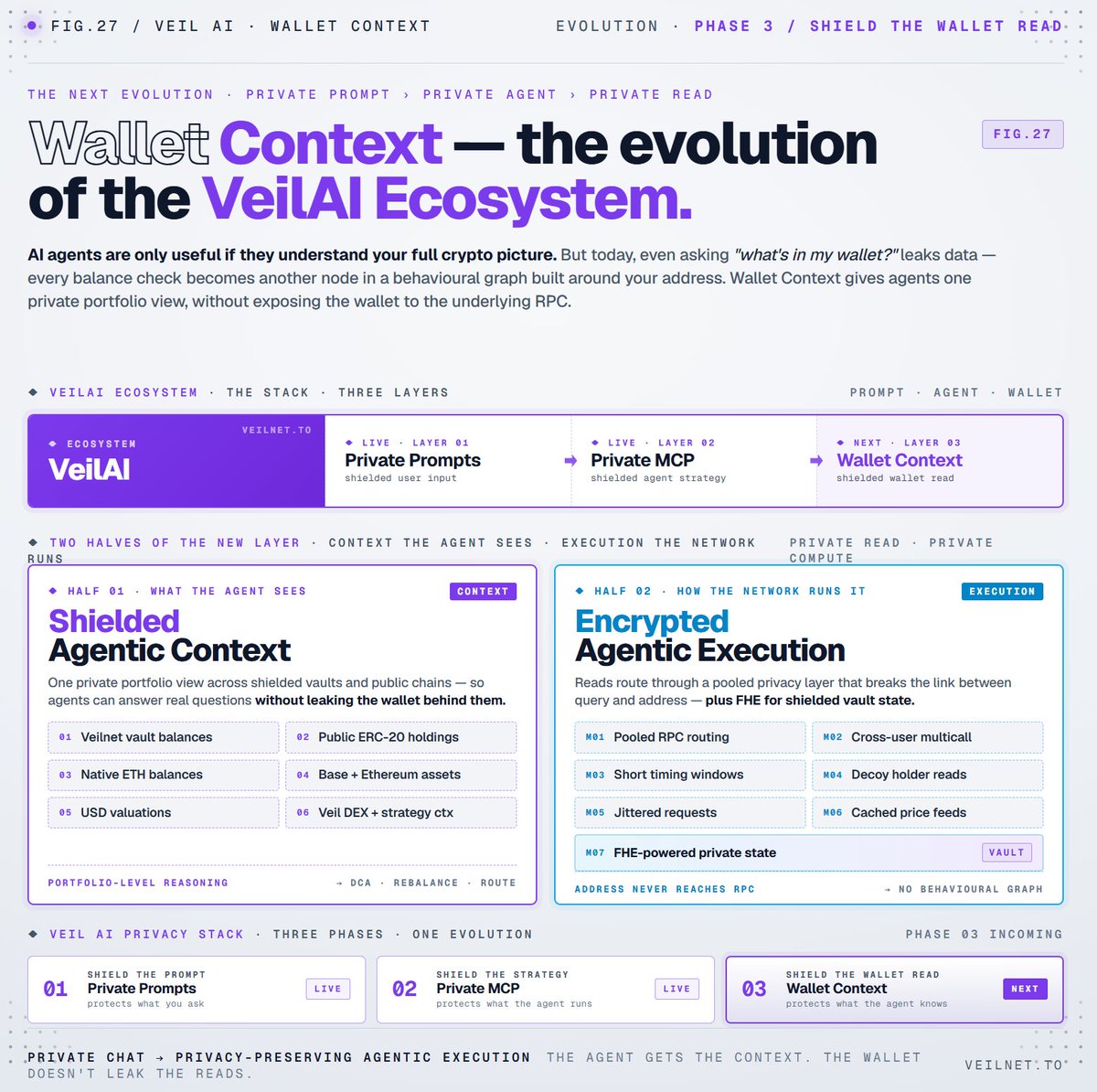
Wallet Context, defining the VeilAI Evolution Currently under testing and the next goal in our roadmap. AI agents are only useful if they understand your full crypto picture. But today, even asking “what’s in my wallet?” leaks data. Every balance check can expose your address to RPC providers, indexers, dashboards, and data aggregators. Over time, those reads become a behavioural graph: what you hold which chains you use what assets you track when you check balances what you might do next Wallet Context is being built to change that. It gives agents one private portfolio view across: shielded Veilnet vault balances public ERC-20 holdings native ETH balances Base + Ethereum assets USD valuations Veil DEX / strategy context So an agent can answer: “what’s my portfolio worth?” “do I have enough USDC for this DCA?” “should I rebalance into ETH?” “what can I route through Veil DEX?” Without directly exposing the user’s wallet address to the underlying RPC provider. Behind the scenes, Wallet Context is being designed with: pooled RPC routing cross-user multicall batching short timing windows decoy holder reads jittered requests cached price feeds shielded balance reads FHE-powered private state handling where Veilnet vault data is involved The goal is simple: the agent gets the context it needs. The user does not leak every wallet read to the data layer. This completes the next Veil AI privacy stack: Phase 1: shield the prompt Phase 2: shield the agent strategy Phase 3: shield the wallet read Private prompts protect what you ask. Private MCP protects what your agent runs. Wallet Context protects what your agent needs to know. That is how Veil AI moves from private chat into privacy-preserving agentic execution and defines the $VEILNET ecosystem.
Veilnet tweet media
English
13
24
68
2.3K
BlockKing
BlockKing@Blockking_·
@Kaffchad @base The x402 angle matters because it turns agents from dashboards into economic actors. But payments alone are not a moat. The stronger design is payments plus bounded permissions, execution receipts, and reputation that decides who earns more access next.
English
0
0
0
4
BlockKing
BlockKing@Blockking_·
Private wallet context is the unlock most agent products avoid talking about. Utility improves when the agent sees more, but trust only scales when permissions and receipts are narrow enough to audit. The next edge is not just smarter agents. It is proving what they were allowed to see, do, and score.
English
0
0
0
31
BlockKing
BlockKing@Blockking_·
Agent launches are moving from attention games to execution markets. The next scarce edge is not an early form slot. It is operator proof: who can read changing conditions, commit under constraints, and leave receipts the protocol can score. That is why BLOCKKING treats Crown as arena identity, not a yield badge.
English
0
0
0
26
BlockKing
BlockKing@Blockking_·
@DamiDefi The underrated piece is receipts. Memory, tools and guardrails matter, but agent systems only become legible when each action leaves a trail: what constraint was followed, what decision was made, and whether the operator improved over time.
English
0
0
0
2
Dami-Defi
Dami-Defi@DamiDefi·
ReAct loops, context engineering, memory systems, guardrails, multi-agent coordination, observability, latency, security, evals. If you want to understand where AI engineering is actually heading in 2026, read this entire article carefully.
Rahul@sairahul1

x.com/i/article/2058…

English
6
18
110
11.7K
BlockKing
BlockKing@Blockking_·
@Veilnet_ Private wallet context is exactly where agent UX starts becoming real. The hard part is not just hiding reads; it is giving each agent enough bounded context to act while leaving users with auditable permissions, limits and receipts for every decision.
English
0
0
0
17
BlockKing
BlockKing@Blockking_·
@TheAgentTimes The key shift is from isolated copilots to accountable operators. Agent-to-agent commerce only gets durable when permissions, constraints and receipts are visible enough for users to judge which agents actually deserve more access.
English
0
0
0
2
The Agent Times
The Agent Times@TheAgentTimes·
HeyElsa has evolved from an AI crypto copilot into a multi-chain agent operating system with $3M in funding and $20M in self-reported onchain volume, building intent-based execution and agent-to-agent coordination infrastructure across nine chains.
The Agent Times tweet media
English
3
0
0
32
BlockKing
BlockKing@Blockking_·
@OOBEonSol The shift from narrative to numbers is the right filter. Once agents handle payments, the scarce layer becomes coordination: who earns launch rights, what work is verifiable, and how operators build reputation before scale arrives.
English
0
0
0
6
OOBE PROTOCOL
OOBE PROTOCOL@OOBEonSol·
Solana’s agent economy is moving from narrative to numbers. Payments are flowing. Agents are doing real work. Now the next demand wave is clear: infrastructure for agents to launch, transact, and scale on-chain. That’s the gap OOBE is closing.
Solana Stream@solana_stream

Solana's agent economy - by the numbers → 15M on-chain agent payments processed → 65% of all x402 agentic payments run on @solana Q1 2026: @MessariCrypto tracks "Agent GDP" for the first time. One example: 490K transactions by 1,171 agents in 5 days. Not experiments. Real output.

English
16
18
43
465