
Tobias Wolfram

965 posts

Tobias Wolfram banner
Tobias Wolfram

Tobias Wolfram

@_twolfram

Sociogenomics, Behavioral Genetics, Statistical Genetics @herasight

Katılım Eylül 2018
1.4K Takip Edilen1.6K Takipçiler
Tobias Wolfram retweetledi
Timothy Bates
Timothy Bates@timothycbates·
This is incredibly misleading. The author admits the Lewis Terman's high IQ sample stunningly outperformed. The author notes the low base rate fallacy makes his own claim false: mathematically, simulations by @Russwarne show Terman had a 53–83% probability of selecting neither future laureate just by chance. The tweet omits the name of the great scientist from the lead. I guess it makes it more clicky but "A Stanford Psychologist" - it's like calling Newton "A Lincolnshire Man". Crucially, the central claim in @ihtesham2005's post is false. Terman did not predict or claim that high IQ is genius or that it alone produces genius-level achievement. Terman did expect, and did find, that when 8% of American men were getting degrees, 70% of Termites did. He did find that Termites incomes were roughly double the white-collar median. The facts are that Terman treated high IQ as a practical, measurable proxy for selecting gifted children to study their real-world development. He viewed it as it is labeled on the tin: Ability, not Achievement. This is about as basic a fact about IQ as there is. But read this tweet, and unless you have a Termite-level IQ, you will come away with diametrically the wrong conclusion about what Lewis Terman thought and what he found. This post provides a helpful antidote to this Gladwellesque traducing of history: x.com/timothycbates/… Like Terman, and Galton, most researchers believe creative achievement requires creativity (of course) and staggering levels of industry. Both, of course are also heritable alongside IQ. No news travels as fast as bullshit about dead people who should be heroes and guides. Sad.
Ihtesham Ali@ihtesham2005

A Stanford psychologist spent 35 years trying to prove that high IQ produced genius. He selected 1,528 of the smartest children in California and tracked them for the rest of their lives. Not one of them won a Nobel Prize. Two of the boys he had rejected from the study won the Nobel Prize in Physics. The trait he had built his entire career on did not predict the thing he thought it predicted. His name was Lewis Terman. The study is one of the most honest accidents in modern psychology. In 1921, Terman was the most famous psychologist in America. He had translated and adapted the original French intelligence test into the version that would dominate American schools for the next 50 years. He called it the 'Stanford-Binet'. He believed, with the certainty of a man who had built a career on a single idea, that intelligence was the master variable behind every form of human achievement. The doctors, the inventors, the senators, the artists, the great writers and great scientists. All of them, in his model, were sitting at the top end of the same bell curve. If you could find the children with the highest scores, you could predict the future leaders of the country. So he set out to prove it. He sent his research team into California schools and screened roughly 168,000 children. He had teachers nominate their brightest pupils. He gave the nominees the Stanford-Binet. He kept the ones who scored 135 or higher, which placed them in roughly the top one percent of the population. The final sample was 1,528 children, average age 11. They had a name in his lab notebooks within a year. Termites. He planned to follow them for the rest of their lives. He died in 1956 having tracked them for 35 years. Stanford kept the study going. The last surviving Termites were tracked until the 2000s. The data set is one of the longest continuous psychological studies in human history. Here is what the data showed. The Termites did well. They went to college at higher rates than their peers. They earned more money. They became professors and engineers and lawyers and physicians at higher rates than the general population. Terman was not entirely wrong. High IQ is correlated with conventional success. The correlation is real and the effect size is meaningful. But that was not what he had set out to prove. He had set out to prove that high IQ produces genius. The kind of genius that wins Nobel Prizes, writes great novels, founds new fields, and reshapes the technological direction of the world. And on that specific question, the dataset turned on him. None of the 1,528 Termites won a Nobel Prize. None of them won a Pulitzer. None of them became world-class musicians. None of them produced a single piece of work that historians of science or art still talk about. They were accomplished. They were comfortable. They were not, in any sense Terman would have recognized in his original ambition, geniuses. The detail that haunts the study is what happened to the children he rejected. In the screening phase, his team had tested two boys named William Shockley and Luis Alvarez. Both scored below the cutoff. Both were sent home. Shockley went on to co-invent the transistor and win the 1956 Nobel Prize in Physics, the same year Terman died. He founded the company that seeded the entire ecosystem we now call Silicon Valley. Alvarez won the 1968 Nobel Prize in Physics for his work on subatomic particles, and later proposed the asteroid impact theory of dinosaur extinction that turned out to be correct, too. Two of the most consequential American physicists of the 20th century had been measured by Terman's own instrument and judged not gifted enough to be worth tracking. There is an important caveat here that the more honest critics have raised in recent years. A 2020 simulation study from researchers at Utah Valley University showed that even with a perfect IQ test, the base rate of Nobel Prizes is so vanishingly low that Terman would have been statistically unlikely to catch a future laureate in any sample of his size, no matter where he set the cutoff. The Shockley and Alvarez story is dramatic but it does not, on its own, prove that IQ does not matter. It proves that rare outcomes are hard to predict from any single variable, including a very good one. That caveat is real. It is also not the most important thing the study showed. The most important thing the study showed is what Terman himself eventually admitted, late in his career, in a quieter voice than he had used for the previous three decades. He wrote that the relationship between intelligence and achievement was, in his words, far from perfect. Within the Termite sample itself, the highest-IQ children did not become the most accomplished adults. The variation in outcomes inside the group of geniuses was enormous, and IQ explained almost none of it. Some of the Termites had unremarkable careers. Some of the Termites had remarkable ones. The thing that distinguished the two groups was not the score he had used to select them. What distinguished them, when researchers eventually analyzed the data more carefully, was a cluster of traits Terman had not been measuring. Persistence. Curiosity. Health. Stable family circumstances. The willingness to keep going when a project stopped being interesting and started being hard. Most of the Termites who went on to do meaningful work were not the ones with the highest scores. They were the ones who had spent decades grinding on a single problem. The lesson is the part that should change how anyone reading this thinks about talent. The trait you select for is the trait you optimize for. If you measure children on a test of pattern recognition and verbal recall, you will find children who are good at pattern recognition and verbal recall. You will not find the children who will spend 30 years thinking about a single equation. You will not find the children who will quietly read the same difficult book six times. You will not find the children whose curiosity is wider than their working memory. Those traits do not show up on the test you are running, which means they do not show up in the dataset you build. Terman spent his life trying to find genius and ended up proving that he had been measuring the wrong thing all along. The kids he rejected were not stupider than the kids he kept. They were running a different program underneath, and his instrument could not see it. The trait you can measure is almost never the trait that actually matters. Most people building careers, hiring teams, and raising children are still selecting for the version of the trait that fits on a test.


English
6
16
152
12.1K
Tobias Wolfram retweetledi
SynBioBeta
SynBioBeta@SynBioBeta·
@JonathanAnomaly said embryo genetics is moving beyond monogenic screening toward polygenic prediction validated within families, with IVG, gene editing, and synthetic chromosomes now back in the conversation. #SynBioBeta #Biotech
SynBioBeta tweet mediaSynBioBeta tweet mediaSynBioBeta tweet mediaSynBioBeta tweet media
English
0
11
23
1.9K
Tobias Wolfram retweetledi
Marios Georgakis
Marios Georgakis@MariosGeorgakis·
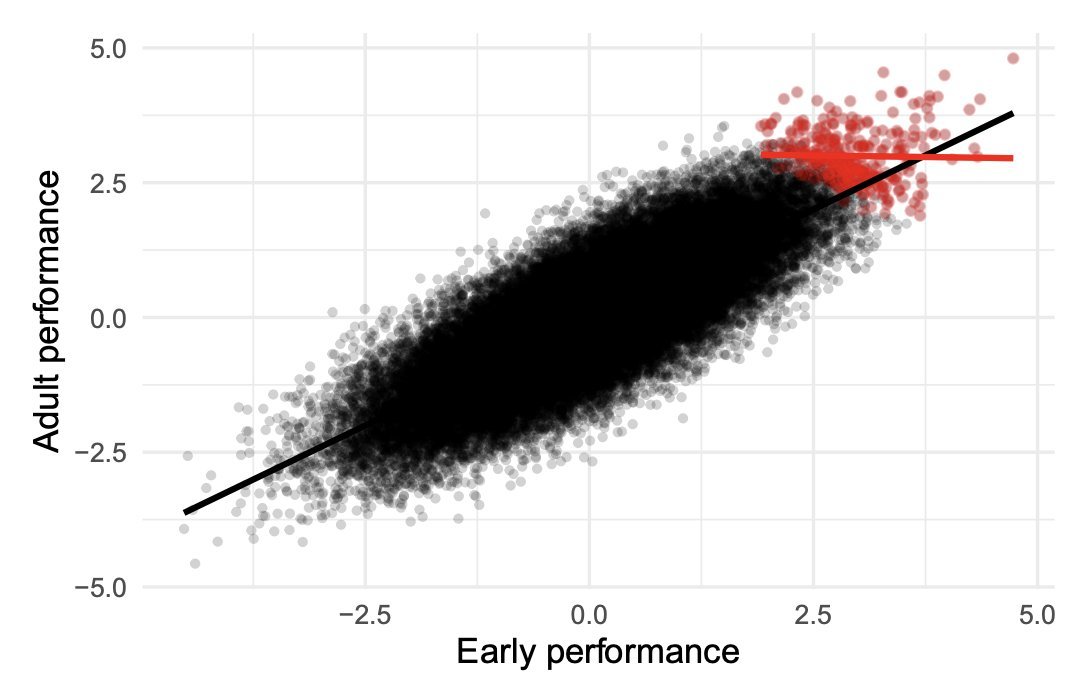
Among elite chess players, those with the lowest IQ are the best. Among NBA players, the shortest ones are the best. Among Hollywood actors, the least attractive are the most talented. Among elite academics, those with poorer early academic performance are the best. Among people with high LDL & high plaque burden, LDL is barely correlated with plaque burden. Learn collider bias. Nice catch by @AlexTISYoung
Marios Georgakis tweet media
Alex Strudwick Young@AlexTISYoung

Isn't this a collider bias phenomenon? If becoming an elite chess kid is due to some combination of IQ and chess skill not explained by IQ, then we'd expect a negative correlation between IQ and chess skill in the elite subsample.

English
231
998
12.8K
2.5M
Tobias Wolfram retweetledi
Riot IQ Test
Riot IQ Test@RiotIQ·
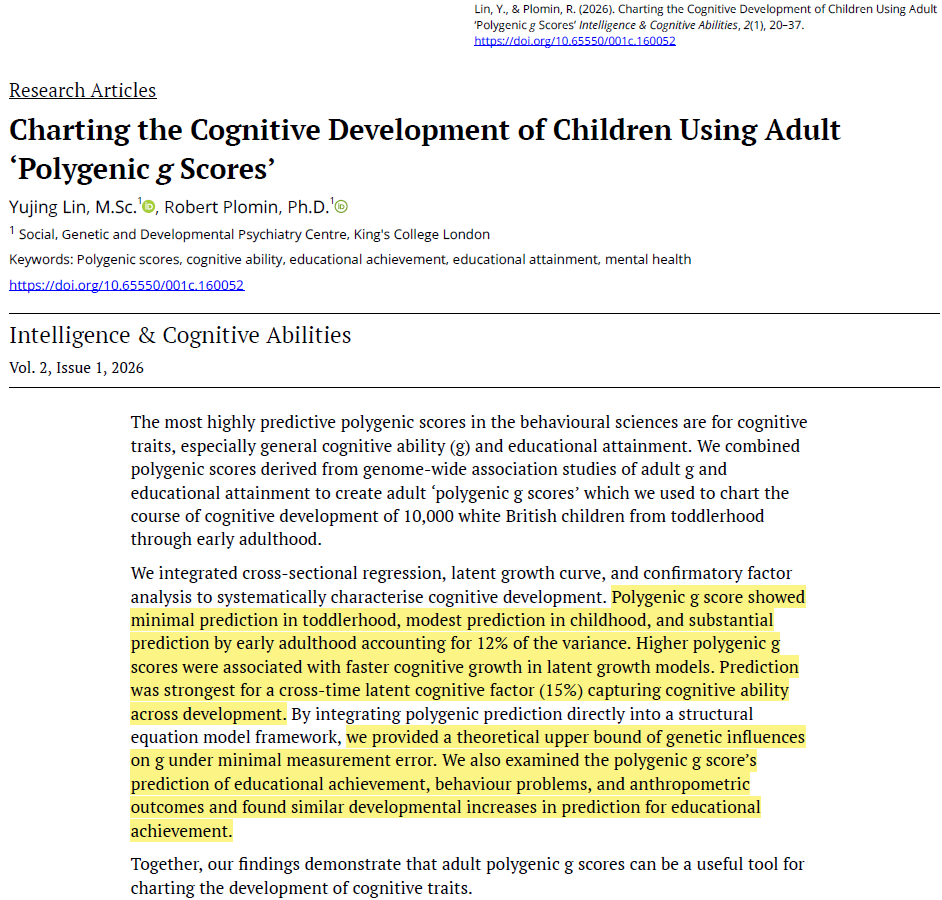
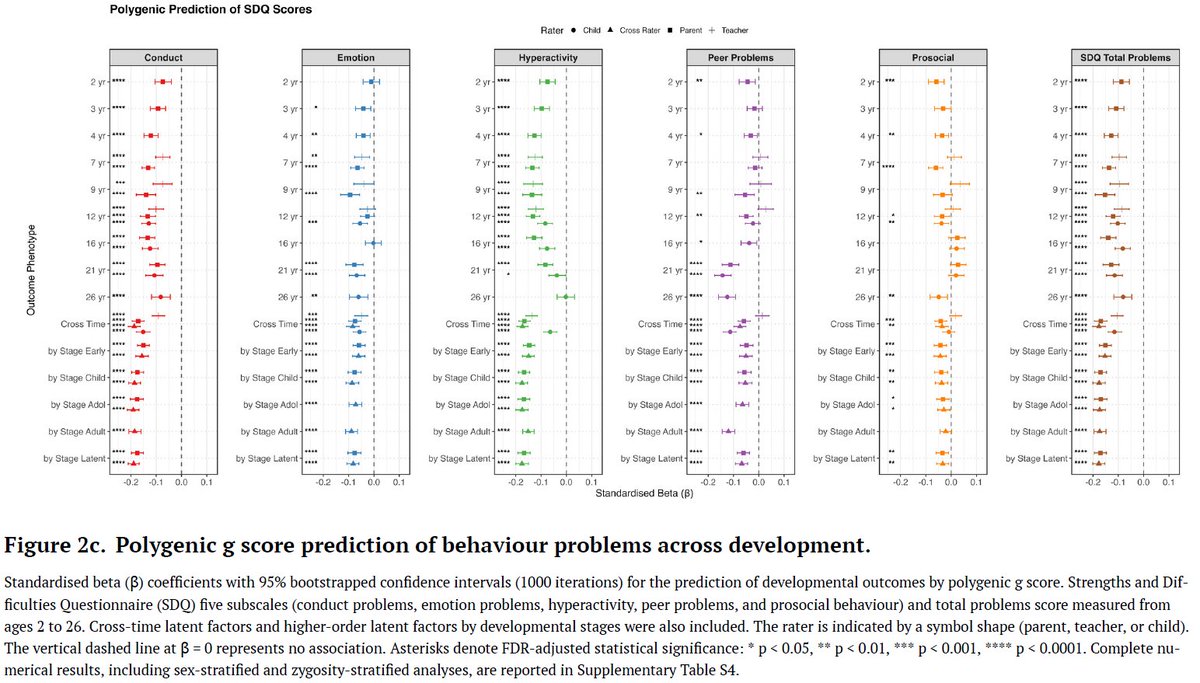
A new must-read article from the Plomin lab was published this week in @ICAJournal. Lin and Plomin used polygenic scores (derived from DNA variation in people) predict life outcomes from ages 2 to 25 in the same sample. Results showed that the scores predicted cognitive abilities (including IQ) and educational attainment well (up to r = .37). But they could also predict some non-cognitive outcomes, such as conduct problems and hyperactivity. Predictions of IQ started weak (r = .03 at age 2) and increased steadily through adulthood (r = .37 at age 25). Predictions of educational outcomes also increased throughout childhood, peaking at age 16. Non-cognitive predictions were weaker (all r's between 0 and .25), but that was expected because the polygenic scores were designed to maximally predict IQ and educational outcomes. Because this was a longitudinal study, the authors could also see whether they could predict trends and growth. They found that children with higher polygenic scores started off with higher IQs and educational attainment and had faster growth over time. (In other words, "the rich got richer.") The results confirm findings from other behavioral genetics studies using other methodologies. For example, the study supports the claim that heritability of IQ increases with age. The study also supports the idea that genes and environment become more strongly correlated as children grown into adulthood. It's great work that pushes the field forward and confirms that children's phenotypes can be predicted with polygenic score derived from adult data. Read the full open-access article here: doi.org/10.65550/001c.…
Riot IQ Test tweet mediaRiot IQ Test tweet mediaRiot IQ Test tweet mediaRiot IQ Test tweet media
English
3
35
102
7K
Tobias Wolfram retweetledi
steve hsu
steve hsu@hsu_steve·
Embryo Selection and Frontier Genomics with Dr. Alex Young – Manifold #111 Dr. Alex Young, a statistical geneticist and assistant professor in the Human Genetics department at UCLA, joins Steve Hsu to discuss the cutting edge of genomic prediction. They cover his research on polygenic embryo screening in IVF (including the ImputePGTA method), family-based DNA analysis, missing heritability, and the implications of polygenic scores for traits like education and disease. Alex also discusses his recent battles with cancer. @AlexTISYoung Chapter Markers: (00:00) - Alex Young Bio (06:36) - Biobank Era Genetics (10:49) - Missing Heritability Debate (27:18) - Embryo Selection Controversy (50:32) - Embryo Selection Backlash (53:42) - Mexico City Admixture Study (01:00:13) - Censorship Via Data Access Control (01:05:02) - Battle With Cancer and Circulating Tumor DNA (ctDNA)
English
3
22
105
19.5K
Tobias Wolfram
Tobias Wolfram@_twolfram·
Good question! This was a pedigree with extensive family history: an affected maternal uncle with schizophrenia, another schizophrenia case, bipolar disorder in the maternal grandfather, and multiple additional mood-disorder diagnoses on both sides. Because relatives were sequenced, we could estimate each embryo’s realized relatedness to affected individuals via IBD rather than rely only on pedigree-average kinship. The risk model then conditioned jointly on embryo PGS, family phenotypes, cross-disorder genetic correlations, and realized relatedness. There was also meaningful PGS stratification: two embryos were around the mid-90s percentile for schizophrenia PGS, one was around the low-20s. Also the whole pedigree was very elevated for bipolar PGS overall. We also gave the family several models depending on phenotype coding so they could understand the assumptions. Strict clinical-diagnosis-only scenarios gave lower risks, while the 18% vs 4% number comes from the broad model. We checked rare/CNV-type burden too and did not find anything explanatory here. Our clinical geneticist also conducted a thorough pedigree review and found no actionable finding. The framework can incorporate rare-variant/CNV information when present, though. This is probably worth writing up as a case study, as it shows what is possible when embryo PGS is combined with sequenced relatives and realized kinship in an informative pedigree.
English
0
0
5
201
Tobias Wolfram
Tobias Wolfram@_twolfram·
It is. Google Health’s breast cancer screening AI was published in Nature without releasing model weights or code, and a group of 19 researchers criticized exactly that in a rebuttal that got published, but did not change the stance of the journal. GRAIL’s Galleri test uses proprietary machine-learning classifiers. Orchid describes their WGS amplification protocol as "laboratory-developed" and that's it . So yes, one can argue about whether this norm is good enough. But it is plainly not unusual for journals to publish validation studies of commercial biomedical tools without requiring full public release of the implementation.
English
1
0
0
178
Tobias Wolfram retweetledi
Spencer Moore
Spencer Moore@SponceyM·
As I understand the argument, a strong preference for increased cognitive ability among those with serious heritable disease risk but few embryos could crowd out selection against disease. In that case embryo selection may no longer be a rational medical decision for those with such misguided preferences, and we'd be abetting poor selection choices given our trait offerings. I think there are at least two issues with this argument. The first is straightforward and empirical: it almost never occurs. Most of our customers don't obsess over IQ, and those with family history of serious disease overwhelmingly prioritize disease selection above all else. The second issue is that it doesn't compare against the counterfactual in which embryo choice is made at random without any genetic testing. This foregoes the possibility of large expected risk reductions when couples screen against certain nasty diseases (the observed preference). For example, Alex mentions below the case of "a European couple with 3 embryos where one parent carries APOE4. Modeling Alzheimer's as an oligogenic trait, their expected risk reductions are around 50%." In the hypothetical world where couples with a family history of disease still have an overwhelming preference for increased cognitive ability (not observed in reality), no genetic testing *also* foregoes the health benefits of cognitive ability screening. That is, we've previously shown that "higher CogPGT score is protective against type-II diabetes and heart disease" within-families and "associated with fewer psychotic-like symptoms, lower ADHD symptoms, reduced externalizing behaviors, and higher positive affect" [1]. In a scan of published genetic correlations between 1,117 traits and diseases, only myopia shared a negative rg with cognitive ability [2]. So in either case when couples select against disease or for higher cognitive ability, they reduce some disease risk in their embryos. Either scenario may therefore entail rational medical choices from the standpoint of reduced disease risk. A third overarching issue is that it isn't up to experts to decree which particular embryo selection tradeoffs made by couples are irrational and to be discouraged or even banned. In my mind the couple has ultimate autonomy over their choice. The genetic counselor/testing provider should provide the best guidance and calibrated predictions, but not force a decision on the couple. I can see reasons why couples would select for cognitive ability and reasons why they would select against disease running in their family; it's their choice. Ultimately, for those with a family history of disease, couples do overwhelming choose to avail themselves of very large disease risk reductions even when they have few embryos to choose from. The offering of other trait predictions is simply not an issue. [1] x.com/_twolfram/stat… [2] herasight.substack.com/p/cogpgt
Marios Georgakis@MariosGeorgakis

"For families with serious heritable disease risk, elective IVF for embryo screening is a rational medical decision, not casual medicalization." I would agree, but it's difficult to make this argument, when one of your flagship products is a PRS for IQ

English
2
3
29
7.7K
Tobias Wolfram
Tobias Wolfram@_twolfram·
I am not quite sure what you are referring to. Sasha posted the editor's note himself, which states that Timothy Bates was recused, had no involvement in any editorial decisions, and was not informed until after the final decision. The paper was handled by a separate editor. The claim that "none of it can be replicated" ignores that every core analysis is replicated with a reproducible score (Supplement 3, Tables S9-S23), as I already mentioned before. All reviewers agreed on the merits of the paper. And, indeed, as written in the note, it is common practice that commercial entities do not fully disclose proprietary details in their academic publications.
English
1
0
0
104
Tobias Wolfram
Tobias Wolfram@_twolfram·
Sasha is referring to a nonsignificant, slightly positive within-family beta of our cognitive ability predictor on Alzheimers (Fig 3 in our paper) and a (after multiple testing correction insignificant) slightly negative population beta of our pgs on autistic symptoms in ABCD (Fig 5A). We did in fact replicate the results in the main text (including these two) using publicly available data (Supplement 3 & Tables S9-S23), albeit (as expected) with less power. icajournal.scholasticahq.com/article/158459…
English
1
0
3
2.1K
Tobias Wolfram retweetledi
Alexander Craig
Alexander Craig@alex1craig·
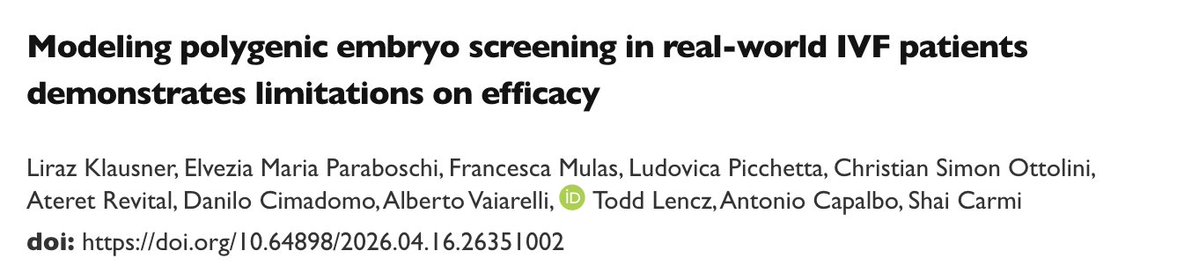
Klausner et al. makes a valuable contribution to modeling polygenic embryo screening (PES) efficacy in real-world IVF data. However, there are some important methodological and conceptual limitations worth discussing 🧵
Alexander Craig tweet media
Veera Rajagopal @doctorveera

Embryo selection using polygenic risk scoring has been a hot topic recently, with startups investing millions into the idea. Previous studies on embryo screening have reported relative risk reductions of up to 50%. The high risk reduction estimates are, however, based on the assumption that each IVF cycle produces 2 to 5 viable embryos, all having a similar chance of a successful live birth. Sadly, that’s not the reality. In a new preprint, the authors analyzed data from 6,944 real IVF cycles from 4,452 infertility patients. The reality of the IVF pipeline: on average, each cycle produced just 0.88 euploid embryos and 0.17 live births. You cannot select the lowest-risk embryo when most cycles don’t give you a choice. Next, the authors simulated how disease risk reduction fares in this realistic scenario. The relative risk reduction ranged from under 0.5% across all cycles to just 1–3% in cycles that resulted in a live birth, far below the previously predicted 50%. It’s worth noting there is one setting where risk reduction reached a reasonable level of ~20%: egg donor cycles, where viable embryos tend to be many due to young donors. Even here, the estimate is a fraction of prior predictions. The findings raise an important question: who is polygenic embryo screening actually for? It’s designed for patients with multiple viable embryos, all birth-ready, in a single cycle. Those patients don’t exist in most clinics. The reality is that this technology is being built for healthy, fertile individuals with plenty of financial resources, doing IVF electively to have designer babies. Klausner et al. medRxiv 2026 medrxiv.org/content/10.648…

English
1
18
41
14.3K
Tobias Wolfram retweetledi
Ron Alfa
Ron Alfa@Ronalfa·
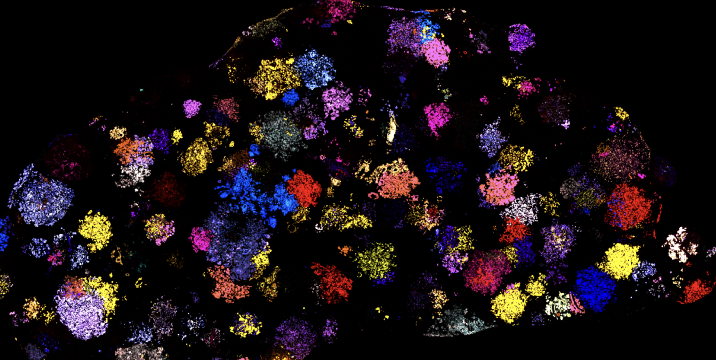
What if we could use a foundation model to simulate human biology from mouse data? Today, we're sharing Perturb-MARS, a platform for genetics and drug treatment in vivo at SCALE. ... and we HUMANIZE the read-outs using TARIO-2.
Ron Alfa tweet media
English
17
44
270
35.7K
Tobias Wolfram retweetledi
Stuart Ritchie
Stuart Ritchie@StuartJRitchie·
-Richard Dawkins writes a delightful, funny, and entertaining article -Everyone hates him for no good reason and decides to massively misrepresent his article in the most smug and humourless way imaginable ^ description of a constant internet occurrence since approximately 2006
English
197
188
2.4K
200.3K
Tobias Wolfram retweetledi
Jonathan Sebat
Jonathan Sebat@sebatlab·
I'm pleased to share our latest preprint: Combinatorial effects of gene dosage, polygenic background and environment on complex traits 🧵medrxiv.org/content/10.648…
English
4
38
114
19.7K