

Alejandro Franco Rodriguez
263 posts

Alejandro Franco Rodriguez
@alejofrcap
Product Builder in Crypto & Fintech | Ex-MoonPay (scaled onboarding from 3M → 45M+ users) | Opinions are my own.
Lisbon, Portugal & Colombia Katılım Eylül 2017
1.1K Takip Edilen130 Takipçiler


@marcelolebre @Jobvo @remote This right here captures the heart of entrepreneurship! That's one hell of a story and conviction. @marcelolebre
English

Those stories where girlfriends drag boyfriends into meeting friend with boyfriend, that was pretty much how I met @Jobvo, my co-founder at @remote.
I had just moved to Lisbon. I’m from a small city up north in Portugal, and I knew no one.
My girlfriend at the time, today my wife, said: remember this friend of mine from college? She’s in town and she’s with her boyfriend. Should we go meet them for coffee?
I was like, come on, I don’t feel like it. I’m not that kind of double-date person.
But anyway, I had nothing better to do. I was about to start working the next day. So I thought, let’s just go and it will be easy to kill off the nerves anyway.
We arrived and Job was there with his girlfriend. He was doing his PhD at Champalimaud. He was in neuroscience but loved technology.
We ended up talking geek stuff, nerd stuff.
And the thing that brought us together was this thought of: why do people suffer through professions or careers or tools or things they have to do every day?
You go to a reception, a public office, a private practice, and people are like, computer says no. They don’t want to help you. They don’t want to do business. They’re just collecting a paycheck.
Why is this?
The reality is that a lot of people have that job because they couldn’t find the thing that made them happy. They need the money, but they didn’t have the opportunity to do the thing they’re really good at.
So we started talking about this.
What if we found a way for the best companies to hire the best people in the world and vice versa?
A week later, Job sent me an email saying he had an idea and wanted to talk.
That’s how it started.
We stayed friends for years. We built a bunch of things together before Remote was a thing.
Then, years later, I told him, look, I just quit.
This was in the morning.
And in the afternoon, his wife, who I’m friends with as well, sent me a video of him coming downstairs.
She was narrating it, saying: he’s coming downstairs. He just spoke with the CEO of GitLab. He quit as well.
That was the moment.
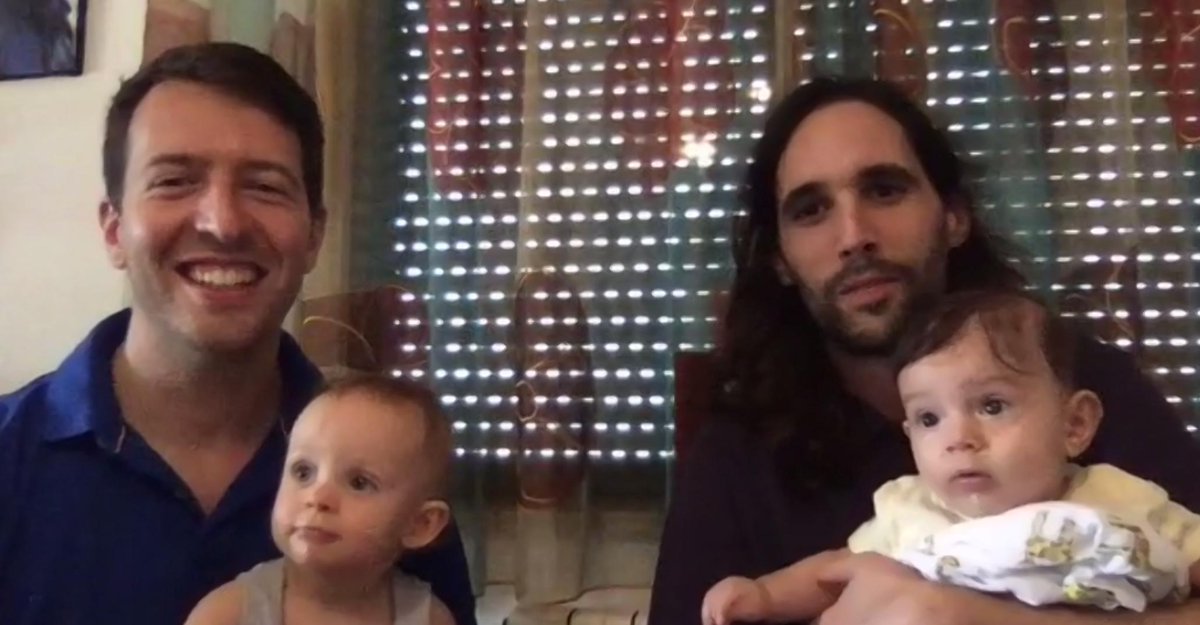
The picture is from 2019. Job and I on a Remote team call with our babies, June and Pedro. Two dads trying to build a company from home, with babies on the team call and a lot to figure out.
At the time, Remote was still tiny. No playbook. No big team. No obvious path.
Today, that same idea has become global payroll and employment infrastructure for companies around the world.
We started with a simple question: what would it take for companies to work with anyone, anywhere, and still get payroll, compliance, and employment right? Turns out, the answer was a lot of infrastructure.
Luckily, we ended up marrying our girlfriends, so it didn’t become awkward to tell the story.
English
Alejandro Franco Rodriguez retweetledi

@jia_seed LFG!! Totally agreed. Met some really cool peeps through X! Lovely place for the people with the right mindset
English

-raised a round in 12 hrs on here, with no prior silicon valley network
-multiple job offers including getting flown to europe to meet a certain cto (started a company instead)
-insane customers from companies i’d always looked up to from $0 launch videos
-lots of new friends
u can literally open so many doors on the everything app.
Nikita Bier@nikitabier
The value of an X account can be measured by what doors it opens for you in real life.
English
Alejandro Franco Rodriguez retweetledi

JUST IN: BlackRock to launch tokenized money-market funds on Ethereum.
English
There’s a lot of hype right now around AI token-spending leaderboards inside companies. And I get it.
Companies should encourage employees to experiment, learn fast, and build AI fluency. But I don’t think “who spends the most tokens” is the metric that will matter for long.
I believe the next valuable skill won’t be “using AI.” It will be understanding the unit economics of intelligence. Because companies don’t create value by generating more output.
They create value by doing more of the work that moves the business forward.
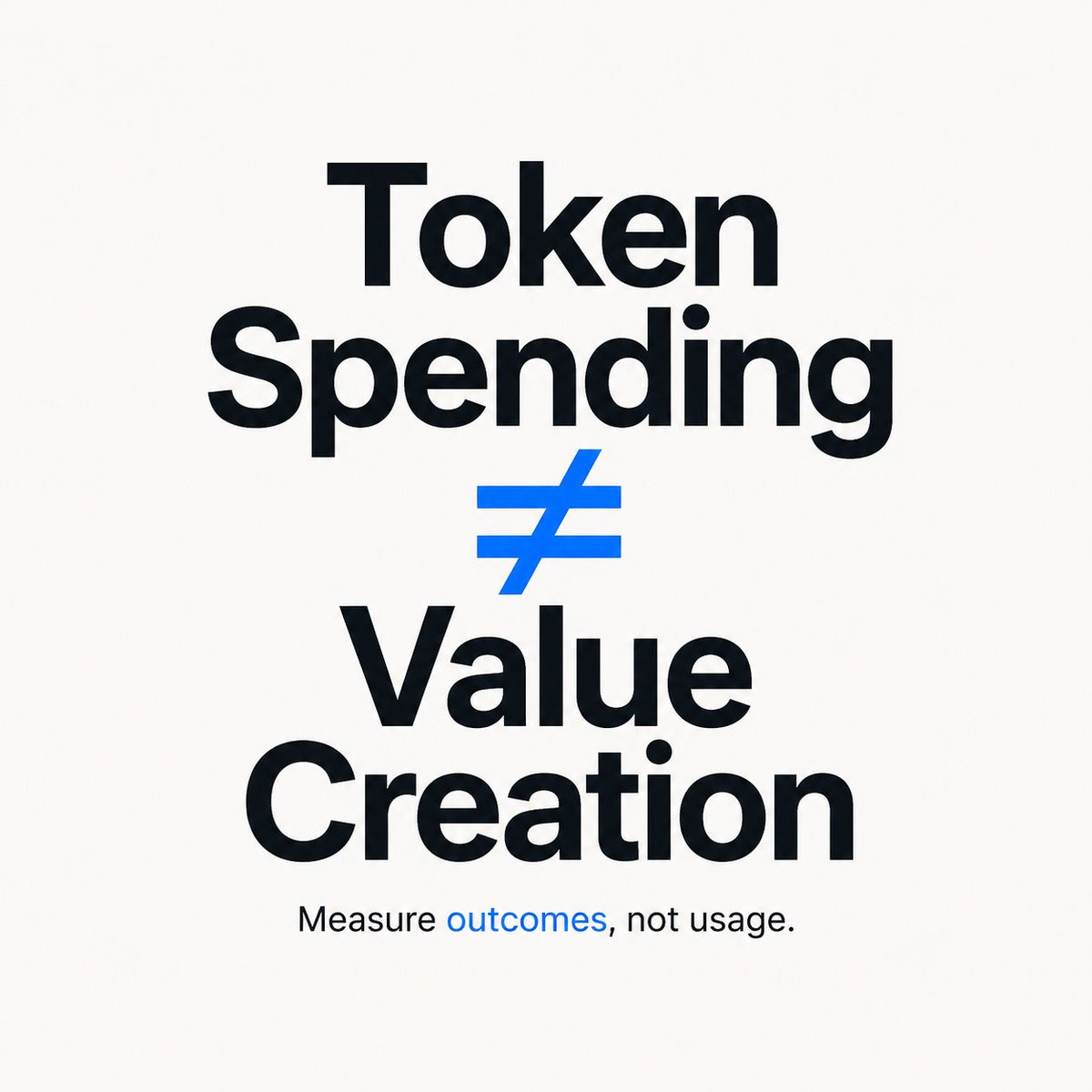
More docs ≠ more value
More prototypes ≠ more value
Unless those lead to:
✅ Faster execution
✅ More revenue
✅ Better customer outcomes
The next phase of AI adoption won’t just be about usage, instead it will be about efficient orchestration and getting the best business outcome with the right mix of:
→ Models
→ Workflows
→ Tools
→ Cost
This is why business units work with a P&L. If you’re a GM, product leader, or anyone responsible for a P&L, you already know this: Output is not the same as value and every new capability has a cost structure behind it that might or might not make it worth the investment.
As usage scales across teams, those costs compound quickly. A simple example:
I built a product in my free time that helps anyone identify market opportunities by analyzing real problems and getting signal online from people who are discussing on Reddit, Facebook groups, forums, and X.
The workflow includes:
🔎 Research
📥 Data extraction
🧠 Clustering
📊 Signal detection
🎯 Opportunity scoring
📝 Business Model & TAM analysis
⚙️ PRD creation
In practice, I could use the most powerful frontier model for every step. But that would make the product economically stupid. So instead, the foundation is an orchestration system automatically uses different models for different jobs.
One model for research, another for processing, aggregation, etc.
Only the highest-leverage steps use the most expensive frontier models. Not because cheaper models are “better"but, because unit economics matter. I strongly believe many companies will eventually have to confront this.
If AI spend grows massively but the business does not become more efficient, more profitable, or more valuable to customers, leaders will start asking harder questions.
Not:
“Who is using AI the most?”
But:
“Who is creating measurable business value?”
“Who understands the unit economics of intelligence?”
My bet:
The most valuable AI-native operators won’t be the people who spend the most tokens. They’ll be the people who know how to orchestrate systems with token economics that are profitable by design.
Best way to learn that? Build something real. Get users and pay the API bill yourself.
Look at the unit economics, then figure out how to deliver the same or better result at a fraction of the cost.
That’s when you stop treating AI like magic and more like leverage.
#AI #ProductManagement #Leadership #Startups #claude
English

I'm organising a co-working day for makers, designers and developers this Friday in Lisbon.
If you're looking to get to know other people without the pressure of large crowds, this is for you!
Lisbon, Portugal 🇵🇹 English
Alejandro Franco Rodriguez retweetledi

Never quit as a founder. I’m begging you.
It’s 0 for longer than you’ll ever expect. No momentum. Soul-crushing doubts. Nobody seems to care. Even when it looks like it’s working, it’s not. You keep trying new things. You don’t lose hope.
Then it snaps to 100. You finally find the one thing that resonates. You wake up with more customers than you can handle. Everything is breaking. Momentum keeps building even when you’re not pushing. Something changed.
You didn’t get lucky, you just didn’t leave.
English
@LouiseDSadeleer @TellaHQ @Remotion @vidIQ This is awesome! will check it out. Seems like a solid setup tbh
English

English

🦞 There's a ton of doom and gloom about how AI is going to take over the world and every single blue collar job in the next 12 months 🦞
There's however, not enough conversation about the opportunities this creates for existing companies and people to shift in their careers and focus on building experiences that weren't possible before. All of those need to be built by people with deep subject matter expertise.
🎙️ If you haven't listened to the latest 20VC episode with Aaron Levie and Harry Stebbings, it's a must.
🗣️ In Aaron's own words: "I've become more convinced that software is headless in the past year than I was three years ago."
For all of the AI-pilled and non-pilled people, let me break down what this actually means 👇
Going headless doesn't mean going humanless. It means the opposite.
Every agentic workflow will always hit a moment where a human needs to step in. Approve a transaction, verify an identity, review a compliance decision or Sign off on something with real risk that the AI labs won't be accountable for.
That's how decisions are made in companies today. And that's how risk management works.
⚡ So what's the exciting part about this shift?
Most software products were designed for a human clicking through a UI from start to finish. Every screen and every step built for a person to interact with.
In an agentic world, that pattern breaks. The agent handles 80-90% of the workflow. But accountability for the outcome? That still ends with a human.
The real product challenge isn't automating humans out. It's designing exactly where and how they step back in — and making that moment as seamless as possible.
🏆 There's two core principles to keep in mind:
1️⃣ Building API-first for the agents which means robust, flexible, composable platforms + extensive documentation for agent accuracy.
2️⃣ The need for seamless handoff interfaces (GUIs) for the human that include clear context, clear action, minimal friction, and clear auditability of risks.
If you have extensive domain experience on something, that means it's not all doom. In fact, it's the best time in history to be building products and asking yourself how to be more efficient at any given task. This will lead to tremendous abundance of more products, those that are deeply integrated into real and tedious workflows but built by people who actually understand the domain.
Aaron captures this beautifully in the full episode, I recommend watching:
🔗 youtube.com/watch?v=qrxQik…
YouTube
English

🔥 330 people showed up in Lisbon today. Unreal energy, amazing adoption, and @davidgomes absolutely earned a rest after spending the whole day answering questions. 🤫Internal rumors say this was one of the best @cursor_ai Café events ever.


English
@levelsio Soo true man, I only wear black tshirts, and once you find a brand that fits, has good materials and is nice enough, then you gotta buy 8 tshirts that last you a year...
Exactly what you mentioned happened to me twice, brands decided to change the shape/trim and it's gone.
English

I was recommended @sonofatailor by all of you
Custom fitted t-shirts based on your own body's measurements
I love them, 100% cotton, great quality
But I guess as is the problem with all clothing brands, they always change stuff every season (to keep selling new stuff) so for ~2 years now they've switched to the most boring uninteresting colors imaginable
It's all some gray pastel depressing shit
There's no happy fun colors anymore
This is why guys when they finally find some good clothes they like, they buy all the colors because you know a month or year later, it's forever gone! Sad!

English

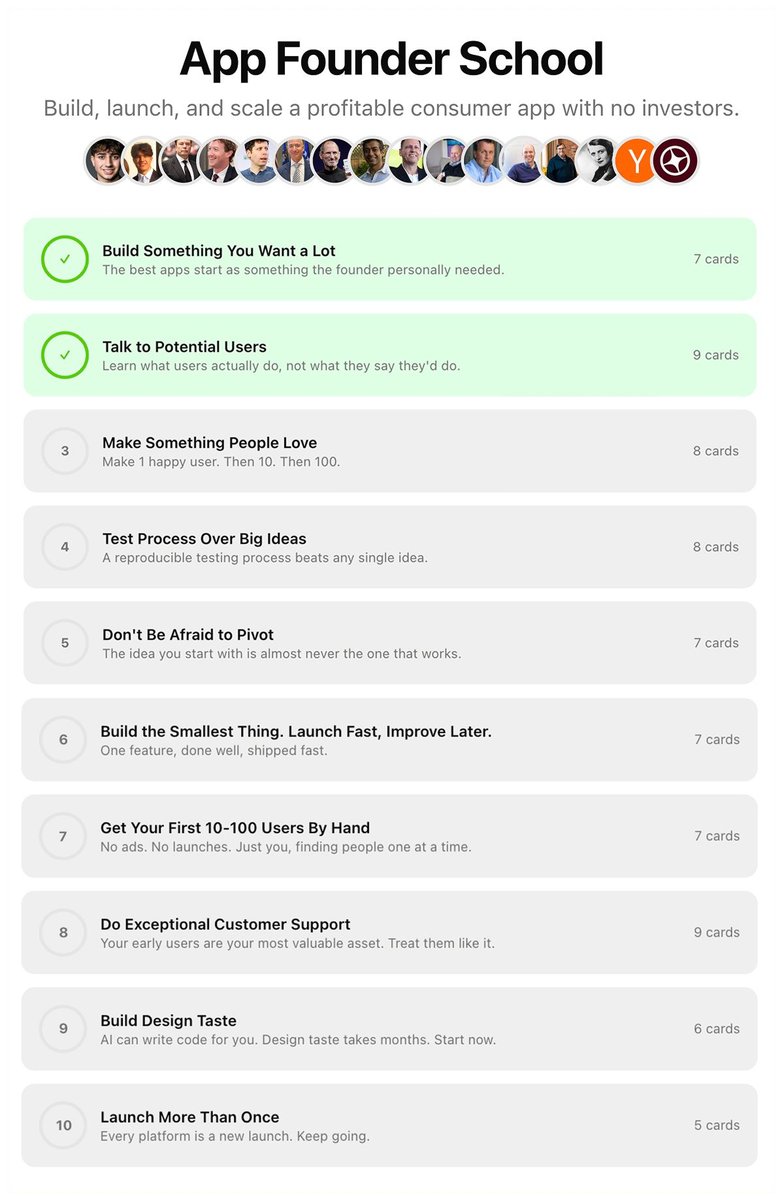
Introducing Rork Founder School v0.1
Learn how to build and scale consumer apps from the great founders like Paul Graham, Mark Zuckerberg, Nikita Bier, Zach Yadegari, Reid Hoffman, and more.
These people taught me a lot through essays, interviews, and talks I consumed obsessively for 7 years before starting Rork.
I took everything I learned from them and turned it into a free Duolingo-style app.
Comment for the link 👇
English
Alejandro Franco Rodriguez retweetledi

VCs that participated in Pre-seed & Seed rounds in 2026 ↓
@GSR_io
@mf__xyz
@paradigm
@Initialized
@DraperVC
@frachtisvc
@colosseum
@cbventures
@1kxnetwork
@flowdesk_co
@BanklessVC
@SeliniCapital
@dragonfly_xyz
@socialgraphvc
@WhiteStarCap
@FulgurVentures
@FigmentCapital
English
@minchi Summer is the best time to be here indeed!
English


If you're a software company, you might be about to lose your best customers and you won't even see it happening.
I was speaking with a founder today and he said something that stuck with me.
"We're making so much more money from our APIs lately thanks to the AI craze" - so I asked him if he knew what his users were actually building with it.He said no.
That answer got me thinking that the moat will increasingly be deep understanding of your usage patterns, especially if in the past you were not a platform product that suddenly becomes platform based.
Let me explain - Over the past months I've been using Openclaw and Claude Code almost every single day. It's gotten to the point where I don't use many products directly anymore. Instead, I consume them through CLI integrations wrapping their APIs.
As a customer, I get 10x the value. Fully customized to how I work and in the way I want to consume it best for my usecase. On paper, that's great for me, but not so great for the product teams behind those products.
Here's the problem:
Their dashboard shows API calls going up and billing is up, that looks great in a townhall or a board meeting... But do you actually understand what those calls mean and what they tell you about your product? Maybe?
The reality is that unless you're building telemetry that tracks not just call volume, but logging what users are actually building on top of your APIs, you might have no idea what's happening.
If that's the case, then the feedback loop that helps you improve your product becomes a black hole and the moment you stop understanding how your product is being used or "hacked around", you stop being able to improve it for your customers.
In the worst case scenario, you're flying blind while your most sophisticated users are building the product they wish you had, but they're not going to tell you about it. They never do (that's the product work).
This isn't even a threat from AI companies. For instance, Anthropic saw that developers were heavily using Claude for coding and built Claude Code to serve that use case natively. They paid attention to how their product was actually being used and built on that insight to ship a winning product in a very short timeframe... however, most companies aren't doing this because they've never been API-centric solutions and perhaps they are even scared of being abstracted completely.
The gold mine:
All the great breakthroughs live in the workflows they're hacking together and if you are not talk to them, you're not doing discovery properly in the age of AI.
My hot take:
If you were not a platform product, you probably didn't pay much attention to API-based usage. Go and Identify the patterns across these increasingly important users and take your learnings to build what they need but do it with the UX and reliability an AI workflow won't match for the rest of your users who will likely never touch an API or use a tool like claude code to access your product.
If you look deep enough, chances are that you'll like see that they value the similar capabilities.
English
We just rebuilt every startup in @ycombinator's latest demo day batch.
Here's what our agentic "founders" pulled off and what it means for the future of startups.
Fully useable products at the bottom of the thread below 🤖🧨
English