

Jonathan Song
90 posts

This estimation comes from my data center colocation valuation modeling simulator (inspired by @accounting_ds video).
If you’re interested in seeing how it works or want to test V1 and give feedback to improve it, just let me know.
English
$CLSK ’s first colocation deal didn’t command a huge premium many expected. The contracted size & revenue also doesn’t stand out versus peers.
But if we value it like a data center landlord instead:
Using a conservative 6.5% exit cap rate, the deal is worth roughly $2.54B in value creation, or about $9.91 per share.
That translates to a roughly 15.1% return on the capital spent building the campus.
The deal looks even more attractive at lower cap rates, and less so at higher ones. (Theoretical results based on assumptions)

English
@0xrhova @InvestLikeBest @dylan522p No, since end of April ddr5 contract price increased less than 10%, spot increase 20%
English

@InvestLikeBest @dylan522p this interview is months old, memory prices have already doubled since.
English

SK Hynix recently reached a $1 trillion market cap. SanDisk started the year at $35B and is now worth $230B.
Dylan (@dylan522p) on why memory prices will still double or triple from here:
"People are like, the memory story is overplayed.
No, you don't get it. DRAM will double or triple from here still, because that's how much capacity is required.
Memory can only grow capacity low double digit percentages a year.
20-30% a year, even less for NAND, a little bit higher for DRAM.
Even though the demand signal was very strong at the end of 2025, the memory companies immediately started reacting.
None of that incremental capacity really gets here until 2028, even if they wanted to build as fast as possible. So the result is memory prices have gone through the roof.
They're going to double and triple again. DRAM, especially.
And they have to steal capacity from somewhere else.
And the only way to steal capacity from somewhere else in a capitalist economy is demand destruction via higher pricing."
Publish date: April 23, 2026
Patrick OShaughnessy@patrick_oshag
Every conversation I have with @dylan522p, I'm really just trying to understand the supply and demand of tokens. This is a unique episode in that it's entirely dedicated to talking about both sides of that equation. We discuss: - The infinite demand for the newest models - @SemiAnalysis_ going from $10K on AI spend to $7M - Mythos and Anthropic's compute problem - Why TSMC spending $100B on CapEx could cause a shortage - Robotics as next demand wave - Why memory prices will double again This is my second conversation with Dylan and find myself needing to speak with him more and more often to make sense of it all. Enjoy! Timestamps: 0:00 Intro 1:00 Surging AI Spend 10:27 Token Demand 16:21 When Ideas Are Cheap and Execution is Easy 20:46 Model Hoarding 22:34 Robotics 27:03 The Compute Bottleneck 30:26 The AI Permanent Underclass 31:39 Supply Chain Reality 37:47 CPUs 42:54 Predictions: Public Backlash
English
@Alex_william25 @perry_lin1 @PaulBPrager You need to consider geopolitics as well. The us won t want to lose AI race against China
English

@perry_lin1 @PaulBPrager although I agree with your take that it may strengthen supply demand imbalance in short term, do you not see this as the tip of the iceberg for politicians impacting DC development and economics? Bipartisan everyone hates AI and DCs aside from investors. And elections in fall…
English

$WULF The management team feels that the market has the Hochul news wrong today. I just got a call from @PaulBPrager and the timelines for Lake Mariner or Cayuga have not moved. In reality, it is a net positive. This will ease some of the backlog in the queue for LM. LM does not require DEC permits so this moratorium will not have an impact. For Cayuga, they can align the build to some of the state goals including green generation if necessary. In the end, both of these sites became more valuable and will garner higher lease rates and NOI. Power is still scarce but even scarcer in NY after this.
English


@GabGrowth Only that based on current trend , there is very little chance it will reach 1.9T. It’s actually declining to less than 80b, let alone 570B lol
English

Quick napkin math on $CRCL
Currently trades at ~$17B market cap.
In FY25, Circle generated $2.7B of total revenue and reserve income, up 64% YoY, and $582M of adjusted EBITDA, up 104% YoY.
Citi’s base case has stablecoin issuance reaching $1.9T by 2030, with a bull case of $4T. Standard Chartered has also projected the stablecoin market could reach $2T by end-2028.
Let’s keep the assumptions simple.
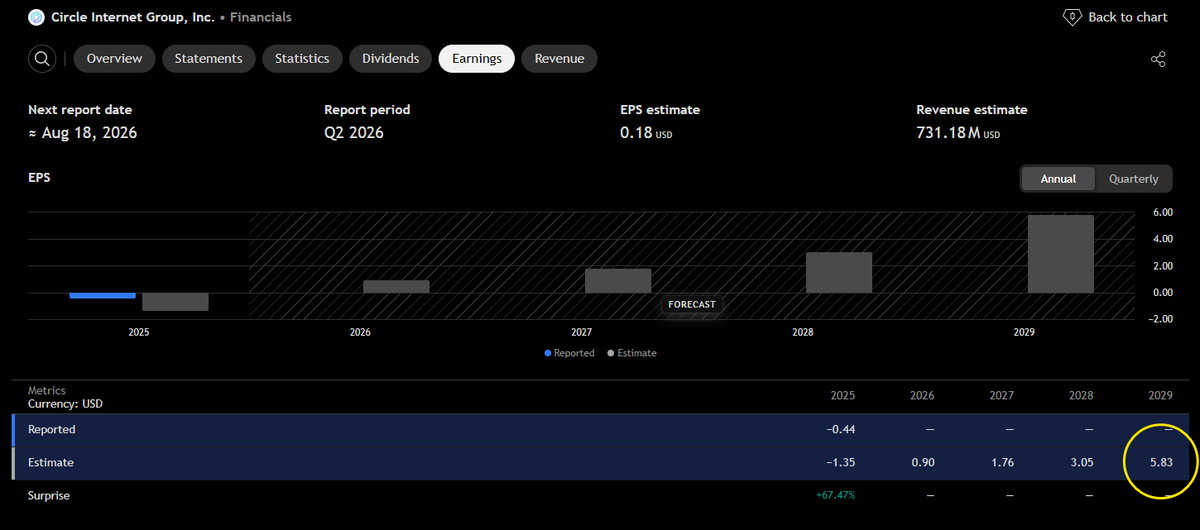
If the stablecoin market reaches $1.9T and USDC captures 30% share (25% today), USDC circulation would be around $570B.
Circle is currently annualising roughly $600M of adjusted EBITDA on $77B of USDC in circulation, or close to 80 bps of EBITDA per dollar of USDC.
To be conservative, let's cut that to 60 bps to account for lower rates, distribution costs, and competition.
$570B of USDC x 60 bps = ~$3.4B of adjusted EBITDA.
Apply a 15x multiple, and the core USDC issuance business alone could be worth around $51B.
That's about 3x today's market cap.
This excludes any upside from Circle Payments Network, Arc, enterprise stablecoin payments, tokenised money market funds, transaction revenue, and broader programmable money infrastructure.
I am watching this very very closely and think it could make a $HOOD or $COIN like move when $BTC bottoms.
English

@oguzerkan before you close that gap, look at how concentrated crwv is. one meta deal is about 21b of the 99b backlog and that 8.5b term loan is secured against the same contract. the discount is customer concentration, not the market being dumb
English

I am seriously considering shifting some of my $NBIS position to $CRWV.
I love $NBIS and it's now a 10x position for me, but the current valuation gap with $CRWV is hard to justify.
$CRWV ARR target for this year and backlog are double those of $NBIS.
$NBIS has a 5 GW capacity target by 2030 while $CRWV is targeting +8GW.
Yes, $CRWV has $25 billion in financial debt and $10 billion in operating lease liabilities, bringing $600–$700 million in interest expense per quarter.
However, its funding structure is improving. It recently secured an $8.5 billion investment-grade term loan, non-recourse and tied to customer contracts. It has raised more than $20 billion in debt and equity this year with no major maturities until 2029.
So, if demand holds up, $CRWV won't have any problems servicing debt. If demand doesn't hold up, $NBIS isn't holding anyway.
There is really nothing that justifies the gap here.
This means either $NBIS or $CRWV is gravely mispriced here.
I bet it’s the latter.


English
@KwzhxIQ1mM2zMyA @jukan05 brr what are you talking about? Ppl either live or die
English


CPO 測試瓶頸成量產最大挑戰 台積電 COUPE 2026 量產在即
隨著 AI 資料中心規模持續擴張,傳統銅互連已達物理極限,CPO(Co-Packaged Optics,共封裝光學)成為下一代高速互連關鍵技術。台積電 COUPE 平台預計 2026 年進入量產,標誌 CPO 正式從實驗室走向商業化。然而,檢測與測試階段卻成為最大瓶頸。
CPO 將 PIC(光子積體電路)與 EIC(電性積體電路)混合鍵合形成 Optical Engine(OE)。相較傳統電性測試,PIC 需同時面對電、光及光電交互測試,需量測插入損耗(IL)、偏振相關損耗(PDL)、響應度等參數。目前產業缺乏統一標準,且光學耦合需奈米級精準對位,單模光纖與波導截面積相差近 800 倍,導致一顆 PIC 完整測試需耗時超過 100 秒,大多仍仰賴人工操作。
CPO 測試分四大階段:
1. PIC 晶圓級測試(OWAT,最關鍵);
2. EIC-PIC 晶圓級測試;
3. OE 級測試(確認 KGOE);
4. 模組級測試。
其中 OWAT 最重要,可在早期篩選不良 PIC,避免與昂貴 EIC 鍵合後報廢,降低整體成本。
供應鏈積極因應:
Advantest 與 FormFactor 合作推出 UFO Probe Card 及 V93000-Triton 系統,透過 9 軸對位與 CalVue 技術大幅縮短對位時間;
Teradyne 收購 Quantifi Photonics 並與 ficonTEC 推出 300mm 雙面晶圓/晶粒測試系統;
Chroma、Keysight、Enlitech(Night Jar)也分別在可靠度測試、偏振量測及高光譜漏光定位提供解決方案。
TrendForce@trendforce
🌐 CPO Is Moving to Market. Testing Infrastructure Is Not Ready. EIC testing: μm-level alignment, fully automated. PIC testing: nm-level precision, no unified standards. That gap is the critical bottleneck as CPO moves to mass production. Traditional test vendors are partnering with PIC specialists, and integrated inspection solutions are emerging. Navigate the CPO testing gap before mass production stalls 👉 buff.ly/AbL97WC Explore CPO Testing Bottlenecks 📖 buff.ly/MRZLVUm #TrendForce #SelectedTopics
中文
@Temple_Eight @KairosPraxis isnt cw laser still the bottle neck with or without TFLN? Why does it matter for lite’s moat
English

@KairosPraxis Not entirely TFLN saves on cooling so instead of retrofitting old data centers with billions of dollars of complex cooling infrastructure they will go with TFLN.
English

The more I learn about photonics, the more I'm convinced that lasers are the real moat, with serious barriers to entry. Each 800g and 1.6t transceiver needs 8 lasers. In 2025, $LITE made 30M eml lasers, $COHR 20M, in '26 $LITE is making 80M eml and Coherent 30M (more CW lasers entering the mix).
This earnings season all the big dogs were complaining about shortages in pump lasers. These are used to amplify signals over 100s of km (so datacenter to datacenter). The expertise was developed over decades for submarine cables, and they're almost as difficult to make as EML as they're high powered. So shortage not going anywhere

English


Deep| $TSEM: SiPho Capacity Inflection Drives Multi-Fold Growth Cycle
AI data center compute clusters are currently scaling from thousands of GPUs to tens or even hundreds of thousands of nodes. At this magnitude, traditional copper interconnects are reaching severe physical limits; once transmission rates hit 800G and above, transmission reach shortens dramatically while power consumption escalates exponentially. To bypass these constraints, Silicon Photonics (SiPho) is becoming the essential backbone for AI Networking.
As of 4Q25, Tower Semiconductor’s Silicon Photonics business has emerged as the company’s primary growth engine. Revenue doubled from $106mn in 2024 to $228mn in 2025, achieving an annualized revenue run rate exceeding $360mn by the end of 2025. As the industry transitions from 400G/800G toward 1.6T, Tower has positioned itself as the lead supplier of 1.6T Silicon Photonics wafers. We believe Tower is currently the premier SiPho PIC (Photonic Integrated Circuit) foundry with a distinct competitive lead. Among major competitors, Malaysia’s Silterra lacks significant expansion capacity, while SiPho offerings from UMC, GlobalFoundries (via the AMF acquisition), and STM still trail Tower by a wide margin.
The TDP (Thermal Design Power) of AI server racks, such as the Nvidia GB200 series, has jumped from 700W in the Hopper generation to over 1,200W, necessitating the adoption of liquid cooling and more efficient optical interconnects. Within these environments, SiPho facilitates higher speeds while maintaining system scalability under strict thermodynamic limits.
On February 5, NVIDIA and Tower Semiconductor established a strategic partnership focused on high-speed optical interconnects for AI data centers. Tower will leverage its SiPho process platform to manufacture 1.6T-class SiPho optical engines and modules for NVIDIA’s next-generation networking architecture, optimized for NVIDIA’s specific protocols. This collaboration aims to resolve bandwidth and energy efficiency bottlenecks during the Scale-out phase of massive GPU clusters.
Separately, we have highlighted the rapid progression of Optical Scale-Up, with volume production expected to commence in 2027. Delivering over 10x the optical bandwidth of traditional Scale-Out, Optical Scale-Up—whether implemented via pluggable modules, NPO, or CPO—will significantly drive demand for SiPho PICs.
Alibaba’s UPN512 (a 512-xPU optical scale-up super-node) validates the migration of optics from scale-out networking into the scale-up core domain, as LPO/NPO and other near-packaged solutions achieve system-level economics. Consequently, optics is evolving from a mere bandwidth expansion tool into a foundational infrastructure component for scale-up architectures.
For SiPho, this shift directly expands the long-term TAM. Scale-up environments demand higher port densities, extreme bandwidth, and stricter power budgets—requirements natively addressed by high-integration SiPho PICs and linear drive solutions. SiPho’s penetration is moving beyond “incremental replacement” to potentially becoming the default interconnect standard for next-generation AI super-nodes.
Detailed Report
open.substack.com/pub/fundaai/p/…
English

People wonder why I'm focusing on non-US markets recently.
Why? CPO is my #1 thematic long.
Markets don't know yet, the sudden paradigm shift in photonics...
I was one of the only to frontrun the current supercycle in 2025 w/ $AAOI @ ~$30, $LITE ~$300s, and $AXTI at ~$13 on X....
With the actual receipts and thesis that others can't show.
CPO goes from ~$0. To $91 Billion TAM opportunity.
In the next 1 1/2 years from GS research.
While overall optical market reaches $154B.
Many players that had little exposure to the current photonics cycle at all:
-> In Europe with high-end lasers design like $SIVE or $SOI with substrates.
-> In Taiwan with Foci (3363), Nextronics (8147), Shunsin (6451) and others for optical components and foundries.
-> In Japan with laser mass production, substrates, and chemicals.
Are suddenly the new dominant players for CPO.
As for US players, there's not much exposure. But the existing ones like $LITE, $COHR still get upside from CPO as that's their new growth vector.
My contrarian thought process on current players:
Is that most of their valuation is priced in huge legacy pluggable revenue that will inevitably face cannibalization over time, so re-rating potential is less unless someone uses leverage.
A lot of these new purer play CPO names go from 0 to 100 extremely quickly one mass production starts H2 2026 for scale out (as a revenue bridge) into H2 2027 for scale up (massive growth driver).
Markets usually price things in 8-12 months ahead of time too...
I have high conviction thematically in my supply chain research despite any market volatility leading up until then.


English
@LOGOinvestor @stalmico @Investor_NICK_ haha fintech’s most lucrative business always about their card business , always
English

@stalmico @Investor_NICK_ Where’s the evidence “fintech” whatever that means is eating their lunch?
English

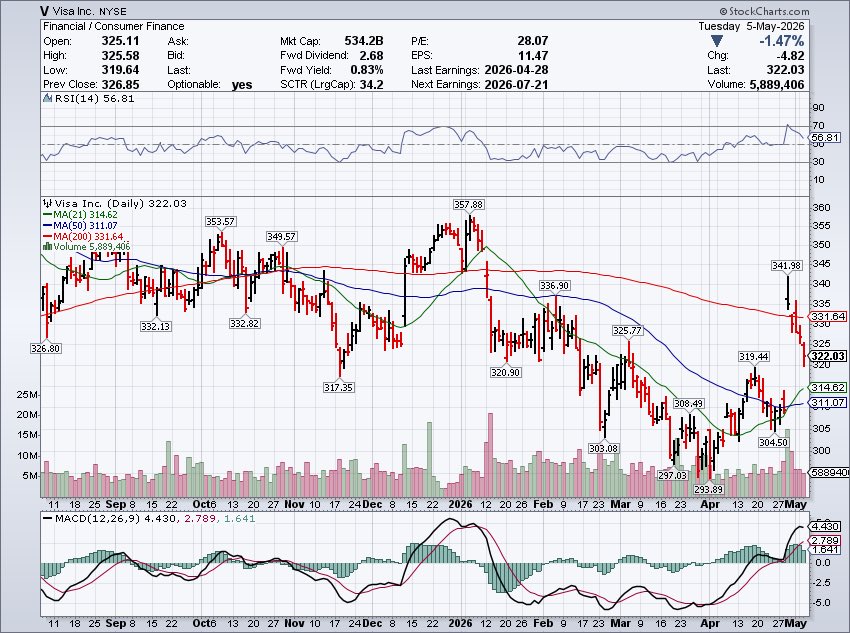
$V / $MA not really trading that well for how strong markets have been.

English
@noyesclt the gap mainly comes from incentives , which is lumpy
English

MA just reported earnings this AM, its apparent that Visa deserves the premium now. Significant gap in transaction volume and revenue growth. s25.q4cdn.com/479285134/file…

English
$AMZN CEO: “There is a power shortage in the US and the world.”
For new data centers, the most optimistic grid connection wait time is 3 years as power transformer lead times stretch to 12-24 months.
So, most of the developers and hyperscalers are resorting to natural gas as it’s the fastest option.
But even then, permitting is still an issue and risks delays and cancellations as is the case for $NBIS New Jersey data center.
Power is now a bigger bottleneck for scaling AI than it’s ever been.
English


@WillBiddy_ What about Europe’s EPI and other initiative? EU seems determined to promote its own payment system
English

The Bear Case for $MA and $V is Very Loud!
It is Also Very Wrong.
There are some concerns surrounding the business that is causing this recent sell-off that I'd like to discuss below👇

English
@adhikansh53 @patientinvestor My point is 12% is not slow, considering quality cash flow and high incremental margin. A lot of names you mention may grow fast near term but won’t last . For example , MU will definitely have negative growth in not to distance future
English

@skytooth @patientinvestor Keep on nit picking. Whatever u know, is already priced-in. Anything can be nit picked in any company no matter how good it is.
English

I can't believe Visa is now trading at 22x earnings! $V

English
@adhikansh53 @patientinvestor Meta: what’s the next form of social media? Will capex have reasonable roi?(poor fcf) . I can almost nitpick about each one
English
@skytooth @patientinvestor In Mega-Cap category? $TSM, $NVDA, $AMZN, $META, $AVGO, $NFLX & $MSFT
In Medium/Large Cap category? $MU, $SNDK, $MELI, $AMD, $UBER, $MRVL, $SE, $TTWO, $RDDT, $CRDO, etc.
Română