Euclid Finance

230 posts

Euclid Finance banner
Euclid Finance

Euclid Finance

@Euclidfi

Building Omnichain Liquid Restake Assets, the simplest way to restake your ETH and liquid ETH to @eigenlayer

Katılım Ocak 2024
55 Takip Edilen4.1K Takipçiler
Sabitlenmiş Tweet
Euclid Finance
Euclid Finance@Euclidfi·
Wishing you a joyous and prosperous Mid-Autumn Festival!
Euclid Finance tweet media
English
1
1
14
1.2K
Euclid Finance retweetledi
EigenCloud
EigenCloud@eigencloud·
Introducing AVS Rewards Mainnet Launch What The Rewards update enables AVSs to provide rewards to stakers and operators and the UI upgrade provides stakers and operators a frontend to track and claim rewards. Why Previously, AVSs did not have the ability to directly reward stakers and operators for the economic security and compute they have been providing to active AVSs on Eigenlayer mainnet. This update grants AVSs the ability to reward stakers and operators for their past, present, and future support. @eigen_da will be the first AVS on EigenLayer to distribute rewards to stakers and operators. Learn More: - Technical Docs: docs.eigenlayer.xyz/eigenlayer/avs… - Smart Contracts: github.com/Layr-Labs/eige…
EigenCloud tweet media
English
0
134
717
172.2K
Euclid Finance retweetledi
TOKEN2049
TOKEN2049@token2049·
Join @sreeramkannan and the global Web3 community next month. Sreeram is the Founder of @eigencloud, a protocol that allows users to stake $ETH across multiple protocols at once, reducing capital costs and increasing trust guarantees. Meet Sreeram at #TOKEN2049 Singapore.
TOKEN2049 tweet media
English
5
6
52
20.8K
Euclid Finance retweetledi
TOKEN2049
TOKEN2049@token2049·
Hear firsthand from @vyas_krishnan next month. Vyas leads Strategy at @eigenfoundation, on a mission to build the shared security commons for crypto and Web3 by supporting the @eigencloud protocol and community. Network with Web3's leading innovators at #TOKEN2049 Singapore.
TOKEN2049 tweet media
English
4
3
44
24.7K
Euclid Finance retweetledi
EigenExplorer
EigenExplorer@EigenExplorer·
If you missed our docs release we’re doing a breakdown of each section, beginning with ‘what is EigenExplorer?’ *️⃣ EigenExplorer is an EigenLayer-native DeFi and data platform. Our first product was data. We connected the data dots between the EigenLayer ecosystem - processing over a million requests a month. (We still do!) As the ecosystem grew, we recognized that both restakers and EigenLayer users weren’t directly connected to the AVS projects that form the ecosystem itself. And so we set about connecting them. We’ve built a DeFi protocol that combines the functions of a liquidity layer with the comprehensive data tools of our first product - allowing users to restake directly into AVSs, and giving them all the relevant data they need for it. How does EigenExplorer allow direct restaking, and what are the DeFi use-cases unlocked? *️⃣ On Thursday, we dive into the Liquid AVS Token (LAT), designed specially to allow users direct access to the AVS projects they want to support, unlocking Eigen-native DeFi, meaningful yield and a sustainable ecosystem. Docs.EigenExplorer.com/introduction
English
1
5
30
14.8K
Euclid Finance retweetledi
Andy
Andy@andyyy·
The Eigenlayer ecosystem is rapidly expanding. Here’s a list of 20+ projects building in the eco, with a short description: @hyperlane restaked interop AVS @lagrangedev ZK-coprocessor AVS @eo_network Ethereum oracle AVS @theblockless dApp infra AVS @buildonatlas validator as a service AVS @OmniFDN rollup unification AVS @alignedlayer ZK verification layer AVS @brevis_zk ZK-coprocessor AVS @EigenExplorer data analytics platform for AVS @DroseraNetwork security via traps AVS @gelatonetwork rollup services for AVSs @0xOthentic infra for launching AVSs @zkhelixlabs OmniVM for LRTs/LSTs AVS @EthosStake securing Cosmos appchains via Ethereum shared security @parasailnetwork DePIN proof of service AVS @SoleraFinance cross-chain stablecoins AVS @OpenledgerHQ AI Data AVS @Calderaxyz rollup services for AVSs @EspressoSys sequencing marketplace AVS @eigen_da DA layer AVS @0xfairblock programmable privacy AVS @0xMantle using EigenDA AVS for DA @fhenix FHE privacy-based AVS @aethosnetwork decentralized policy AVS The Eigenlayer ecosystem is poised to grow massively over the next 12 months.
English
50
61
385
221.4K
Euclid Finance retweetledi
nader dabit
nader dabit@dabit3·
We're working on an initiative to streamline connections between investors and builders in the EigenLayer ecosystem (AVSs, rollups, apps, dev tooling, etc..). If you're a builder interested in participating in this program, please fill out this form. eigenlabs.typeform.com/AVSFundraise
English
6
9
87
18K
Euclid Finance retweetledi
DCo
DCo@Decentralisedco·
On EigenLayer and AI If AI needs the cloud, then web3 AI needs the web3 cloud. @eigencloud and Artificial Intelligence have been two of the hottest narratives in crypto over the past year. In this post, we explore their intersection and some of the projects building at this juncture. What is an AVS? Let’s start by understanding what an actively validated service (AVS) on EigenLayer is. The best way to think of EigenLayer is as a marketplace for security and compute. Blockchains and other crypto protocols, such as bridges, rely on decentralized node operators to process transactions. These node operators maintain the current state of the network and individually process incoming transactions. For a transaction to be validated, a majority of the node operators must agree on its validity. Consequently, the more nodes there are, the greater the network's security. New protocols often struggle to establish a robust base of node operators due to a cold start problem. Operators are typically incentivized with a protocol’s native tokens. However, in the early stages, without a strong node network, the token may have limited value. To solve this, teams may offer a larger number of tokens to incentivize node operators. However, this approach can lead to high inflation and token value dilution, which are not ideal. Additionally, having a small number of nodes in the early stages poses security and centralization risks. EigenLayer solves this by helping any blockchain service (called an actively validated service, or AVS) bootstrap security backed by Ethereum. The protocol comprises operators who specialise in providing compute and security. Users allocate either ETH or liquid staked ETH to these operators, who then validate one or more AVSes. If operators perform their duties adequately, the AVS rewards them, and they, in turn, pass these rewards on to their depositors. If operators fail to perform their duties, their stakes are slashed. By having a common set of operators validate multiple services, all governed by a standard economic layer, EigenLayer simplifies the launch of projects that rely on distributed nodes for security. This proposition has attracted various projects, including data availability solutions, bridges, oracles, and ZK processors. AI Over the past two years, artificial intelligence has become a focal point of the tech world, capturing the attention of entrepreneurs, investors, and users alike. Naturally, this fervor has also touched the crypto landscape. According to @_kaitoai, AI has captured the highest narrative mindshare amongst all crypto sectors in the past 12 months. Operators in the context of blockchain are essentially computers. When validating rollups, they accept incoming transactions, process them against the current state, and output a new state. However, this input-process-output paradigm can be extended to any distributed computing operation if operators can provide hardware like GPUs, SSDs, and ZK Provers. Consequently, EigenLayer can be envisioned as a web3 distributed cloud service provider. Today, most AI processes run on the cloud—from hyperscalers like AWS to specialised cloud providers like Lambda and Coreweave. These services facilitate both training models and inference. This makes EigenLayer, as the web3 cloud, a natural fit for web3 AI applications. Let’s look at some of them. Ritual Today, most users and developers access AI services through APIs provided by centralized cloud providers. However, this status quo poses several issues, including a lack of privacy, questionable computational integrity (how can you be sure the response comes from the model you requested?), and potential censorship. Smart contracts, in contrast, operate in highly secure, transparent, and trusted environments. There are cases where smart contracts need to interface with AI services. However, it is computationally infeasible to run any AI process on-chain. Existing cloud providers cannot service smart contracts either, as this would break their trust assumptions. @ritualnet is addressing this problem by building an open, privacy-first, censorship-resistant, and verifiable AI layer for blockchain AI services. Their first product, Infernet, allows smart contracts to request AI model inferences that come with proof of computational integrity. In the future, Ritual plans to expand by creating a sovereign chain, Ritual Chain, which will offer expanded capabilities such as fine-tuning and training AI models. Ritual Chain will be built as an AVS on EigenLayer. Operators with specialized, in-demand hardware like GPUs will execute the AI queries that the chain serves. The decentralized validator set will provide high availability and censorship resistance, as each query will be served by multiple operators. Additionally, these operators will also provide basic security to the Ritual Chain itself. OpenLedger A few weeks ago, we discussed the data challenges in AI and how blockchain protocols can play a part in solving them. While we recommend reading the entire article, the most significant issue we highlighted was the centralization of AI data. Platforms with valuable data are striking high-value deals worth millions with well-capitalised companies while restricting access for smaller startups and research firms. @OpenledgerHQ aims to provide solutions by creating a “sovereign data blockchain for AI.” OpenLedger provides AI teams with: High quality annotated data to ensure effective training and accuracy Reinforcement learning and human feedback (RLHF) services to enhance models Tools to assess AI models for accuracy, reliability, and safety OpenLedger is also building as an AVS on EigenLayer. While the exact nature of their implementation is not fully disclosed, we can make some educated guesses. To build a distributed, high-availability data layer, the nodes of the chain would require large quantities of fast memory. EigenLayer operators are well-suited to provide this, along with basic compute and security services. Sentient @sentient_agi made headlines earlier this month by announcing an $85 million seed round backed by some of the top investors and operators in crypto. Their goal is to create an “open platform for AGI development.” What does that mean? Currently, the most top AI models are closed-source and controlled by a few powerful organisations. This level of control is unhealthy for one of the most important technologies of our times. In response, there is a growing open-source movement where the weights (configuration) of a model are made available to anyone, allowing them to run the model on their own hardware or fine-tune it to their specific needs. The problem is that while open-source models are crucial, it is very difficult for their creators to monetize their usage. Once the weights are publicly available, anyone can host, modify, tinker, and create services based on them without sharing any revenue with the original model creator. This fundamental mismatch in incentives threatens the pace of open-source AI development. Sentient’s goal is to bring “ownership rights to AI development.” It aims to create technology that allows researchers and developers to monetize AI models while keeping them open and secure. When a developer uses a model created by Sentient, they can be assured of its validity as they would when hosting an open-source model. However, they will also need to compensate the model creator by paying for inference. Sentient is built using Polygon CDK technology and as an AVS on EigenLayer. While the exact usage of EigenLayer by Sentient is not fully disclosed, we can speculate that it will be similar to Ritual’s approach. This likely involves operators providing computing resources for inference as well as security for the chain. In a blog post from last year, the EigenLayer team mentions AI inference as one of 15 potential unicorn ideas that can be built as an AVS. Clearly, many teams believe this potential to be real. While both EigenLayer and the Web3-AI sector are still in their early stages, the intersection between them is a natural fit. If AI needs the cloud, then Web3 AI needs the Web3 cloud. The projects we highlighted are just the initial wave of experiments. We anticipate many more to follow.
DCo tweet mediaDCo tweet mediaDCo tweet media
English
8
28
103
23.1K
Euclid Finance retweetledi
Eda
Eda@edatweets_·
Actively Validated Services are the most exciting part of the @eigencloud ecosystem & the unique value EigenLayer brings. This post is an overview of the EigenLayer AVS landscape. With an introduction to what an AVS even is & what people are building 🏗️ mirror.xyz/edatweets.eth/…
English
11
29
140
81.2K
Euclid Finance retweetledi
EigenCloud
EigenCloud@eigencloud·
What kinds of things are possible with restaking in the proposer/commitment landscape? @sreeramkannan explains preconfirmations and more in this discussion with @thebellcurvepod.
English
16
29
222
27.9K
Euclid Finance
Euclid Finance@Euclidfi·
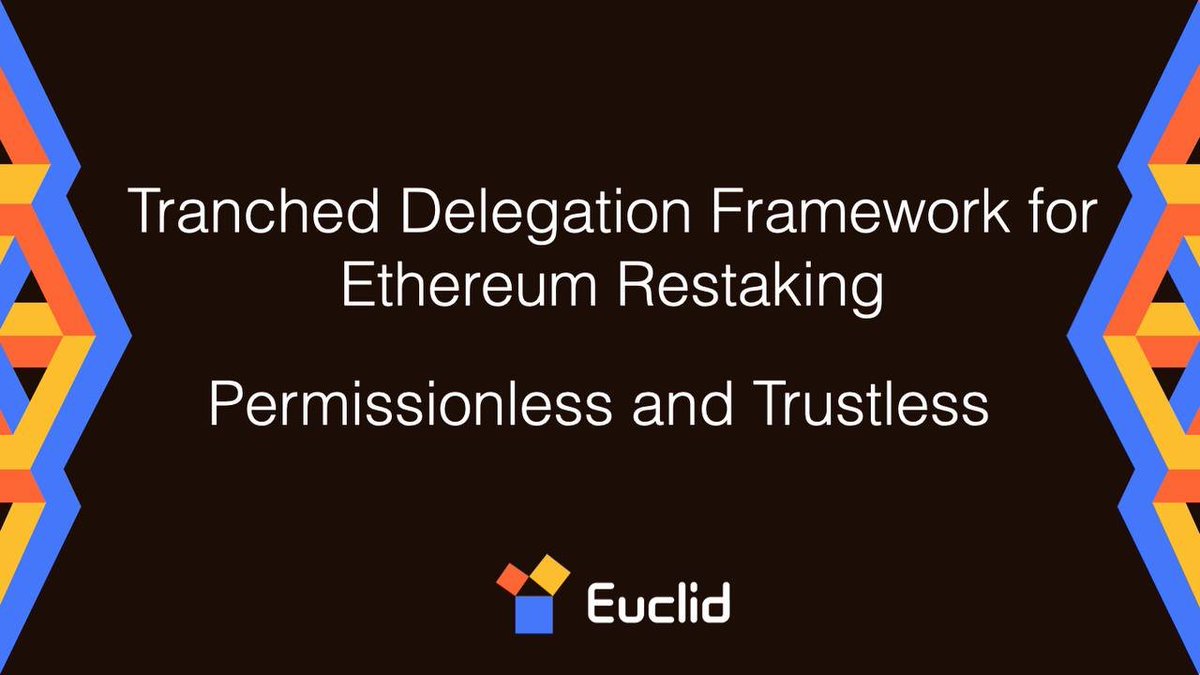
The Tranched Delegation Framework is a game-changer for Euclid, driving innovation and fairness for all operators. It's the ultimate breakthrough for secure restaking!🚀 ​ Under this structure, operators must pledge their self-delegate assets and staked $ECL tokens as collaterals. In case of slashing, their assets take the hit first. Fairness and safety guaranteed.🛡️ ​ It creates a win-win-win scenario for restakers, operators, and AVS. ​ 👉Restakers can spread their risk across different operators and chains. 👉Operators can demonstrate integrity via bearing slashing risks. 👉AVS can promotes wider operator participation, enhancing security against collusion attacks.
Euclid Finance tweet media
English
2
1
5
460
Euclid Finance
Euclid Finance@Euclidfi·
🚀 Why Euclid? 🚀   ✅ Shatter Restaking Barrier No need for 32 ETH—convert any amount to elETH and restake on EigenLayer.   ✅ Diversify & Secure Spread your assets across a decentralized operator network, reducing single point of failure risks. And the staked ECL will serve as a security deposit to compensate restakers for unintended slashing. Dive in: euclidfinance.io/restake
Euclid Finance tweet media
English
2
1
4
529
Euclid Finance retweetledi
IC3
IC3@initc3org·
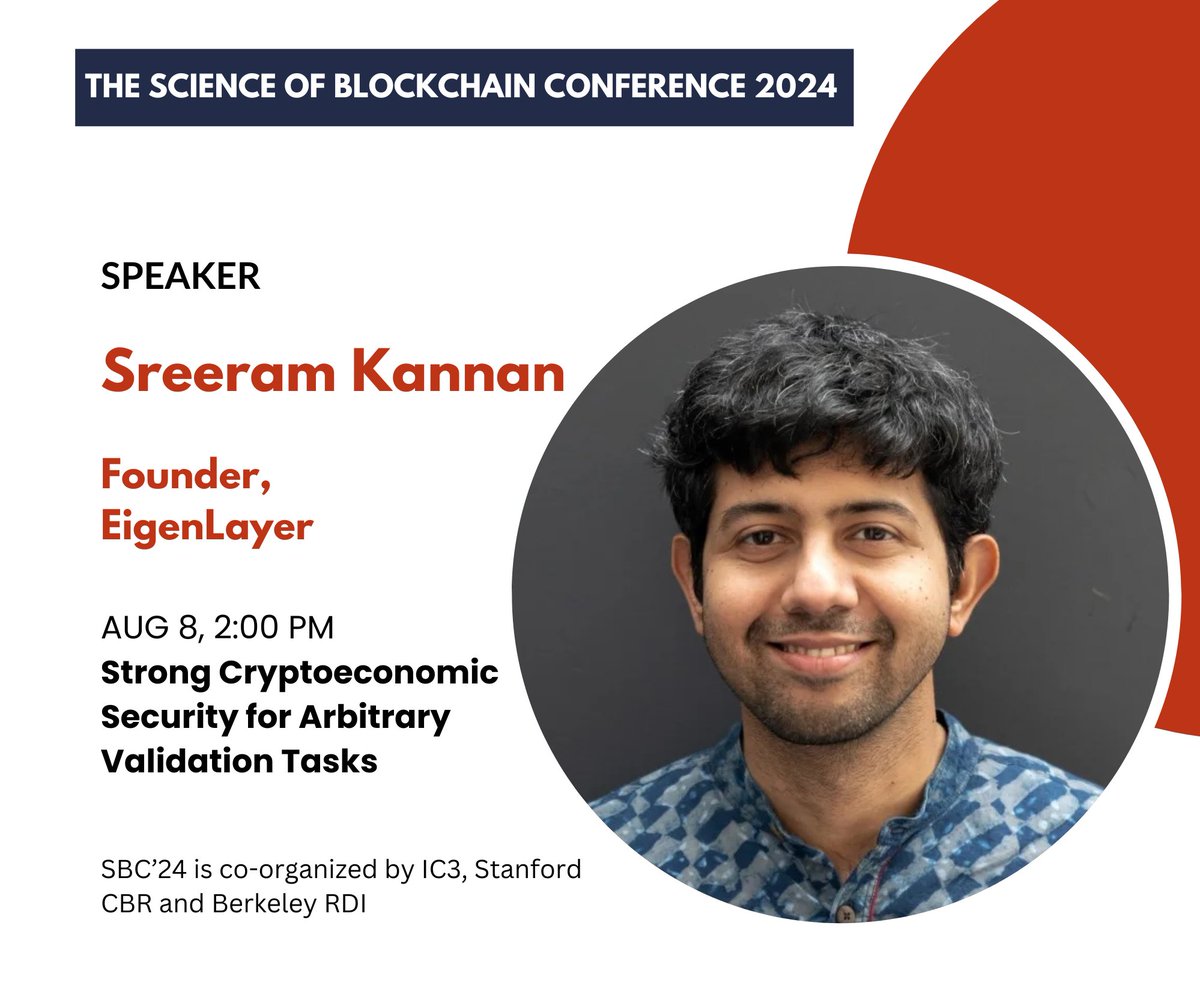
SBC'24 speaker announcement! We're thrilled to have @sreeramkannan, founder of @eigencloud, present at this year's conference!
IC3 tweet media
English
0
4
35
10.3K
Euclid Finance
Euclid Finance@Euclidfi·
𝐖𝐡𝐚𝐭'𝐬 𝐭𝐡𝐞 𝐛𝐮𝐳𝐳 𝐚𝐛𝐨𝐮𝐭 𝐓𝐫𝐚𝐧𝐜𝐡𝐞𝐝 𝐃𝐞𝐥𝐞𝐠𝐚𝐭𝐢𝐨𝐧 𝐛𝐞𝐧𝐞𝐟𝐢𝐭𝐬?   👉 Operators can showcase integrity by bearing slashing risks.   👉 AVS promotes wider operator participation, enhancing security against collusion.   👉 Restakers can diversify their risk across various operators and chains.   Explore more: docs.euclidfinance.io/mechanism/tran…
Euclid Finance tweet media
English
1
0
2
452