Bertus TenBrinke

1.1K posts

Bertus TenBrinke

Bertus TenBrinke

@bertust

Katılım Haziran 2013
368 Takip Edilen137 Takipçiler
Nick Schmidt
Nick Schmidt@NickSchmidt·
I've decided to step away from TraderLion and Deepvue. The last 10 years with Rai, Richard, and Ross has been the journey of a lifetime. Proud of what we’ve built to help traders, and rooting for everything they do from here. I’m looking forward to the future and what’s next.
English
139
29
882
94.8K
Bertus TenBrinke
Bertus TenBrinke@bertust·
@stamatoudism It doesn't matter how successful you are. There will always be someone standing by to tell you that you are wrong.
English
0
0
0
44
Marios Stamatoudis
Marios Stamatoudis@stamatoudism·
George you remember I am trader and not an investor right? My portfolio is fully around different domains of AI . Why should I care about the 4th wave when I know which is just the next one in the value chain and the parallels . The deeper you look at the value chain waves the less chances of these materializing exactly . I am a Momentum Swing trader not a macro investor . Market pulls me in , it pulls me in. Who cares about if Robotics is the 3rd or 4th wave . I will it picking up momentum first
English
3
0
10
709
Marios Stamatoudis
Marios Stamatoudis@stamatoudism·
Am I the only one who honestly doesn’t care if we’re in an AI bubble or at the start of an epic run? No matter what it is, it doesn’t change the required usual actions: follow price, keep risk management and portfolio dynamics in check, and keep routines sharp. Even if things go the opposite way, the 20MA will get you out in time. Every big correction starts as a small one. Overhyping or demoralizing ourselves and others based on macro views never ends well . Staying focused , versatile and not anchored is an edge.
English
24
46
604
23.9K
Wey How
Wey How@wey_how12640·
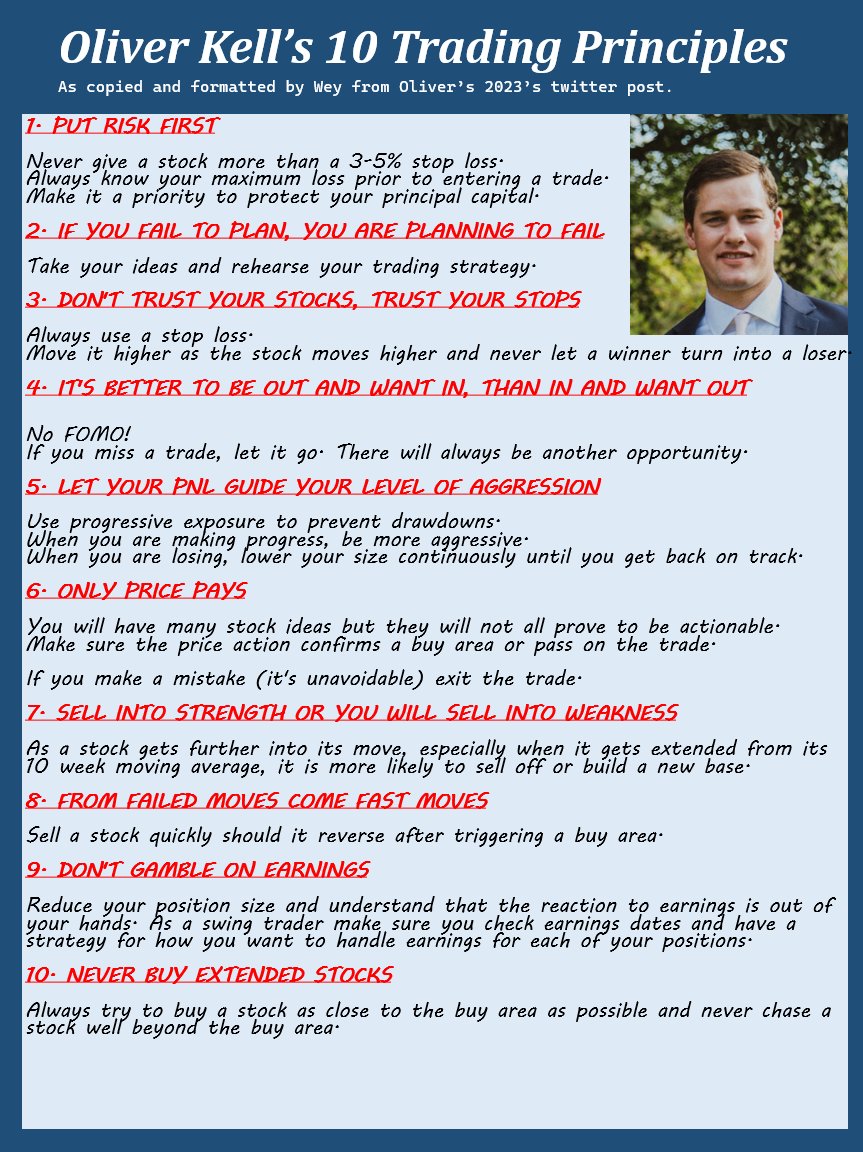
Oliver Kell's 10 Trading Principles Just thought it is time to touch up on the formatting after 2 years+. Please feel free to use/ circulate, I personally have this 10 principles pinned on my trading wall. The Youtube video where you can hear the champion speaks about them: The 10 Principles of Trading with Investing Champion Oliver Kell youtu.be/ElocJ-b_NTs?si…
YouTube video
YouTube
Wey How tweet media
Wey How@wey_how12640

Oliver's 10 Trading Principles About half a year ago, I joined twitter and stalked around. I didn't post a lot when I first joined, as I was from the old facebook era, and I don't have any friends on twitter. I should have joined much earlier! X is full of wise traders who are helpful and like to share. Their posts, their knowledge and their energy help me grow as a trader. I am still learning from the community, there is so much to receive. Perhaps someday I have something valuable which I can share back to the community. Anyway, last December I came across a post from @OliverKell_ , I quickly did some copy and paste into a page (attached) which I can read easily, and snapped it into a place which I can access at all time when I am planning my trades. I think I adhered to those principles really well (ok, the truth is as far as possible.....) all except one, and it remains my weakness as a trader.... Point 7: "Sell into strength or you will sell into weakness". When to press the sell button is an art, when the price is trending up. Taking $SMCI and $NVDA as example ~ riding the trend as far as possible vs selling into strength. $SMCI I actually held on to the stock since Jan 19, learned a new trick that time about 10ema and there it is, I kept riding it without selling into strength. On Feb 15, when it thrusted above 1000, it was already more than +200% within a month. I didn't sell into strength (On Feb 16 I did put a SL of 990 on some partials which is good), and forced to sell most into weakness when it failed 10ema on 2/20. Overall, still a pretty good trade, after suffering a -20% single day drop! Should I have learned about Mark O'Neil's characteristics of climax top, I should have been more alert about this and preserve more gains. Not only our original capital, but our hard-earned gains are valuable enough to be preserved, to cushion further undertaking of risks. $NVDA Didn't let what happened on $SMCI be a repeat. Planned the scenario in advance and I happily trimmed it into strength. Both my experience on these two names were shared in my previous posts. Perhaps $SMCI and $NVDA examples are more on the extreme, in that they run up to climax top, hence riding the trend as far as possible pays. For other cases, riding the trend is trickier. Things like $META. I didn't sell into strength when it hit over 520 and boom, it fell 4.42% to 21ema. $APP, hit 65.67 then boom, it fell 5.35% single day. Their uptrends still look intact and perhaps those falls were to shake out weaker hands (including me), but we never know. Things like these. I am learning to take partials at times. Finally, what I think: Taking full / partials into strength is OK. There is no regret, any profitable trade is good. Just rinse and repeat. Being stopped into weakness is also OK, if you have more cushion to sit, but generally take partials if things are going too well. Trading without planning for exits, NOT OK.

English
2
15
59
5K
Mark Ritchie II
Mark Ritchie II@MarkRitchie_II·
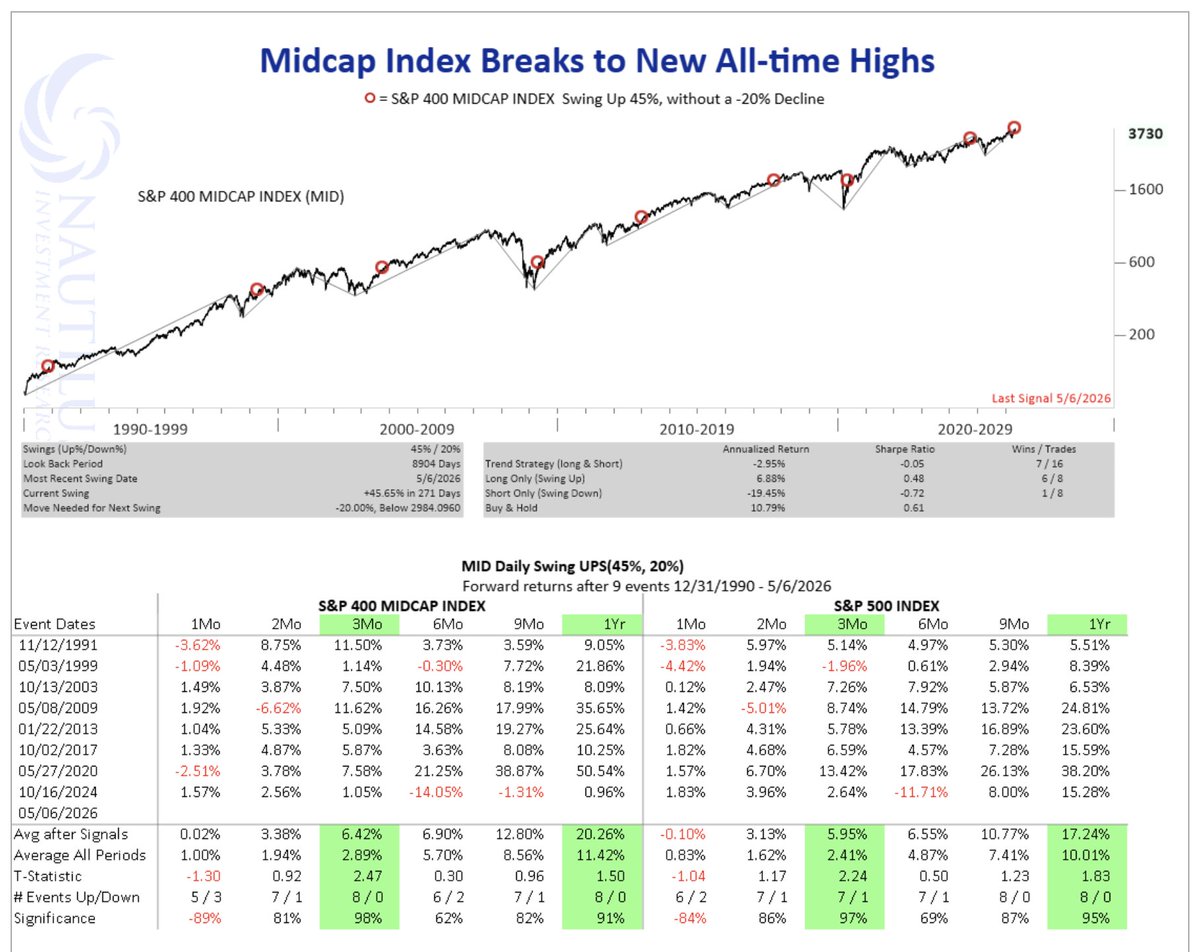
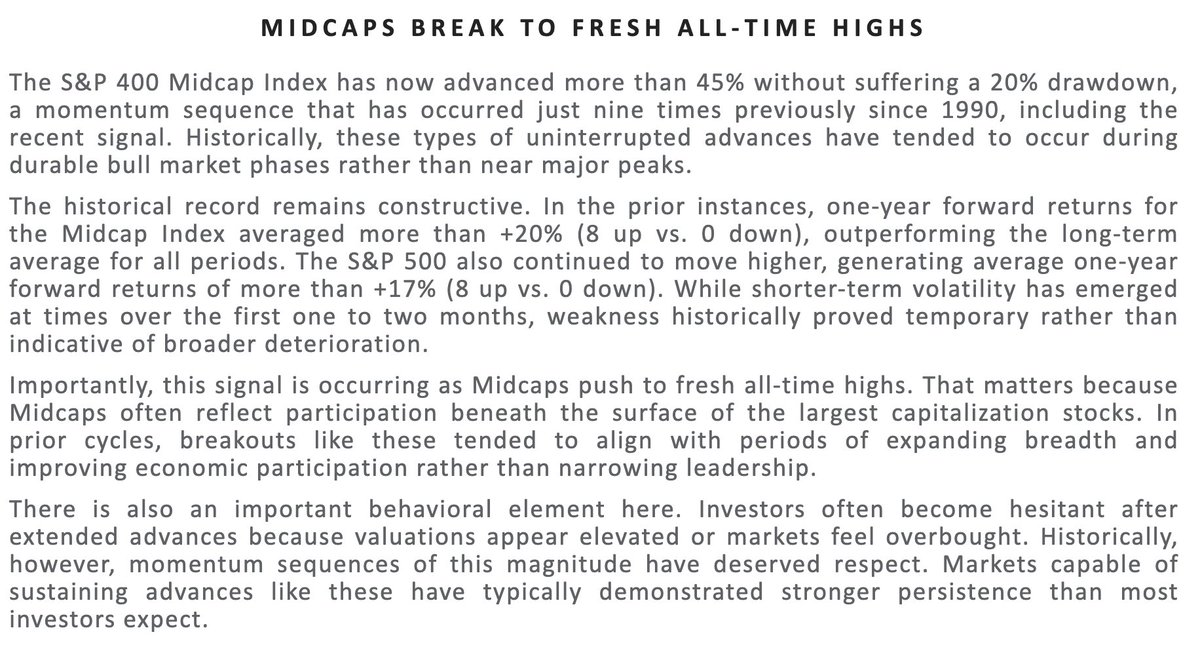
This note from @NautilusCap pretty much says it all. Pair this with the level of skepticism out there and it's everything you need for a market that likely goes higher. I may do a post on 'lockout rallies' next week and the ones I've traded as well as some historical precedents I've studied.
Mark Ritchie II tweet mediaMark Ritchie II tweet media
English
6
23
208
29K
Bertus TenBrinke
Bertus TenBrinke@bertust·
@PrimeTrading_ It's also about making peace with the fact that your equity curve will not go up in a straight line.
English
0
0
0
14
Alex Desjardins
Alex Desjardins@PrimeTrading_·
You can spend your time trying to sound right, calling the top, explaining why it should end… or you can focus on staying aligned with the trend and managing risk along the way. Those are two very different games. One is about being right. The other is about making money. Trend trading isn’t about predicting where things will turn; it’s about participating while conditions are favorable and stepping aside when they’re not. It requires letting go of the need to call every move and instead staying grounded in structure, process, and feedback. The ego wants to anticipate and prove a point. The process just follows what’s working.
English
1
3
42
4.1K
Chris Perruna
Chris Perruna@cperruna·
I have sold my shares in $TTD (in the spec account) ahead of earnings today for a long term capital gain (cost basis was $77.76 from October 2023). Sold $131.33 for a 69% gain.
Chris Perruna tweet media
English
26
3
179
301.4K
Mike Webster
Mike Webster@mwebster1971·
Study history to understand the present!!! We are clearly seeing moves reminiscent of the 1920s & 1990s The best way to understand what's going on is to study wild & crazy moves from Model Book stocks (the kids call them True Market Leaders, TMLs) Until human nature changes (fear, greed & hope) these will keep playing out the same way... I have a whole series of them on my YouTube channel Webby5150, I'd watch them in the following order: WRO #28 QCOM WRO #30 JDSU WRO #33 SCHW WRO #26 EBAY WRO #16 TASER WRO #15 AMGN WRO #24 PCLN WRO #3 CSCO WRO #19 CMG WRO #7 AAPL WRO #8 GOOGL Hope these help🍀 WRO #28 Qualcomm's Epic MOVE!!!!!!!!!!! youtu.be/2GSJNx8znSg?si… via @YouTube
YouTube video
YouTube
English
16
30
256
79.2K
Bertus TenBrinke
Bertus TenBrinke@bertust·
@NordicPips @NickSchmidt I'm kind of going through that epiphany at the moment. Once you start going through charts without any indicators and see how often price responds at key levels, you realize how simple it can be. Not easy, but simple.
English
1
0
1
47
Tobias
Tobias@NordicPips·
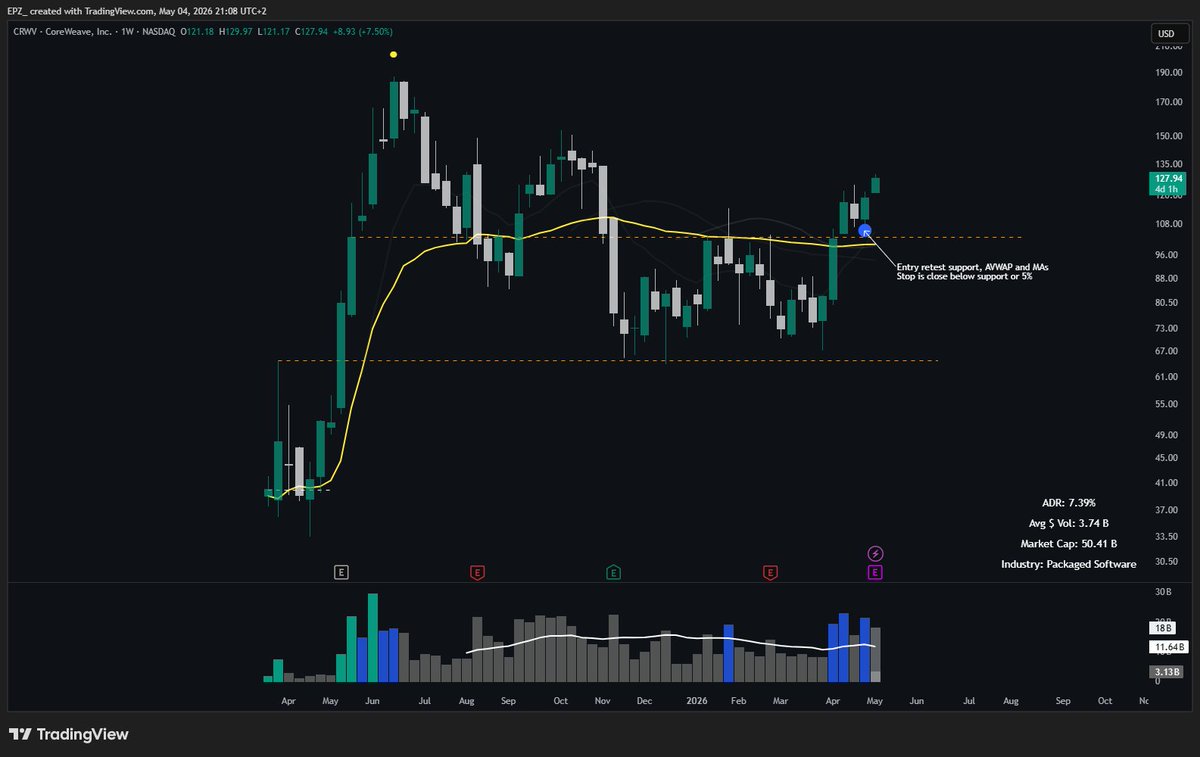
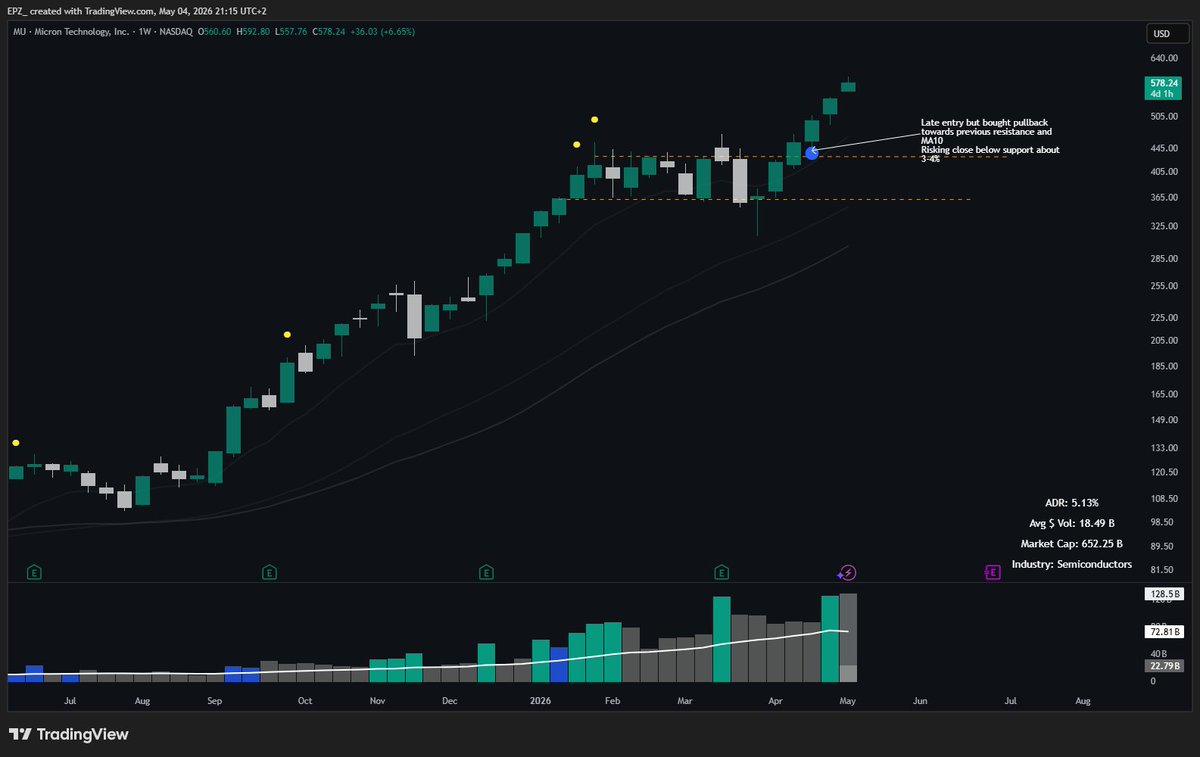
This one tweet from @NickSchmidt gave me one of my biggest aha moments and is one of the things that had the biggest impact on my trading. Breakouts, cup with handles, double bottoms and every other setup surely works great for some but I haven't found much success in trading that. Could be that I'm just horrible at it idk. What Nicks tweet made me realize is that you don't need a "setup" to profit. Last year when I saw this tweet I wen't back and marked up a bunch of previous and current TML's. What type of support was respected, how did TMLs behave in corrections, how long was an average TML in stage 2, what type of alternative entries like shakeouts and dips works and how should they be managed etc etc. In short, how can I take advantage of big picture trends and at the same time keep a tight logical stop. I try to buy weakness and pullbacks in strong stocks in healthy markets. In other words, I try to find entries around the structure of a stock with a stop where my thesis is wrong, rather than a breakout or range break. If I can't find structure and a tight risk at a logical level - no trade. I mainly use weekly charts since levels and structure are much clearer than the daily. The times I try to snipe my way in on the daily I have a tendency of micromanaging, forgetting the bigger picture of the stock and mess up the trade. $CRWV, $NBIS and $MU are my current positions and show quite well what I'm trying to achieve.
Tobias tweet mediaTobias tweet mediaTobias tweet media
Nick Schmidt@NickSchmidt

What if I told you that some of my best trades didn't have a setup? “No setup, no trade” is great advice...but for me its a little different: If I can’t define my risk, I don’t trade. Period. The market isn’t always clean. Patterns don’t always line up perfectly. But here’s the rule that never changes: I know exactly where I’m wrong before I hit buy. If I can’t define that level? The trade doesn’t happen. End of story. That risk level can be anything... a support line, a prior high, even a psychological price point. It doesn’t have to be fancy, but it must exist. If I don’t have a clear exit if I’m wrong, I’m not trading. I’m gambling. And I don’t gamble. The bottom line is setups are secondary. The real edge in trading is risk management. The question isn’t “Is this a setup?” It’s “Can I manage risk here?” If the answer is no, you walk away. The market will always give you another shot. Discipline wins. Always. Define your risk, or don’t trade.

English
6
8
85
15.8K
Ariel Hernandez
Ariel Hernandez@RealSimpleAriel·
@NickSchmidt That's too much chop. I normally just like trading the decade chart. Must easier to ride the trend
English
9
0
59
4.6K
Nick Schmidt
Nick Schmidt@NickSchmidt·
What a monthly candle
Nick Schmidt tweet media
English
10
5
90
8.9K
PotentialShift
PotentialShift@PotentialShift·
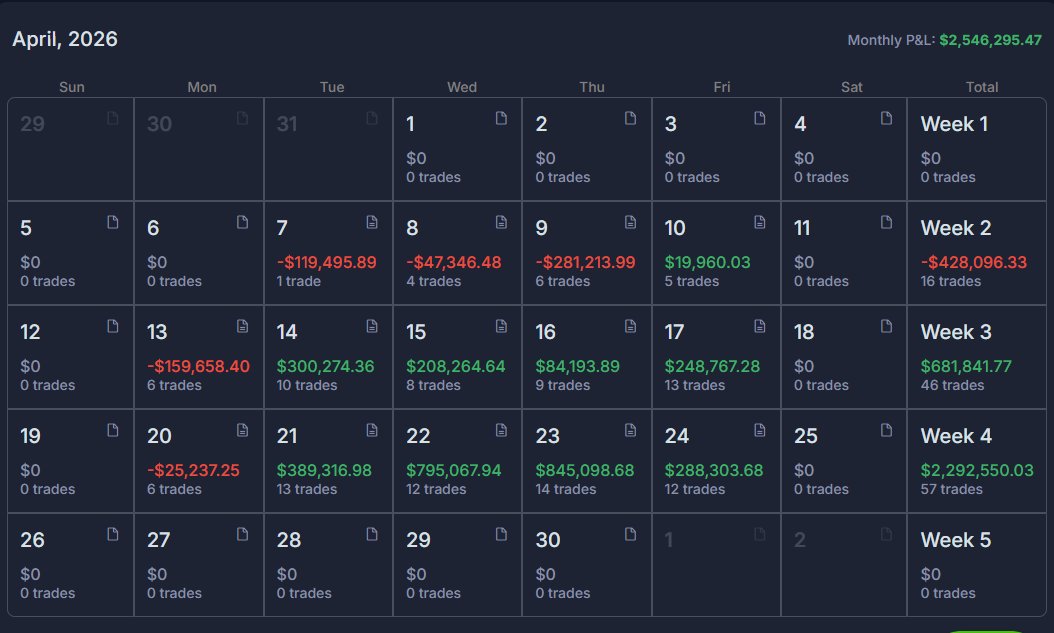
@RealSimpleAriel What REAL day trading looks like if anyone is interested, with real results and real totals. And the actual trades I make. Not paper trading results, or a single lucky two weeks that will be gone next month.
PotentialShift tweet media
English
10
0
8
77.2K
Ariel Hernandez
Ariel Hernandez@RealSimpleAriel·
What an absolutely epic month. Didn't start perfect but I just closed out the best single week of my career. $CAR $MU $ARM $IGV $NVDA $AMZN $DELL $RKLB A week to remember!
Ariel Hernandez tweet media
English
281
39
2K
147.1K
Clement Ang
Clement Ang@Clement_Ang17·
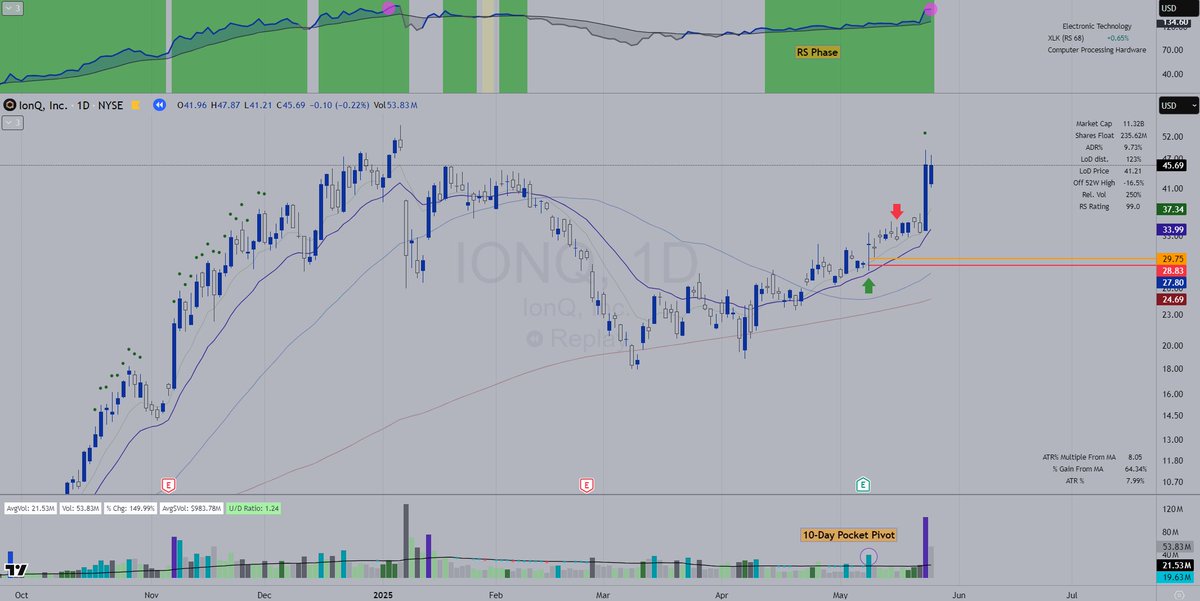
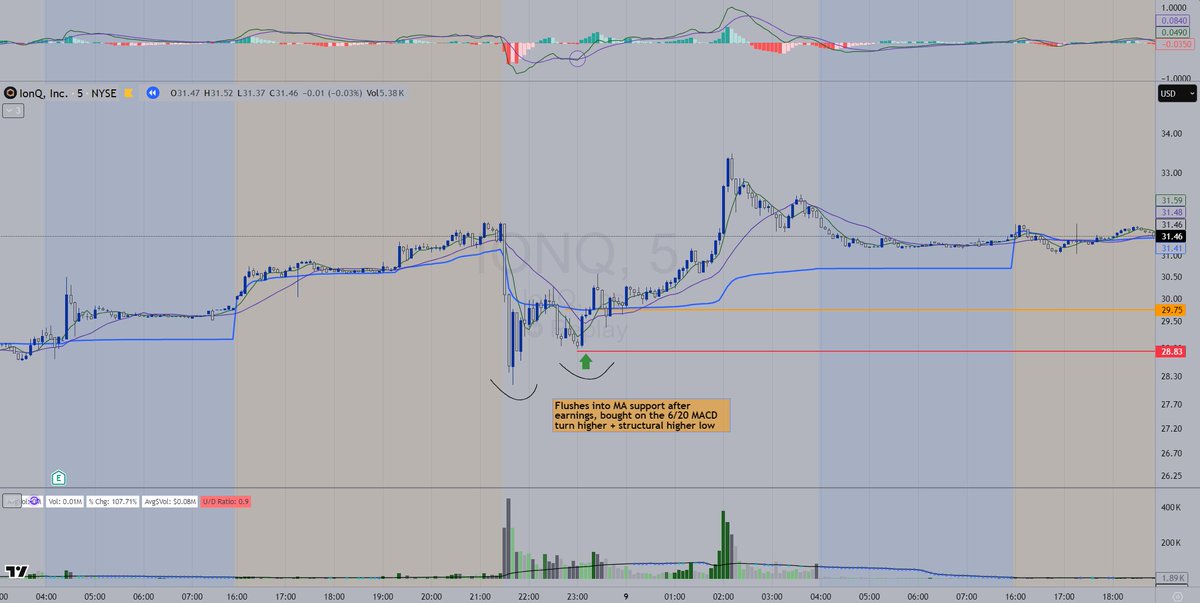
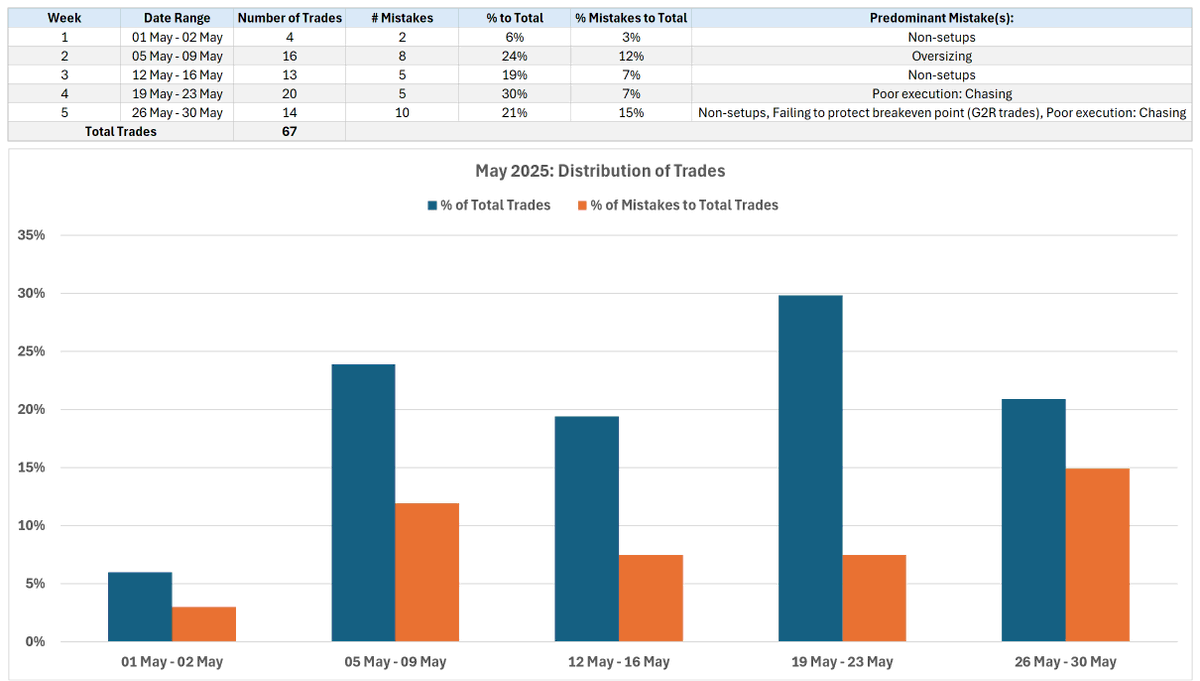
06 June 2025: May Trading Recap - With the conclusion of May, I would say this was the best month of trading I've had this year. My performance was attributed largely due to the general market following through and providing a nice little trend to work with. Overall, I'd say I've done well as I took advantage of the swing cycle and stepped on the gas. That said, I still made a ton of mistakes, most notably towards the end of the month when market conditions began to change. Let's dig in: Trading Stats (MTD +33.5%, YTD +75%) – The first couple of weeks in May saw myself get into a zone. As the market heated up, I got positioned in a couple of big winners and rode them higher as they followed through to the upside. I've gone through a few notable wins here: x.com/Clement_Ang17/… That was the pretty part - now here are a few pretty big misses that would have contributed well towards my equity curve: 1. Cutting my trades prematurely $IONQ was a huge miss as I was able to get this on weakness post-earnings. While it did nothing wrong on the daily chart, the intraday action was infuriating - often giving a little squirt to the upside near the open before selling down lower. It was due to this frustration that I decided to let go of this position prematurely, even though it had not violated the 10-EMA at all. Lo and behold, their CEO goes on CNBC claiming to be the next $NVDA of quantum computing, and I watched it helplessly as it provided the biggest +37% squirt on the 22nd May. 2. Not letting my winners run Generally for this swing cycle, I would say I've done a decent job in this respect, selling out of my winners as my rules dictate. That said, there were two notable stocks where I failed to do so, and that was in $CRWV and $HOOD. Again, I have failed to trail the MAs for those two - bummer, but a good reminder to let the magical MAs define the trade. Letting your winners run for as long as possible helps to cover up for the mistakes you make in between. That is key to a profitable trading system. I've lately also ran a little thought experiment during my morning breakfast a few days back: Imagine getting in heavy on margin during an early uptrend, and hypothetically speaking you've got yourself in 10 of the best stocks which you've trimmed and de-risked. Now imagine for those 10 stocks, they have been trimmed (profits taken, stops to entry) to become 10% of your overall NLV. You are essentially fully invested risk-free to ride the trend till the end where it bends. Wouldn't that be sweet? Key message: I need to ride my winners better. Even a small position would make a huge difference when you let time compound money for you. 3. Behavioral leakages: Trading mistakes towards month end My PnL post perfectly top-ticked my equity curve that day 🤣. For the most part I've contained the drawdown relatively well, but I still think it could be better had I handled the last week of May properly. When tabulating my stats, it became obvious that the bulk of my trading mistakes occurred during the last two weeks of May. Putting that in the context of the market environment, that was when we began to shift from a nicely trending market to one that was more choppy. When looking at each trade, I realized that I began taking non-setups, chasing trades, and allowing trades go from green to red on me (a big no-no). Couple that with not sizing down quick enough contributed to the equity curve downdraft. At that point I was at an emotional high, which I feel is a perfectly normal human reaction, and I wanted to chase that dopamine hit again. The last week of May effectively brought me out of my trading flow as the market conditions began to shift. Correcting for behavioral leakages In relation to point 3 above, I've mentioned in the previous daily plan that the old Clement would have likely given back all his profits at this point. How that happened in the past is that once I've gotten off equity curve highs and the market environment shifts, I would be too focused on making those gains back and chasing that dopamine hit (greed). Consequently, the shifting market environment would not even register with me. As I continually stop out of new trades, frustration builds up and I would: > Continue to trade with the same frequency, taking setups that seemingly look good but often fail immediately (this is market feedback that should be heeded) > Doubling down in size, thinking that this next trade would work and that will be my ticket back to Valhalla (losers average losers) Oversizing and overtrading is the biggest way to erode your edge. When this happens, you typically get caught in a 'trader death spiral', being unable to process the feedback of your last trades as you continue to work yourself back into a drawdown. Here are a couple ways that have helped me to overcome this: A. Be very diligent in keeping track of your trading journal: Your trading journal tells you everything. This keeps me very conscious of how I've been performing, especially on my last 10 trades. While it does not completely eradicate my behavioral leakages at the start, at least it allows you to begin working on reducing those mistakes as much as possible over time. One thing that I've done every monthly market review is calculating what my trading stats would have been if I removed all my trading mistakes. Seeing those amazing trading stats is encouragement to keep going and strive for greatness. (Note that it is near impossible to trade at 100% capacity imo, but even trying to get close to perfection as possible is a nice goal to have and encouragement to keep going) B. Doing the exact opposite of oversizing and overtrading (doh!): Coming into the month of June, I have traded very little. However, when I do trade, I make it a point to correct for my mistakes in the prior month - emphasizing on proper execution (a setup where I have edge), and trying to get my entry-to-stop as tight as possible so I can risk less but size larger. Looking at my trade journal in relation to the market environment, it registers with me now that the risk-reward trading long setups here pales in comparison to where we were in late April/early May. (I will share more on this in a reply to this trade review) C. Thinking long-term: Know that once you've committed to the career of trading that this is going to be a lifelong journey towards continuous growth. It is not realistic to think that you will be a perfect trader from day 1, or even ever in your career. But the choice is yours to face yourself in the mirror and commit to being a better version every single day. At least when I think of that, the urge to 'win it all in one trade' goes away. As a result, June has been an exceptional start for myself so far, as I am once again knocking on the door towards equity curve highs again. Onwards and upwards! 📈📊
Clement Ang tweet mediaClement Ang tweet mediaClement Ang tweet mediaClement Ang tweet media
English
11
16
109
34.6K
Bertus TenBrinke
Bertus TenBrinke@bertust·
@Clement_Ang17 It’s funny, but I find taking partials to be a lot more difficult than taking stop losses. I think I have to start looking at it as being risk management to the upside, putting a floor on unrealized gains just as I do on losses when entering the position.
English
0
0
1
432
Clement Ang
Clement Ang@Clement_Ang17·
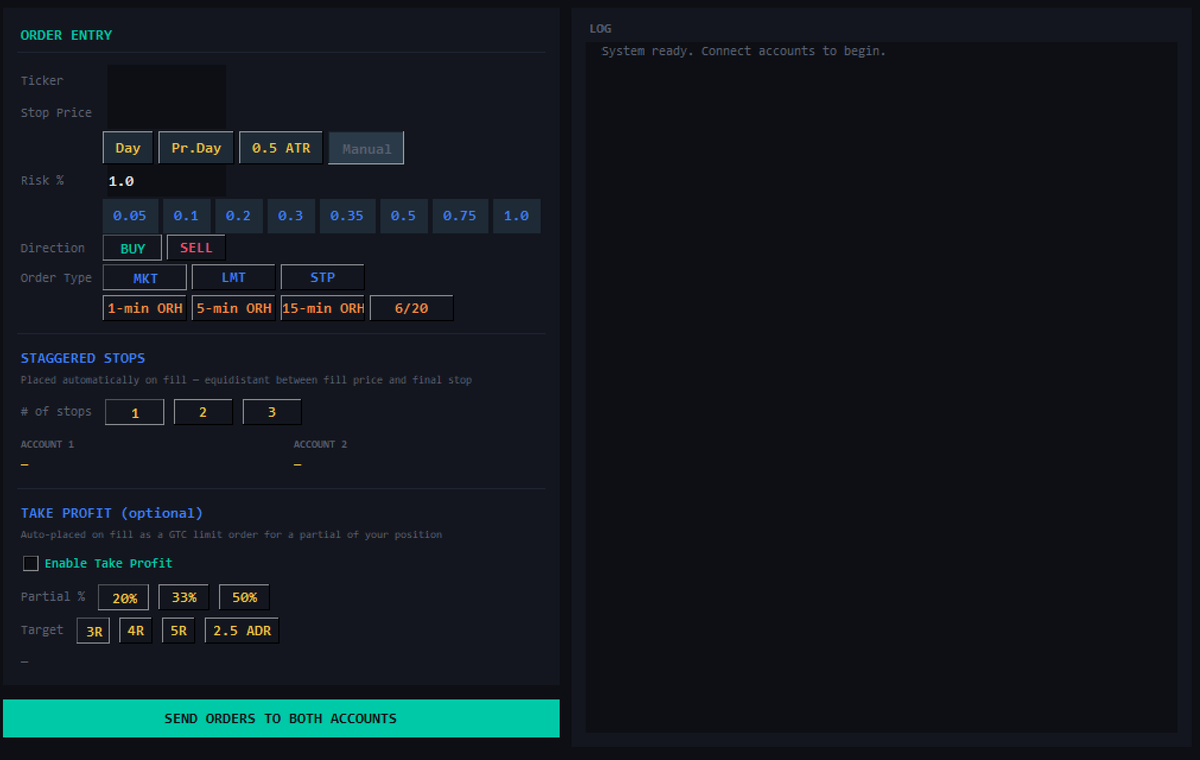
The main features for what I built is to have the tool: (1) Automatically calculate position sizes based on my specified stop loss level and risk to equity. (2) The option to create 2, or 3 staggered stop loss levels. (3) Opening range style entries for momentum markets. (4) Automatic take partial levels to further push my execution to becoming more systematic. It looks something like this - a pretty simple tool that addresses my execution needs in trading. Hope this helps!
Clement Ang tweet media
Jamil Muna@Jamilmuna

Hey Clement, I was thinking of doing the same. Mind sharing a little more what you automated? All good if not, no pressure. I'm thinking of getting a lower timeframe, and tight stop loss system going. A simple bot, but when I tried in the past with IBKR execution speed left a lot to be desired. Thanks in advance!

English
17
19
167
26.2K
Lunar
Lunar@LunarResearcher·
An OpenAI researcher sat down next to me at a coffee shop in Mission District I had my terminal open. Three panels. Live trades scrolling. He was reading something on his laptop. Glanced over. Stopped reading. "That's not a dashboard. That's a live scoring engine. What model is running that" I told him. Claude Code. Four repos. $25 a month. He closed his laptop. "I work at OpenAI. We benchmarked Claude internally last month. You're using it to trade prediction markets?" I opened one link. github.com/warproxxx/poly… 86 million trades. Every wallet. Every entry. Every exit. The entire Polymarket history since day one. "This is public? We quoted a seven-figure budget to reconstruct this kind of dataset from on-chain data. The project is still in review" I told him Claude Code connects directly. It reads the whole dataset. Finds the wallets that win. Then finds WHY they win. Then copies the pattern. He pulled his chair closer. "Walk me through the exit logic" Top wallets exit before resolution 91% of the time. They capture 86% of the move and cut losers at 12%. Everyone else holds to 58%. Same entries. Completely different exits. My bot cuts at 85% of expected move. Or on a 3x volume spike. Whichever hits first. "Who gave you that threshold" Claude Code found it in poly_data. In about 20 minutes. "We had a team of nine working on this exact problem for six months. They never shipped it. You did it in a weekend with a competitor's model" I opened another link. github.com/Polymarket/pol… Three commands. 500+ markets. No API key. Claude scores them in 20 minutes. "That's our internal eval pipeline. Except it took us six months and you built it on a Saturday" My setup: Claude API - $20/mo VPS - $5/mo poly_data - free polymarket-cli - free 19 days. 4 agents. 74% win rate. +$9,400. Copytrade here: @lunar" target="_blank" rel="nofollow noopener">kreo.app/@lunar I showed him the article where I broke down every repo, every command, every dollar. He read it for five minutes. Then looked up. "You just published what we presented to Sam last quarter. Using the other team's model" He texted me the next morning. "My director found your thread. Take it down" Too late.
Lunar@LunarResearcher

x.com/i/article/2041…

English
32
13
246
159.1K
Lars de Ridder
Lars de Ridder@theRedbeardIO·
@LunarResearcher Of all the things that never happened, this never happened the most. That initial quote was hilarious.
English
2
0
14
1.2K
Nick Schmidt
Nick Schmidt@NickSchmidt·
This was before the Covid V next year oops so many
English
4
2
16
2.8K
Nick Schmidt
Nick Schmidt@NickSchmidt·
The higher the market goes without pulling back the stronger it is. This action makes me believe that this is just the very beginning of a massive trend.
Nick Schmidt tweet media
English
77
27
455
61.9K